
Let's get one of the most common points of confusion out of the way. The difference between a view and an impression seems simple, but it’s where most small business owners trip up when looking at their analytics. Getting this right is fundamental to working efficiently.
Think of it like a billboard on a busy highway. Every single car that drives past it is an impression. But a view? That’s the driver who actually slows down, turns their head, and reads the message. One is a measure of potential, the other is a measure of actual attention.
The Core Difference Between Views and Impressions
For a solopreneur or small team, you can't afford to waste time on metrics that don't tell the full story. Understanding views vs. impressions is the first real step toward knowing if your marketing is actually working. While they're related, they reveal two very different things about how people are responding to your content.

What Each Metric Really Signals
An impression is all about visibility. It simply means your content was served to someone's feed. They could have scrolled right past it without a second thought, but if it appeared on their screen for even a moment, that's one impression. It’s a classic top-of-funnel metric that shows your potential reach.
A view, on the other hand, signals attention. It means someone took an action. For video, this usually means they watched it for a minimum amount of time set by the platform. This tells you your content was interesting enough to make them stop scrolling and engage.
Practical Example: Let's say you post a new video announcing a service. You check your analytics and see 10,000 impressions but only 2,000 views. This is valuable data. It tells you your distribution is working (your content is being served), but 80% of the audience didn't watch. This isn't a failure; it's a productivity tip. Instead of creating more content, your time is better spent improving your video's first few seconds to turn more of those impressions into views.
This distinction is one of the most critical social media metrics a small business owner needs to master.
Key Takeaway: Impressions show you how many times your content could have been seen. Views show you how many times it was actually watched. This makes views a much stronger sign of genuine interest from your audience.
To make it even clearer, here’s a quick breakdown of how these two metrics stack up against each other.
Quick Guide: Views vs. Impressions at a Glance
This table offers a simple side-by-side comparison to help you quickly differentiate between the two core metrics.
| Metric | What It Measures | User Action Level | Primary Strategic Goal |
|---|---|---|---|
| Impressions | How many times content is displayed on-screen. | Passive – No interaction required from the user. | Building brand awareness and visibility. |
| Views | How many times a video is watched for a set duration. | Active – User consciously chooses to watch. | Driving engagement and demonstrating interest. |
Ultimately, you don't have to choose one over the other. A smart, productive content workflow uses both to get a complete picture. High impressions with low views tells you your distribution is working but your creative might not be. High views tell you that when people see your content, they stick around.
How Social Platforms Define Views and Impressions
Ever looked at your social media stats and felt like you're comparing apples to oranges? It’s a common frustration. You can’t just assume a "view" on one platform means the same thing as a "view" on another—because it doesn't.
What one platform counts as a view is often what another calls an impression, and the rules are constantly shifting. If you ignore these differences, you'll end up with a flawed analysis and a misguided strategy. Wasting time on the wrong metrics is a major productivity drain.
For example, on X (formerly Twitter), a video gets a "view" after just two seconds of playback with 50% on screen. That’s an incredibly low bar. It’s easy to rack up views, but it can give you a false sense of how many people are actually paying attention. A YouTube view, on the other hand, requires a much more deliberate action from the user.
A Platform-by-Platform Breakdown
Every social network has its own rulebook. As a solopreneur or small business owner trying to manage multiple channels, knowing these rules is key to an efficient workflow. It’s the only way to set realistic goals and create content that actually works for each platform's algorithm.
So, how do the major players define their metrics?
- LinkedIn: For static content like text or image posts, LinkedIn leans on impressions—counted when a post is at least 50% visible on-screen. But for video, a view isn't counted until after 3 seconds of watch time, which signals a more interested user.
- X (formerly Twitter): As mentioned, a video view is registered after just 2 seconds with at least half the video visible. This means your opening hook is absolutely everything on this platform.
- Meta (Facebook & Instagram): Both platforms count a video view after only 3 seconds. But there’s a massive change on the horizon for Instagram that will completely reshape how you analyze your data.
Starting back on January 1, 2025, Instagram began replacing its impressions metric with views, a change that was also applied retroactively to all your historical data. Since views are more inclusive and can be 25% or more higher than impressions, this shift has probably already changed how your Instagram content performance looks.
This evolution makes one thing crystal clear: you can't compare your Instagram "views" to your LinkedIn "impressions" and expect to get a meaningful takeaway. They're just measuring two different things.
Platform Metric Guide for 2026
To help you keep it all straight, here’s a quick-reference guide breaking down what matters on each platform in 2026. Use this as your cheat sheet for a more productive content strategy.
| Platform | Primary Reach Metric | Video View Definition | Strategic Takeaway for Small Business |
|---|---|---|---|
| Instagram & Facebook | Views (for video) & Reach (for static) | 3 seconds of playback. | Your first 3 seconds must be unskippable. Use bold visuals and immediate motion to stop the scroll. |
| X (formerly Twitter) | Impressions | 2 seconds with 50% of the player visible. | Views are easy to get but shallow. Focus on thumb-stopping text hooks or striking visuals in the first 2 seconds. |
| YouTube | Views | Varies (~30 seconds for standard videos), based on user intent. | Views here signal real intent. Your content needs to deliver on its promise immediately and sustain value. |
| Impressions | 3 seconds with 50% of the player visible. | Treat it like Meta: create a strong professional hook that delivers value in the first 3 seconds to capture a view. | |
| TikTok | Video Views | Any duration, from the moment a video starts playing. | The easiest platform to get a "view." Success depends on watch time and completion rate, not just the initial view. |
| Impressions | Standard Pin: 1 second with 50% on-screen. Video: 2 seconds of continuous playback. | Focus on visually arresting Pins that grab attention instantly. A quick glance is all it takes to count. |
This table isn't just about definitions—it’s about productivity. Knowing that a TikTok view is instant while a YouTube view is earned helps you decide where to invest your time creating short, snappy content versus longer, more in-depth videos.
The Impact on Your Content Strategy
These platform-specific rules should directly shape your creative choices. A 3-second view threshold on Instagram or LinkedIn means your opening has to be powerful enough to literally stop someone's thumb mid-scroll.
Practical Example: For your next LinkedIn video, script a powerful question or surprising statistic right at the start. Instead of a slow fade-in, start with an immediate, high-value statement like, "Here's the number one mistake professionals make in their first 90 days." That directness is what turns a passive impression into an active view.
Once you understand these nuances, you can stop comparing metrics that were never meant to be compared and build a more productive, platform-specific workflow.
When to Prioritize Impressions for Brand Awareness
It’s easy to get fixated on views as the ultimate sign of engagement. But for a new or growing business, ignoring impressions is a huge misstep. Think of impressions as the foundation of your entire brand awareness strategy—each one is a chance to make a mark, even for just a second during a doomscroll.
Picture a new local shop, maybe a bakery or a pet groomer, just getting started. Before anyone clicks, buys, or even thinks about visiting, one thing has to happen: people need to know they exist. Name recognition is everything. That’s where shifting your focus to impressions really pays off.
Building Familiarity Through Repetition
Seeing your logo, colors, and name over and over again is how you build trust. It’s the digital version of driving past the same coffee shop sign on your daily commute. You might not stop for weeks, but when you finally want a latte, it's the first place that pops into your head. This is the mere-exposure effect in action—we naturally start to prefer things just because they feel familiar.
For a solopreneur or someone with a side hustle, this means your content has to be "scannable." To be productive, create a simple brand kit.
- Stick to a consistent visual identity: Use tools like Canva or VistaCreate to set up brand templates with your logo, colors, and fonts. This makes creating consistent content faster. Pricing for these tools can be found on their respective websites.
- Write a clear, simple tagline: A short phrase explaining what you do can easily stick in someone's memory.
- Focus on one message per post: Don't try to say everything at once. Make a single point that’s easy to get at a glance.
This graphic breaks down the key metrics you'll be watching on different platforms as you build up that awareness.
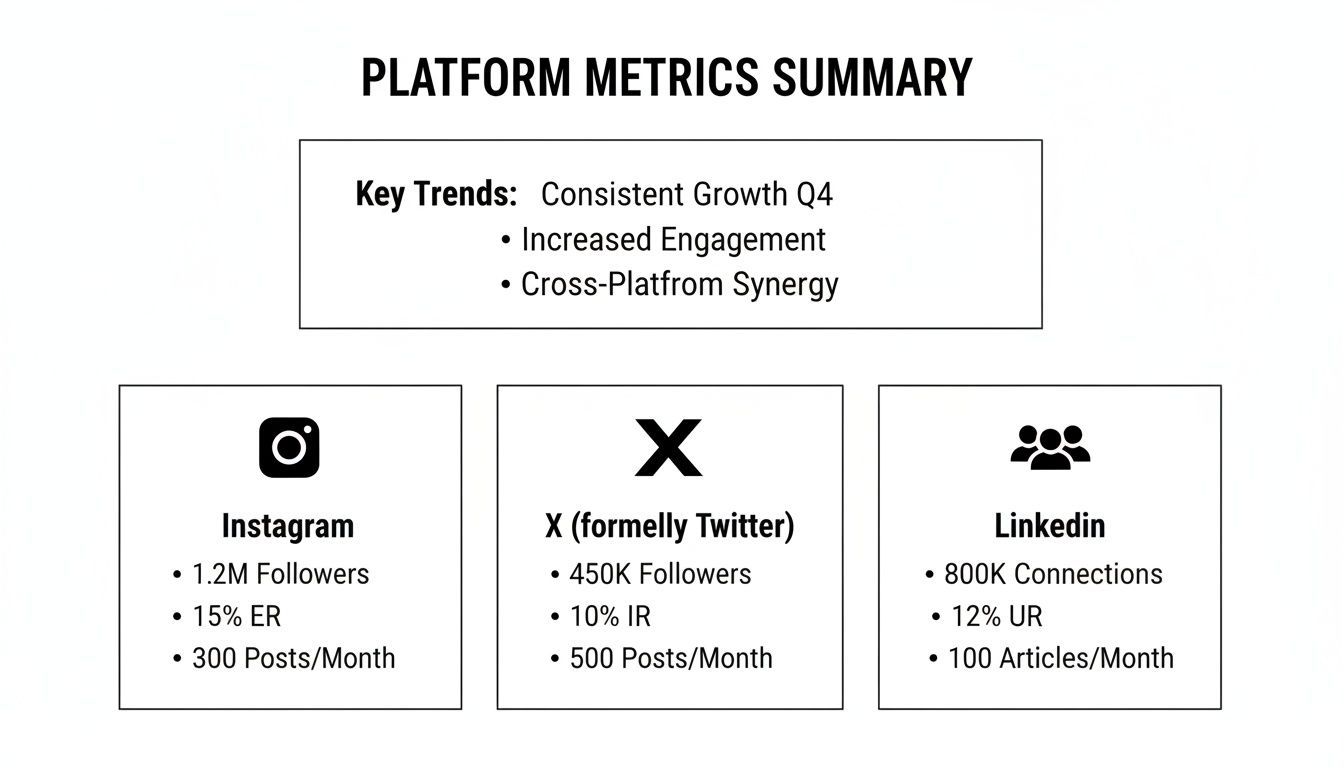
You can see how a platform like LinkedIn still puts a lot of weight on impressions, making it a critical space for B2B companies trying to get their name out there.
Key Insight: An impression isn't a "failed view." It's a small deposit into your brand's awareness bank. Over time, those deposits add up, turning your unknown business into a familiar name.
When your main goal is simply to get on the map, the whole views vs. impressions debate becomes secondary. The right move is to play the long game with an impressions-focused strategy. This top-of-funnel work ensures that when a potential customer is finally ready to make a move, your brand is the first one they think of.
Turning Content Views Into Business Results
It's a great feeling to see a high view count, but let's be honest: views alone don't pay the bills. That number is just potential. The real work is turning that attention into something that actually grows your business, moving someone from a passive scroll to a paying customer.
This is where you need a productive workflow. You have to give your audience a clear path from watching your content to taking the next step.

Think about it this way: if your video gets thousands of views but almost no one clicks over to your website, what does that tell you? It means your content was interesting enough to hold someone's attention, but it didn't give them a compelling reason to act.
That’s a lost opportunity. Your content might have been entertaining or informative, but without telling the viewer what to do next, you've hit a dead end.
Crafting Content That Converts
To get results, every video or post needs a job. The goal is to make the next step you want them to take feel like the most natural thing to do.
A few practical things that make a huge difference:
- Nail the first three seconds. Your opening is a promise. Ask a sharp question, show a surprising visual, or make a direct statement that tells the viewer exactly what they’ll get if they keep watching.
- Weave in your call-to-action (CTA). Don’t just tack it on at the end. Mention it in the middle of the video or use text on the screen. Practical Example: If you're a coach, while explaining a concept, say, "I cover this in-depth in my free weekly newsletter, which you can sign up for at the link in my bio."
- Be specific and make it easy. Instead of the generic "link in bio," tell them exactly what to do and what's in it for them. "Download our free guide to planning a month of content" works so much better than "Visit our website."
If you're having trouble getting those initial views in the first place, especially on a platform like Instagram, it’s a good idea to take a step back and look at your whole approach. We put together some thoughts in our guide on how to get views on Instagram.
A Quick Diagnostic Framework
Use this simple set of questions to figure out why your views aren't turning into results. This workflow helps you pinpoint exactly where to focus your efforts.
Content Diagnostic Questions:
High Views, Low Clicks?
- Question: Is my call-to-action obvious and easy to find? Is it compelling?
- Productivity Fix: Make your CTA impossible to miss. Tell people exactly what to do and why it benefits them. Test a different CTA on your next video.
High Impressions, Low Views?
- Question: Is my opening hook strong enough to stop the scroll? Does my thumbnail make people curious?
- Productivity Fix: Your content isn't grabbing attention. Spend 15 minutes brainstorming 5 new hooks for your next post before you even start creating.
High Clicks, Low Conversions?
- Question: Does the page they land on deliver what my video promised? Is it easy for them to take the next step?
- Productivity Fix: Ensure message consistency from video to landing page. The path to conversion should be simple and clear. Remove any unnecessary steps.
By looking at these patterns, you stop just counting views and start understanding what your viewers are actually doing. That's the shift that turns passive watchers into active customers.
Beyond the immediate click, you can also look at the longer-term impact of your content. Metrics like the view-thru rate (VTR) can show you who converts later on after seeing your ad, even if they didn't click on it right away. It's another layer of insight into how your content influences behavior over time.
Optimizing Content for Both Views and Impressions
A smart, productive content strategy doesn’t make you pick between views and impressions. It makes them work together. When you get how these two metrics interact, you can start to diagnose what’s wrong with your content and build a workflow that actually pays off.
Think of your analytics dashboard as a health check for your content. We’ve all been there: you see a huge impression count, but the number of actual views is depressingly low. This isn’t a total failure. It’s a very specific signal. Your distribution is working, but your creative isn't.
The algorithm is putting your post in front of plenty of people. The bad news is your headline, thumbnail, or the first few seconds of your video isn't doing its job. This gap is exactly where you should focus your time.
Turning Impressions Into Views With A/B Testing
The fastest way to close that gap between impressions and views is to start A/B testing. It’s a simple workflow that helps you isolate what’s working and what isn’t, so you can stop guessing and start making data-backed creative choices. This will save you time and get better results.
Here’s a simple way to get started:
- Test Your Headlines: For the same piece of content, try a question against a statement. Practical Example: "How I Doubled My Leads in 30 Days" versus "This 3-Step Process Doubled My Leads." See which performs better over 24 hours.
- Experiment with Visuals: Pit a bold, graphic-based image against a photo of a person. See which one stops more thumbs and earns the click.
- Refine Your Opening Hooks: In your videos, test different opening lines in the first three seconds. A surprising statistic might hook one audience, while a direct problem-statement could work better for another.
Prioritizing Quality Over Quantity
At the end of the day, a massive number of impressions means nothing if they aren't the right impressions. The goal is to be productive, not just busy. Focusing on optimized targeting is a huge productivity win.
A high impression count with low views is a red flag. It means either your creative isn’t grabbing attention or your targeting parameters need adjustment. Use this insight to refine your approach.
This focus on quality is about making every single impression count. A well-targeted impression served to the right person is far more likely to become a valuable view. By continuously testing and refining, you build a smarter content engine that turns visibility into genuine audience attention. You start maximizing the impact of every single post you create.
A Simple Routine for Tracking Your Performance
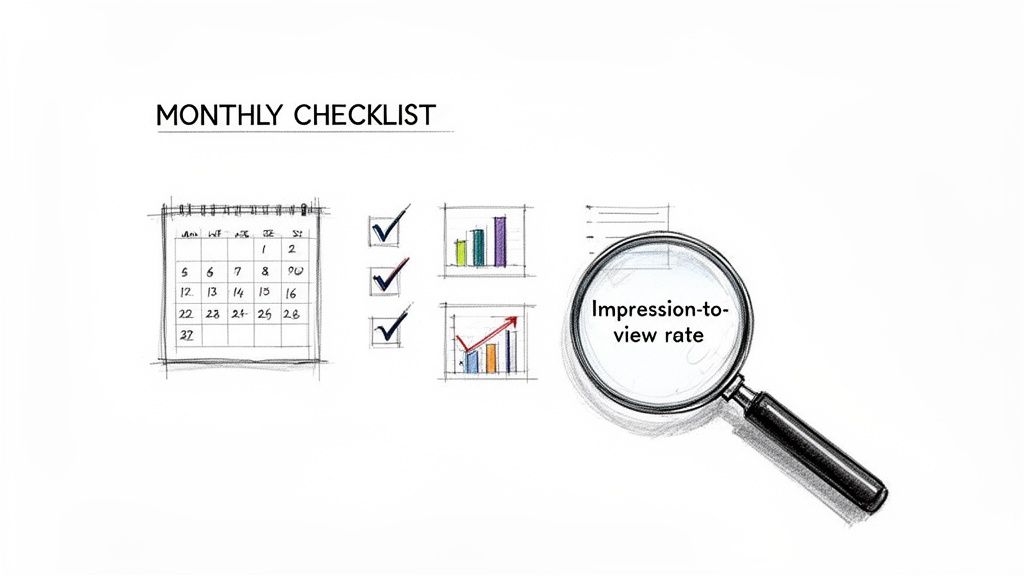
Turning data from a chore into your secret weapon starts with a simple, repeatable routine. A quick monthly check-in is all it takes to see what's really working, helping you make smarter content decisions without getting lost in spreadsheets. This workflow is about finding patterns to boost your productivity.
Your Monthly Metrics Checklist
Block one hour in your calendar each month for this review. When you do it consistently, you'll start to spot trends and get a feel for how impressions and views connect for your brand.
Pull the Numbers: Grab the essentials from each social platform for the last 30 days. All you need are Impressions, Views (where it applies), and one key engagement metric that matters to you, like clicks or shares. Many scheduling tools can aggregate this data for you, saving significant time.
Find Your Impression-to-View Rate: This is the magic number. For every video you post, just divide the total views by the total impressions, then multiply by 100. The percentage you get tells you exactly how good your content is at turning a passing glance into real attention.
Practical Example: Your video gets 5,000 impressions and 250 views. Your impression-to-view rate is (250 / 5,000) * 100 = 5%. A low rate like this is a huge red flag. It usually means your headline or thumbnail isn't strong enough, even if the algorithm is showing it to people.
- Spot the Winners and Losers: Now, make two quick lists in a document or spreadsheet. The first ranks your posts by impressions—these are your awareness champs. The second ranks them by views or your impression-to-view rate—these are your engagement superstars.
Turning Those Insights into Action
With your two lists ready, it's time to get strategic for next month. The goal is to figure out what made your top content work and learn from what didn't.
Break Down Your Winners: What do your best posts have in common? Was it the topic? The format? That killer opening line? Find the specific ingredients you can reuse in your next batch of content. This is your template for future success.
Examine What Flopped: Look at the posts that got a ton of impressions but hardly any views. Why did people see them but keep on scrolling? This is your chance to brainstorm better hooks, more interesting visuals, or clearer headlines that demand a click.
Of course, digging into all this is much easier when you have the right tools. While native platform data is a great start, specialized tools can provide a much clearer picture and automate reporting. The best YouTube analytics tools, for instance, offer insights you just can't get otherwise. Several excellent tools are available to help you streamline this process; their pricing information can be found on their respective websites.
This monthly review stops being a report card and starts becoming your roadmap—a clear guide for creating content that people actually want to watch.
Common Questions About Views and Impressions
Still thinking through the difference between views and impressions? We get it. Here are a few of the most common questions we hear from entrepreneurs, with some straight-to-the-point answers.
Which One Should I Care About More, Views or Impressions?
Neither is "more important" on its own. It all comes down to what you're trying to achieve with a specific post or campaign.
Think of it this way: impressions are for brand awareness. If your goal is simply to get your name, logo, or message in front of as many eyeballs as possible, then impressions are your go-to metric. But if you need to know that people actually watched your video or read your message, then views are what you need to track for engagement. A productive workflow looks at both to get the full story of how your content is really doing.
Can One Person Give Me Multiple Impressions and Views?
Yes, absolutely. If someone scrolls past your post in their feed in the morning and then again in the evening, that’s two impressions.
The same logic applies to views. If that same person watches your video multiple times, it can rack up multiple views (though how this is counted can differ from platform to platform). This is exactly why it’s a good idea to also keep an eye on reach, which measures the unique number of people who saw your content. Tracking reach alongside impressions gives you a clearer picture without adding much work to your analysis routine.
How Can I Quickly Get More Views?
The most productive way to turn an impression into a view is to master your "hook." You have to give people a reason to stop scrolling.
For video, that means making your first three seconds impossible to skip. Try opening with a bold question, a surprising visual, or a statement that piques curiosity. For a static image post, you need a high-contrast image and a headline that makes someone pause and think. The best way to figure out what works for your audience is to A/B test different hooks. It's the most productive way to learn what actually grabs their attention.
Ready to turn your work into more business? Postful is an AI-powered social media tool that makes it simple to create, schedule, and analyze content that gets results. Start for free on Postful.ai.