
Let's get one thing straight: for entrepreneurs, "time management" isn't about productivity hacks. It’s a survival system. It’s about being ruthless with your focus and spending your energy on the few things that will actually grow your business, not just keep you busy.
When you get this right, your calendar stops being a source of stress and becomes your single most powerful tool for building something that lasts.
Why Most Time Management Advice Fails Entrepreneurs
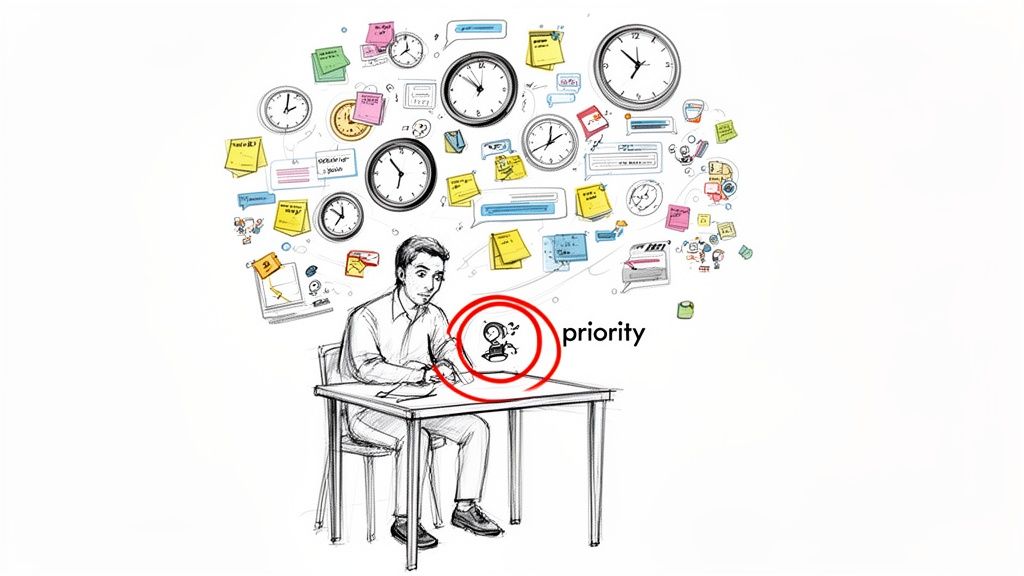
Most of the time management advice out there feels like it was written for a different species. Tips like "just make a to-do list" or "wake up earlier" are almost insulting when you're trying to juggle fundraising, product development, and a customer support meltdown all in the same afternoon.
The founder’s reality is pure, unfiltered chaos. Your day isn’t a neat list of tasks you can check off. It's a constant battle against context switching. One minute you're deep in a spreadsheet, the next you're handling an angry customer, and ten minutes later you're trying to write marketing copy. That mental whiplash is exhausting, and it makes generic advice completely useless.
The Founder's Dilemma: Busy but Not Productive
We've all been there. You start your day with a mountain of a to-do list. You spend the next 12 hours hammering out emails, putting out tiny fires, and bouncing between meetings. At the end of it all, you're totally drained, but you can't point to a single thing you did that actually moved the needle.
Meanwhile, the big, game-changing goals—like closing that next funding round or shipping a critical feature—are still sitting on the back burner.
This trap of feeling constantly busy but making zero real progress is where so many startups die. It happens when you spend your day reacting to what’s urgent instead of proactively driving what's important. The "always on" pressure just pours gasoline on the fire, leading straight to burnout without any of the rewards.
Here's a wild stat: a whopping 82% of entrepreneurs admit they don't use any formal time management system. That means the vast majority are just winging it, trying to manage the chaos with whatever makeshift solution they can cobble together.
This guide is about flipping that script. It’s about treating your time not as a constraint, but as your most valuable strategic weapon. It’s about carving out the mental space you need to actually think, innovate, and lead.
Moving from Reactive to Proactive
To break out of the reactive firefighting cycle, you need a system built for the entrepreneurial battlefield. This isn't about finding more hours in the day—it’s about making every hour count.
Over the next few sections, we'll walk through a practical framework to help you:
- Define what actually matters so you can pour your energy into high-impact work.
- Build a resilient schedule that can absorb the daily punches without falling apart.
- Use delegation and automation to multiply your impact and get more done than you ever could alone.
Mastering this stuff is how you shift from feeling overwhelmed to being in control. It's time to build a workflow that fuels proactive growth, not just survival. For a deeper dive, check out our guide on how setting a clear direction can boost small business growth.
Finding Your High-Leverage Priorities
Real time management for entrepreneurs doesn't start with your calendar. It starts with getting brutally honest about what's actually worth your time.
If your to-do list is a mile long but filled with low-impact tasks, you’re just organizing chaos—not building a business. The real goal is to stop asking "what needs to be done?" and start asking "what will make the biggest difference?"
This isn’t about a simple checklist. It’s about creating a strategic filter for every single task that comes your way. True productivity isn't about doing more things; it's about doing more of the right things.
The Eisenhower Matrix: An Entrepreneur's Filter
A classic for a reason, the Eisenhower Matrix is a powerful tool for this. It forces you to sort tasks based on two simple criteria: urgency and importance. In the fast-paced world of a startup where everything feels like a five-alarm fire, this framework is a lifesaver.
Here’s a practical workflow to apply it daily:
- Urgent & Important (Do First): These are the genuine crises and hard deadlines. Example: Your website's payment gateway is down, or a major investor meeting is in two hours and the deck isn't finalized. These get your immediate, undivided attention.
- Not Urgent & Important (Schedule): This is where real growth happens. Example: Developing a new marketing strategy for Q4, building a key partnership with another company, or training a new hire. These tasks need dedicated, protected time on your calendar. Block out "Deep Work" sessions specifically for them.
- Urgent & Not Important (Delegate): These are the interruptions that kill your flow. Example: Answering non-critical emails, scheduling meetings, or handling routine admin requests. Use a tool like Calendly to automate scheduling, or delegate inbox management to a virtual assistant.
- Not Urgent & Not Important (Eliminate): These are the time-wasters. Example: Mindlessly scrolling social media, tweaking your website’s color scheme for the tenth time, or sitting in on meetings where you have no real role. Be ruthless and cut them out.
Using this matrix makes it painfully clear that answering every email immediately (Urgent but Not Important) often steals time from planning your next product launch (Important but Not Urgent). That shift in perspective is a total game-changer.
Uncovering Your 80/20 Activities
The Pareto Principle, better known as the 80/20 rule, is another must-have concept. It basically says that roughly 80% of your results will come from just 20% of your efforts. As a founder, your job is to find that golden 20% and become completely obsessed with it.
Practical Example: I once fell into the trap of being everywhere—active on five social platforms, running paid ads, sending weekly newsletters. I felt incredibly busy, but our lead generation was flat. I finally audited my activities and dove into our analytics. The 80/20 was staring me right in the face: our company blog and one specific LinkedIn outreach strategy were driving over 80% of our qualified leads. Everything else was just noise.
By ruthlessly cutting my effort on the low-performing channels, I clawed back nearly an entire workday each week. I poured that time into doubling down on what was already working, and our growth took off.
To help you find your own 80/20, here’s a quick way to think about your tasks.
High-Leverage vs. Low-Leverage Tasks for Entrepreneurs
This table is a quick reference to help you start categorizing your own daily tasks. The goal is to spend as much time as possible in the "High-Leverage" column.
| Task Category | High-Leverage Example (Do This) | Low-Leverage Example (Delegate/Automate This) |
|---|---|---|
| Sales & Marketing | Building strategic partnerships with 3 key players in your industry. | Scheduling social media posts using a tool like Postful. |
| Product & Strategy | Personally calling your top 10 customers for feedback on a new feature. | Fixing minor website typos or updating plugins. |
| Operations | Creating a repeatable hiring process and a scorecard for interviews. | Managing your email inbox and calendar scheduling. |
| Finance | Securing a new round of funding or negotiating a line of credit. | Entering receipts into accounting software. |
| Team Management | Mentoring a key employee to take over a department. | Approving routine expense reports under a certain amount. |
Use this as a starting point. Every week, look at your calendar and ask yourself what percentage of your time is spent on the left side of this table versus the right. That number will tell you everything you need to know.
Prioritizing isn't just about managing tasks; it's about managing your energy. By focusing on high-leverage activities, you ensure your limited energy is invested where it can produce the greatest return for your business.
How to Say No and Protect Your Focus
The final piece of the puzzle is learning to say "no." It sounds simple, but it's incredibly hard for founders who want to be helpful and chase every opportunity.
Here's the thing: every time you say "yes" to a low-priority request, you are implicitly saying "no" to something more important.
Saying no doesn't have to be rude. It’s about setting boundaries to protect your most critical work. Here are a few scripts you can steal:
- For a meeting request: "Thanks for thinking of me. My schedule is packed with [Project X] right now, but could we handle this over email to keep things moving?"
- For a new idea: "That’s an interesting idea. I'm focused on hitting our Q3 goals at the moment, but let's revisit this next quarter."
- For a small favor: "I can't help with that right now as I'm on a tight deadline, but [Person Y] might be a good person to ask."
Learning how to manage multiple projects at once means you have to become the gatekeeper of your own time. By using these frameworks and learning to set boundaries, you can finally ensure your daily efforts are actually moving the needle.
Designing a Workflow That Actually Works
Once you know your high-leverage priorities, the real challenge is building a schedule that actually protects them. A simple to-do list just doesn't cut it against the daily chaos of running a business. To get a real handle on your time, you need a resilient structure that forces you to turn good intentions into action.
This is where two of my favorite productivity methods come together: time blocking and task batching. Time blocking is just what it sounds like—scheduling your entire day into specific blocks. Task batching is its secret weapon: grouping similar tasks to knock them all out in one focused session.
When you use them together, the results are incredible. You drastically cut down on context switching—that mental whiplash from jumping between writing an email, tweaking a design, and then trying to think strategically about your next big move.
Create a Master Weekly Template
Stop starting every week from scratch. Instead, design a "master template" that gives your days a specific theme. This creates a predictable rhythm and guarantees that every critical part of your business gets the attention it deserves. Think of it as creating a default setting for your most productive self.
A big piece of this is learning how to manage multiple calendars effectively so all of your commitments play nicely together.
Your template might look something like this:
- Marketing Mondays: All things growth—content creation, reviewing ad campaigns, reaching out to partners.
- Team Tuesdays: One-on-one meetings, team syncs, and moving internal projects forward.
- Deep Work Wednesdays: A strict no-meetings day for high-focus strategic work, like product development or long-term planning.
- Sales Thursdays: Client calls, demos, follow-ups, and pipeline management.
- Finance & Admin Fridays: Invoicing, payroll, reviewing metrics, and planning the week ahead.
This structure puts up clear boundaries and prevents you from trying to wear all your hats at once. It helps you get into a state of flow by focusing on one kind of work for a solid chunk of time.
This diagram is a great way to visualize how you can categorize those tasks before slotting them into your themed days.
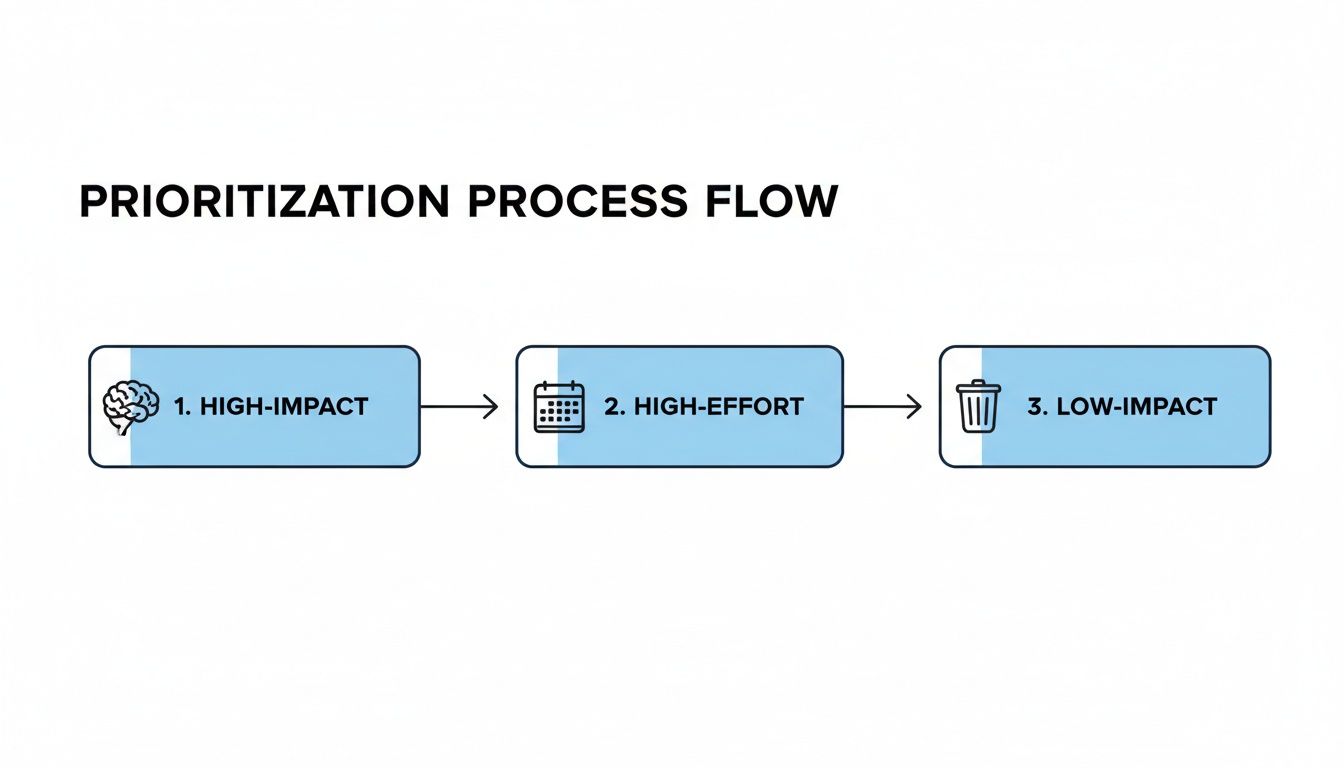
It reinforces the simple filter of impact versus effort, which is exactly what you need to decide what gets a spot in your weekly template.
The Power of Task Batching in Action
Task batching is how your themed days come to life. Instead of checking emails every ten minutes, you batch them into two or three 30-minute blocks. Instead of scrambling to create a social media post every morning, you knock out a month's worth of content in one afternoon.
Here’s a practical workflow for content creation: A founder who needs to create short-form video content could dedicate one Monday afternoon to the entire process.
- Outlining (30 min): Brainstorm and outline 10-15 video ideas in a shared document.
- Recording (90 min): Record all the raw videos in one session, changing outfits for variety.
- Editing & Scheduling (60 min): Use a simple video editor and a scheduling tool to batch edits and schedule them for the entire month.
In just three hours, they’ve handled a task that would have otherwise derailed their focus every single day. That's a massive win. Distractions are a huge productivity killer; research shows entrepreneurs lose an average of 1 hour and 18 minutes daily to them. That adds up to nearly 340 hours annually. It’s no surprise when you find out 68% report having no uninterrupted blocks of focus time. Batching is how you reclaim that time.
Plan Tomorrow Tonight
One of the simplest habits that delivers the biggest results is planning your next day the night before. This isn't about creating some rigid, hour-by-hour schedule. It's about making your most important decisions when you're not in the middle of a fire.
Your 10-Minute End-of-Day Workflow: Before you log off, open your calendar and to-do list. Identify your single most important task for tomorrow—the one that will make you feel most accomplished. Block out the first 90 minutes of your day for it. This tiny investment prevents morning indecision and ensures you start with clarity and purpose.
This 10-minute ritual completely eliminates that "what should I work on now?" scramble in the morning. You wake up knowing exactly what matters most, letting you dive right into high-impact work before the day’s distractions have a chance to take hold.
Using Automation to Scale Your Impact
As a founder, you're the single biggest bottleneck in your own company. That's a hard truth, but an important one. Growth doesn't come from just working more hours; it comes from multiplying your impact beyond what you can do alone. To do that, you have to master delegation and automation to break free from the daily grind.
It all starts with a critical mindset shift. You have to get past the all-too-common entrepreneurial trap of thinking, "I can just do it faster myself." That might be true for a single task, but it’s a disastrous long-term strategy. The real question isn't about speed, it's about value: "Is this the absolute best use of my time right now?"
If the answer is no, it's time to offload it.
Finding What to Delegate or Automate
Start by taking a hard look at your weekly tasks. You’re looking for anything that’s repetitive, time-consuming, and doesn't require your unique strategic input. These are the perfect candidates for either a human assistant or a digital one. What drains your energy but doesn't directly move the needle on growth?
Common culprits usually fall into a few buckets:
- Administrative Work: Managing your inbox, scheduling meetings, and basic bookkeeping.
- Social Media Management: The daily grind of creating posts, scheduling content, and monitoring comments.
- Data Entry: Updating your CRM, transferring info between spreadsheets, or compiling reports.
- Customer Support: Answering the same questions over and over or handling initial inquiries.
Once you have a list, you can decide whether to delegate to a person or automate with a tool. The goal is to build systems that run smoothly without your constant hands-on involvement.
Your First Step Into Delegation: Finding a VA
Hiring a virtual assistant (VA) can feel like a huge step, but it's one of the highest-leverage moves you can make as a founder. The key is to start small and build trust. Please, don't just hand over your entire inbox on day one and hope for the best.
Practical Workflow: Start with a single, well-defined task like calendar management. Create a simple Standard Operating Procedure (SOP) by recording your screen with a tool like Loom. Walk them through how you accept, decline, and schedule meetings based on your weekly template. That 15-minute video becomes a reusable training asset.
As they master that task, you can gradually add more responsibilities, like filtering your email or handling travel arrangements. This methodical approach minimizes risk and builds a reliable support system, freeing you up for the high-value work only you can do.
The most successful entrepreneurs don't do everything themselves. They build systems and teams—both human and digital—that allow them to focus their energy exclusively on the tasks that only they can do.
Building Your Digital Team With Automation Tools
While a VA is fantastic for tasks requiring human nuance, automation tools are your tireless digital employees who work 24/7 without complaint. Founders often waste nearly a full workday each week on administrative tasks that could be automated away. Imagine what you could do with an extra day every single week.
This is where you can truly scale your efforts without scaling your headcount. If you want to get a real handle on this, check out a founder's guide on how no code automation can help your business handle these exact kinds of repetitive tasks.
A perfect real-world example is managing your social media presence. Instead of manually creating and publishing content every day, you can build a workflow that runs itself.
Practical Example: An Automated Social Media Workflow
Using a tool like Postful, you can automate your entire social media process from start to finish. This turns a daily time-sink into a system that works for you in the background.
- AI-Powered Content Creation: Instead of staring at a blank page, you can use AI to generate dozens of post ideas and drafts tailored to your audience. This can cut creative brainstorming time by 90%.
- Smart Scheduling: In a single session, you can schedule an entire month's worth of content. The platform will then post everything for you at the optimal times, ensuring you have a consistent presence without the daily effort.
- Analytics and Reporting: The tool can automatically track performance, showing you what’s resonating with your audience so you can double down on what works.
By setting up this kind of system, a task that once ate up 4-5 hours per week can be managed in under an hour. That reclaimed time can be invested back into product development, talking to customers, or strategic planning. To see how to set up your own, take a look at this marketing automation workflow. This is what effective time management for entrepreneurs looks like—using technology to create leverage.
Protecting Your Focus in a Distracted World

Let's be real: the most perfectly crafted schedule is worthless if you can't actually focus. In a world practically designed to steal our attention, protecting your focus is one of the most important things you can do. Without it, your carefully planned deep work blocks will crumble into a mess of notifications and interruptions.
The cost of these distractions is just staggering. Research shows that a mind-boggling 51% of the workday is lost to low-value tasks. Even a small interruption can take you over 23 minutes to fully recover from, costing businesses billions. If you want to go down the rabbit hole, you can find more insights on time management statistics that paint a pretty grim picture.
To get anything meaningful done, you need a multi-layered defense system. It’s about protecting your focus from both digital and physical intruders.
Building Your Digital Defenses
Your phone and computer are engineered to hijack your attention. The only way to win is to fight back and create an environment that serves your goals, not the goals of some app developer in Silicon Valley.
Practical Tip: During your deep work sessions, use an app blocker like Freedom or Cold Turkey. This isn't about weak willpower; it's about making willpower irrelevant by creating a digital fortress. Set it to block social media, news sites, and your personal email for a 90-minute block.
Next up, you have to escape the black hole of your inbox. The constant drip of emails is a massive focus killer. Use the "two-touch" email workflow to stay sane:
- First Touch (Scan & Sort): During a scheduled 30-minute email block, scan your inbox. Archive or delete anything non-essential. If a reply takes less than two minutes, handle it immediately.
- Second Touch (Action): For emails that need real thought, drag them to a dedicated "Action" folder or use a tool to convert them into a task in your project manager (like Asana or Trello). Address these during a separate admin block later in the day.
This keeps your inbox from becoming a to-do list and stops random emails from derailing your most important work.
Managing Your Physical Environment
Your physical space matters just as much as your digital one. A cluttered desk leads to a cluttered mind. Start by clearing everything off your desk except the absolute essentials for the task at hand.
Beyond that, you have to communicate your needs to the people around you, whether it's your team at the office or your family at home. A closed door is a good start, but being explicit is better. A simple sign that says "Deep Work Session" can work wonders. If you're remote, update your Slack status to something like "Focus Mode – Will respond after 2 PM" to manage expectations.
As a founder, your mental energy is your most valuable and finite resource. Every interruption is a small withdrawal. Protecting your focus is like protecting your capital—it's essential for long-term growth and sustainability.
Overcoming Founder's Guilt and the "Always On" Mindset
Maybe the biggest distraction isn't Slack or email. It's the internal pressure—that nagging guilt that you need to be "always on." This mindset is a direct path to burnout and one of the biggest hurdles for any entrepreneur.
You have to set firm boundaries. Define your "off" hours and stick to them. Practical Suggestion: Set a recurring calendar event at 6 PM every day titled "SHUT DOWN." When that notification pops up, it's your signal to close your laptop. This isn't lazy; it's strategic. Your brain needs downtime to solve complex problems and come up with creative ideas.
When you step away, you'll come back sharper, more focused, and far more effective than if you had just tried to grind it out.
Your Questions on Time Management Answered
Even with a killer system, things get messy. Let's tackle some of the most common hurdles entrepreneurs run into when they're trying to get a handle on their schedule. Here are a few quick answers to keep you moving.
How Do I Stick to My Schedule When Emergencies Always Come Up?
The secret here isn’t about being more rigid—it's about building in flexibility from the start.
Practical Workflow: Instead of packing your calendar back-to-back, leave one or two 60-minute "buffer blocks" empty each day. Think of them as shock absorbers. When a real crisis hits—a server goes down, a key employee quits—you have a pre-allocated slot for it, and your whole day doesn't go off the rails. If no emergency happens, use that block to get ahead on email or plan the next day.
This little trick also forces you to quickly gut-check what's a true emergency versus what's just a loud distraction. You'd be surprised how often something that feels urgent can actually be delegated or pushed to later.
A schedule without buffer time is a plan to fail. By building in flexibility, you give yourself permission to handle the unexpected without sacrificing your most important priorities.
It’s a simple shift, but it turns chaos into just another variable you can manage.
What Are the First Tasks an Entrepreneur Should Delegate or Automate?
Start with the easy stuff: anything that's repetitive, takes up a ton of time, and doesn't require your unique genius. These are the tasks that drain your battery but don't actually move the needle.
If you’re not sure where to start, track your time for one week using a tool like Toggl or Clockify. The results can be a real eye-opener and will practically write your "delegation list" for you.
Good candidates usually fall into these buckets:
- Social media management: Scheduling posts and creating basic updates are perfect for a tool like Postful or a virtual assistant.
- Basic bookkeeping: No one gets into business to enter receipts. Outsource it.
- Appointment scheduling: Stop the email ping-pong. A tool like Calendly or a VA can save you hours.
- Filtering your inbox: A VA can act as your gatekeeper, flagging only the emails that truly need your eyes on them.
The goal is to offload the tasks that keep you busy but not productive.
I'm a Solo Founder with No Budget. How Can I Apply These Principles?
When you're a one-person show, time management is everything. You just have to be more ruthless with your priorities and lean on free (or nearly free) ways to get leverage.
First, make the 80/20 rule your new best friend. Every morning, identify the one thing that will have the biggest impact on moving your business forward. Do that first, before anything else. It's a simple way to guarantee you’re making progress, even when the day gets crazy.
Next, get creative with free automation tools.
- Use a free scheduling tool like Calendly's free tier to kill the back-and-forth emails.
- Zapier's free plan can connect a few of your apps and automate simple data entry, like saving new email attachments to Dropbox.
- Task batching costs absolutely nothing. Instead of writing emails all day, block out 30 minutes and knock them all out at once. The mental energy you save is huge.
Being solo means your time is your single most valuable asset. Protect it like a hawk.
Ready to reclaim hours each week from your social media workflow? Postful uses AI to help you create and schedule high-quality content in a fraction of the time, so you can focus on growing your business. Get started for free at https://postful.ai.