
This article was assisted with AI. We may include links to partners.
Let’s be real for a second: that generic social media posting template you downloaded? It feels like a quick win, but it’s often just a shortcut to flat engagement and a ton of wasted effort. Real consistency, the kind that actually grows your audience, comes from a schedule built for your people, not someone else’s.
Why Generic Templates Fail Your Strategy
If you’re filling calendar slots but the likes and comments just aren’t showing up, you’re not alone. It’s a classic symptom of the one-size-fits-all template. They’re built on broad assumptions, not hard data about your specific audience.
Most of these templates suggest posting at universal “best times,” but they completely ignore where your followers actually live and when they’re scrolling. For instance, a template might tell you to post at 9 AM EST. But if your audience is mostly in California, you’ve just posted while they’re still asleep. It’s this kind of fundamental mismatch that kills your reach before you even start.
The Pitfall of Misaligned Content
Timing is only half the battle. Generic templates often push content pillars that have absolutely nothing to do with your brand’s voice or what your audience cares about. A template designed for a B2B tech company is going to feel completely different from one built for a direct-to-consumer fashion brand.
When you try to cram your unique message into these pre-made boxes, your content ends up feeling inauthentic and disconnected. Over time, this does more than just hurt engagement; it can actually damage your brand’s credibility and train the platform’s algorithm to think your content isn’t relevant to your own followers.
The goal isn’t just to post consistently; it’s to be consistently relevant. A generic template prioritizes the former while completely ignoring the latter, and that’s where real growth happens.
Shifting to a Strategic Mindset
To build a schedule that actually performs, you have to stop thinking about just filling a calendar and start creating a strategic framework. That means ditching the guesswork and building a system based on your own data. The best social media posting schedule template is the one you build yourself.
Your custom system should be grounded in three things:
- Audience Behavior: Knowing exactly when your followers are online and ready to engage.
- Content Pillars: Defining core themes that genuinely reflect your brand and connect with your audience.
- Platform Nuance: Accepting that what crushes it on Instagram won’t necessarily fly on LinkedIn.
This approach transforms your schedule from a simple to-do list into a powerful tool for driving real, meaningful engagement. In the next few sections, I’ll walk you through how to build this exact system from the ground up.
Gathering Your Scheduling Essentials
Before you can build a powerful social media posting template, you need to gather the right ingredients. A truly effective schedule is fueled by data, not assumptions. This initial legwork turns a simple calendar into a strategic asset.
Think of this as the research phase. It’s the core of good social media management and ensures your efforts are targeted and measurable. Without this step, you’re essentially posting in the dark, just hoping something sticks.
Find Your Audience’s Peak Active Times
First thing’s first: you have to figure out when your followers are most likely to see and engage with your stuff. Every social platform has built-in analytics that hand you this information on a silver platter.
On Instagram, for example, just head to your Professional Dashboard and tap Total Followers. You’ll find a detailed chart showing their most active times, broken down by day and hour. You might find out your audience is all over Instagram on Tuesdays at 7 PM but are practically ghosts on Friday mornings.
Facebook has a similar tool. Check your Page Insights under the “Posts” section for a graph of when your fans are online. Your job is to pinpoint the top three to five time slots on your key platforms. Jot them down—these will become the prime real estate in your new schedule.
Set Clear and Measurable Goals
Posting without a purpose is just noise. Your goals are what dictate the kind of content you create and, just as importantly, the metrics you’ll track to see if it’s working. It’s time to get specific and move past vague objectives like “increase engagement.”
Instead, define clear, actionable goals that are tied directly to your business outcomes.
Here are a few practical examples of what strong goals look like, along with their Key Performance Indicators (KPIs):
- Goal: Increase brand awareness among a new demographic (e.g., college students).
- KPIs: Track Impressions, Reach, and Follower Growth Rate.
- Goal: Drive more qualified traffic to our website’s product pages.
- KPIs: Monitor Click-Through Rate (CTR) and Referral Traffic from social in your Google Analytics.
- Goal: Generate 10 new leads per week for our sales team.
- KPIs: Measure form submissions from a social-specific landing page or track conversions from UTM-tagged links.
A goal without a measurable outcome is just a wish. By tying your social media activity to tangible KPIs, you can prove its value and make smarter decisions about your strategy.
Define Your Core Content Pillars
Finally, you need to establish your content pillars. These are the 3-5 core themes or topics your brand will consistently talk about. They keep your content focused, relevant, and true to your brand’s identity.
Let’s say you run a small, eco-friendly coffee shop. Your content pillars might be:
- Behind the Scenes: Showcasing your coffee-making process, introducing your awesome baristas, or sharing the story of your bean suppliers.
- Product Spotlight: Highlighting the weekly specialty drink, new pastry arrivals, and your retail coffee bags.
- Community Engagement: Featuring local artists whose work you display, promoting neighborhood events, or sharing photos of happy customers.
- Educational Tips: Offering quick tutorials on home-brewing techniques or explaining the differences between coffee roasts.
Having these pillars makes creating content so much easier. Instead of staring at a blank calendar wondering what to post, you can simply rotate through your pillars. This workflow—Pillar Monday, Pillar Tuesday, Pillar Wednesday—is a simple productivity hack for building a balanced and engaging feed.
Building Your Instagram Content Rhythm
Instagram is a visual platform, first and foremost. That means your schedule has to be built around great storytelling through images and video. The real key is finding a good rhythm between your Feed posts, Stories, and Reels—one that keeps your audience hooked without burning you (or them) out.
Forget the old advice about posting three times a day. Quality beats quantity every single time on Instagram. Aiming for 3-5 high-quality Feed posts a week is a much smarter strategy than churning out daily content that feels rushed or off-brand. Every post in your Feed should have a clear job to do, whether it’s to teach, entertain, or inspire.
This is where your content pillars—which we talked about earlier—really come in handy. They give you a framework to keep your feed balanced and consistent. A solid social media posting schedule template is the best way to map all of this out and see the bigger picture.
The Power of Daily Stories
Think of your Feed posts as the polished, high-value highlights of your week. Your Instagram Stories, on the other hand, are your daily check-ins. They’re perfect for the raw, unedited stuff: behind-the-scenes glimpses, quick polls, Q&As, and sharing content from your community.
Posting 1-2 times a day to your Stories is a great way to stay top-of-mind and build a real, personal connection with your followers. They don’t need the same production value as your Feed posts, which makes them a sustainable way to keep a constant presence. Stories are fantastic for driving traffic, getting quick feedback, and just showing the human side of your brand. If you’re looking for more ideas, check out our guide on using Instagram for small businesses.
Productivity Tip: Batch-create your Stories. Spend an hour on Monday morning planning out your story topics for the week. You can design templates in a tool like Canva and have them ready to go, so all you have to do each day is add the final text or sticker.
A Real-World Instagram Schedule Example
Let’s make this concrete. Here’s what a sample week could look like for a fictional e-commerce brand that sells sustainable home goods. Notice how we’re spreading out the content pillars and mixing up the formats to keep things interesting.
| Day | Time | Platform | Content Type | Content Pillar | Practical Example |
|---|---|---|---|---|---|
| Monday | 3:00 PM | Feed Post | Product Spotlight | Carousel post showing 3 ways to use our new bamboo kitchen organizer. | |
| Tuesday | 10:00 AM | Story | Behind-the-Scenes | A quick video tour of the warehouse as new inventory arrives. | |
| Wednesday | 3:00 PM | Reel | Educational Tip | A fast-paced Reel: “3 Zero-Waste Swaps You Can Make Today.” | |
| Thursday | 3:00 PM | Feed Post | User-Generated | Reshare a customer’s photo, tagging them and asking others to share theirs. | |
| Friday | 11:00 AM | Feed Post | Community Feature | Spotlight a non-profit partner we donate to, telling their story. |
This schedule doesn’t just throw content out there randomly; it targets peak engagement times. The data generally shows that mid-afternoon on weekdays, especially from Tuesday to Thursday around 3 p.m., gets the best response on Instagram. For more on this, Outfy.com has some great insights on posting frequency. This simple framework gives you a practical, sustainable pace to work with.
Mapping Out Your Facebook Posting Plan
When it comes to Facebook, your goal isn’t just to post—it’s to start a conversation. Unlike the visual-first approach of a platform like Instagram, Facebook’s algorithm is all about creating meaningful interactions. Think comments, shares, and genuine reactions. The real trick is to build a rhythm that gets people talking.
So, how often should you post? For most businesses, the sweet spot is 1 to 2 high-quality posts per day. This gives your content enough breathing room to gather engagement without getting lost in the noise or overwhelming your followers’ feeds.
Finding Your Prime Posting Windows
Posting great content is only half the battle; you have to post it when people are actually there to see it. This is where your Facebook Page Insights become your best friend. Seriously, the data in there is gold.
Head over to the “Posts” tab, and you’ll find a detailed graph showing exactly when your fans are most active, broken down by day and time. You might find your audience is scrolling during their lunch break or after dinner.
While general wisdom points to peak times between 12 p.m. and 3 p.m., your audience is unique. Recent data also suggests that Monday and Friday are becoming the new peak days for engagement. Always trust your own analytics first. Use them to pinpoint your prime windows and build your schedule around what your followers are doing. For more on this, check out these insights on Facebook posting strategies from Slate Teams.
The infographic below shows how to balance different content formats for a visual platform like Instagram, but the core principle of a mixed-media approach is just as important for your Facebook strategy.
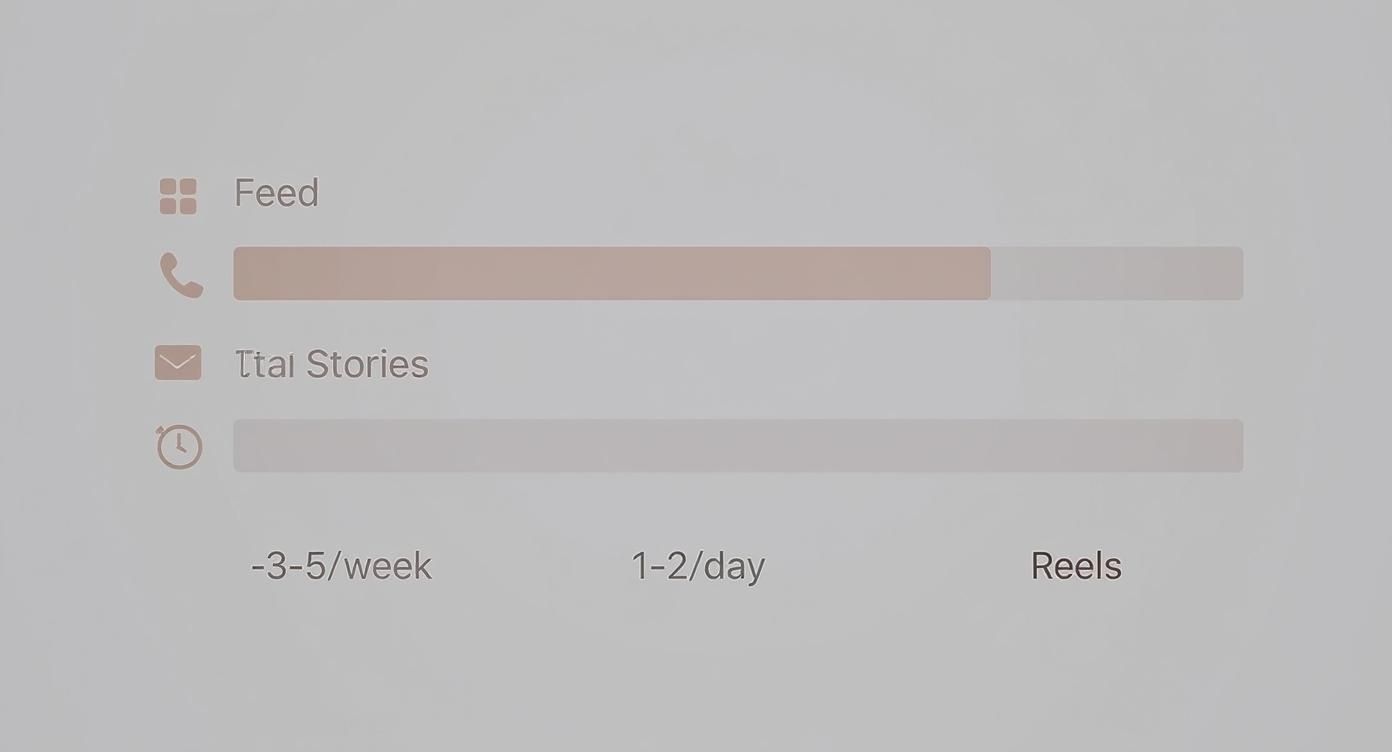
As you can see, the key is mixing evergreen Feed posts with more frequent, in-the-moment Stories to keep that daily connection alive.
A Sample Facebook Schedule for a Service Business
Let’s make this real. Here’s a sample weekly schedule for a local landscaping company, designed to mix promotion with community building.
- Monday (9 AM): Kick off the week with a “Monday Motivation” post. A beautiful shot from a recent project paired with a question like, “What’s one thing you’re hoping to tackle in your garden this week?” This encourages immediate comments.
- Tuesday (1 PM): Share a short, native video tip. A 60-second tutorial on how to properly prune rose bushes is a great example. Native videos almost always outperform links to YouTube.
- Wednesday (7 PM): Drive traffic back to your home base. Share a link to a new blog post, like “5 Low-Maintenance Plants for Sunny Gardens,” and ask a question in the copy to spark a discussion.
- Thursday (1 PM): Host an “Ask Our Expert” session right in the comments. Announce the topic ahead of time and let your followers drop their lawn care questions. This builds authority and provides immense value.
- Friday (11 AM): End the week with some social proof. Post a “Client Spotlight” with a glowing testimonial and some high-quality photos of the finished job. Tag the client’s business page if applicable to increase reach.
This kind of balanced schedule proves you’re not just there to sell. You’re providing value, building relationships, and sparking conversations—exactly what the Facebook algorithm is designed to reward. It’s how you build a real community, not just a list of followers.
Choosing Your Tools to Automate Your Workflow
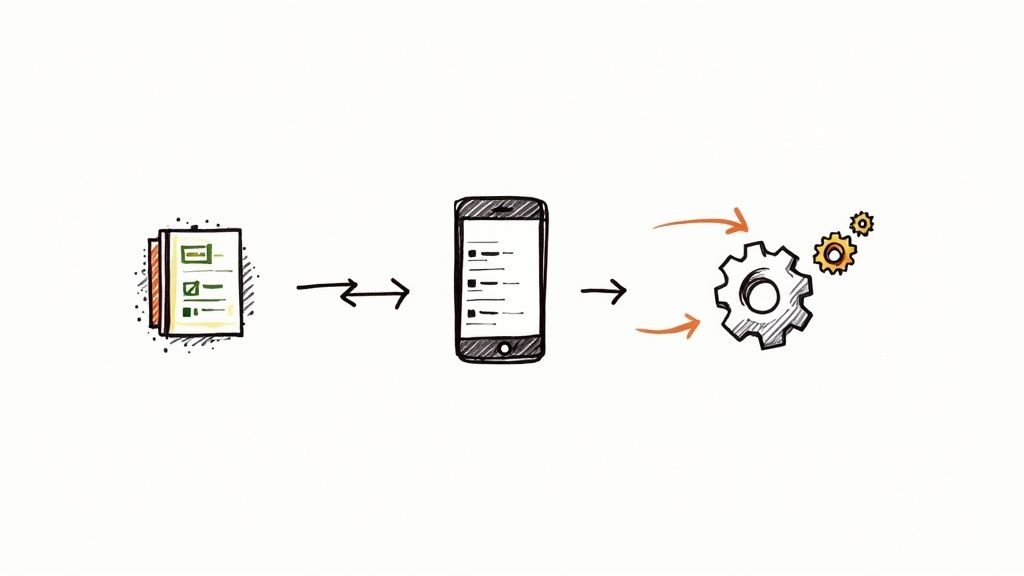
A great strategy is just a plan on paper until you have an efficient workflow to execute it. This is where we shift from planning to doing. The right tools can make the difference between a social media schedule that feels like a chore and one that runs smoothly in the background, making consistency almost effortless.
Your choice of tool depends entirely on your needs and budget. You don’t have to start with a complex, expensive platform. In fact, for many founders and small businesses, a simple spreadsheet is the perfect starting point.
Starting with a Simple Spreadsheet
A spreadsheet is the most accessible social media posting schedule template you can create. Tools like Google Sheets or Airtable are free, completely customizable, and perfect for getting your content organized without any financial commitment.
Here’s a practical way to set up your own content calendar in a spreadsheet. Create a simple table with these essential columns to get started:
- Date: The exact day you plan to publish the post.
- Platform: Which social network this post is for (e.g., Instagram, Facebook).
- Copy: The full text for your post, including hashtags.
- Visual: A link to the image or video file (e.g., a Google Drive or Dropbox link).
- Status: A dropdown menu with options like “Idea,” “Draft,” “Scheduled,” and “Published.”
This simple setup gives you a clear, at-a-glance view of your entire content plan. It keeps everything organized in one place, which is a massive productivity win when you’re juggling multiple tasks.
Pro Tip: Use color-coding for the ‘Status’ column. For example, make “Published” posts green and “Idea” posts yellow. This visual cue helps you instantly see what’s done and what still needs your attention.
Leveling Up with Automation Tools
As your social media presence grows, manually copying and pasting from a spreadsheet can become a major time sink. That’s when it’s time to consider dedicated social media management platforms like Buffer, Later, or even our own tool, Postful.
These tools do more than just schedule posts; they offer powerful automation that can save you hours every week. One of the most impactful features is the ability to create evergreen content queues.
Think about all the timeless content you have—blog posts, helpful tips, or brand stories that are always relevant. Instead of manually rescheduling them, you can add them to an automated queue. The tool will then recycle this content automatically, filling gaps in your schedule and ensuring a consistent stream of valuable posts without any extra work from you.
For example, a business coach could create a queue of 52 different productivity tips. The scheduling tool would automatically post one tip every week for an entire year, creating a consistent content feature that drives engagement with almost zero ongoing effort. This is how you build a system that works for you, giving you back the time to focus on other parts of your business.
Got Questions? Let’s Talk Strategy
Even with the best template in hand, putting a social media schedule into practice brings up questions. It’s totally normal. Let’s walk through a few of the most common ones I hear, so you can fine-tune your workflow and keep things running smoothly.
How Often Should I Update My Social Media Posting Schedule?
Think of your schedule as a living document, not something you carve in stone. A good rhythm to get into is a monthly check-in. This is your chance to look at the analytics and make small, smart adjustments—maybe you shift a few posting times by an hour or double down on a content format that’s clearly hitting the mark.
Then, block off time for a deeper review every quarter. This is when you step back and ask the big-picture questions. Are my content pillars still connecting? Have my audience’s habits changed? This flexible approach ensures your schedule keeps up with algorithm shifts and audience trends instead of becoming stale.
What Is the Best Tool for Managing a Content Schedule?
Honestly, the best tool is the one you’ll actually use consistently. If you’re just starting out or your budget is tight, don’t underestimate the power of a well-organized spreadsheet. A custom-built schedule in Google Sheets or Airtable can be incredibly effective, and it costs nothing. You get total control to build a system that works exactly how you think.
For teams or anyone juggling a bunch of accounts, this is where dedicated tools like Buffer, Later, or Sprout Social really shine. They’re built for collaboration and efficiency, offering things like advanced analytics, approval workflows, and direct scheduling that can save you a massive amount of time.
Your tool should reduce friction, not add to it. Start simple, and only upgrade when you feel the limitations of your current system are holding back your growth. The goal is efficiency and consistency.
Should I Use the Same Schedule for All Social Media Platforms?
Definitely not. This is one of the most common mistakes I see—blasting the exact same content at the exact same time across every platform. It just doesn’t work and leads to crickets. Each network has its own vibe, its own audience expectations, and its own peak times. What kills it on LinkedIn will probably fall flat on Instagram.
A much smarter approach is to build a master schedule with tailored sections for each platform. Your LinkedIn content, for instance, might be more professional and scheduled during business hours on weekdays. Your Instagram content, on the other hand, could be more visual and casual, timed for evenings and weekends when people are scrolling for fun. Customizing your game plan for each channel is how you build a real connection.
Ready to stop guessing and start growing? Postful is the AI-powered tool built for founders and doers who need to create consistent, high-quality content without the grind. Join the waitlist today to get early access and simplify your social media workflow. Secure your spot on Postful’s waitlist.