

Think of a social media content strategy as the detailed blueprint that guides everything you do online. It’s your plan for what you’ll say, who you’ll say it to, and why any of it matters for your business. Flying without one is just posting into the void and hoping something sticks. A solid strategy is the key to improving your productivity and getting real results.
Why You Need a Blueprint, Not Just Bricks
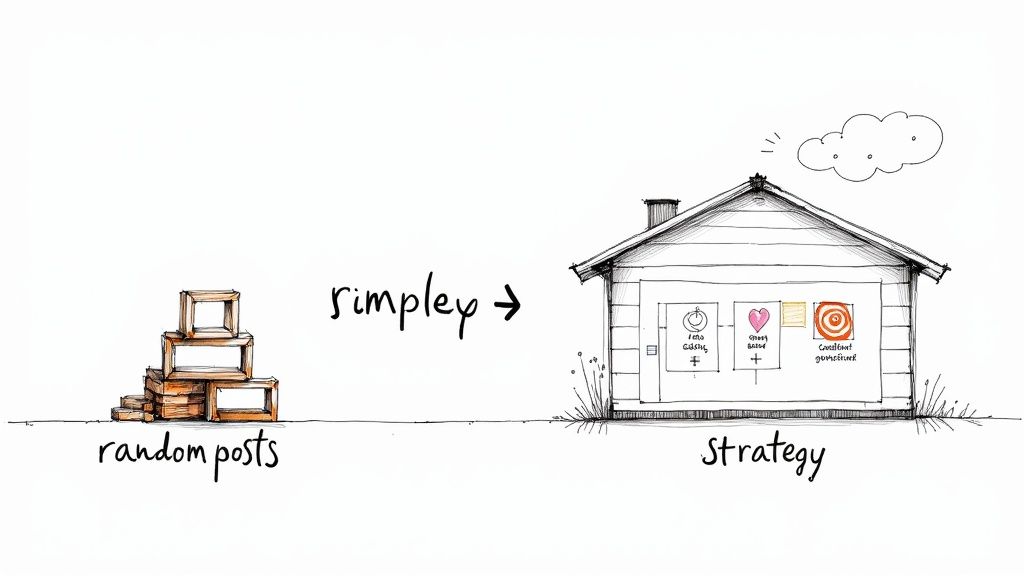
Imagine trying to build a house by just piling up bricks wherever you feel like it. You’d end up with a chaotic mess, not a sturdy home. The same goes for your social media presence. Posting without a plan is just piling up random content; a social media content strategy is the architectural plan that ensures every single post intentionally builds your brand.
For busy founders and side-hustlers, time is everything. A real strategy moves you from that reactive, soul-crushing cycle of “what on earth should I post today?” to a proactive, efficient workflow. That shift is a game-changer when you’re juggling a million other things. You stop guessing and start executing with a clear guide that can save you hours every week.
The Core Benefits of a Strategic Approach
Having a documented plan does more than just organize your content—it drives real business results. It turns your social channels from a simple megaphone into a powerful engine for growth.
Here’s what a solid strategy actually gets you:
- Saving Precious Time: A clear plan kills the daily decision fatigue. Practical suggestion: Use a content calendar template in a tool like Notion or Google Sheets to plan a month’s worth of content in one afternoon.
- Building a Loyal Community: Consistent, valuable content acts like a magnet for the right audience, turning passive followers into genuine fans who actually trust your brand.
- Hitting Tangible Business Goals: Your content finally gets tied directly to objectives that matter, like driving website traffic, generating qualified leads, or making sales.
- Maintaining a Consistent Brand: A strategy ensures your brand’s voice, tone, and look are unmistakable, no matter which platform you’re on.
A common mistake is confusing long-term strategy with short-term tactics. Strategy is your overarching vision and game plan. Tactics are the specific moves you make to execute it, like running a contest or posting a behind-the-scenes video.
To make this crystal clear, let’s break down the difference.
Strategy vs Tactics At a Glance
| Element | Strategic Approach (The Blueprint) | Tactical Approach (Random Acts) |
|---|---|---|
| Timeframe | Long-term (quarters, years) | Short-term (days, weeks) |
| Focus | “Why” we are doing this | “What” we are doing right now |
| Goals | Big-picture objectives (e.g., brand awareness) | Specific actions (e.g., get 50 contest entries) |
| Example | Build a community of engaged founders. | Post a poll asking about their biggest challenge. |
See the difference? The tactical poll serves the bigger strategy of building community. Without the strategy, the poll is just a random post.
Understanding the Modern Social Landscape
The need for a strategy is even more critical when you look at how people use social media today. As of 2025, an estimated 5.42 billion people are active social media users—that’s 65.7% of the entire global population.
What’s really telling is that the average person uses about 6.84 different social platforms every month. This explodes the myth that you can just copy and paste the same content everywhere.
This multi-platform world means a “one-size-fits-all” approach is dead on arrival. Your strategy has to account for the unique audience and format of each channel, making sure your message actually lands wherever it appears. This is where a clear plan becomes non-negotiable, guiding not just what you create but also how you manage and distribute it. If you want to go deeper on this, check out our guide on what social media management truly involves.
Laying the Foundation of Your Strategy
A great social media strategy isn’t built on luck. It’s built on a few core components that work together to make sure every single post has a purpose. Getting these basics right is the difference between shouting into the void and actually connecting with people who will become customers.
Think of it like building a house. You wouldn’t start putting up walls without a solid foundation. These components are your foundation, ensuring everything you do is stable, intentional, and actually contributes to your business goals.
Let’s break down exactly what you need.
Define Your Ideal Audience
Before you write a single word, you have to know who you’re talking to. And I don’t just mean their age or where they live. To create content that genuinely connects, you need to go deeper and build an Audience Persona—a clear, detailed picture of your ideal customer.
This isn’t just a marketing exercise; it’s about giving your data a human face. A persona captures what drives your audience, what they struggle with every day, and what problems they’re desperately trying to solve. When you know what keeps them up at night, you can create content that feels like you’re reading their mind.
Practical Prompts to Build Your Persona:
- What are their biggest professional or personal challenges right now? Practical Example: A side-hustling graphic designer is struggling to find high-paying clients and feels burnt out from managing projects and marketing simultaneously.
- Where do they hang out online? Practical Example: They scroll Instagram for design inspiration but use LinkedIn to find professional opportunities and connect with potential clients.
- What kind of content would genuinely make their life easier? Practical Example: A quick tutorial on pricing design work, a simple client proposal template, or a guide on using Trello for project management would be a game-changer for them.
Set Your SMART Goals
Posting just to post is a waste of time. Your social media efforts have to be tied to real business outcomes. “Getting more followers” is a wish, not a goal. To give your strategy some teeth, you need to use the SMART framework.
SMART goals are Specific, Measurable, Attainable, Relevant, and Time-bound. This simple structure turns a vague idea into a concrete action plan. It’s the difference between saying “I want to grow” and saying, “I will increase qualified leads from LinkedIn by 15% over the next 90 days by posting three educational carousels per week.” See the difference? One is a dream, the other is a plan.
Setting clear, measurable goals is the most critical step in proving social media is worth your time. It’s how you track what’s working, justify the effort, and show exactly how your content is helping the bottom line.
Practical Examples of SMART Goals in Action:
- Brand Awareness: Increase Instagram post reach by 20% and impressions by 15% in Q3 by collaborating with two micro-influencers in our niche.
- Lead Generation: Generate 50 new email subscribers in the next 30 days by promoting a free downloadable guide on Facebook and LinkedIn with a clear link in bio.
- Community Engagement: Boost the average number of comments per post from 5 to 15 by the end of the quarter by asking open-ended questions and replying to every comment within two hours.
Establish Your Content Pillars
You can’t be an expert on everything. Content pillars are the 3-5 core themes your brand will own, talk about, and become known for. They’re the backbone of your content, making sure everything you publish is focused and reinforces why people should listen to you.
Think of your pillars like the main sections in a bookstore. You know exactly what you’ll find in each one. Your audience should have that same clarity about your content. This consistency builds authority and makes you the go-to resource for a few specific topics.
Practical Example: A productivity coach for founders might build their strategy on these pillars:
- Time Management Systems: Breaking down frameworks like Pomodoro or time blocking. Content Idea: A carousel showing “How to Time Block Your Week in 30 Minutes.”
- Founder Mindset: Talking through burnout, focus, and overcoming procrastination. Content Idea: A short video on “3 Ways to Beat Procrastination When You’re Overwhelmed.”
- Productivity Tools & Tech: Reviewing apps and software that actually save time. Content Idea: A Reel showcasing “My Top 5 Favorite AI Tools for Founders.”
Determine Your Posting Cadence and KPIs
Finally, you need a realistic plan for how you’ll execute and measure all this. Your posting cadence is simply the rhythm of your content—how often you’ll post on each platform. Consistency beats frequency every time. It’s far better to post three amazing pieces of content a week than seven rushed, low-effort ones that nobody engages with. Pick a schedule you can actually stick to without burning out.
To see if that schedule is working, you need to track the right Key Performance Indicators (KPIs). Your KPIs should tie directly back to the SMART goals you already set. They’re the specific numbers that tell you if your strategy is on the right track or if it’s time to adjust.
| Goal Category | Corresponding KPI to Track | Why It Matters |
|---|---|---|
| Brand Awareness | Reach and Impressions | Shows how many unique people see your content and how often it’s displayed. |
| Engagement | Likes, Comments, Shares, Saves | Tells you if your content is actually resonating and starting conversations. |
| Lead Generation | Click-Through Rate (CTR) and Conversion Rate | Measures if people are taking the action you want them to, like clicking a link. |
When you take the time to define your audience, goals, pillars, and metrics, you stop throwing content at the wall and hoping it sticks. You build a predictable engine for growth.
How to Build Your Strategy from Scratch
Okay, the foundation is set. Now it’s time to get your hands dirty.
Building a social media content strategy from scratch can feel like a massive task, but it really doesn’t have to be. I’ve designed this workflow specifically for busy founders who need to turn ideas into action—and fast.
We’ll go from a quick health check of what you’re doing now to a complete content plan you can start using this week. Think of this as your cheat sheet for creating a structured, efficient process that actually gets results.
Start with a Quick Social Media Audit
Before you can figure out where you’re going, you have to know where you are right now. A quick audit isn’t about getting lost in spreadsheets; it’s about getting a clear snapshot of your current efforts. This simple exercise will help you spot what’s working, what’s not, and where the biggest opportunities are hiding.
Productivity Suggestion: Spend just one hour on this. Set a timer and answer these questions for each platform you’re on:
- What are my top 3 performing posts from the last 90 days? Look for themes. Were they carousels? Videos? Did a certain topic or call-to-action get all the love?
- Which platform is driving the most engagement or website traffic? This tells you where your audience is most active and where you should probably double down.
- Is my profile complete and consistent across all channels? Check for a clear bio, a high-quality profile picture, and an up-to-date link. Seriously, you’d be surprised how many people skip this.
This quick once-over gives you a baseline. It stops you from repeating mistakes and helps you build on what your audience has already told you they like.
Define Your Audience and Set a Primary Goal
Now that you know what’s working, it’s time to get laser-focused on who you’re talking to and what you want to achieve. Instead of trying to do everything at once, just pick one primary goal for the next quarter. For a founder with limited time, this singular focus is a superpower.
A common mistake is setting a bunch of competing goals. By choosing one primary objective—like ‘increase brand awareness’ or ‘generate leads’—you give every single piece of content a clear job to do. It makes your whole strategy far more effective.
Once your goal is set, get specific about your audience with that goal in mind. For instance, if your goal is generating leads for a new software tool, your persona might be “Sarah, the Side-Hustling Founder.”
Practical Example Persona Snapshot: Sarah, the Side-Hustling Founder
- Main Goal: Find tools that save her time and automate repetitive tasks.
- Biggest Pain Point: Juggling her day job with her growing business; feels completely overwhelmed by marketing.
- Where She Hangs Out: LinkedIn for industry news, Instagram for quick tips and inspiration.
This level of clarity means your content will speak directly to the person most likely to care about what you’re selling.
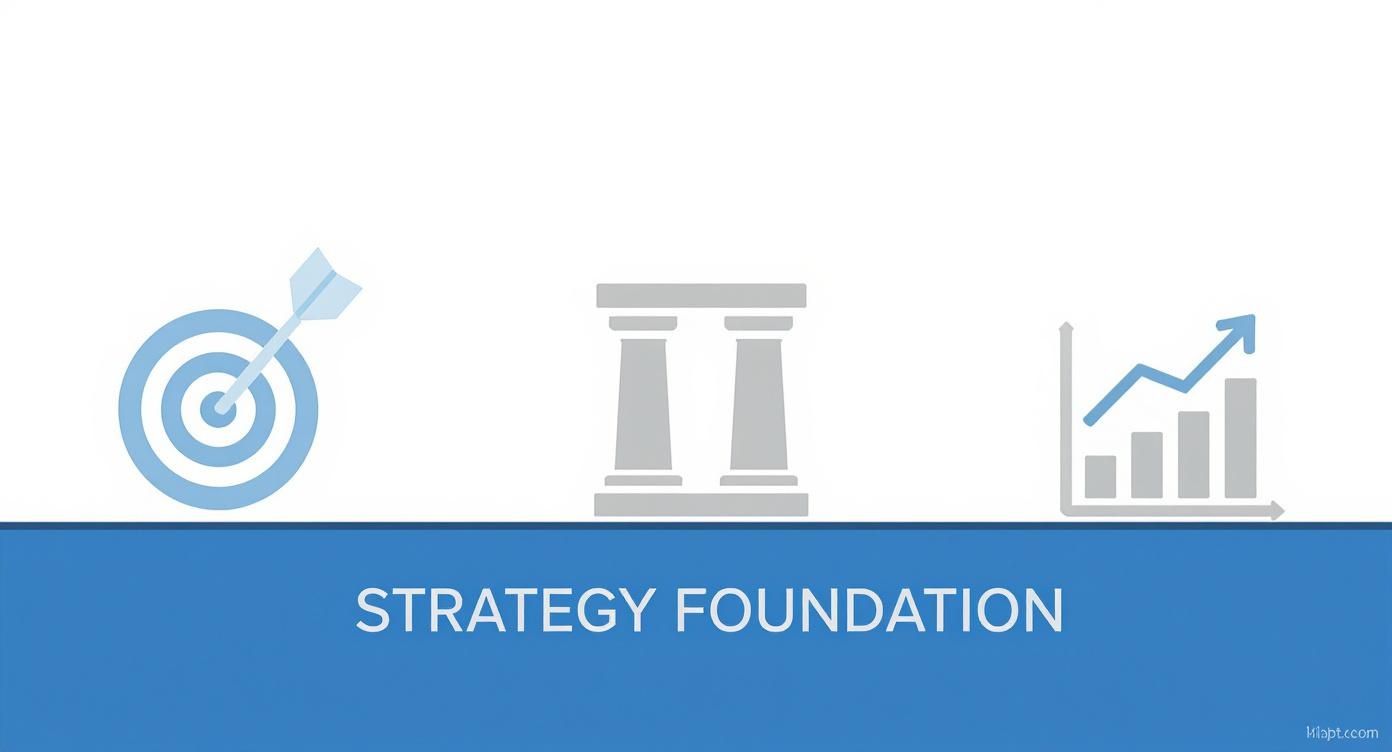
This is how these foundational pieces—your Goals, your Pillars, and your KPIs—all work together. It’s a simple system that connects everything you do.
Brainstorm Pillars and Map Your Content Calendar
With your goal and audience locked in, you can now brainstorm your content pillars—the core topics you’ll talk about over and over again. From there, you can map out a simple content calendar for the next month. This isn’t about filling every single day; it’s about creating a rhythm you can actually stick to.
Step-by-Step Workflow for Content Planning:
- Brainstorm 3-5 Content Pillars: Based on your persona’s needs, what are the key themes you can own? For Sarah, pillars could be “Productivity Hacks,” “Automation Tools,” and “Side-Hustle Growth Stories.”
- Select Your Primary Platforms: Don’t try to be everywhere. Based on Sarah’s habits, you’d focus your energy on LinkedIn and Instagram. That’s it.
- Map Your First Month: Assign one pillar to each week. For “Productivity Hacks” week, you could plan a carousel on LinkedIn and a short video Reel on Instagram.
- Create a Simple Content Brief: For each post, fill out a quick brief. This keeps your quality high and your message consistent, even when you’re rushing.
Productivity Tool: Fill-in-the-Blank Content Brief Template
- Topic: [e.g., 5 Time-Saving Email Templates]
- Pillar: [e.g., Productivity Hacks]
- Platform: [e.g., LinkedIn]
- Format: [e.g., Carousel Post]
- Key Message: [e.g., Stop writing emails from scratch; use these templates to save 30 minutes a day.]
- Call to Action (CTA): [e.g., “Which template will you use first? Let me know in the comments!”]
This structured approach turns your strategy from a vague idea into a concrete, actionable plan you can start executing today.
Choosing Your Content Mix and Platforms
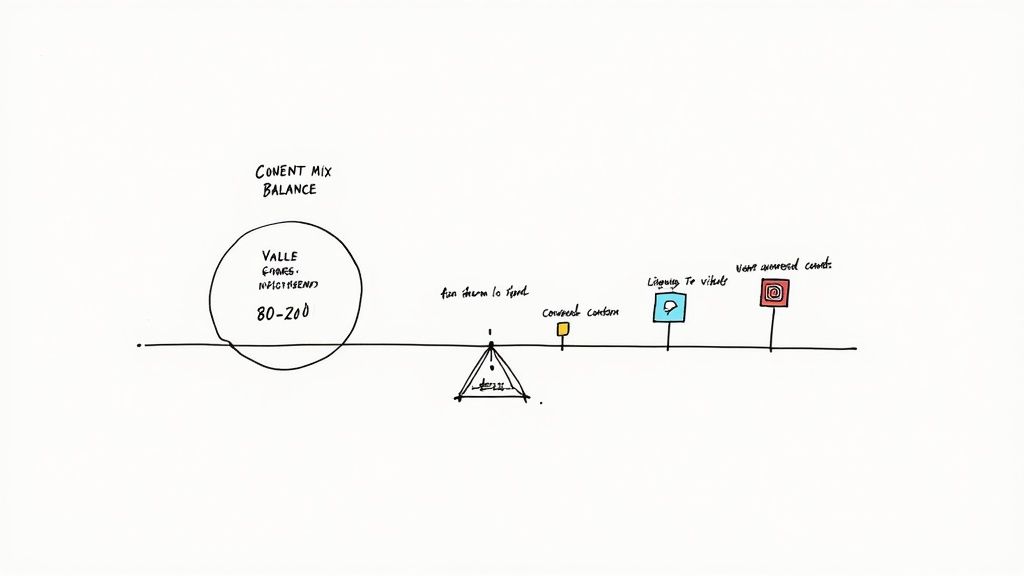
Alright, you’ve got your plan. Now for the two questions that trip everyone up: what should you actually post, and where? This is where most founders get stuck. They either fall into the trap of promoting way too much or just copy-pasting the same content across every single platform.
A great social media content strategy is all about finding the right balance and tailoring your message to the environment you’re in. Let’s break down how to create a content mix that actually attracts your audience and how to pick the platforms where your work will pay off.
Mastering the 80/20 Rule for Content Creation
The most effective social media accounts I’ve seen all run on a simple but powerful principle: the 80/20 rule. Think of it as your secret weapon for building a community that genuinely trusts you, instead of just tolerating your sales pitches.
Here’s the breakdown:
- 80% of your content should provide value. This means it educates, entertains, or inspires your audience. Practical Example: Sharing a free checklist, a quick video tutorial, or a behind-the-scenes look at your process. You’re solving a problem for them without asking for anything in return.
- 20% of your content can be promotional. This is where you finally get to talk about your product, share a killer customer testimonial, or announce a sale. Practical Example: A post announcing a new feature, a case study video, or a limited-time offer.
Because you’ve spent the vast majority of your time giving, your audience is far more open to listening when it’s time to ask. This balance prevents people from tuning you out and positions your brand as a helpful guide, not just a walking billboard.
Choosing Powerful Content Formats
Not all content is created equal. The format you choose can completely change how well your message lands. Video is an absolute cornerstone of any effective social media strategy in 2025, consistently crushing static posts in engagement on pretty much every platform. To dig deeper, check out these social media strategies that drive business growth.
Beyond video, here are a few other high-impact formats to mix in:
- Carousels: These multi-slide posts are perfect for breaking down complex topics into simple, digestible steps. Practical Example: A 10-slide carousel on “How to Onboard Your First Client” for a freelance consultant.
- User-Generated Content (UGC): Sharing posts from your customers is one of the most powerful forms of social proof out there. Practical Example: Reposting an Instagram story from a customer unboxing your product. It builds community and gives you authentic content. It’s a win-win.
- Behind-the-Scenes Stories: People connect with people, not logos. Use Stories on Instagram or Facebook to show the human side of your brand—your workspace, your creative process, or just a day in your life.
Productivity Suggestion: Match the format to the message. A quick tip is perfect for a short-form video, while a step-by-step guide is much better suited for a carousel. Don’t try to force your ideas into a format that just doesn’t fit.
Tailoring Your Content for Each Platform
The single biggest mistake I see founders make is creating one post and blasting it across every single channel. That one-size-fits-all approach ignores a fundamental truth: each social media platform has its own culture, its own audience expectations, and its own algorithm.
What kills it on LinkedIn will almost certainly fall flat on TikTok.
To get real results, you have to adapt your core message for each platform’s unique vibe.
Practical, Platform-Specific Content Examples:
Let’s say you’re the founder of a project management app, and one of your content pillars is “Team Productivity.” Here’s how you could adapt one core idea for different channels:
- LinkedIn: The audience here is professional and career-focused. You could post a text-based article or a carousel titled, “5 Project Management Mistakes That Are Killing Your Team’s Momentum.” The tone should be educational and authoritative.
- Instagram: This platform is all about visuals and community. You could create an engaging Reel showing a “before and after” of a chaotic workflow transformed by your app, all set to some trending audio.
- TikTok: Here, authenticity and entertainment are king. A great post would be a short, relatable video with on-screen text like, “My face when the team closes a project two days early using one simple trick.”
By tailoring your approach, you show respect for each platform’s community and massively increase your chances of engagement. This thoughtful adaptation is what separates a good social media strategy from a great one.
Tools and Workflows to Boost Your Productivity
Look, a brilliant social media content strategy is only as good as your ability to actually execute it. Without solid systems, even the best plans fall apart under the crush of daily tasks. This section is all about implementation—giving you the tools and workflows to save time, stay organized, and keep your content quality high.
For founders and side-hustlers, a lean, powerful tech stack is everything. You don’t need a dozen expensive tools. What you need are a few smart ones that do the heavy lifting for you. The goal is to build a well-oiled machine that lets you focus on growing your business, not just feeding the content monster.
Building Your Lean Tech Stack
The right tools can automate the grunt work and give you creative superpowers. Instead of juggling a bunch of complex platforms, focus on a simple stack that covers the three core functions: creation, scheduling, and listening.
- AI-Powered Content Creation: Tools like Postful are built to crush writer’s block. They can help you brainstorm ideas, tighten up your messaging, and generate post drafts from simple prompts. It turns hours of work into minutes.
- Smart Scheduling and Automation: A reliable scheduler is non-negotiable. It lets you batch-create your content and then “set it and forget it,” making sure you have a consistent presence even on your busiest days.
- Social Listening Tools: These tools are your eyes and ears. They help you monitor conversations about your brand and industry. Practical Example: Set up alerts for your brand name and key industry terms to find real-time content ideas and opportunities to engage.
A great workflow transforms social media management from a chaotic scramble into a predictable, low-stress process. By systemizing your tasks, you reclaim mental energy and ensure high-quality output every single week.
Essential Social Media Tool Stack for Founders
Here’s a quick look at the kind of lean tool stack that can keep your social media strategy humming without breaking the bank.
| Tool Category | Example Tool(s) | Primary Function |
|---|---|---|
| AI-Powered Content Creation | Postful | Brainstorms ideas, drafts posts, and refines messaging from simple prompts. |
| Scheduling & Automation | Buffer, Hootsuite | Schedules posts in advance to maintain a consistent publishing cadence. |
| Design & Visuals | Canva, Figma | Creates professional-looking graphics, videos, and visual assets quickly. |
| Social Listening | Brand24, Mention | Tracks brand mentions, keywords, and industry conversations in real-time. |
| Analytics & Reporting | Native Platform Analytics | Provides data on post performance, audience growth, and engagement KPIs. |
This combination covers your bases, letting you create, schedule, and analyze your content without getting bogged down by overly complicated software.
A Sample Weekly Workflow for Maximum Efficiency
Having the tools is one thing; using them effectively is another. A structured weekly workflow is what brings your social media content strategy to life. Here’s a simple but powerful schedule you can adapt for yourself.
- Monday (1 Hour) Brainstorming and Briefing: Start the week by planning your content. Look at your content pillars and KPIs, then brainstorm post ideas for the week ahead. Create simple content briefs for each one.
- Tuesday (2 Hours) Content Creation: This is your dedicated creation block. Using your briefs, write captions, design graphics, or record videos. Batch-create everything for the entire week in this one session.
- Wednesday (30 Mins) Scheduling: Load all your finished content into your scheduling tool. Set the posts to go live at the best times throughout the week. Once it’s done, you don’t have to think about posting again.
- Friday (30 Mins) Performance Review and Engagement: Check your analytics. Which posts did well? What can you learn for next week? Spend the rest of the time replying to comments and engaging with your community.
The social media world is getting louder, which means you need more content to stay visible. Some research shows that successful brands now post between 48 and 72 times per week across different platforms to keep their audience engaged. That kind of frequency makes efficient, AI-assisted production a necessity, not a luxury. For more on this, Hootsuite’s latest social media trends report is a great read.
If you want to go deeper on streamlining your production, you can explore some of the best social media content creation tools out there. And since picking the right automation platform is so important, check out our guide on the best social media scheduling tools to find one that fits your workflow.
Your Path to Consistent Social Media Growth
A social media content strategy isn’t something you create once and then shove in a drawer. Think of it as a living blueprint—one that needs constant attention to actually work. The founders who really succeed on social media treat their strategy not as a one-off task, but as a continuous process of tweaking and refining.
This is where sustainable growth comes from—from a commitment to planning, not from just randomly posting and hoping for the best. The frameworks and templates in this guide are your starting point, designed to get you from guessing what might work to building a predictable engine for success. It’s all about creating a system that delivers results, week after week.
Make Quarterly Reviews Non-Negotiable
A powerful habit to get into is the quarterly strategy review. Every 90 days, block off some time to dive into your analytics, look back at your goals, and ask yourself what’s changed. This regular check-in is what keeps your content sharp and relevant.
Your social media strategy is your compass, not a rigid map. If the terrain changes—like a new platform trend or a shift in audience behavior—you need to adjust your course to keep moving toward your goals.
Use this simple checklist to guide your review:
- Performance vs. KPIs: Are you actually hitting the numbers you set out to achieve?
- Audience Feedback: What are your comments and DMs telling you? What’s the real vibe?
- Pillar Relevance: Are your main content themes still landing with your audience, or are they getting stale?
- Platform Shifts: Have any new features or algorithm changes opened up new opportunities you should be jumping on?
Your Next Step Starts Now
This guide has given you the tools; now it’s time to put them into action. Don’t wait for the “perfect” moment to get started. Use the checklists and templates we’ve shared to map out your first social media content strategy this week. Taking that first step is the single most important thing you can do to transform how you grow your social media presence.
For more ideas and to stay on top of what’s working, keep an eye on industry resources like Branditok’s blog for ongoing tips. It’s time to stop guessing and start building.
Frequently Asked Questions
Even the best social media strategy comes with questions. As you start putting your plan into action, you’re going to hit a few snags. It’s totally normal. Here are some clear, straight-to-the-point answers to the most common questions I hear from founders and side-hustlers.
How Often Should I Post on Social Media?
There’s no magic number here. The right frequency really depends on the platform and what your audience has come to expect. A solid starting point is 3-5 times per week for platforms like Instagram and LinkedIn, and maybe 1-3 times a day on faster-moving feeds like X (formerly Twitter).
But here’s what really matters: consistency over sheer frequency. It’s so much better to publish three high-quality, genuinely helpful posts every week than to blast out seven rushed, low-effort ones just to hit a quota. Productivity suggestion: Use a scheduling tool to batch-create your weekly content in one session. This ensures consistency without daily stress.
What Are Content Pillars and How Do I Choose Them?
Think of content pillars as the 3-5 core themes your brand will own. They’re the foundational topics you’ll talk about again and again. This keeps all your content focused, relevant, and helps build your reputation as the go-to expert in your niche.
To nail them down, find where these three things overlap:
- Your unique expertise (what you know better than anyone).
- Your audience’s biggest problems and passions.
- Your business goals (what you’re trying to achieve).
Practical Example: A financial advisor for tech startups might build their content around pillars like “Startup Funding Strategies,” “Founder Wealth Management,” and “Scaling Financial Operations.” These pillars act as guardrails, keeping your message sharp and reinforcing what your brand is all about.
How Long Until I See Results From a New Strategy?
You might get some early wins with engagement, but seeing the results that really move the needle—like steady follower growth, more website traffic, or qualified leads—usually takes 3-6 months of consistent, dedicated effort. Social media is a long game. You’re building a community and earning trust, and that doesn’t happen overnight.
Be patient and stick with your plan. It’s critical. Track things like engagement and reach in the short term, but measure the big stuff like leads and sales over a longer period to see the real return on your effort.
It’s like planting a tree. You won’t see much growth on day one, but if you keep nurturing it, you’ll end up with something strong and lasting. Stay the course, trust the process, and use the data you gather to make smart tweaks along the way.
Ready to stop guessing and start growing? Postful is the AI-powered tool built for founders who need to create high-quality social media content, fast. Get ready-to-use templates and brainstorming tools to build a consistent presence without the grind. Join the waitlist to secure your early access today!