
The struggle with online marketing isn’t due to a lack of ideas. It's because marketing turns into a second job.
You’re trying to serve clients, ship work, answer emails, maybe keep a side-hustle alive after hours, and then somehow also post consistently, write emails, update your website, test offers, and track results. That’s where the wheels come off. The problem usually isn’t motivation. It’s workflow.
If you want to learn how to market your business online, start with a simpler goal: build a system that helps you turn the work you already do into more business. That means fewer random tactics, fewer last-minute posts, and more repeatable actions that create leads, conversations, and sales.
Define Your Foundation Before You Build
A lot of small business marketing fails before the first post goes live. The message is vague, the audience is too broad or too narrow, and every channel pulls in a different direction.
The fix isn’t a thick strategy deck. It’s a one-page operating document you can implement.
Pick one business goal
Marketing gets messy when you try to do everything at once. More reach, more followers, more leads, more authority, more sales. That usually creates scattered effort.
Choose one primary outcome for the next cycle of work:
- Lead generation if you sell a service and need inquiries
- Email list growth if you want an owned audience
- Discovery calls booked if your sale needs conversation
- Product page visits if your offer is already clear
- Repeat purchases if you sell to existing customers often
Write that goal in one line. Then write the action that matters.
For example:
| Business type | Useful goal | Action to track |
|---|---|---|
| Freelance designer | More qualified leads | Contact form submissions |
| Local service business | More booked jobs | Calls or appointment requests |
| Coach or consultant | More sales conversations | Discovery calls booked |
| Creator selling a product | More owned audience | Email sign-ups |
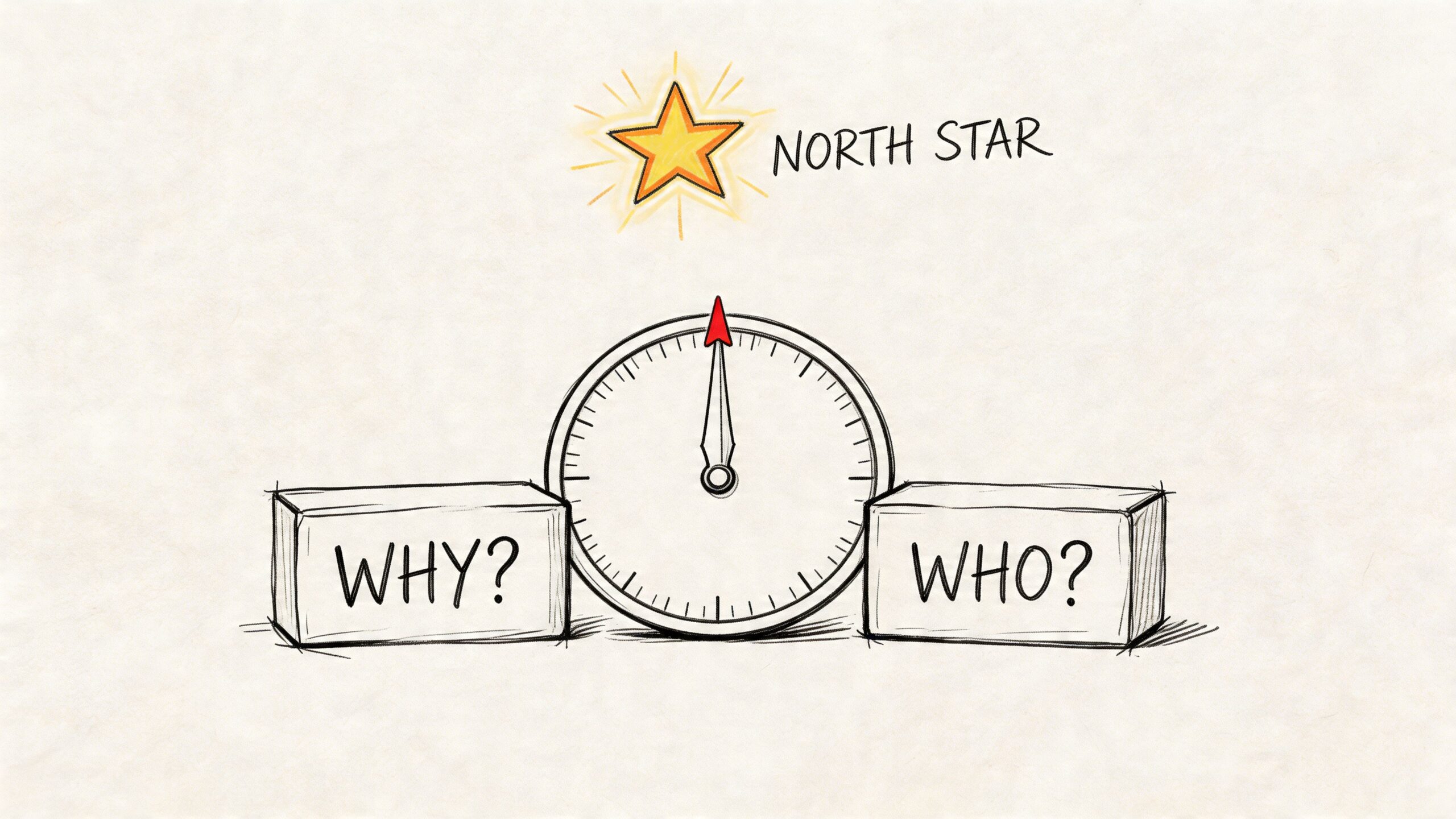
That’s your North Star. If a marketing activity doesn’t support it, it’s optional.
Build a practical customer snapshot
You don’t need ten personas. You need one clear picture of the buyer you want most.
Keep it short:
Who they are
Role, business stage, and how they describe themselves.What they’re trying to achieve
Not your feature list. Their result.What gets in the way
Time, confusion, inconsistent leads, lack of confidence, too many tools.What they’re already trying
Posting on social, relying on referrals, occasionally sending emails, tweaking their site.What they need to hear to take action
Usually clarity, proof of relevance, and a simple next step.
A good snapshot sounds like a real person. “Solo accountant trying to get more local clients without spending every evening making content” is useful. “Ambitious entrepreneur aged 25 to 44” is not.
If you need help tightening that profile, this guide on how to find your target audience is a solid starting point.
Practical rule: If your audience description could apply to everyone, your marketing will feel like it’s for no one.
Don’t narrow yourself into a corner
Some founders make the opposite mistake. They define the audience so tightly that they cut out people who would happily buy.
That’s one reason buyer research matters. Marketers can discard 25 to 35% of viable audience segments when they get too narrow, and 55% of campaigns ignore post-click optimization. Building buyer personas and mapping the full customer journey helps avoid both problems, as noted by Convertize’s digital marketing experts.
In practice, that means asking:
- What does this person see first?
- Where do they click next?
- What page or offer should they land on?
- What would make them trust me enough to reply, book, or buy?
Make your one-page plan usable
Put these five blocks in a note, doc, or spreadsheet:
Primary goal
One goal for the next month or quarter.Audience snapshot
One buyer profile you want to attract.Core problem
The main pain your offer solves.Main message
One sentence that connects your work to their result.Next step
The action you want someone to take after seeing your content.
Here’s an example:
I help independent bookkeepers get more local clients without relying on daily social posting. My content shows practical ways to improve local visibility, referrals, and follow-up. The next step is booking a short consultation.
That’s enough foundation to guide your website copy, emails, posts, and offers.
Choose Your Online Marketing Battlegrounds Wisely
A common solo business problem looks like this. You post on Instagram, tweak your LinkedIn headline, start a newsletter, think about YouTube, and still end the week with no clear lift in inquiries. The issue usually is not effort. It is channel sprawl.
Pick fewer places. Give each one a job.
Think in two buckets. Discovery channels help new people find you. Owned channels help you follow up, stay visible, and turn attention into conversations. Time-poor solopreneurs get better results from a small system they can run every week than a five-channel plan they abandon after ten days.

Start with one owned channel
If all your marketing lives on rented platforms, your pipeline depends on other companies’ rules. Reach shifts. Formats change. A strong week of posting can still produce weak follow-up because you have no direct way to continue the conversation.
Email is usually the first owned channel to set up.
Use it for practical jobs social platforms handle poorly:
- Follow-up after someone downloads, books, or replies
- Nurture for buyers who need more time
- Reactivation for old leads who went quiet
- Offers with a direct call to action
- Relationship building that does not depend on feed visibility
Keep the setup light. One welcome email. One short weekly or biweekly message. One offer when it makes sense. That is enough to start building a reliable path from interest to inquiry.
Match your channel to your sales process
Different businesses need different battlegrounds. A local service business does not need the same channel mix as a B2B consultant or a visual creator.
Use this filter instead of chasing every platform feature:
| Channel type | Best use | Good fit |
|---|---|---|
| Expertise and trust | Consultants, B2B services, agencies, coaches | |
| Visual proof and personality | Creators, local brands, lifestyle businesses | |
| YouTube | Searchable teaching | Educators, software, service explainers |
| Google Business Profile | Local discovery | Local services, clinics, home services, studios |
The useful question is simple. Does this channel help the right buyer find you faster or trust you faster?
If the answer is unclear, reduce your effort there.
Keep Google Business Profile current if you serve a location
For local businesses, Google Business Profile often does more selling than social media. People check reviews, photos, service details, and opening hours before they ever visit your website.
Keep these basics current:
- Accurate services so people know what you do
- Fresh photos if visuals affect trust
- Clear contact details so there is no friction
- Review responses that show you are active
- Posts or updates when they help answer common questions
A neglected profile makes an active business look hard to reach. That costs leads.
Social media does not need to carry the whole plan
Many solopreneurs waste time forcing themselves into a daily posting routine that does not suit their business or energy. Social can work well, but it is one option, not the whole system.
If you do not want your growth engine to depend on constant posting, use channels that reward expertise and consistency instead:
Podcast guesting
Show up where your buyers already listen. Bring one useful lesson, one clear example, and one next step.Referral partnerships
Build relationships with adjacent service providers who already serve your kind of client.Search-driven blog posts
Publish answers to the questions prospects ask before they buy.Communities and networking groups
Participate where trust builds through repeated useful contribution, not volume.
That mix often works better for service businesses because it creates warmer leads with less content churn.
Go deep on one discovery channel
If one platform clearly fits your audience, commit to it and build a repeatable workflow around it. One discovery channel is plenty if it produces conversations.
For example, a visual business may choose Instagram. A solo consultant may get better results from LinkedIn. A local service business may rely on Google Business Profile and referrals. The trade-off is reach versus maintenance. The more channels you add, the less consistent each one becomes.
If Instagram is your main discovery source, study formats that earn attention efficiently. This guide on how to go viral on Instagram Reels is useful for understanding how creators shape short-form content without turning every post into guesswork.
Then make execution easier. Batch ideas once a week, draft core points in one place, and use AI tools such as Postful to turn rough notes into usable posts faster. If you need a lightweight system for planning what goes where, this simple content calendar workflow for small businesses keeps the process tight.
One discovery channel. One owned channel. One clear next step.
That is enough to turn marketing work into more business.
Develop Your Simple Content Strategy and Calendar
Monday starts with client work. By noon, three admin tasks have appeared, two leads need replies, and marketing drops to the bottom of the list again. A simple calendar fixes that by deciding the work before the week gets noisy.
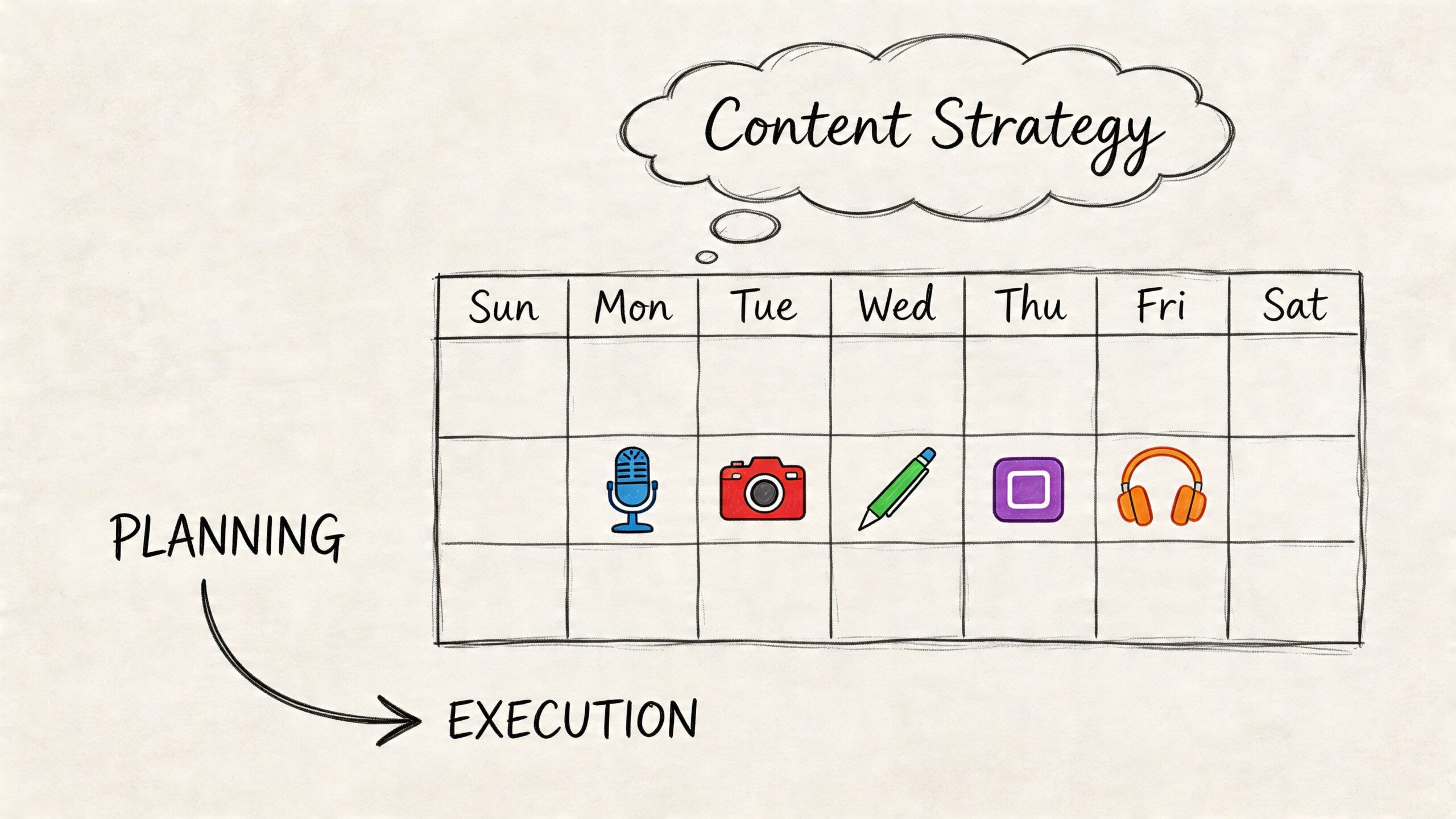
The goal is not to fill every day with posts. The goal is to turn one planning block into a month of useful marketing assets, including the ones that do not live on social media.
Choose three or four content pillars
Content pillars give your calendar boundaries. Without them, every idea feels possible, and that usually means nothing gets finished.
Pick topics that connect three things:
- what you know well
- what buyers already ask about
- what leads naturally to your offer
A practical mix looks like this:
Problem content
Show the issue your audience is dealing with right now.Process content
Explain how you solve that issue in plain language.Proof content
Share client lessons, examples, outcomes, or before-and-after thinking.Offer content
Clarify what you sell, who it is for, and the next step.
A bookkeeping business might choose:
- tax-time mistakes
- clean-up workflows
- reporting habits
- what monthly support includes
A fitness coach might choose:
- training myths
- easy meal habits
- client routines
- coaching FAQs
That gives you structure without making your content repetitive.
Build a calendar you can maintain in under an hour
Fancy systems fail fast if they need daily attention. A spreadsheet, Notion page, Google Doc, or notes app is enough.
Use five columns:
| Date | Channel | Pillar | Topic | CTA |
|---|
Then map the month in one sitting.
I usually recommend a four-part rhythm for solopreneurs because it keeps setup light and execution fast:
One planning session
List the main themes, buyer questions, and offer pushes for the month.One production block
Draft the core assets in batches. One email, one article, a few short posts, and one outreach task is plenty.One review pass
Clean up headlines, links, CTAs, images, and formatting.One scheduling block
Queue what can be queued and leave space for timely posts if something relevant comes up.
That schedule cuts context switching. It also makes AI more useful. Tools like Postful work best when you start with a clear pillar, a rough angle, and a destination channel instead of a blank page.
If you want a practical template, this guide on how to create a content calendar for a small business lays out a system that is easy to keep running.
Use prompts that lead to finished pieces
“Create content” is too vague to be helpful after a long workday. Specific prompts produce better raw material and make drafting faster.
Use questions like these:
- What do buyers ask right before they hire me?
- What mistake do I correct every week?
- What false assumption slows a prospect down?
- What quick win can I help someone get this week?
- What usually happens before a client reaches out?
- What changes after they start working with me?
Those prompts are useful because they connect directly to sales conversations, delivery work, and real objections. You are not inventing topics. You are documenting patterns you already see.
Your calendar does not need to impress anyone. It needs to make publishing easier on a busy Wednesday.
Add non-social tasks to the calendar
Many solopreneurs lose time by treating marketing as a stream of social posts. That creates a lot of activity and not always much pipeline.
As noted earlier, time pressure is one of the biggest reasons solo business owners struggle to market consistently, and non-social channels often get ignored. A better calendar accounts for both visibility and follow-up work.
Include a few non-social tasks every month:
- One email tied to the month’s main topic
- One blog post answering a high-intent buyer question
- One partnership or referral outreach task
- One website update that sharpens your offer, CTA, or booking page
- One review request or testimonial follow-up
Here, the trade-off becomes clear. Social content can get attention fast, but email, blog content, partnerships, and website improvements often keep producing after the post is gone. A strong calendar covers both.
Later, if you want a visual walkthrough of batching and planning, this is a useful reference:
A good calendar protects your best hours and turns scattered marketing effort into finished assets that can bring in business.
Create and Repurpose Content the Smart Way
Most business owners don’t need more ideas. They need a way to turn one idea into several finished assets without sounding copy-pasted.
That’s where repurposing becomes a business skill, not just a content trick.
Start with one strong source piece
Pick one useful idea from your client work, product knowledge, or customer conversations.
Example: a freelance web designer wants to market a service that helps small businesses improve conversions. One solid core idea might be:
“Most homepages try to say everything and end up saying nothing.”
That can become a short article, a talking-head video, a voice note transcript, or even a bullet outline. The format matters less than the clarity of the idea.
Here’s the key workflow:
- Draft the core point.
- Pull out the strongest angle for each platform.
- Adapt the format and tone.
- Keep the message consistent.
- Add one clear CTA per asset.
A practical remix example
Let’s turn that homepage idea into three assets.
LinkedIn post
On LinkedIn, the strongest angle is usually insight plus consequence.
Example structure:
- Hook: “If your homepage tries to speak to everyone, it usually converts no one.”
- Body: Explain that visitors need to know who you help, what problem you solve, and what they should do next.
- CTA: Invite readers to review their homepage headline.
This format works because it reads like a real business observation, not a slogan.
Instagram carousel
On Instagram, the same idea needs more visual progression.
Slide flow:
- Slide 1: “Why your homepage isn’t converting”
- Slide 2: “Too many businesses lead with vague claims”
- Slide 3: “Visitors want clarity fast”
- Slide 4: “Start with who you help”
- Slide 5: “Then name the result”
- Slide 6: “Then show the next step”
- Slide 7: CTA to save or message
That isn’t just reposting. It’s restructuring for the way people consume the platform.
Email newsletter snippet
In email, the strongest version is shorter and more personal.
Example:
- Subject line focused on the problem
- Quick lesson about homepage clarity
- One example of a weak statement versus a clearer one
- Link to book a review or reply for feedback
Email rewards directness. It doesn’t need platform-style theatrics.
Use AI to speed up the boring parts
AI is useful when it helps with expansion, variation, and cleanup. It’s less useful when you ask it to invent your strategy from scratch.
A practical workflow looks like this:
| Task | Human input | AI assistance |
|---|---|---|
| Idea selection | Pick a real customer problem | Generate angles and hooks |
| Drafting | Provide your point of view | Expand rough notes into first drafts |
| Repurposing | Choose channel-specific goal | Reformat into post, carousel, or email versions |
| Editing | Protect voice and accuracy | Tighten wording and suggest options |
One option is Postful, which provides AI brainstorming, template-based post creation, remixing for different networks, and scheduling in one workflow. Used well, that kind of tool helps turn rough ideas into publishable drafts faster without forcing you to start from a blank page.
Good repurposing keeps the idea. It changes the packaging.
Customize or your reach won’t matter
Often, people lose results. They paste the same wording everywhere, maybe trim a sentence or two, and call it syndication.
That usually feels lazy because every platform has different expectations. The hook, pacing, layout, and CTA should change.
Multi-platform posting can boost reach by 4.2x, but 72% of solopreneurs struggle with content fatigue. Poor remixing can drop engagement by 35%, while platform customization lifts conversions by 28%, according to Invoke Media’s analysis of underserved market segments.
That doesn’t mean creating from scratch each time. It means changing the expression of the same idea.
A weekly production rhythm that saves time
For a one-person business, this is usually enough:
Monday
Capture ideas from sales calls, client work, or FAQs.Tuesday
Draft one source piece.Wednesday
Turn it into social, email, and short-form variants.Thursday
Edit for tone, clarity, and CTA.Friday
Schedule, publish, or send.
That’s a manageable loop. It also keeps your marketing tied to real business conversations instead of generic trends.
If you want your online marketing to produce business, repurposing isn’t optional. It’s how you stay visible without spending all week creating from scratch.
Automate Scheduling and Run Simple Paid Campaigns
If you’re still posting manually every day, you’re spending high-quality attention on low-value logistics.
Scheduling matters because consistency is easier when publishing happens in batches. You write when you’re in writing mode. You review when you’re in editing mode. You schedule when you’re in distribution mode. That separation reduces friction and protects your best energy for client work and sales.
Treat scheduling like operations
Marketing usually breaks down at the handoff between “content exists” and “content got published.” Automation fixes that gap.
A simple system should let you:
- Batch posts ahead of time so your week doesn’t depend on daily willpower
- Syndicate across networks when the same idea has been adapted for each platform
- Reuse past posts that still reflect your offer and expertise
- Keep a queue full so busy weeks don’t become silent weeks
Social media tools earn their keep. Buffer, Hootsuite, and Later all help with planning and scheduling. Pricing: see website for details. If you want one workspace for AI-assisted drafting, remixing, and scheduling, the tool mentioned earlier fits that workflow too.
Automation doesn’t make your marketing generic. It makes your consistency realistic.
Run paid campaigns the easy way
Paid promotion doesn’t need to start with a giant funnel, multiple ad sets, and endless creative testing.
Start with a post that already earned attention organically. That tells you the topic, hook, or angle has some traction. Then put a small budget behind it to reach more of the right people.
Good candidates for boosting are usually:
- Posts with clear buyer pain
- Short educational videos
- Strong proof or transformation posts
- Offer posts with a simple call to action
Keep the destination clean. Don’t boost a good post into a weak landing page.
If you want a deeper look at the software side of paid media workflows, especially if you eventually manage campaigns across accounts, this guide to PPC software for agencies is a useful reference point.
For a solo operator, the rule is simpler: automate the repeatable parts, then spend paid budget only where the message already shows signs of life.
Measure What Matters and Iterate on Your Success
Most small businesses don’t need more dashboards. They need a short list of numbers tied to the goal they picked at the start.
If your goal is leads, track leads. If your goal is email growth, track sign-ups. If your goal is discovery calls, track booked calls. Everything else is secondary.
Use a small KPI set
Keep it tight:
- Traffic metric such as website clicks from posts or emails
- Conversion metric such as sign-ups, inquiries, or bookings
- Channel signal such as replies, saves, or click-throughs
- Sales outcome such as qualified leads or purchases
That’s enough to spot patterns without drowning in reports.
Look for direction, not perfection
Data-led strategies yield 4.2x higher ROI than tactic-first approaches, while integrating a multi-channel journey can lift leads by 25 to 40%. The same source notes that failing to align marketing with business goals can lead to 50% wasted ad spend. That’s why measurement has to connect back to business outcomes, as outlined by Growth Partners’ piece on why digital marketing strategies fail.
You don’t need perfect attribution to act intelligently.
If three email topics consistently drive replies, write more like those. If one social channel brings attention but no inquiries, adjust the CTA or reduce effort there. If your blog drives traffic but not sign-ups, improve the offer on the page.
Close the loop every month
At the end of each month, review:
- What content got attention?
- What content drove action?
- Which channel moved people closest to a sale?
- What should be repeated, improved, or dropped?
If you want a simple framework for that review, this guide on how to measure social media ROI is a practical resource.
The best marketing systems improve because they loop. Publish, measure, learn, repeat.
If you want a simpler way to turn rough ideas into posts, remix them for different networks, and schedule them without juggling multiple tools, take a look at Postful. It’s built for small business owners, solopreneurs, and side-hustlers who want to turn their work into more business, and it’s free during early access.