
Let's be honest: marketing a small business can feel overwhelming. But it really boils down to a few simple things: figuring out who you're talking to, picking one or two places to talk to them, and then creating stuff that actually helps them solve a problem. The trick is to start small and focus on building real connections. Sales will follow.
Your Simple Start to Small Business Marketing
It’s easy to look at marketing and see a massive, complicated puzzle. But for solopreneurs and side-hustlers, the secret isn't a huge budget or a 50-page strategy doc. It's about clarity, consistency, and focusing your limited time on what actually gets you results.
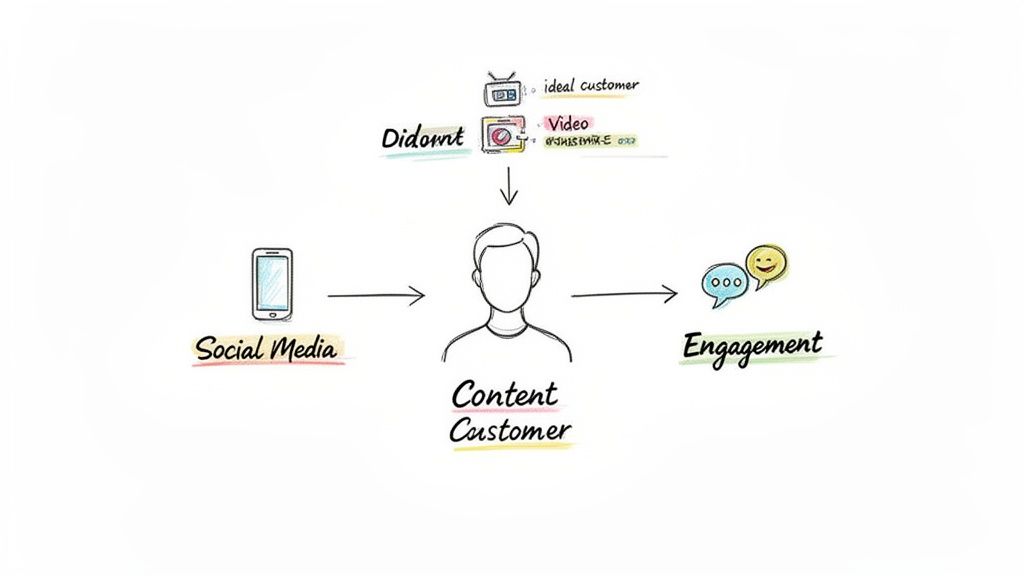
To make sense of it all, I've seen that modern marketing really stands on three core pillars. These are the fundamentals that every small business needs to get right.
To help you visualize this, here’s a quick breakdown of what makes up a simple, yet powerful, marketing plan.
Core Pillars of Your Small Business Marketing Plan
| Marketing Pillar | What It Is | Why It Matters | Quick Win Example |
|---|---|---|---|
| Social Media | The channels where you build community and brand awareness. | This is where you find new customers and create a direct line to your audience. | Pick one platform where your ideal customer hangs out and post consistently three times a week. |
| Content Creation | The value you provide through posts, articles, videos, or images. | It demonstrates your expertise, builds trust, and attracts the right people to you. | Create a short "how-to" video or post answering the #1 question you always get from customers. |
| Direct Engagement | Responding to comments, running a newsletter, or hosting a Q&A. | It turns passive followers into loyal fans who feel seen and heard. | Spend 15 minutes each day responding thoughtfully to every new comment on your posts. |
Instead of trying to be everywhere at once, the smartest move is to pick your battleground. And right now, that battleground is overwhelmingly social.
Find Your Customers Where They Already Are
The data doesn't lie: 96% of small businesses now rely on social media as a key marketing channel. Why? Because these platforms are no longer just for connecting with friends. They're discovery engines, with 58% of consumers finding new businesses right in their feeds.
This means a focused social media presence isn't just a nice-to-have; it's a must for growth. The great news is you don’t have to master every single platform. The real work is figuring out where your audience spends their time so you can direct your energy there.
The most productive marketing strategy is doing fewer things, better. Instead of spreading yourself thin across five platforms, dominate one or two. This focused approach saves time and delivers more meaningful results.
Building a solid foundation is what sets you up for long-term success. If you're looking for a deeper dive, exploring a digital marketing strategy for small business can give you a great framework to build on.
Think of your marketing as a simple, one-page plan. In the sections ahead, we’ll walk through exactly how to build this plan, create content that truly connects, and measure what matters—all while using smart tools and workflows to get more done.
Build Your Foundation With a One-Page Marketing Plan
Let’s be honest. You’re not going to read a 50-page marketing strategy. Those dusty binders are where good intentions go to die.
What you really need is something simple, actionable, and easy to glance at when you're making decisions. Your best marketing tool isn't a complex spreadsheet—it's a single page that brings laser focus to every move you make.
This one-pager is your North Star. It’s what keeps every social media post, email, and ad campaign pulling in the same direction. Going through the process of creating it forces you to answer the three most important questions in marketing: Who are you talking to? What makes you different? And where will you actually find them?
Define Your Ideal Customer With a Persona
Before you write a single post, you have to know who you're talking to. And no, "women aged 25-45" isn't going to cut it. That’s just noise.
You need to get specific by creating a simple customer persona—a fictional character who represents your perfect customer. Give them a name, a job, and most importantly, a problem that you solve. This simple exercise shifts your marketing from yelling into a crowd to having a personal conversation.
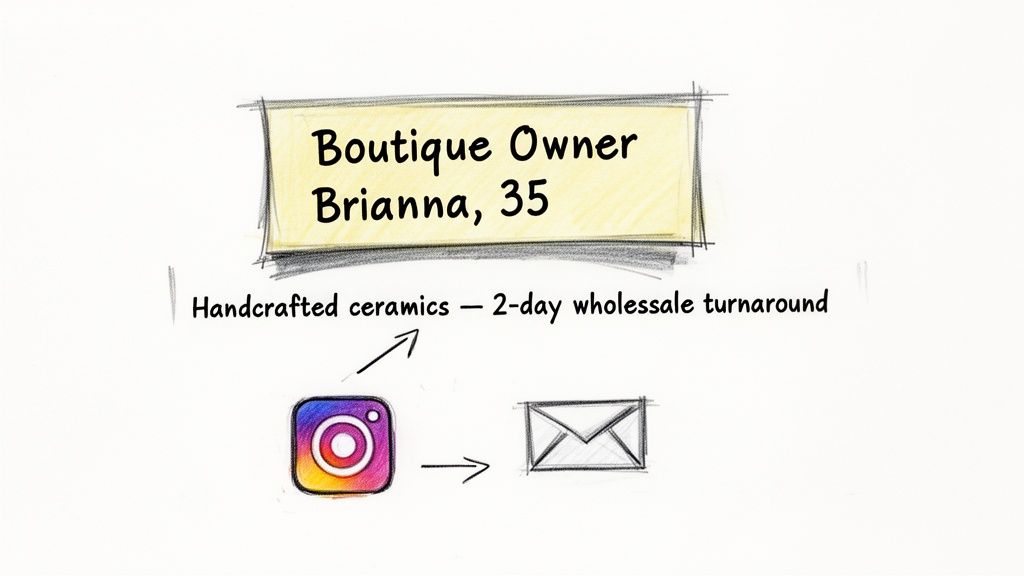
Let's meet "Boutique Owner Brianna"
- Name: Brianna
- Age: 35
- Role: Owner of a small, independent home goods boutique.
- Goals: She’s always hunting for unique, high-quality inventory that sets her shop apart from big-box stores.
- Pain Points: She’s frustrated with the huge wholesale minimums and long lead times from most suppliers. To keep her shelves stocked, she needs products that can ship fast.
See the difference? Now you're not just marketing to a vague group; you’re talking directly to Brianna. This makes it so much easier to figure out what to say and where to say it. If you need a little more help with this crucial first step, our guide on how to find your target audience walks you through the whole process.
Craft Your Unique Selling Proposition
Okay, you know who you’re talking to. Now you need to give them a reason to listen. This is your unique selling proposition (USP)—a short, clear statement that tells your ideal customer why they should choose you and no one else.
It’s not just a clever tagline. It's the very core of your message.
A great USP gets specific and avoids generic claims like "we sell high-quality products." It has to be something you can prove, and it should speak directly to your customer's biggest pain point.
Think of your USP as the answer to this question: "If a customer is comparing you and three competitors, what is the one thing that makes you the obvious choice for them?"
Let's stick with our persona, Brianna. A generic USP would be something like, "We sell handmade ceramics." A powerful USP is so much better.
USP Framework: [What You Do] for [Your Target Customer] with [Your Unique Benefit]
- Weak USP: We sell high-quality ceramics for retailers.
- Strong USP: We provide handcrafted ceramics with a 2-day wholesale turnaround for independent retailers like Brianna.
That strong USP is a game-changer. It instantly solves Brianna’s biggest headache—those long lead times. It’s specific, highlights a massive benefit, and makes your business the clear winner for her.
Choose Your Primary Marketing Channels
The last piece of your one-page plan is deciding where you’ll actually show up. With so many platforms out there, trying to be everywhere is a fast track to burnout. Don't do it.
The secret to actually getting things done is to pick just one or two primary channels where you know your ideal customer is already hanging out. This lets you get really good at one platform and build real momentum instead of spreading yourself thin.
- Selling visual products like our ceramics? Instagram or Pinterest are your best friends.
- Offering B2B services like freelance accounting? You should probably be living on LinkedIn.
- Running a local business, like a neighborhood bakery? A hyper-focused Facebook Page and a local Instagram presence are all you need.
By committing to a one-page plan—built on a sharp persona, a strong USP, and a couple of well-chosen channels—you lay a powerful foundation for everything you do. This simple document will become your most-used tool, guiding you to make smarter, more productive decisions as you grow.
Choosing Your Channels to Reach the Right Audience
Okay, you know who you’re talking to. Now, where do you find them? It’s easy to feel like you need to be everywhere at once, but that's a surefire recipe for burnout. The smart move is to pick one or two platforms where you can actually make an impact, not just show up.
Think of it like setting up a pop-up shop. You wouldn't just drop it in a random neighborhood. You’d go where your customers hang out. The same logic applies online.
Match the Platform to Your Business Model
The right channel for a B2B consultant is totally different from what works for a boutique selling handmade goods. Don't chase trends. Go where your expertise or product feels most at home.
Here are a couple of practical examples:
For B2B Professionals (Accountants, Consultants, Coaches): Your home base is LinkedIn. This is where business decision-makers are actively looking for industry insights. Practical example: A freelance accountant can create a workflow to share a quick tax tip every Tuesday ("Tax Tip Tuesday"), break down new regulations in a short article once a month, and post one client success story every other Friday. It's the perfect way to build authority and attract clients who need your specific knowledge.
For Visual Brands (Bakeries, Artists, Boutiques): Instagram and TikTok are your digital storefronts. These platforms are all about visual storytelling. Practical example: A local bakery can use short videos to show off the morning pastry lineup, go behind the scenes on a new cake design, or run a flash sale on Instagram Stories. It creates an immediate connection and can drive real foot traffic through your door.
This is the power of organic social media, which 73% of businesses were using in 2026 to build authentic connections. For a small operation, that direct line to customers is your secret weapon. The potential reach is massive, with platforms like Facebook having 3.07 billion users and Instagram at 2 billion. By choosing wisely, you tap into that audience without needing a huge budget.
Build Your Owned Audience
Social media is great for getting discovered, but you're essentially on "rented land." You don't control the algorithm, and you don't own your follower list. This is why building an email newsletter is so important. Your email list is an asset you fully control—a direct, reliable way to talk to your most loyal fans.
Think of social media as the party where you meet new people. Your email list is the intimate dinner party you host for your closest friends. Both are important, but the real connection happens in the more personal setting.
Start small. Offer a simple incentive for signing up—a 10% discount, a free checklist, or early access to new products. It’s a simple strategy to turn casual followers into a dedicated community.
A Simple Framework for Choosing Your Channels
Still feeling a bit lost? Use this quick framework to make a decision. Just score each potential platform from 1 (low) to 5 (high) based on these three factors.
| Decision Factor | Question to Ask | Example (for a B2B Consultant) |
|---|---|---|
| Audience Fit | Is my ideal customer actively using this platform for professional or buying decisions? | LinkedIn: 5, TikTok: 1 |
| Content Alignment | Can I easily create content that fits the platform's style and plays to my strengths? | LinkedIn (text posts, articles): 5, Instagram (visuals): 2 |
| Time Investment | Realistically, how much time will it take to create good content and engage here? | LinkedIn (1-2 hours/week): 4, TikTok (heavy video editing): 2 |
After you run through this exercise, the best choice usually becomes pretty clear. Go with the platform that has the highest score. It’s far better to master one channel than to be mediocre on five.
Finally, no matter which channels you focus on, you need to be visible when people are actively searching for what you offer. To make sure your business shows up, take a look at this Ultimate Guide to Small Business SEO. It’s a fantastic resource for getting the fundamentals of search right.
Create Content That Connects and Converts
Now that you have your plan and you know where you’ll be posting, it’s time to actually create the content. This is where your strategy comes to life. Think of it less as "posting" and more as starting conversations, building trust, and showing people the value you offer before they ever think about buying.
A simple rule of thumb that keeps me from getting burnt out is the 80/20 rule. 80% of your content should give pure value—no strings attached. Only 20% should be promotional. It's a balance that helps you build a real community, not just a list of customers.
Provide Value Before You Ask for the Sale
Value-driven content is anything that educates, entertains, or inspires your audience without a direct sales pitch. It's how you prove you're an expert who genuinely wants to help. When you consistently show up with valuable content, your promotional posts feel less like an ad and more like a helpful recommendation from a friend.
This whole process is a loop: define who you’re talking to, pick the right place to talk to them, and create content they’ll actually care about.
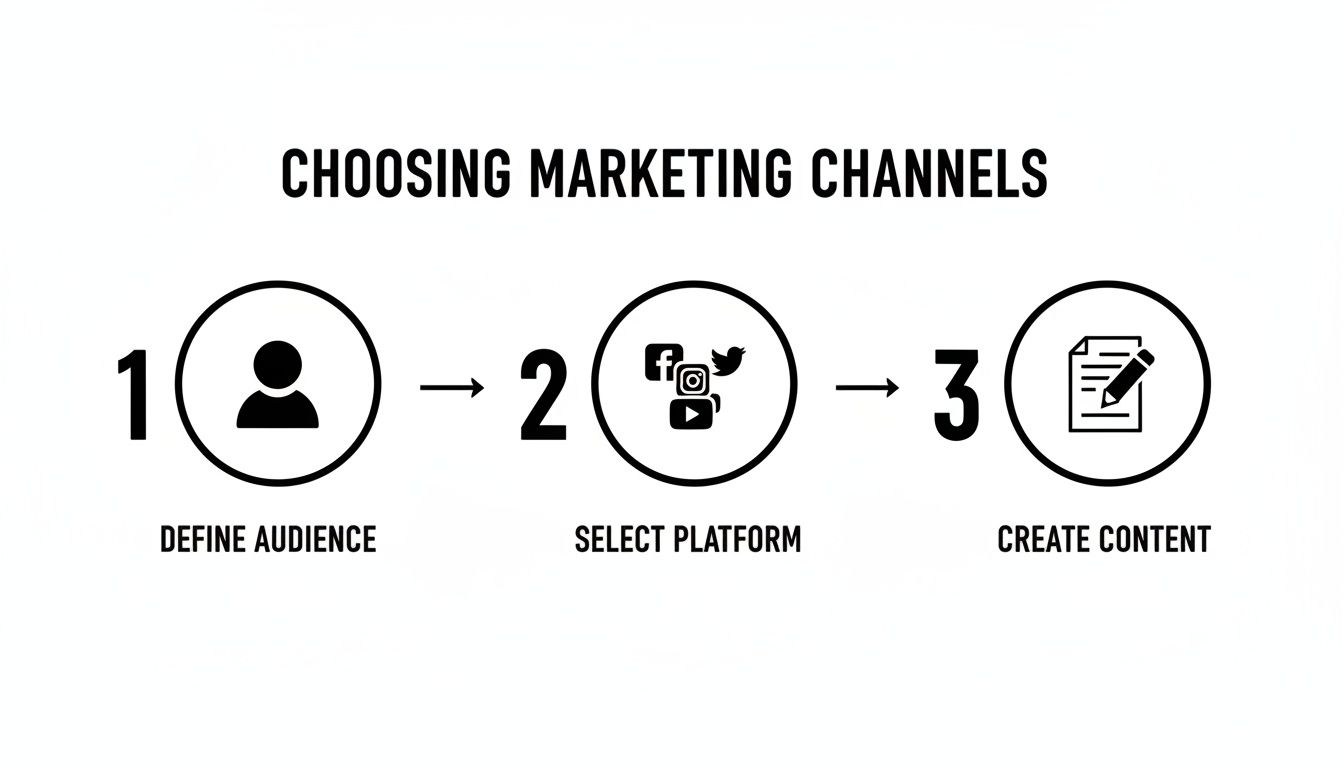
This simple cycle ensures you’re not just shouting into the void. Your content stays sharp, relevant, and focused on the people who matter most to your business.
So what does "value" actually look like in practice? Here are a few practical examples:
- Educational Posts: A home decor brand could post, "3 Ways to Style Our Scarf as Wall Art." It teaches a new skill while subtly featuring a product.
- Behind-the-Scenes Glimpses: Share a quick video of you packing an order, making a product, or just brainstorming ideas. People love feeling like insiders—it makes your brand more human.
- User-Generated Content: Did a customer post a great photo using your product? Share it! It’s powerful social proof, and it makes your community feel seen.
When you do get to that 20% of promotional content, the approach makes all the difference. Instead of a bland "SALE ON NOW!" post, try creating a little urgency. A local bakery could post, "We made a few extra cinnamon rolls this morning! Swing by before 1 PM to claim yours—they’re going fast." It feels exclusive, not pushy.
Embrace the Power of Short-Form Video
Let's be honest: video isn't just an option anymore. It's essential. Short-form video, in particular, is what small businesses are using to get incredible results. Projections show that by 2026, short-form video will deliver the highest ROI of any format at 41%. And when you pair it with influencers, the results get even better—94% of organizations find it can outperform traditional ads by 2-3 times.
My best productivity tip: Don't get hung up on creating a Hollywood-level masterpiece. The most effective videos are often the most authentic. Just use your phone. Record a quick tip, a tour of your workspace, or a customer sharing their thoughts. Done is better than perfect.
Maximize Your Output With a Repurposing Workflow
This is the biggest productivity hack I know. Stop creating content from scratch every single time. Instead, think "create once, distribute many." Take one solid idea and spin it into multiple formats for different platforms.
This approach saves an incredible amount of time and keeps your message consistent. It's the secret to having a strong online presence without chaining yourself to a desk.
Example Workflow: One Customer Story, Three Pieces of Content
Let's say you have an amazing customer success story. Here’s how you can turn that single idea into content for a whole week.
The Core Piece: A Blog Post
- Start by writing a detailed story or case study on your blog. Go deep into the customer's problem, how you helped, and the results they got. This is your "pillar" content.
The Visual Hook: An Instagram Reel or TikTok
- Pull the most powerful quote from the story. Create a short, punchy video with that quote as text on the screen, set to some trending audio.
- Or, make a 30-second video summarizing the story with quick cuts and text. End with a simple call-to-action: "Read the full story on our blog!"
The Professional Summary: A LinkedIn Post
- On LinkedIn, strip the story down to a concise, professional summary. Start with a hook that highlights the key result (e.g., "How our client cut costs by 30% in just 60 days").
- Share the business lesson you learned and tag the customer's company (if it makes sense). Then, link back to the full blog post for anyone who wants to dig deeper.
This kind of workflow is a total game-changer for solopreneurs. If you want to go deeper on structuring your posts, our guide on how to create social media content has more templates and ideas. By building smart systems like this, you can create a marketing engine that truly connects with people and drives your business forward.
Smart Growth Strategies for a Small Budget
When you're running a small business, every marketing dollar has to count. The good news is, you don't need a massive budget to see real growth. It’s not about outspending your competitors; it’s about being smarter and more strategic with the resources you have.
Think of it like planting seeds. These low-cost, high-return strategies build momentum over time. We'll walk through how to build a direct line to your customers with email, get found by locals who are ready to buy, and make a tiny ad budget go further than you’d expect.
Build Your Small but Mighty Email List
I always tell people: social media is for handshakes, but email is for conversations. Your email list is one of the only marketing channels you truly own. It’s a direct connection to people who’ve already said they’re interested in what you do.
The easiest way to get started is by offering a lead magnet—a simple, valuable freebie in exchange for an email. Simple is almost always better here.
- Service Business: A PDF checklist, like "5 Things to Check Before Hiring a Web Designer."
- E-commerce Brand: A classic "10% Off Your First Order" discount code.
- Local Business: A helpful local guide, like "The Best Local Hiking Trails."
Once you have their email, the goal is to build the relationship, not just sell. Share behind-the-scenes stories, offer exclusive tips, or give them early access to new products. With an average return of $36 to $42 for every dollar spent, email marketing remains one of the most powerful tools in your arsenal.
Get Found Locally with Your Google Business Profile
If your business has a physical storefront or serves a specific area, your Google Business Profile (GBP) is your most important free marketing tool. It's the single biggest factor in showing up on Google Maps and in "near me" searches.
Think about it. When someone searches for a "yoga studio near me," Google’s job is to show them the best, most active, and most relevant businesses. A complete profile tells Google you’re a serious contender.
Here’s a simple productivity workflow to get your GBP in great shape:
- Claim and Verify: This is step one. No excuses.
- Fill Out Everything: Don't skip a single field. Add your services, hours, accessibility info, and a good description.
- Add High-Quality Photos Weekly: Post new photos of your space, team, or products. Fresh photos signal to Google that you're an active business.
- Drive Reviews: Ask happy customers for a review. Then, make sure you respond to every single one, good or bad. It shows you're engaged.
- Use Google Posts: Treat this like a mini-blog. Post weekly updates, offers, events, or news.
An optimized Google Business Profile is the digital version of having the best sign on the busiest street in town. You become visible to the people most likely to walk through your door.
Run an Effective Ad on a $5 Daily Budget
Paid ads can feel like a big, expensive leap, but they don't have to be. A small, targeted ad can punch way above its weight, especially if you amplify something that’s already working organically.
Instead of creating an ad from scratch, find a post that your audience already loves and boost it.
Let's take a local yoga studio as an example.
The Scenario: The studio shares an Instagram post about a "New Student Special: 3 Classes for $30." The post gets a bunch of likes and comments organically—a clear sign the offer is hitting the mark.
The Workflow:
- Find a Winner: The studio owner notices the post is doing well. This is the one to boost.
- Set a Tiny Budget: They commit just $5 a day for a week. That’s it.
- Target a Niche Audience: Using Instagram’s ad tools, they target women aged 25-45 who live within a 5-mile radius of the studio and are interested in "yoga" or "wellness."
- Launch the Boost: They simply hit "boost" on the existing post, pushing it out to this new, highly relevant audience.
For just $35, the studio’s offer gets seen by hundreds of potential new students right in their neighborhood, driving direct sign-ups. This is how you market a small business—by being strategic, not by having the biggest budget.
Measure What Matters and Improve Your Results
Posting content without looking at the numbers is like talking to an empty room. You're putting in the work, but you have no idea if anyone is listening or, more importantly, if they care.
Let's cut through the noise of analytics. You don't need to track dozens of metrics. For a small business owner, just a handful of numbers will tell you almost everything you need to know about what's working and what isn't.
Forget vanity metrics like your follower count. Instead, let's zero in on the data that actually points to business growth.
Focus on These Key Metrics
You can find all of these right inside the platforms you’re already using. No fancy dashboard needed.
Engagement Rate: This is the percentage of people who liked, commented, shared, or saved a post. A high engagement rate is a direct signal from your audience: "We love this. Give us more." You'll find this in your Instagram Insights or your social media scheduling tool's analytics.
Website Clicks (or Link Clicks): How many people left the social platform to check out your website, book a call, or buy a product? This number tells you if your social media is successfully driving traffic to where the real business happens.
Direct Inquiries: This one is less about a clean dashboard and more about paying attention. How many DMs, emails, or contact form submissions mentioned a specific post or campaign? This is your clearest sign that a piece of content is directly generating leads.
Turn Your Data Into a Simple Productivity Workflow
Looking at data is one thing; using it to make your life easier is another. The goal here is to build a simple, repeatable process that makes your content better and saves you time.
Once a month, block out 30 minutes. Your only mission is to find your top 3-5 performing posts. That’s it. These are your winners.
Now, what do you do with these winners? You start what I call a "winners folder."
This folder becomes your secret weapon. It’s your own private library of proven content templates. When you find a post that got incredible engagement or drove a ton of clicks, save it.
The next time you feel stuck staring at a blank page, you won't be starting from scratch. You'll open your winners folder and see what's already worked.
Maybe it was a behind-the-scenes video that people loved. Great—that's your format. A post with a vulnerable story that led to a dozen DMs? That's your angle. You already have a proven hook, a familiar structure, and a call to action that gets results.
Tools like Postful can improve this workflow. It includes features that analyze your best content and offers AI-powered tools to help you create more posts based on your proven successes. Pricing: see website for details.
Frequently Asked Questions About Small Business Marketing
When you're running a small business or a side-hustle, marketing questions pop up all the time. Here are the ones we hear most often, with straight-to-the-point answers from our own experience.
How Much Time Should I Spend on Marketing Each Week?
There isn’t a magic number, but I can tell you what works: consistency beats intensity every single time. Forget about those all-day marketing sprints you do once a quarter. They burn you out.
A much better approach is to block out 3-5 focused hours per week. This is a sustainable rhythm that actually gets results over the long haul.
Productivity tip: Batch your content. Use a scheduling tool to create and schedule all your posts for the week (or even the month) in one sitting. For example, dedicate Monday morning from 9 AM to 11 AM solely to marketing. During this block, you can plan your content themes, write captions, create visuals, and schedule everything. Once it's set, you can get back to running your business, knowing your marketing is humming along in the background.
Do I Really Need a Website if I’m on Social Media?
Yes, you absolutely do. Here's why: think of your social media profiles as rented land. You don't own your followers, you don't control the algorithm, and the rules can change without warning. It's a great place to connect with people, but it’s a terrible place to build your entire business.
Your website is your digital home base—the only piece of online real estate you truly own. It’s where you control the experience from start to finish.
Use social media as the engine that drives people to your website. From there, you can capture email addresses, share your best content, and build a business that isn’t at the mercy of another company's platform.
How Do I Handle Negative Comments or Reviews?
First, take a breath. It happens to literally every business, and it's not the end of the world. How you respond is what matters, and a quick, professional response can actually win over new customers who are watching from the sidelines.
Here’s a simple workflow that works:
- Acknowledge their frustration in public. This shows everyone you’re listening.
- Apologize for their bad experience. No excuses, just a simple apology.
- Offer to make it right privately. Ask them to send you a DM or email.
This simple act of showing you care can turn a critic into a fan and demonstrates excellent customer service to everyone else watching.
Should I Pay for Marketing When I’m Just Starting?
Hold off on paid ads until you have some data. Your first step should always be organic (free) marketing. This is your testing ground.
Focus on creating genuinely helpful content and engaging with your community. Pay attention to what people respond to, what gets shared, and what drives clicks.
Once you have a post or an offer that’s clearly a winner organically, that's the moment to put a small budget behind it. Even $5 a day can make a huge difference. By amplifying what’s already proven to work, you guarantee a much better return on every dollar you spend.
With the right plan and simple tools, you can build a marketing engine that works for you, not the other way around. Postful was designed to give you guided templates, AI-powered brainstorming, and dead-simple scheduling, so you can turn your effort into real business growth. Get started with Postful for free and simplify your social media today.