
You publish a post. It gets a few likes, one comment, maybe a share from a loyal customer. Then the platform puts that bright button in front of you: Boost Post.
That button is useful, but it’s also one of the easiest ways to waste money if you use it at the wrong time. Most solopreneurs don’t need more random reach. They need a repeatable way to turn good content into more clicks, leads, bookings, and sales without adding hours to the week.
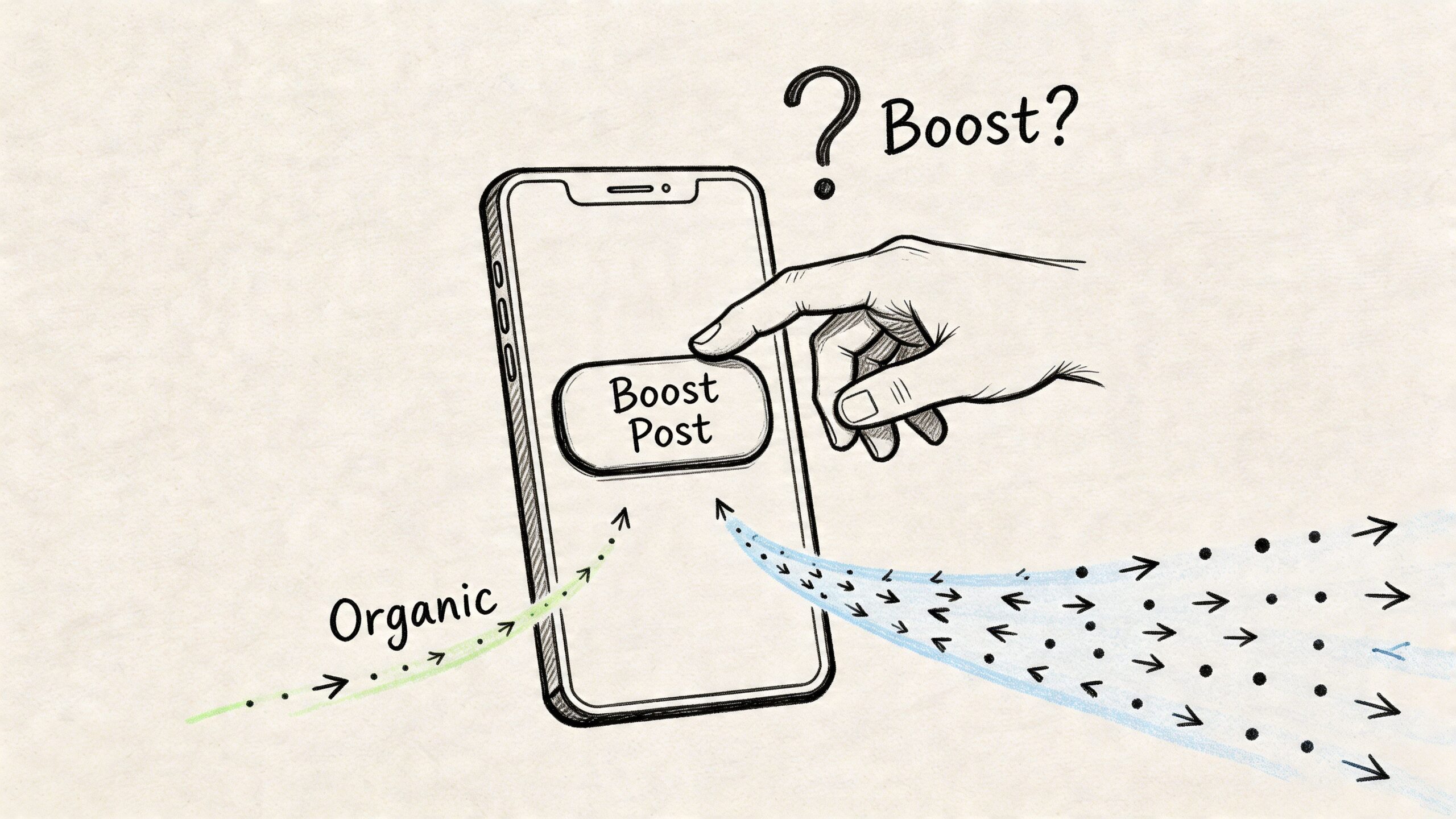
The practical way to boost a post is to treat it like an amplifier, not a rescue plan. Organic content does the testing. Paid promotion scales what already has momentum. That’s the difference between spending and investing.
When to Boost a Post vs Trusting Organic Reach
A familiar small-business mistake looks like this. You post something on Tuesday, check it an hour later, see a few likes, and hit Boost Post because you want the day’s marketing done.
That shortcut gets expensive fast.
Boosting works best as a time-saving filter for solopreneurs. Organic reach does the first round of testing for free. The post either earns attention on its own, or it doesn’t. That approach removes the guesswork and keeps you from spending money on content that was never going to pull its weight.
A post worth boosting usually shows signs of life before you add budget. Look for saves, shares, comments, replies, or clicks that are stronger than your normal baseline. If a post falls flat with the people who already follow you, paying for extra distribution rarely fixes the underlying problem.
Use the 6 to 24 hour test window
For most small accounts, a simple workflow is enough. Publish organically first. Watch the first 6 to 24 hours. If the post is clearly outperforming your usual engagement and driving useful actions, it has earned a closer look for paid support.
This is the practical version of media buying on a small budget. Your audience does the first screening. You spend only on posts that already proved they can hold attention.
I use a quick rule here. If a post gets polite likes and nothing else, leave it alone. If people save it, share it, ask follow-up questions, or click through, that post may deserve budget.
What a good boost candidate looks like
A strong boost candidate usually checks several boxes:
- It beats your baseline: The post is doing better than your recent average, not just getting a handful of vanity likes.
- It drives useful actions: Saves, shares, clicks, replies, and profile visits carry more weight than passive engagement.
- It supports a business goal: There’s a logical next step, such as a product page, booking page, inquiry form, or offer.
- It speaks to one buyer: Broad posts often get weak results because the message is trying to cover everyone.
Here’s a simple example. A local meal prep business posts a short video with three easy work lunches. Followers start saving it and asking whether delivery is available in nearby zip codes. That is a practical boost candidate because the post already connects attention to buying intent.
A generic “Happy Monday” graphic is different. It may be fine for keeping the account active, but it is rarely where a solopreneur should put ad dollars.
Practical rule: Use paid reach to scale relevance, not to justify the time you already spent making the post.
When not to boost a post
Some posts are better left alone, even if you spent an hour making them.
Skip the boost if the post has weak early traction, no clear next step, poor creative, or a message that does not match the action you want. Community conversation posts are a common trap here. They can be good organic content and still be poor paid content.
This is one of the biggest workflow advantages for a solo operator. You do not need to treat every post like an ad candidate. Publish consistently, let organic performance surface the winners, then put a small budget behind the few that show real commercial potential.
For a clearer distinction between paid amplification and sponsorship models, this guide on what a sponsored post is is a useful companion.
Trust organic reach when the post is doing a different job
Some posts are supposed to build trust, familiarity, or conversation. They do that job well without paid support.
Here’s where I’d usually let organic carry the load:
| Post type | Better left organic when |
|---|---|
| Behind-the-scenes content | It builds personality and familiarity |
| Customer replies and community posts | The value is in conversation |
| Trend participation | The shelf life is short |
| Personal founder updates | It strengthens connection with existing followers |
The best use of boosting is selective. Publish organically, keep a simple review window, and promote the posts that already prove they can attract the right attention. That gives solopreneurs a workable system instead of another button to click on impulse.
Preparing Your Post Creative for Maximum Impact
A boosted post has to earn the spend. If the creative is weak, paid reach just gets more people to ignore it.
For a solo business owner, that matters for two reasons. You waste money, and you waste time boosting posts that were never built to convert. The better workflow is simple. Create organic posts with boost potential in mind, publish, watch for early traction, then polish the winners before putting money behind them.
Fix the visual first
Creative usually breaks at the first frame.
A clear short video often outperforms a plain image because it stops the scroll faster, especially in mobile placements. That does not mean you need polished production. A service business can use a talking-head clip with captions. A product business can show the item in use. A consultant can record a screen and explain one mistake clients keep making. Good boosted creative looks clear and useful, not expensive.
Use this quick check before you spend anything:
- Is the first frame clear without sound? People should understand the topic in a second.
- Is the subject obvious? Busy backgrounds, tiny text, and too many visual elements hurt performance fast.
- Does it look native on mobile? Vertical framing usually gives you better odds.
- Is the payoff visible early? Do not make people wait to see the product, result, or lesson.
If you already know you may want more control later, it helps to build the post like a lightweight ad from the start. This practical guide on how to post ads on Facebook for small businesses is a good reference for that mindset.
Rewrite the hook
The opening line decides whether the post gets attention from the right person or dies as background noise.
Weak hooks sound like announcements from the business. Strong hooks name a problem, a result, or a mistake the audience already cares about. That is the difference between a post that gets polite likes and one that earns clicks.
Here are a few cleaner upgrades:
Before: “We’re excited to share our newest service.”
After: “Still losing leads because prospects do not understand what you offer?”
Before: “Here are some marketing tips.”
After: “Three posts I’d test before spending another dollar on ads.”
Before: “Check out our latest collection.”
After: “Customers who start work before 7 a.m. keep buying these first.”
The hook does not need personality for its own sake. It needs relevance.
Match the CTA to the objective
A lot of boosted posts fail because the post asks for one action and the platform is optimized for another. If you want traffic, tell people what they will get after the click. If you want leads, make the offer concrete. If you want sales, remove extra explanation and friction.
A simple match-up looks like this:
- Traffic goal: “Read the full guide” or “See the menu”
- Lead goal: “Book a consult” or “Get the checklist”
- Sales goal: “Shop now” or “Order today”
Longer captions can work well if they carry the reader toward action. Short captions can work too, but only if the visual does enough of the selling. For local businesses, adding location context often helps because it makes the post feel immediately relevant. A bakery should say the neighborhood. A service provider should name the city or service area. A consultant targeting professionals can call out the industry.
On LinkedIn, the same rule applies with a slightly different tone. Clarity beats cleverness, and proof beats hype. If LinkedIn is part of your mix, this guide on how to boost a post on LinkedIn is useful for understanding how the platform handles boosted content.
The practical standard is simple. Before you boost, ask one question: would this post still make sense to a stranger who knows nothing about your business? If the answer is no, fix the creative first.
Boosting on Facebook, Instagram, X, and LinkedIn
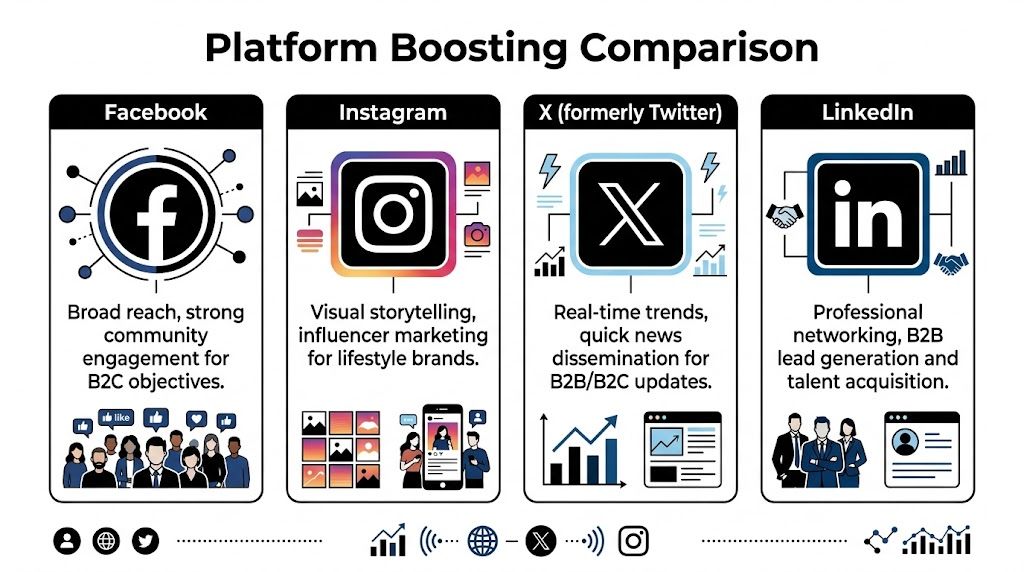
The platform matters as much as the post. A boost that works on Instagram can feel clumsy on LinkedIn. A post that gets traction on X may disappear on Facebook.
The fastest way to choose the right channel is to match platform behavior to your goal.
Facebook and Instagram for broad demand capture
If you’re a local business, creator, coach, ecommerce shop, or service provider with visual content, Meta is usually the first place I’d test. The targeting is familiar, the placements are flexible, and you can move from a simple boost to a more structured campaign when you need more control.
One detail matters more now than it used to. As of early 2025, accounts with Meta’s paid verification receive a 10% to 15% algorithmic boost in organic reach on Facebook and Instagram, according to Hashmeta’s summary of Facebook algorithm changes in 2025. For a small business already getting decent traction, that can improve the baseline before any paid spend starts.
The practical takeaway isn’t “everyone should subscribe.” It’s this: if your Facebook or Instagram presence already reaches people consistently and drives revenue, verification can become part of your amplification stack.
For Meta campaign setup, I prefer Ads Manager over the simplified boost button when the goal is traffic, leads, or sales. You get better control over audience, placements, and optimization. If you want a more detailed starting point, this breakdown of how do you post ads on Facebook is a useful reference.
X for relevance and timing
X works best when your business benefits from live conversation. That includes founders, media brands, consultants, event-driven businesses, SaaS teams, and local brands reacting to news or trends.
I wouldn’t use X as the first paid channel for every small business. I would use it when your audience pays attention to topics, commentary, launches, or industry chatter in real time.
Good boost candidates on X often include:
- Opinion-led posts: A clear take on an industry issue
- Event-tied updates: Product launch commentary, webinar reminders, conference reactions
- Useful threads: Short educational sequences that already earned replies
The creative has to feel native. Formal ad copy usually sticks out. Posts that read like genuine contribution tend to travel further.
LinkedIn for high-intent B2B audiences
LinkedIn is where boosted posts can get expensive fast if your message is broad. It’s also where a precise offer can be worth the spend if one client is valuable.
Service businesses, recruiters, consultants, agencies, and B2B founders do well here when they boost content built around a problem buyers already recognize. Think hiring friction, sales process bottlenecks, compliance headaches, onboarding issues, or revenue leaks.
A practical setup on LinkedIn starts with targeting by role, company type, or industry rather than trying to reach “business owners” in the abstract. If you want a more platform-specific walkthrough, Narrareach has a solid guide on how to boost a post on LinkedIn.
LinkedIn rewards clarity. If the post doesn’t say who it’s for and what problem it solves, don’t put money behind it.
A quick platform decision grid
| Platform | Best fit | Strong post type |
|---|---|---|
| Local services, community-driven B2C, general awareness | Offers, testimonials, educational videos | |
| Lifestyle brands, creators, product businesses | Reels, demos, visual transformations | |
| X | Timely brands, founders, commentary-led businesses | Opinions, threads, event-based posts |
| B2B services, recruiting, consulting | Insight posts, case-style lessons, lead magnets |
If you’re juggling all four, don’t boost everywhere at once. Start where your audience already engages, then adapt the winner for another platform.
Smart Budgeting and ROI Measurement for Solopreneurs
Most small business owners aren’t afraid of spending money on marketing. They’re afraid of spending money and not knowing what came back.
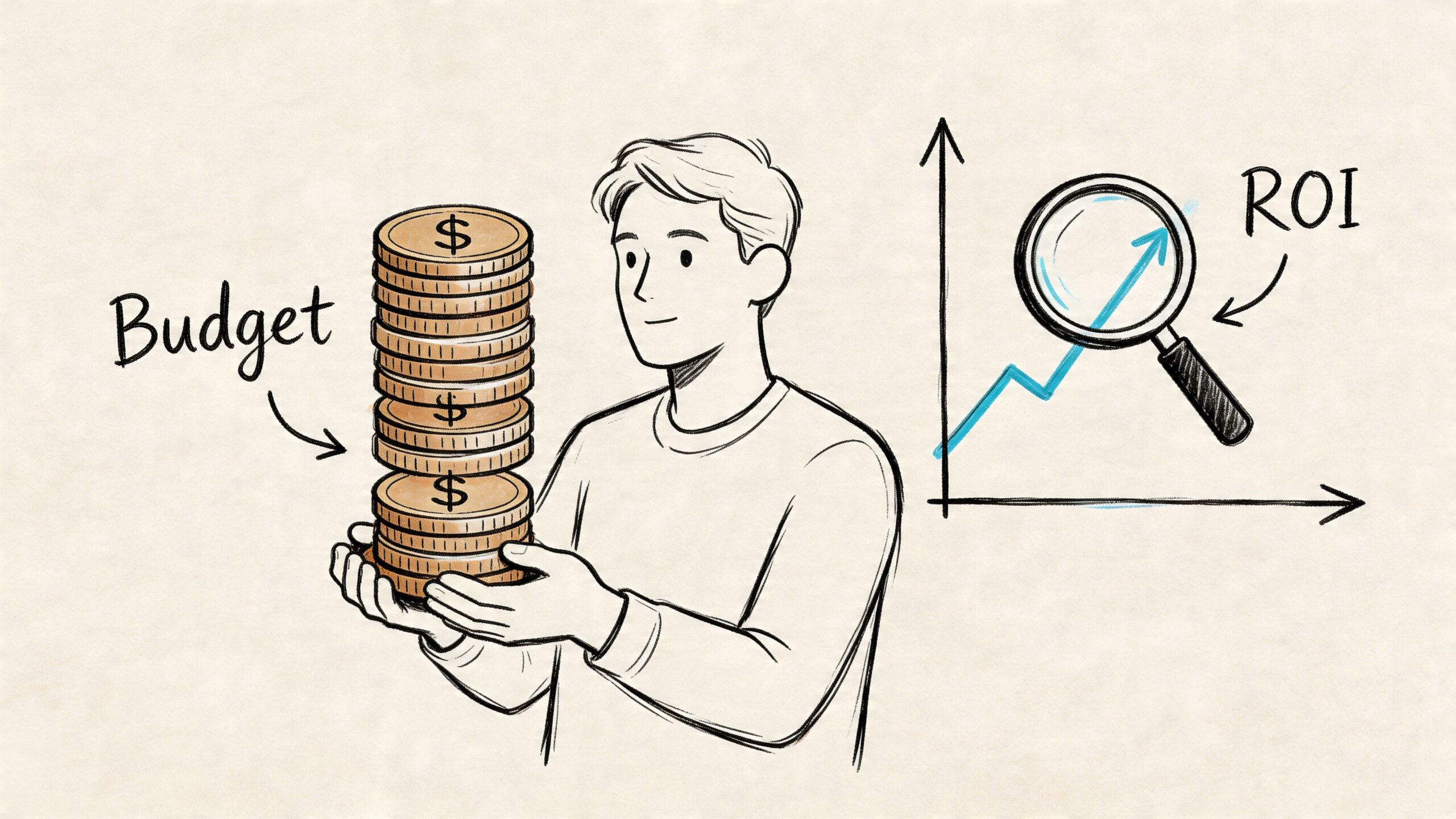
That fear is justified. Evokad’s analysis of boosted posts and social media strategy points out a real problem: many small business owners struggle to measure the true ROI of boosted posts because basic engagement metrics don’t show business impact. It also notes a major knowledge gap around cost-per-lead benchmarks and decision frameworks, which is why so many people feel like their budget disappears without a clear answer.
Stop measuring likes as if they were revenue
A boosted post can get attention and still fail commercially. If your goal is leads, track leads. If your goal is sales, track sales. Likes are context, not outcome.
The simplest measurement framework is this:
Name the action that matters
Email signup, booking request, product purchase, phone call, DM inquiry.Connect the destination
Use a landing page, booking page, product page, or lead form that matches the post.Track the result
Use platform analytics and your site tracking to see what happened after the click.
A practical budget workflow
You don’t need a giant budget to test. You need discipline.
A simple solopreneur workflow looks like this:
- Start with a small test: Put a modest amount behind one proven winner, not several average posts.
- Run one variable at a time: Keep the creative stable while you test audience or placement.
- Scale only after evidence: If the post attracts the right clicks or leads, add budget gradually.
Many people go wrong. They spread spend across too many posts, too many audiences, and too many goals. Then the data becomes useless.
Working rule: If you can’t explain what success looks like before launch, you’re not ready to boost the post.
Here’s a useful explainer if you want to tighten your measurement habits around social campaigns and business outcomes: ROI on social media.
What to track in real life
If you sell directly online, track product page visits, add-to-cart behavior, and purchases. If you run a service business, track form fills, booked calls, and qualified inquiries. If you’re building an audience, track email signups or resource downloads.
A simple note-taking habit helps more than one might expect. For each boost, write down:
- The post used
- The audience targeted
- The offer or CTA
- The destination page
- The business result
Later, patterns start to show. You’ll find that some posts attract cheap clicks but poor leads. Others generate fewer clicks but better customers. That’s the kind of data worth keeping.
If lead quality is your focus, this social media lead generation playbook is a helpful companion resource because it keeps attention on lead flow, not vanity metrics.
A short walkthrough can also help if you’re setting this up for the first time:
A clean ROI formula anyone can use
For solopreneurs, the first question is usually simple: “Did this make me money?”
Use a plain version:
ROI = value generated from the boost minus ad spend
If you boosted a lead magnet and got inquiries, estimate the value based on what those leads usually become. If you boosted a product post, use actual sales tied to the campaign.
Keep it simple. Precision improves over time. The main goal is to stop guessing.
Accelerate Your Workflow with Postful
The main bottleneck usually isn’t the ad platform. It’s the content pipeline.
Most solopreneurs don’t struggle because they can’t click the boost button. They struggle because they don’t post consistently enough to discover winners in the first place. When content creation is sporadic, every paid decision gets harder because there’s nothing to compare against.

Organic testing needs a repeatable system
A major strategic gap for solopreneurs is the lack of guidance on how organic creation and paid boosting should work together. SocialToaster’s discussion of organic reach strategy highlights that tools for content ideation and repurposing can bridge that gap by helping creators test AI-suggested posts organically before putting budget behind top performers.
That’s the right way to think about workflow. Create more quality posts with less effort. Publish them consistently. Watch what gains traction. Then boost the posts that earned it.
A practical weekly workflow
Here’s a realistic operating rhythm for a one-person business:
| Day | Task | Outcome |
|---|---|---|
| Early week | Brainstorm content ideas from customer questions, offers, and FAQs | A short list of post candidates |
| Midweek | Draft and schedule several posts across networks | Consistent organic presence |
| After publishing | Check which posts attract comments, saves, clicks, or replies | Early signals of winners |
| End of cycle | Repurpose the best post for another platform or audience | More mileage from one good idea |
| After that | Boost the post that proved itself | Paid spend goes behind evidence |
That workflow saves time because it prevents reinvention. One strong idea becomes a short video, a carousel, a text post, and a boosted asset.
Why remixing beats constant reinvention
A lot of owners waste energy trying to create something brand new every day. That’s not necessary. If one message works, adapt it.
Examples:
- A consultant’s LinkedIn post becomes a shorter Instagram Reel script.
- A product FAQ post becomes a Facebook demo clip with a stronger CTA.
- A founder story becomes a more direct lead-generation post for a professional audience.
Good boosting starts with good inventory. If you only publish occasionally, you won’t produce enough evidence to know what deserves budget.
This is why content tools matter so much for lean teams. Not because they replace strategy, but because they reduce the friction between idea, post, test, and scale.
Your Smart Boosting Checklist
When you boost a post without a system, every campaign feels like a gamble. When you use the same process each time, boosting becomes a manageable growth tool.
Use this checklist before you spend anything:
Run this check before every boost
- Confirm the post earned attention organically: It should show meaningful traction, not just polite likes.
- Wait for early signals: Give the post enough time to prove itself before paying to expand reach.
- Tighten the creative: Fix the first frame, the opening line, and the CTA before adding budget.
- Match platform to goal: Use the channel that fits the audience and the buying context.
- Choose one objective: Don’t ask one post to do awareness, traffic, leads, and sales at once.
- Send traffic somewhere relevant: The destination page should continue the promise made in the post.
- Track business outcomes: Watch inquiries, signups, bookings, or sales. Don’t stop at engagement.
- Keep notes on what happened: Record the post, audience, offer, and result so the next decision gets easier.
What works and what wastes money
A quick summary from practice:
| Works | Wastes money |
|---|---|
| Boosting proven winners | Boosting weak posts to “help” them |
| Clear CTA and aligned landing page | Generic captions with no next step |
| One audience and one goal | Broad targeting and fuzzy intent |
| Small tests, then scaling | Launching multiple variables at once |
| Repurposing winners across platforms | Creating every boosted post from scratch |
If you stick to that discipline, the boost button stops being tempting and starts being useful.
Postful helps you build the part that most solopreneurs skip: a steady stream of testable content. You can brainstorm ideas, draft posts, schedule across networks, and reuse winners so you have better candidates to boost in the first place. If you want a simpler way to turn your work into more business, take a look at Postful.