

For a startup, social media isn't just a "nice-to-have"—it's a core part of your growth engine. Good social media management means turning platforms like LinkedIn and X into real tools for building a community, getting customer feedback in real-time, and proving your product works. All with a lean, efficient workflow. This guide is your blueprint for making social media a measurable asset, not just another chore.
Why Social Media Is Your Startup's Greatest Lever
A brilliant product with no social presence is like a storefront with no sign on it. People who might love what you're building will just walk right by. For a startup, social media is the ultimate lever, letting you punch way above your weight and compete with established giants on a tiny budget. It’s less about broadcasting ads and more about making genuine connections in a ridiculously crowded market.
This direct line to your audience gives you advantages that old-school marketing just can't touch. You can test new messaging on the fly, get gut-reactions to a new feature, or build a waitlist for your next launch. Every single post, comment, and DM is a data point that can help shape your product roadmap and your entire business strategy.
The Challenge of Staying Consistent
The real problem for founders isn't understanding why they should be on social media, but figuring out how to actually do it. Juggling product development, fundraising, and sales calls doesn't leave much time for thinking up the perfect tweet. The pressure to be "always on" leads straight to burnout, sporadic posting, and a lot of wasted energy.
This is a feeling most small business owners know well. In fact, a staggering 96% of them are already using social media, which shows just how essential it is for survival and growth. You can dig into more social media marketing statistics and their impact on businesses to see the full picture.
This reality means you can't afford to just "do social media." You need a system—an approach focused squarely on efficiency and impact.
"For a startup, social media isn't about being everywhere. It's about being brilliant where it matters most. Focus, consistency, and a smart workflow will always outperform a scattered, high-effort approach."
A Lean Approach to Social Media Management
The fix is a lean, tool-assisted workflow that focuses only on high-impact activities. Forget trying to manage five different platforms at once. Your mission is to pick one or two channels where your ideal customers actually hang out and own that space.
When time and budget are tight, it's all about making smart choices. Here's a quick look at where your energy should go.
Startup Social Media Priorities at a Glance
| Priority Area | Why It Matters for Startups | Example Action |
|---|---|---|
| Channel Focus | Spreading yourself too thin guarantees you'll make zero impact. Dominate one platform first. | Pick the single platform (e.g., LinkedIn) where your ideal customer is most active and go all-in there. |
| Content Batching | Frees up your brain. Avoids the daily scramble of "what should I post today?" | Block 2 hours on a Friday to write and schedule all of next week's posts. |
| Community Engagement | Turns passive followers into true fans and advocates. This is where real relationships are built. | Spend 15 minutes a day replying to every comment and engaging with 5-10 other accounts in your niche. |
| Smart Automation | Lets you maintain a consistent presence without being chained to your desk. | Use a tool like Postful to schedule posts in advance and syndicate content across your chosen channels. |
Focusing on these core areas ensures your social media efforts are an investment, not a time-sink.
This strategy boils down to a few key principles:
- Batch Your Content Creation: Instead of daily panic-posting, set aside one block of time each week to plan, write, and schedule everything. It builds consistency and frees up a ton of mental space for other things.
- Use Smart Tools: Lean on platforms built for productivity. A tool like Postful can help you brainstorm ideas with AI and automate your entire publishing schedule, turning what used to be hours of work into just a few minutes.
- Focus on Community, Not Just Content: Your real goal is to start conversations. Ask questions, reply to every single comment, and jump into discussions with others in your industry. This builds the kind of relationships that a simple follower count can never measure.
Building Your Lean and Agile Social Media Strategy
Forget those 50-page marketing plans that are outdated before the ink dries. As a startup, you need a social media strategy that’s lean, agile, and something you can build this afternoon and start using tomorrow. This isn't about complex theory; it's about a simple, actionable roadmap that gets you real results from day one.
The core idea is focus. Instead of trying to be everywhere at once, your mission is to be incredibly effective in just one or two key places. For a founder juggling a million tasks, this approach is the only way to make a real impact with limited time and resources.
Define Your Core Business Goal
Before you even think about writing a post, you need to answer one question: what business result do you want social media to drive? Vanity metrics like followers and likes are just noise. Your goals have to be specific, measurable, and tied directly to the health of your startup.
So, instead of a fuzzy goal like "increase brand awareness," get concrete.
- Weak Goal: "Grow our followers on X."
- Strong Goal: "Generate 15 qualified demo sign-ups per month from LinkedIn."
- Weak Goal: "Get more engagement."
- Strong Goal: "Drive 50 new email subscribers to our newsletter each week from Instagram."
A clear goal is your North Star. It tells you which platforms matter, what content to create, and how you know if you're actually winning. This clarity transforms social media from a time-suck into a predictable growth engine.
Pinpoint Your Ideal Customer and Platform
Okay, you’ve got a goal. Now, where do your future customers hang out online? Don't fall into the trap of thinking you need to be on every platform. A startup’s most valuable currency is focus. Your job is to find the single platform where your ideal customer is most active and actually listens.
If you’re a B2B SaaS startup trying to reach tech executives, that’s almost certainly LinkedIn. Building a DTC brand for millennial home decor lovers? Pinterest or Instagram is probably your best bet. It’s far better to dominate one channel than to be a faint whisper on five. Once you've picked your spot, you can explore the best social media management tools for startups that help you nail consistency there.
Establish Your Minimum Viable Presence
Consistency will always beat intensity. A Minimum Viable Presence (MVP) is simply a posting schedule you can realistically stick to, week in and week out, even when things get crazy. It’s all about building momentum through reliability.
Your social media MVP isn't about spamming your followers. It's about showing up predictably with valuable content, creating a rhythm your audience can learn to expect and trust.
A simple MVP might look like this:
- LinkedIn: 3 high-value text posts per week (say, Monday, Wednesday, and Friday).
- Instagram: 2 solid feed posts and 4 stories per week.
- X (Twitter): 1-2 insightful threads and 3-4 quick, engagement-focused tweets weekly.
Pick a cadence that feels sustainable, not stressful. This approach builds a foundation of trust and keeps your brand on people's radar without burning you out. It's the smart way to handle your social media management for startups workflow.
Craft Your Core Message
Finally, what’s your voice? What do you want to be known for? Your core message should be simple, clear, and feel like your startup’s personality. Are you the helpful expert, the bold disruptor, or the friendly guide?
A strong social presence is built on great content, and this often connects to a broader strategy. For a deeper dive into building that foundation, this content marketing startup guide is a fantastic resource. Getting this right is critical, especially when you consider that CMOs plan to allocate just 16% of their marketing budgets to social media—that small slice has to work incredibly hard. And with US businesses set to spend $88.3 billion on social ads, every single post from a bootstrapped founder needs to count.
Your Step-by-Step Content Creation Workflow
A solid strategy is your map, but your content workflow is the engine that actually moves you forward. For a founder juggling a million things, this process can’t be a chaotic, last-minute scramble. It needs to be a repeatable system that turns raw ideas into a week of solid posts without eating up all your time.
The secret to sustainable social media isn't about working harder; it's about working smarter. The real goal is to escape that daily panic of "what on earth do I post today?" and replace it with a calm, organized process that actually builds momentum. This is exactly where content batching comes in.
The Power of Content Batching
Content batching is simple: you create all your social media content for a set period—say, a week—in one dedicated session. Instead of trying to force creativity on demand every single day, you block out a 2-hour window, get into the zone, and knock it all out at once.
This approach has some huge benefits for founders:
- It saves a ton of time. Constantly switching between tasks is a productivity killer. Batching keeps you focused on one thing—creating content—making you way faster and more efficient.
- It actually improves your content quality. When you aren't rushing, you can think more strategically about your messaging. Your posts end up feeling more cohesive and connected to your goals.
- It guarantees you stay consistent. Life gets busy. Batching ensures your social media presence doesn't just go dark because you had a week full of investor meetings or a critical product bug to fix.
A consistent presence builds trust way faster than sporadic, high-effort posts. Your audience learns to expect value from you, and that's the foundation of a real community.
Your 2-Hour Weekly Content Workflow
Ready to see how this works in practice? Here’s a lean, step-by-step workflow you can use to crank out an entire week's worth of content in a single 2-hour block.
Step 1: Idea Generation (30 Minutes)
First things first: brainstorm a pool of ideas. Don't censor yourself; just get concepts down on paper (or a doc). Think about common questions your customers ask, behind-the-scenes moments from your startup journey, or a valuable tip you learned this week.
To speed this up, a tool like Postful is a game-changer. Instead of staring at a blank page, you can use its AI to generate dozens of post ideas tailored to your niche. This turns a tough creative task into a simple selection process. You can learn more about this in our guide to AI for social media content creation.
Step 2: Repurpose Your Pillar Content (30 Minutes)
Most startups are sitting on a goldmine of content they don't even realize they have. A single blog post, a customer case study, or one YouTube video can be "unpacked" into a whole slew of social media posts. This is the ultimate productivity hack.
For example, a 1,000-word blog post can become:
- Three LinkedIn posts sharing key takeaways from different sections.
- A five-tweet thread summarizing the main arguments.
- An Instagram carousel visualizing the core concepts with simple graphics.
- Two short text posts asking your audience questions related to the topic.
This simple process of visualizing your goals, selecting a platform, and building a schedule is the foundation of a successful strategy.
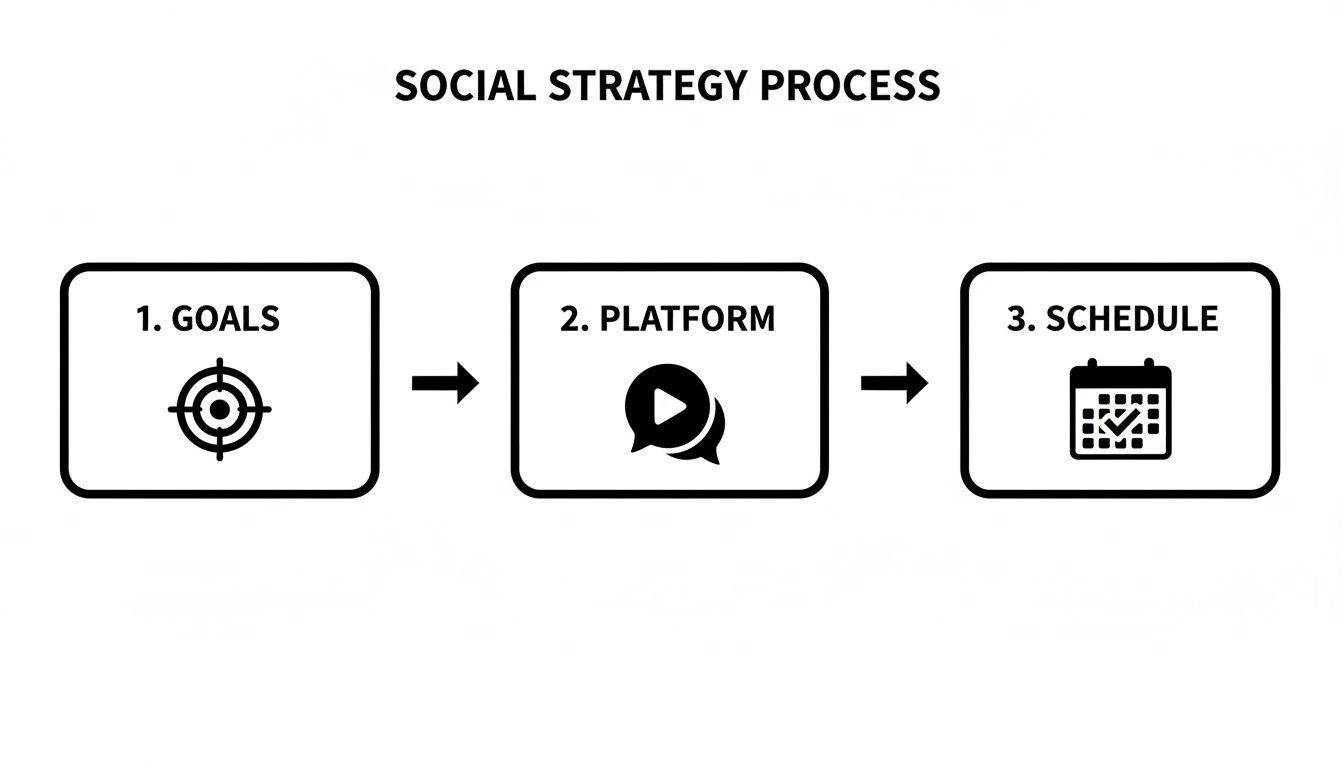
This flow ensures every piece of content you create serves a specific, strategic purpose.
Step 3: Write and Refine Your Posts (45 Minutes)
Now it's time to actually write the posts. Working from your list of ideas and repurposed content, draft everything out. Focus on clear, concise language that gives your audience immediate value.
This is where you can really hone your message. If a draft feels flat, use an AI brainstorming partner to suggest different angles or rephrase it for more impact. The key is to get all the writing done in this single block so you don't have to think about it again for the rest of the week.
Step 4: Schedule Everything (15 Minutes)
The final step is the easiest part. Once your posts are written, load them into your scheduling tool. Platforms like Postful let you schedule everything with just a few clicks, automatically publishing your content at the best times for engagement.
This final step is what truly frees you up. You've front-loaded the work, and now you can get back to building your business, confident that your social media is running smoothly in the background. It's about taking back your time and making your content work for you, not the other way around.
Content Frameworks That Actually Build a Community
Knowing you need to post is one thing. Knowing what to post is the real game. Staring at a blank content calendar is enough to give any founder a headache, but a few proven frameworks can turn that empty space into a powerful community-building machine.
These aren't just random ideas. They're strategic pillars that give your audience a reason to follow, engage, and ultimately, trust what you're building. The goal isn’t to just blast your product into an echo chamber; it’s about creating a genuine group of fans and advocates who are invested in your journey.
Let's break down three high-impact frameworks perfect for any startup trying to make a real connection.
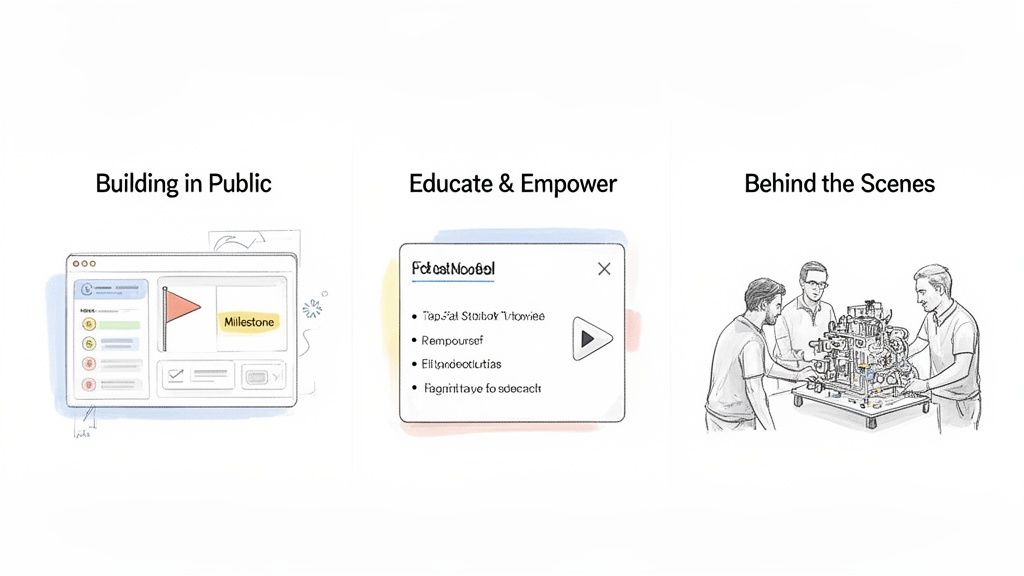
Build in Public for Radical Transparency
The Build in Public framework is exactly what it sounds like: pulling back the curtain and sharing your startup’s journey—the wins, the gut-wrenching losses, and all the messy stuff in between. This approach humanizes your brand and makes your audience feel like they're part of the story, not just customers on a mailing list. That transparency builds an insane amount of trust and loyalty.
This is especially powerful for founders on platforms like LinkedIn, which is a goldmine for building your personal brand. The platform just crossed 1 billion global members, and 85% of B2B marketers say it’s their top channel for ROI. Sharing your journey there connects you with potential customers, investors, and your next key hire. You can dig into more social media marketing statistics and how they affect business to see the full picture.
How to do it:
- Share Milestones: Post a screenshot of your Stripe dashboard when you hit your first $1,000 in monthly recurring revenue (MRR). People love to cheer for the underdog.
- Talk About Failures: Write about a feature launch that totally flopped and what you learned from it. This kind of vulnerability is magnetic.
- Ask for Feedback: Before you build, share a rough wireframe of a new feature and ask your followers for their unfiltered thoughts.
Educate and Empower to Build Authority
The Educate and Empower framework shifts your role from a product vendor to a helpful expert. The idea is simple: give away valuable information that helps your audience solve a problem, learn something new, or just do their job a little better. When you consistently offer value for free, you become the go-to resource in your niche.
This isn’t about giving away the secret sauce. It’s about sharing knowledge that proves you know what you're talking about and builds incredible goodwill along the way.
People don't buy what you do; they buy why you do it. The 'Educate and Empower' framework shows your audience that you genuinely care about their success, which is far more powerful than any sales pitch.
How to do it:
- Quick Tutorials: Record a short screen-share video showing how to solve a common pain point your product addresses.
- Actionable Tips: Write a simple text post on LinkedIn like, "5 common mistakes people make when [doing X] and how to fix them."
- Industry Insights: Share your take on a recent industry trend and what it actually means for your audience.
Go Behind the Scenes to Humanize Your Brand
Finally, the Behind the Scenes framework is about showing the people and the process that make your startup tick. It reminds your audience that there are real, passionate humans behind the logo, not just an automated marketing machine. This type of content is fantastic for building an emotional connection and making your brand far more memorable.
It tears down the corporate wall and invites people into your world.
A Sample Weekly Content Calendar
The key is to balance these frameworks so your feed feels well-rounded. Here’s a simple weekly calendar that mixes value-driven content with the occasional promotional post.
| Day | Framework | Post Example |
|---|---|---|
| Monday | Educate and Empower | A text post sharing a quick industry tip or a common mistake to avoid. |
| Tuesday | Behind the Scenes | A photo of the team (even if it's just you!) working on a new feature. |
| Wednesday | Build in Public | A short update on a key metric you're tracking, like user sign-ups or website traffic. |
| Thursday | Promotional Post | A post highlighting a specific product feature and the benefit it provides. |
| Friday | Educate and Empower | A link to a helpful article or resource (even if it's not yours) that your audience would find valuable. |
This simple cadence ensures you’re consistently adding value while still making space to talk about your product. It’s a sustainable approach to social media management for startups that turns followers into a true community.
Measuring What Matters: Your Startup's Social Media KPIs
Let's be honest. Your follower count might feel good, but it doesn't pay the bills. The single biggest trap for startups on social media is chasing vanity metrics. These are the flashy numbers—likes, new followers—that look great on a report but don’t actually tell you if your business is growing.
Real growth comes from measuring what actually matters.
Instead of getting lost in the noise, you need to zero in on a few Key Performance Indicators (KPIs) that connect your social media activity directly to your startup's bottom line. These are the numbers that prove your efforts are working, turning social media from a shot in the dark into a predictable growth engine.
The KPIs That Actually Drive Growth
Forget tracking a dozen different stats. For a lean startup, you only need to obsess over a few metrics that show your content is driving real action. Think of these KPIs as your true north—they should guide every single content decision you make.
Here are the essentials:
- Click-Through Rate (CTR): This is the percentage of people who saw your post and actually clicked the link. A high CTR means your message was compelling enough to pull someone off a noisy social feed and onto your website—the very first step toward a sale.
- Conversion Rate: This tracks what happens after the click. How many of those visitors signed up for your newsletter, requested a demo, or started a free trial? This is the ultimate test of whether your social media is generating legitimate leads.
- Engagement on Product-Related Posts: Don't just track overall engagement. Pay close attention to the likes, comments, and shares on posts that specifically talk about your product, its features, or a problem it solves. This tells you if your core message is landing.
A high follower count with zero conversions is just a crowd of window shoppers. A smaller, engaged audience that clicks, signs up, and buys is a community that will build your business.
Your 30-Minute Monthly Report
You don’t need fancy, expensive analytics software to get started. Every social platform has free, built-in analytics that give you all the data you need. The goal is to create a simple report each month—something you can knock out in 30 minutes—that cuts through the fluff and gives you a clear path forward.
Here’s a quick workflow:
- Pull the Key Data (10 minutes): Log into your platform’s native analytics (like LinkedIn Analytics or Meta Business Suite) and grab the numbers for your top-performing posts from the last 30 days. Focus on the posts with the highest CTR and engagement.
- Find the Patterns (15 minutes): Look at the posts that drove the most clicks and sign-ups. What do they have in common? Was it the topic? The format (text vs. video)? The call-to-action you used?
- Define Your Next Move (5 minutes): Based on what you found, decide what to do next month. If posts about a specific customer pain point had a killer CTR, your action is simple: create more content around that pain point.
This quick, data-backed check-in helps you double down on what works and, just as importantly, stop wasting time on what doesn't. To go a bit deeper on this, you can learn more about how to measure your social media ROI in our detailed guide.
Common Social Media Pitfalls That Sink Startups
Knowing what to do on social media is only half the battle. The other half—the one that really separates the winners from the losers—is knowing what not to do. Countless well-intentioned founders burn through their most valuable resources (time and energy) on tactics that go absolutely nowhere.
Let's walk through the most common traps. Spotting them early is the first step to building a social media presence that actually works.
The "Be Everywhere" Trap
One of the biggest mistakes I see is trying to be everywhere at once. A startup trying to post on five different platforms usually ends up making a weak impression on all of them. It's far better to dominate a single channel where your ideal customers hang out than to spread yourself thin. A practical example is a B2B SaaS startup focusing solely on LinkedIn for six months, building authority there before even considering another platform like X.
The Corporate Jargon Trap
Another killer is using stiff, corporate language that sounds like it was written by a committee of lawyers. Nobody wants to follow a brand that speaks in buzzwords and polished marketing-speak. They want to connect with the real people behind the logo. This is a conversation, not a press release.
The goal of social media is to build relationships at scale. Stiff corporate jargon creates distance, while authentic, human language builds a bridge directly to your audience.
So, how do you fix it? Simple: write like you talk. Share the journey, admit when things are tough, and drop the corporate mask. This kind of transparency is what turns a passive follower into a true advocate for what you're building.
Ghosting Your Community
Ignoring comments, questions, and DMs is the digital equivalent of hanging up on a customer who called your office. It's a terrible look. Every single interaction is a chance to build a relationship, get feedback, or solve a problem for someone. When you don't engage, you're sending a loud and clear message: "We're not listening."
Make engagement a non-negotiable. A productive workflow for this is to block out 15 minutes every single day, perhaps with your morning coffee, just to reply to comments and messages. It's a small habit, but it shows your audience you value them, which is everything when you're building a community from scratch.
The Curse of Inconsistency
Posting in chaotic bursts—a flurry of activity one week, then radio silence the next—is the fastest way to kill your momentum. Algorithms hate it, and your audience will quickly tune you out. Consistency signals that you're reliable and keeps your brand top-of-mind.
The fix here is the content batching workflow we covered earlier. Set aside a single two-hour block each week to plan, create, and schedule everything. This guarantees a steady stream of content, no matter how crazy your schedule gets, and turns your social media from a chore into a dependable asset.
A Few Common Questions About Startup Social Media
Trying to figure out social media as a founder can feel a lot like building the plane while it's in the air. I get it. Below are some clear, no-nonsense answers to the questions I hear most often, designed to help you make better decisions and get some precious time back.
How Much Time Should a Solo Founder Realistically Spend on Social Media Each Week?
If you’re a solo founder, aim for 3-5 hours per week. The only way to make that happen is with an efficient workflow.
The key is content batching. Set aside a dedicated block of time—maybe two hours on a Sunday afternoon—to write and plan out everything for the week ahead. This completely eliminates that daily "what do I post?" scramble.
Once everything's written, use a scheduling tool to get it all in the queue. From there, you can time-box your daily engagement (replying to comments and messages) to just 15-20 minutes. This approach keeps you consistent without letting social media swallow your entire schedule.
Which Social Media Platform is Best for a B2B SaaS Startup?
For nearly every B2B SaaS startup, LinkedIn is your top priority. It's the one place where your potential customers, future investors, and next key hires are all hanging out and actively consuming professional content.
Your focus should be on sharing real industry insights, building your personal brand as an expert, and posting valuable case studies. X (formerly Twitter) is usually a strong second choice for jumping into real-time industry conversations. Don't feel like you have to be on Instagram or TikTok unless your product is incredibly visual or you know for a fact your specific audience lives there.
The goal isn't to be everywhere. It's to be incredibly effective where it matters most. For B2B, that almost always starts with LinkedIn.
What's a Simple Way to Create Visuals Without a Designer?
You absolutely do not need a designer on payroll to create visuals that look great. Modern tools have made this part easier than ever.
- Lean on Template-Based Tools: Platforms like Canva have thousands of professional, easy-to-customize templates. You can crank out a week's worth of on-brand graphics in less than an hour just by sticking to your company's colors and fonts.
- Just Be Authentic: Sometimes, the best visuals are the most human. Don't underestimate the power of behind-the-scenes photos and short videos shot on your phone. A simple screen recording of your product in action can be incredibly effective, too.
For an early-stage startup, the goal is clarity and authenticity, not Hollywood-level production. A consistent look and feel is what makes your visuals feel cohesive and professional, and that's what builds brand recognition over time.
Ready to stop guessing and start growing your social media presence with a smarter workflow? Postful gives you the AI-powered tools to brainstorm ideas, create content, and automate your schedule in minutes. Start building your audience for free on Postful.