
You check your phone before starting work. Instagram comments look promising. A DM raises a concern. A review sounds positive at first, then slips in a complaint you did not expect. By the time you finish scrolling, you have plenty of reactions and very little clarity.
Sentiment analysis social media helps you sort that noise into something useful.
For a solopreneur, it works like a quick way to read the room. Instead of guessing based on the last few comments you saw, you start spotting patterns across posts, replies, reviews, and messages. You can tell whether people feel excited, annoyed, confused, or skeptical, and that changes what you post next, what you fix first, and what you stop saying.
That matters because small businesses rarely need a complicated enterprise dashboard. They need a low-effort habit that fits between client work, fulfillment, and content creation. If people keep praising one feature, you can turn that into your next post. If the same frustration keeps showing up in comments, you can address it before it grows. If you want more ideas for posts that reflect what your audience already responds to, this guide on increase social media engagement pairs well with that approach.
Speed is the key advantage. You are not collecting feedback just to admire a chart. You are using everyday signals to make better marketing decisions and turn audience language into content. That gets even easier when you start with better customer research questions that lead to clearer insights and use a simple publishing workflow with a tool like Postful to turn what people are already saying into posts you can publish without a lot of extra work.
Understanding What Your Customers Really Think Online
You post about a new offer before breakfast. By lunch, you have a few likes, one enthusiastic comment, two quiet DMs with questions, and a review from last week still sitting in the back of your mind. Nothing looks dramatic on its own. The hard part is figuring out what all of it means together.
That is the primary challenge for a solopreneur.
You are already reading feedback all the time, but manual reading works like checking the weather by looking out one window. You might catch the sunshine and miss the storm rolling in from the other side. Social feedback is scattered across comments, replies, reviews, tags, and messages, so small patterns are easy to miss until they start affecting sales.
A simple example makes this clearer. Say you run a home bakery. Instagram comments say your seasonal box looks beautiful. DMs ask whether pickup can happen earlier. A Google review praises the taste but says ordering felt slow. Each message is small. Together, they point to one useful conclusion. Customers love the product, but convenience is shaping how they judge the full experience.
That kind of pattern matters because it gives you direction. You can keep highlighting the presentation people already love. You can fix the ordering friction before it turns into more negative reviews. You can turn the pickup question into a quick post, story, or FAQ so fewer people have to ask.
For a small business, sentiment becomes practical in this scenario. You are not building a giant reporting system. You are creating a low-effort habit for spotting repeated emotions, then using those signals to make better content and business decisions.
A good starting point is to ask better questions while you review comments and messages. Instead of asking, “What did people say?” ask, “What felt exciting, frustrating, confusing, or reassuring here?” If you want help building that habit, this guide to better customer research questions that lead to clearer insights is a useful place to start.
It also helps to connect feedback with content right away. If people keep reacting warmly to behind-the-scenes posts, make more of them. If they sound hesitant about pricing, explain the value more clearly. If engagement feels flat, this guide on how to increase social media engagement can help you turn audience signals into stronger posts.
As noted earlier, interest in sentiment tools is growing fast. That matters less as a trend and more as a reminder that small businesses now have access to simpler options. You do not need an enterprise team to benefit. You need a repeatable way to notice what your audience feels and a tool like Postful to turn those insights into posts while the topic is still fresh.
What Is Social Media Sentiment Analysis?
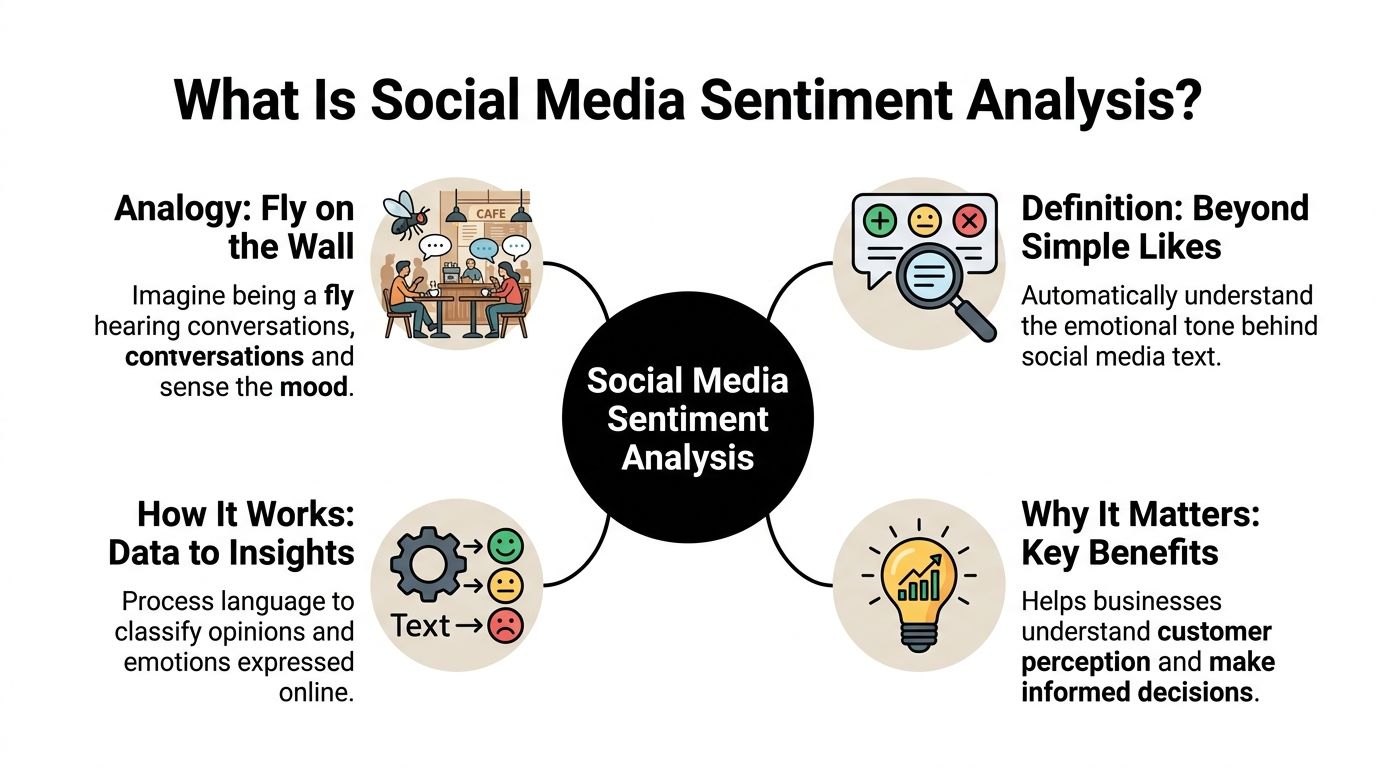
Social media sentiment analysis is like being a fly on the wall in a busy cafe where every table is talking about your business. You can’t join every conversation, but you can still pick up the mood. Some people are delighted. Some are annoyed. Some are just making neutral observations.
That’s the basic job of social media sentiment analysis.
The basic idea
Sentiment analysis looks at written reactions on platforms like Instagram, TikTok, X, Facebook, LinkedIn, and review sites, then classifies the emotional tone behind them.
At the simplest level, tools usually sort posts into three buckets:
| Sentiment type | What it means | Simple example |
|---|---|---|
| Positive | The person likes, approves, or feels good | “Loved this. Ordering again.” |
| Negative | The person is unhappy, disappointed, or upset | “Customer support never got back to me.” |
| Neutral | The person is stating something without strong emotion | “They launched a new version today.” |
That sounds straightforward. Sometimes it is.
If someone writes, “This was amazing,” the tone is clear. If someone writes, “This took forever and I’m annoyed,” that’s also clear.
Where people get confused is when language becomes messy.
It’s not just counting nice and nasty words
A basic tool might see the word “great” and assume the comment is positive. But humans know better than that.
Take this sentence: “Great, my order is late again.”
The word looks positive. The meaning is negative.
That’s why modern sentiment analysis social media tools try to understand context, not just word lists. They look at how words work together, what tone they suggest, and whether the writer sounds sincere, sarcastic, frustrated, or enthusiastic.
Beyond positive and negative
For a solopreneur, three buckets are helpful, but they’re often not enough.
You don’t just want to know that a launch got “positive” reactions. You want to know whether people felt:
- Joy
- Trust
- Confusion
- Surprise
- Frustration
- Anger
Those differences matter because they point to different actions.
A positive reaction driven by trust suggests you should publish more proof, testimonials, and behind-the-scenes content. A positive reaction driven by surprise might suggest your audience responds well to unexpected tips, product reveals, or before-and-after style posts.
The useful question isn’t only “Was this received well?” It’s “What emotion did it create, and what should I do with that?”
What it looks like in daily business
Here’s a practical example.
You post a short video about a new service package.
The visible metrics tell you one thing:
- likes
- comments
- shares
- saves
Sentiment tells you something different:
- Are people excited?
- Are they confused by the offer?
- Do they trust the promise?
- Are they comparing it to a competitor?
- Are they asking for details because they’re interested, or because your message was unclear?
That’s why sentiment analysis is more than monitoring mentions. It helps you interpret reaction quality, not just reaction volume.
For a busy owner, that changes how you plan content. You stop guessing why a post worked and start reading the emotional pattern behind the response.
Why Tracking Sentiment Is a Game-Changer for Small Businesses
A small business doesn’t need more raw feedback. It needs clearer feedback.
Most owners already have comments, reviews, replies, and DMs. The challenge is deciding what deserves action. Sentiment analysis helps by highlighting which reactions carry urgency, loyalty, hesitation, or momentum.
It helps you hear the truth behind polite language
Customers rarely write like researchers. They write like tired people on their phones.
A message like “Looks nice, but not sure it’s for me” isn’t just mild feedback. It may signal pricing friction, unclear positioning, or a mismatch between your message and your audience’s needs.
That matters because solopreneurs often overreact to loud opinions and underreact to repeated low-key signals.
Here’s what sentiment tracking can reveal faster:
- Product friction when the same complaint keeps popping up in different wording
- Offer confusion when neutral comments are really requests for clarity
- Brand strengths when positive reactions cluster around one feature or promise
It improves customer service without adding a full support team
If you only look at volume, one angry comment can feel bigger than it is. If you look at sentiment patterns, you can prioritize better.
A local fitness coach, for example, might notice that comments about class quality are warm, while comments about booking are tense. That tells the coach where to fix the experience first.
A simple weekly review can help you separate:
| What you see | What it may mean | Likely action |
|---|---|---|
| Repeated praise for responsiveness | Trust is growing | Create content that highlights your service style |
| Neutral questions about pricing | Interest exists, clarity is missing | Post an explainer or FAQ |
| Sharp reactions after a policy change | Frustration is building | Respond publicly and clarify the reason |
It helps you spot issues before they spread
This is one of the most overlooked uses.
Research shows that sentiment analysis in social media during emergencies helps first responders assess crowd reactions and identify people in need. Small businesses can adapt that same thinking for crisis management.
If a local shop gets hit with a viral complaint, it doesn’t need enterprise dashboards to benefit from the idea. It needs a quick way to sort the reaction:
- Which comments are upset
- Which are defending the business
- Which are just asking what happened
That gives the owner situational awareness. Instead of responding emotionally to the loudest comment, they can respond to the overall mood and decide what kind of damage-control content is needed.
When sentiment turns negative quickly, your first job isn’t to post more. It’s to understand what people are actually reacting to.
It makes competitor research more useful
Looking at competitor comments is one of the easiest ways to find content ideas.
If people keep praising a competitor’s fast turnaround, that’s not just praise for them. It’s a clue about what buyers care about in your category. If customers complain about confusing instructions or slow replies, that also gives you positioning opportunities.
For a handmade product seller, competitor sentiment might show that customers love custom options but hate long fulfillment uncertainty. That tells you exactly what to emphasize in your own content.
It shows whether your campaigns create the feeling you wanted
A campaign can get attention and still miss emotionally.
Say you run a promo post and comments flood in. If the tone is curious but skeptical, you need clearer proof. If the tone is warm and enthusiastic, you may want to extend the campaign theme into follow-up posts, testimonials, or a behind-the-scenes series.
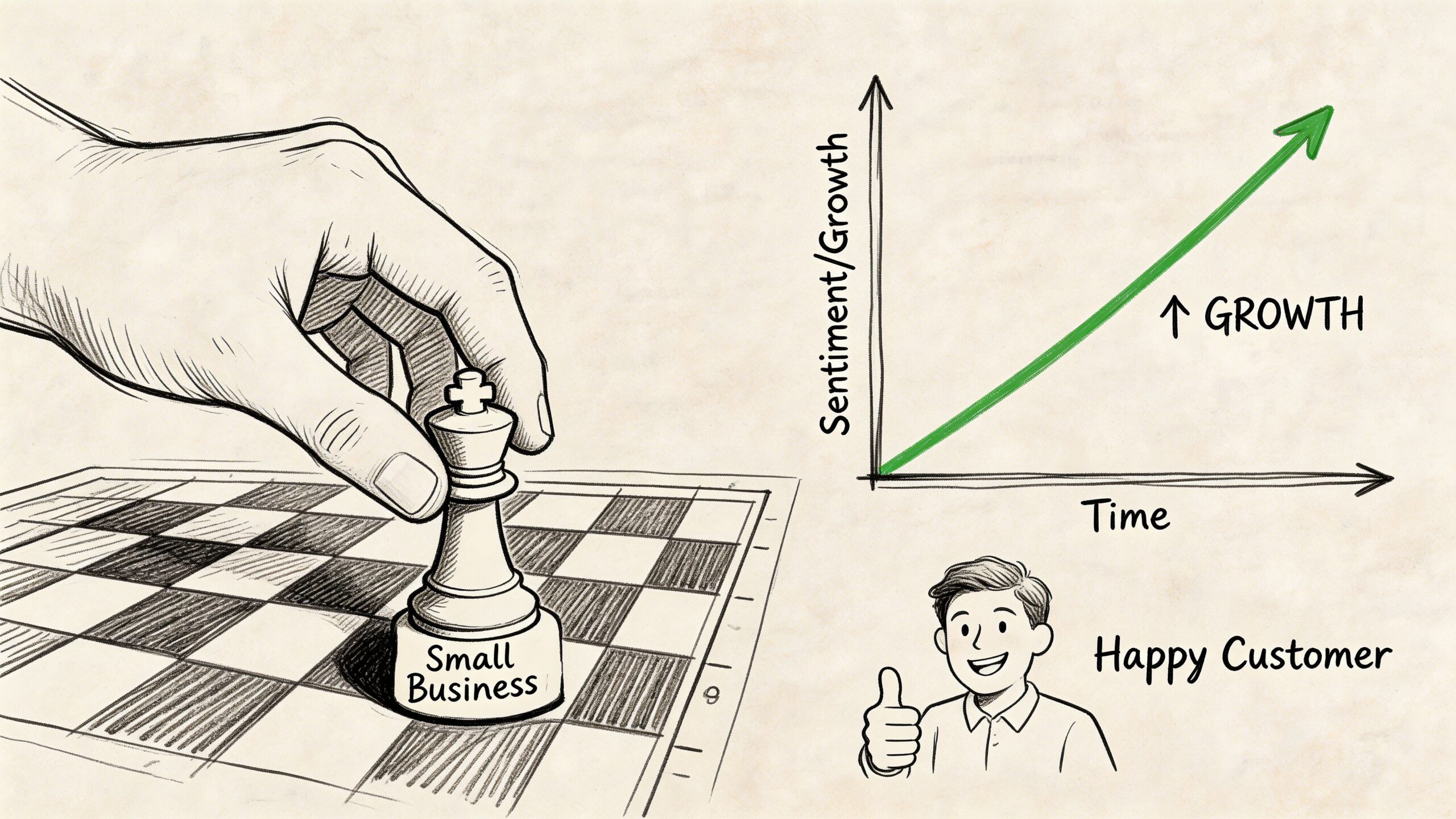
That’s why sentiment analysis social media is a growth tool, not just a monitoring tool. It helps you make sharper decisions about content, service, offers, and reputation.
How Sentiment Analysis Works and What to Measure
You don’t need to build an AI model to use sentiment analysis well. You only need enough understanding to read the output and know what to do next.
Three common ways tools analyze sentiment
Most tools use one of three broad approaches.
Rule-based systems
This is the simplest version.
A rule-based system works like a dictionary of approved and disapproved language. It looks for words commonly associated with positive or negative feeling and applies rules around them.
That can work for obvious phrases. It struggles when language gets casual, sarcastic, or context-heavy.
Machine learning systems
This approach is more like a student that learns from examples.
Instead of relying only on a preset list of words, it learns patterns from large amounts of language. That helps it understand that the same word can mean different things in different settings.
Hybrid and LLM-based systems
In this area, many modern tools have become more helpful for small businesses.
According to Thematic’s overview of advanced social media sentiment analysis, advanced sentiment analysis uses Large Language Models trained on billions of interactions. The same source says this approach is better at handling context and sarcasm, which matters because 70% of purchase decisions are emotion-driven.
For a small business owner, the takeaway is simple. Newer tools are better at reading nuanced feedback than older systems that only counted positive and negative words.
What happens before a tool gives you a score
Behind the scenes, the software usually cleans and prepares the text first.
That often includes:
- Removing clutter such as URLs, tags, or characters that don’t help interpretation
- Converting informal signals like emojis or slang into something readable
- Breaking text into pieces so the model can evaluate phrases instead of one giant block
- Normalizing language so different forms of the same word still connect
You don’t need to manage that process yourself. But knowing it exists explains why one tool may understand “love this 😍” or “yeah, great job messing this up” better than another.
The metrics that matter most
Sentiment reports can get noisy fast. For a solopreneur, a small set of metrics is usually enough.
Net sentiment
This is your overall balance of positive versus negative reaction.
Think of it as a mood snapshot. It won’t tell you the whole story, but it can help you see whether brand perception is generally moving in a healthy direction.
Mention volume by sentiment
This shows how many reactions fall into each category.
A rise in positive mentions can be encouraging. A rise in negative mentions can be urgent. A large neutral category often means people are aware of you but not emotionally engaged yet.
Sentiment trend over time
This is often more useful than a single-day snapshot.
If negative reactions rise after a product change, price change, or campaign message, you’ve learned something specific. If positive sentiment grows after customer stories or tutorial posts, that’s also a useful signal.
Keep this in mind: A single angry comment is an event. A repeated pattern is an insight.
Topic-level sentiment
At this point, reports become actionable.
Instead of “people feel mixed about the brand,” topic-level sentiment tells you whether people feel one way about your shipping, another way about your customer service, and another about your product quality.
If you want a practical frame for combining sentiment with reporting basics, this guide on https://blog.postful.ai/social-media-metrics/ pairs well with a hands-on social listening tools comparison when you’re deciding what to track.
Your Practical Workflow to Get Started with Sentiment Analysis
The easiest mistake is making this too big.
You don’t need a full listening program, a team dashboard, and a giant taxonomy of brand terms. You need a repeatable workflow that fits into a busy week and produces decisions you can use in content, service, or offers.
Start with one business question
Don’t begin with “track everything.”
Begin with a narrow question like:
- How are people reacting to my new service
- What do customers feel after they buy
- Which content topics create the warmest response
- What complaints show up most often
A narrow starting point keeps you from drowning in data.
For example, if you run a local photography business, your first question might be: “How do people react when I post family mini-session offers?” That’s focused enough to analyze comments, DMs, and story replies without overcomplicating the project.
Choose an easy tool, not the most advanced one
If you’re a solopreneur, usability matters more than feature depth.
A few accessible options include:
- Brand24 for monitoring brand mentions across the web. Pricing: see website for details.
- Mention for keeping an eye on conversations and alerts across social channels. Pricing: see website for details.
- Sprinklr for more advanced enterprise-grade sentiment and customer experience analysis. Pricing: see website for details.
You don’t need to commit forever. You’re looking for a tool that helps you do three things well:
| Need | What to look for |
|---|---|
| Capture feedback | Pull comments, mentions, or reviews into one place |
| Sort reaction quality | Label reactions by sentiment or emotion |
| Make review easy | Let you filter by topic, platform, or time period |
Gather a small, useful dataset
Pull in the places where your audience already talks.
For most small businesses, that’s likely some mix of:
- Instagram comments and DMs
- TikTok comments
- Google reviews
- Facebook comments
- Product or service reviews
- Tagged mentions
Don’t force every platform into the workflow. If your audience mainly lives on Instagram and Google reviews, start there.
Review sentiment in batches
Daily checking can make you reactive. Weekly review is usually better.
A practical rhythm looks like this:
- Collect one week of reactions
- Filter by positive, negative, and neutral
- Tag recurring topics
- Write down what appears more than once
- Decide on one action
That action might be:
- making a clarifying post
- replying publicly to a concern
- creating more content around a praised feature
- updating your offer page language
Look for emotion, not just polarity
In these situations, modern tools become more valuable.
According to Sprinklr’s explanation of social media sentiment analysis, enterprise-grade tools can detect over 40 nuanced emotions with 85-95% accuracy. The same source gives an example where a campaign evoked 65% enthusiasm, which correlated with a 25% boost in shares.
You may not need that level of reporting every week. But the lesson matters. “Positive” isn’t specific enough if you want better content.
Positive reactions can mean:
- relief
- trust
- excitement
- surprise
- gratitude
Each one suggests a different next post.
If customers sound relieved, make content that reduces anxiety.
If they sound excited, post momentum-building follow-ups.
If they sound trusting, lean into proof and social validation.
Turn sentiment into content immediately
This is the step most guides skip.
Insights have no value if they stay in a spreadsheet or dashboard. Your workflow should end with content action.
Here’s a low-effort system that works well:
When sentiment is strongly positive
Create posts that amplify what people already love.
Examples:
- A skincare seller notices warm reactions to “simple routine” language. They create three posts around quick routines, common mistakes, and beginner-friendly tips.
- A consultant sees praise around responsiveness. They publish a post about their client communication process and a short FAQ.
When sentiment is mixed
Clarify before you promote harder.
Examples:
- A service package gets attention, but comments show confusion about what’s included.
- Instead of reposting the same promo, create a carousel explaining deliverables, timeline, and who it’s best for.
When sentiment is negative
Respond and reduce uncertainty.
Examples:
- Several comments mention shipping confusion.
- Publish a brief update, pin a clarification, and adjust future captions so the issue doesn’t keep repeating.
Your next piece of content should answer the strongest emotion in the feedback, not just repeat your marketing message.
Keep the workflow small enough to repeat
If you need an hour every day, you probably won’t stick with it.
A more realistic workflow for a solo operator is:
- Once a week review sentiment patterns
- Once a week note top praise, top confusion, and top complaint
- Once a week create one piece of content from each insight type if needed
That gives you a practical loop:
listen, sort, decide, post.
Done consistently, sentiment analysis social media becomes less about analytics and more about productive marketing judgment.
Common Mistakes to Avoid and Best Practices to Follow
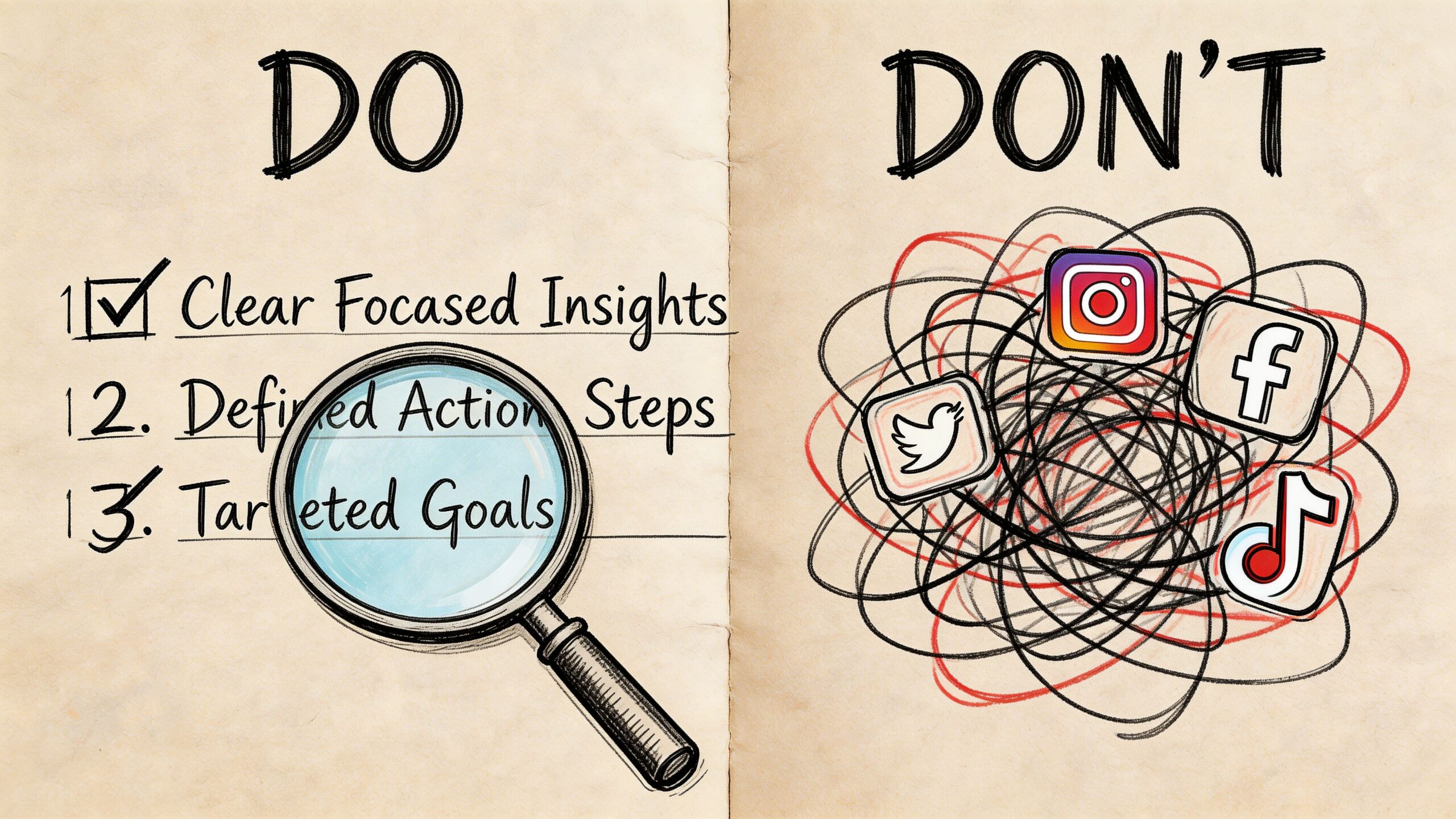
Most problems with sentiment analysis don’t come from the concept. They come from using it too broadly, too superficially, or without context.
Mistakes that waste time
Some errors are common because they sound sensible at first.
- Tracking without a goal. If you don’t know what question you’re trying to answer, every chart feels interesting and none of it feels useful.
- Interpreting sentiment too strictly. Sarcasm, jokes, and mixed comments can fool simple tools.
- Watching only your brand name. People often discuss your product category, your offer type, or the problem you solve without tagging you.
- Reacting to one dramatic comment. A single post can be loud and still not represent the wider pattern.
- Treating all platforms the same. The tone on Instagram may differ from the tone on X, Reddit, or review sites.
Better habits for small teams of one
A good sentiment workflow is light, consistent, and tied to action.
Start with unlabeled, messy feedback
One useful shift for solopreneurs is moving beyond the idea that you need perfectly tagged training data.
According to this 2025 study on unsupervised multi-emotion sentiment analysis, an emerging best practice is using unsupervised methods that can cluster nuanced emotions like fear or joy from unlabeled social data. The study also describes a browser-extension-style approach for showing real-time emotion breakdowns.
That matters because small businesses usually don’t have the time or expertise to label data manually.
Compare trends, not snapshots
A single day can mislead you.
It’s more useful to ask:
- Are complaints becoming more frequent?
- Is trust increasing after a change in messaging?
- Did reactions shift after a launch, promo, or announcement?
Segment before you decide
Split feedback by source, campaign, or topic before you take action.
A practical segmentation method looks like this:
| Segment by | Why it helps |
|---|---|
| Platform | Audience mood and behavior vary by channel |
| Topic | You may have positive brand sentiment but negative shipping sentiment |
| Time period | Changes often reveal what caused the reaction |
| Offer or campaign | Lets you tie emotion back to a specific message |
Don’t ask sentiment data to answer a broad business question. Ask it to explain one reaction in one context.
Pair sentiment with real business signals
Sentiment alone can point you in the right direction. It gets stronger when you compare it with outcomes like inquiries, repeat purchases, replies, or conversions.
For example:
- Warm reactions plus more inquiries suggest message-market fit is improving.
- High attention plus confused comments suggest the offer caught interest but needs clearer explanation.
- Positive praise around one topic can guide future post themes.
A simple best-practice checklist
Keep this short and repeatable:
- Choose one listening goal per month
- Review sentiment weekly, not constantly
- Tag recurring topics by hand if needed
- Check context before acting
- Turn every clear pattern into one business action
That last part matters most. Good sentiment analysis doesn’t end with a report. It ends with a response, a revised offer, a better caption, or a clearer campaign.
Turning Social Media Chatter into Business Growth
If you’ve ever felt buried in comments, reviews, and mixed reactions, sentiment analysis gives you a cleaner way to listen.
It helps you see the difference between noise and pattern. It helps you tell whether customers feel trust, confusion, excitement, or frustration. And it helps you turn those signals into better content and better decisions.
For a solopreneur, that is the key advantage. You don’t need a giant dashboard. You need a practical habit.
Use a simple workflow. Review reactions in batches. Look for repeated emotional signals. Then turn what you learn into your next post, your next service update, or your next customer response.
If you want to make the work more accountable, pair sentiment insights with a clear measurement habit. This guide on https://blog.postful.ai/how-to-measure-social-media-roi/ is a helpful next step for connecting audience reaction to business results.
The businesses that get the most from sentiment analysis social media aren’t the ones with the most data. They’re the ones that listen well, respond quickly, and turn audience feeling into useful action.
Postful helps you turn customer feedback, business ideas, and content themes into posts you can publish. If you want a simpler way to brainstorm, schedule, remix, and syndicate content across networks, try Postful. It’s built for solopreneurs and small business operators who want to turn their work into more business.