
For small business owners, founders, and side-hustlers, social media often feels like a full-time job you didn't sign up for. The pressure to post consistently, brainstorm fresh ideas, and engage a growing audience can quickly lead to burnout, leaving you staring at a blank content calendar. The cycle of creating, posting, and analyzing feels endless, often with uncertain returns on your most valuable asset: your time.
This guide is designed to break that cycle. It’s more than just a list; it’s a strategic toolkit of 10 proven social media ideas for small businesses, complete with actionable workflows, practical examples, and ready-to-use prompts. We will move beyond generic advice and show you how to build a sustainable content engine that saves you time, genuinely connects with your audience, and drives measurable results for your brand.
Here, you'll find everything you need to transform your approach from reactive to strategic. We'll cover how to create compelling behind-the-scenes content, leverage user-generated campaigns, build educational micro-series, and master short-form video. Each idea is structured to be implemented immediately, helping you work smarter, not harder. Forget the content treadmill and the endless scroll for inspiration. Let's build a system that works for you, turning your social media presence into a powerful, efficient growth tool.
1. Behind-the-Scenes (BTS) Content
Behind-the-scenes (BTS) content is one of the most powerful social media ideas for small businesses because it peels back the professional curtain. Instead of just showcasing a polished final product, you reveal the process, the people, and the passion that bring your business to life. This authentic approach humanizes your brand, building trust and a genuine connection with your audience. People buy from people, and BTS content shows them who they're supporting.
It’s about sharing the unpolished journey, from unboxing new inventory and sketching product designs to celebrating a team member's birthday or even troubleshooting a problem. This transparency makes your brand relatable and memorable in a sea of perfectly curated feeds.

Why It Works for Small Businesses
For a small business, authenticity isn't just a buzzword; it's a competitive advantage. Unlike large corporations, you can create a direct, personal link with your customers. BTS content forges this bond by showcasing the real work and dedication that goes into every product or service.
It answers questions your customers might not even know they have: Who makes this? What does their workspace look like? What challenges do they overcome? This storytelling builds an emotional investment that transforms one-time buyers into loyal brand advocates.
How to Implement BTS Content
Integrating BTS content doesn't require a big budget or professional equipment. In fact, a raw, phone-shot video often feels more genuine.
- Batch Your Content: Dedicate a specific block of time each week, perhaps an hour on Friday, to capture BTS photos and videos. Film yourself packing orders, brainstorming new ideas, or setting up for an event. Example: A candlemaker could film the entire process of pouring a new scent, then edit that footage into five different short videos to use over the next month.
- Feature Your Team (Even if it's just you): Introduce the people behind the brand. A simple video of your barista perfecting their latte art or your designer choosing fabric samples adds a human touch. Example: A "Meet the Maker Monday" series where you answer a fun question each week.
- Showcase the "Before and After": This works for almost any industry. Show the messy desk before a big project, the raw ingredients before they become a delicious meal, or the initial sketch next to the final product. Example: A web designer can show a screenshot of an old website next to the new, sleek design they created.
- Share Setbacks and Solutions: Don't just post wins. Talk about a shipping delay and how you solved it, or a product design that failed and what you learned. Vulnerability builds immense trust. Example: Post a Story saying, "Our new packaging was delayed! Here's how we're making it right for everyone who ordered."
Pro-Tip: Use a content scheduler like Postful to easily plan and repurpose your BTS footage. A single 10-minute video of you making a product can be edited into a Reel, a series of Stories, a static post with a quote, and even a GIF. This "content atomization" workflow maximizes your productivity.
2. User-Generated Content (UGC) Campaigns
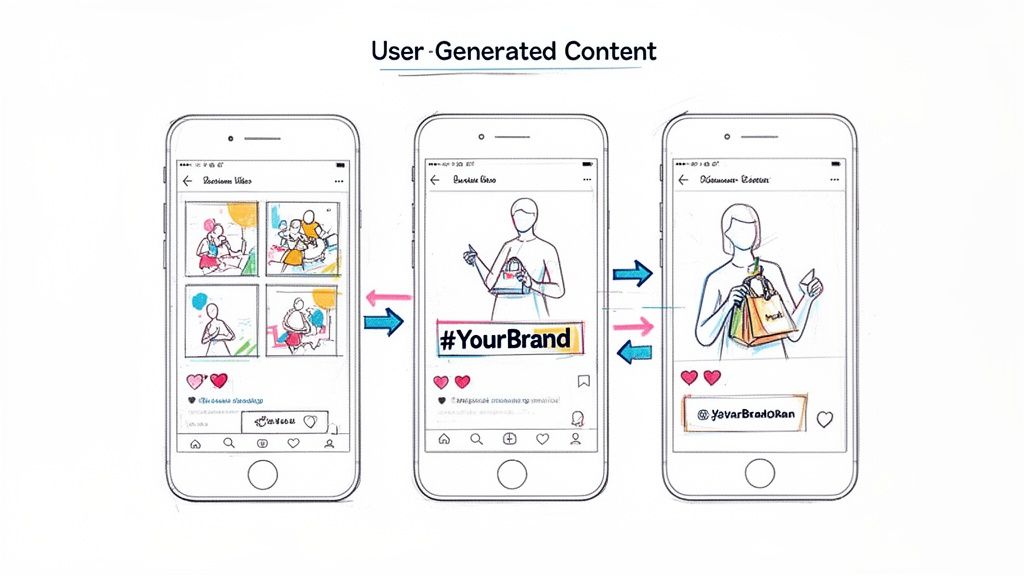
User-generated content (UGC) is a powerful strategy where you encourage your customers to create and share posts featuring your products or services. By reposting this content on your own channels, you transform happy customers into your most authentic marketers. This approach provides a steady stream of genuine social proof, reduces your content creation workload, and taps into your community's creativity.
Instead of you telling people your product is great, your customers show them. From a customer unboxing their order to a client sharing their results after using your service, UGC builds a powerful, trust-based narrative around your brand.
Why It Works for Small Businesses
UGC is one of the most effective social media ideas for small businesses because it levels the playing field. You don’t need a big marketing budget when your own customers become your brand advocates. This content is seen as more trustworthy and influential than traditional advertising because it comes from real, relatable people.
For small businesses, leveraging UGC builds a vibrant community and fosters a sense of belonging. When you feature a customer's post, you're not just getting a free piece of content; you're acknowledging their loyalty and making them feel valued, which strengthens their connection to your brand.
How to Implement UGC Campaigns
Launching a successful UGC campaign is about making it easy and rewarding for your audience to participate. The key is to create a clear call to action and a simple submission process.
- Create a Branded Hashtag: Develop a unique and memorable hashtag for your campaign, like Starbucks' #RedCupContest. Promote it in your bio, on your packaging, and in your email signatures. Example: A pet bakery could use #MyHappyPupBakery.
- Offer Incentives: Motivate participation by offering rewards. This could be a discount on a future purchase, a feature on your social media feed, or entry into a giveaway for a free product. Example: "Share a photo with our product and tag us for 15% off your next order!"
- Ask for Permission and Give Credit: Always ask for permission before reposting a customer's content. When you do, be sure to tag their account in the photo and caption to give them full credit. A simple DM like, "We love this photo! May we share it on our feed and tag you?" works perfectly.
- Provide Clear Instructions: Tell your audience exactly what you're looking for. For example, "Show us how you style our new scarf! Tag us and use #MyScarfStyle for a chance to be featured." This clarity increases the quality and quantity of submissions.
Pro-Tip: Use a social listening tool (many scheduling platforms have them built-in) to automatically track your branded hashtag and mentions. This creates a curated folder of potential UGC, saving you from manually searching for content. Schedule a recurring "Feature Friday" post in Postful to make sharing UGC a consistent part of your strategy.
3. Educational Content & Micro-Learning Series
Educational content positions your brand as a helpful authority in your niche by teaching your audience something valuable. Instead of a hard sell, you offer solutions, tips, and insights related to their problems. This strategy, often delivered as a micro-learning series, breaks down complex topics into bite-sized, digestible pieces like quick tutorials, carousels, or short videos, building trust and keeping followers engaged.
This approach transforms your social media from a simple product catalog into a valuable resource. By consistently providing "aha!" moments, you build an audience that not only trusts your expertise but also sees your product or service as the logical solution to the problems you help them solve.

Why It Works for Small Businesses
Small businesses can’t always compete on price, but they can win on expertise and trust. Sharing your knowledge for free demonstrates generosity and confidence, establishing you as the go-to expert. When a follower has a question about your industry, they'll think of you first.
This strategy nurtures leads over time. A follower who learns from your "5 Ways to Style a Bookshelf" carousel is more likely to buy a decorative vase from you later. You're not just selling; you're educating and empowering, which creates a much deeper, more loyal customer relationship than a simple transaction.
How to Implement Educational Content
Creating a library of valuable content is easier than it sounds. Focus on the most common questions you receive from customers.
- Start with Customer Problems: Brainstorm the top 10 questions your customers ask. Each question can become a post. Example: A coffee shop could create a post on "How to Choose the Right Coffee Bean," covering acidity, roast, and origin.
- Create a Content Series: Break a large topic into smaller parts. For instance, a financial advisor could run a "Wealth-Building Wednesdays" series, with Part 1 on budgeting, Part 2 on saving, and so on. This encourages followers to return each week. Workflow: Plan the entire series in a simple document, then schedule all the posts at once.
- Use Visual Formats: Don't just write a caption. Create a simple infographic using a tool like Canva, a step-by-step carousel with images, or a quick screen-recorded tutorial with Loom. Visuals make complex information easy to understand and share.
- Add a Clear Call-to-Action (CTA): End your educational post by telling your audience what to do next. This could be asking a question ("What's your biggest budgeting challenge?"), linking to a full blog post, or suggesting they check out a related product.
Pro-Tip: Use a tool like Postful to create branded templates for your educational posts. This ensures a consistent look and feel for your series, making it instantly recognizable as your followers scroll their feeds. You can also schedule your entire series in advance to stay consistent.
4. Carousel Posts & Multi-Slide Content
Carousel posts are multi-slide formats that bundle several images or videos into a single, swipeable post. This is a top-tier social media idea for small businesses because it encourages active engagement. Instead of passively scrolling past a single image, users are prompted to swipe, significantly increasing the time they spend interacting with your content.
This extended dwell time signals to platform algorithms that your content is valuable, often resulting in greater reach. Carousels are perfect for telling a story, breaking down complex information, or showcasing a product from multiple angles. They transform a simple post into an interactive, educational, or narrative experience.
Why It Works for Small Businesses
Small businesses can use carousels to provide immense value in a compact format, establishing themselves as an authority without needing a long-form blog post. You can teach, inspire, and sell all within one post. This format allows you to go deeper than a single image, offering room for detailed tips, step-by-step guides, or customer testimonials.
For example, a bakery can share a carousel detailing the "5 Steps to the Perfect Sourdough," or a financial advisor can create a slide deck on "3 Common Tax Mistakes to Avoid." This approach positions your brand as a helpful resource, building trust and keeping your audience coming back for more expert insights.
How to Implement Carousel Posts
Creating effective carousels is about storytelling and strategic design. Each slide should logically lead to the next, keeping the user engaged until the very end.
- Create a Powerful First Slide: Your first slide is the hook. Use a bold title, an intriguing question, or a stunning image to grab attention and make people want to swipe. Example: "Your plants are dying? Here’s why."
- Tell a Cohesive Story: Ensure your slides flow together. Use consistent branding (colors, fonts) and a clear narrative. A great format is: Hook > Problem > Solution/Tips > Call-to-Action. Example: A fitness coach could post a carousel titled "3 Myths About Weight Loss," with each myth on a separate slide followed by the truth.
- Showcase Products in Detail: Use carousels to show different product colors, feature close-ups of material quality, or demonstrate how to use your product in various real-life scenarios. Example: A skincare brand could show the texture of a cream on slide 2, the ingredients on slide 3, and a customer's before-and-after on slide 4.
- End with a Strong Call-to-Action (CTA): The last slide is prime real estate. Tell your audience exactly what to do next: "Save this post for later," "Share your thoughts in the comments," or "Shop the collection via the link in our bio."
Pro-Tip: Use Postful's carousel templates to streamline your creation process. You can quickly input your text and images into professionally designed layouts, ensuring your multi-slide content looks polished and on-brand every time. This saves hours of design work.
5. Short-Form Video Content (Reels, TikToks, Shorts)
Short-form video is the undisputed king of social media engagement. These vertical, 15-60 second clips on platforms like Instagram Reels, TikTok, and YouTube Shorts are designed to capture attention quickly. They are prioritized by platform algorithms, making them one of the most effective social media ideas for small businesses looking to maximize their reach and visibility without a large ad budget.
This content format thrives on creativity, personality, and trends. From quick tutorials and humorous skits to product showcases, short-form video allows you to connect with audiences in a dynamic and highly entertaining way. It’s less about polished production and more about authentic, value-packed moments.
Why It Works for Small Businesses
Short-form video levels the playing field. A clever, relatable video can go viral regardless of your follower count, putting your small business in front of thousands or even millions of potential customers. The barrier to entry is low-you just need a smartphone and a good idea.
This format excels at showcasing your brand's personality, a key differentiator for small businesses. Whether you’re funny like Duolingo or helpful like a local tax advisor sharing quick tips, video builds a memorable brand identity that encourages follows, shares, and ultimately, sales.
How to Implement Short-Form Video
Success with short-form video hinges on a consistent and strategic approach. It's about being both creative and efficient.
- Hook Viewers Immediately: You have less than three seconds to stop the scroll. Start with a bold statement, a compelling visual, or a question to grab attention. Example: Start a video with text that says, "You're cleaning your air fryer WRONG."
- Leverage Trending Audio: Use sounds and music that are currently popular on platforms like TikTok and Instagram. This can significantly boost your video's visibility in algorithmic feeds. Workflow: Spend 10 minutes daily scrolling Reels/TikTok, save 2-3 trending sounds, and think of how they apply to your niche.
- Keep It Vertical and Accessible: Always film in a 9:16 vertical format. Use on-screen captions or text overlays, as many users watch videos without sound. Tools like CapCut or the native apps make this easy.
- Show, Don't Just Tell: Instead of talking about your product, show it in action. A 15-second video of your candle being lit in a cozy room is more powerful than a static image. For specific inspiration to kickstart your short-form video strategy, explore these high-impact YouTube Shorts ideas.
Pro-Tip: Batch-film your video content. Dedicate two hours one day to film 5-7 short videos. This creates a consistent content pipeline you can schedule with Postful, saving you time and ensuring you post regularly to keep the algorithm happy. To better understand how the feed works, read our guide on the Instagram Reels algorithm.
6. Engagement Loops & Interactive Content
Interactive content is designed to get your audience to do more than just scroll; it prompts them to actively participate. This creates an "engagement loop," where a follower's action (like voting in a poll) encourages more interaction, boosting your post's visibility within the algorithm. This method turns passive viewers into an active community.
Instead of just telling your audience something, you're asking for their input, opinions, and creativity. From simple polls and quizzes to more involved contests, this strategy is one of the most effective social media ideas for small businesses looking to build a loyal following and gain valuable customer insights without a big budget.
Why It Works for Small Businesses
For a small business, every interaction counts. Engagement loops are powerful because they feed social media algorithms, which prioritize content that sparks conversation and activity. This increased visibility helps you reach more potential customers organically.
Furthermore, interactive content provides direct feedback from your target market. By asking questions about product preferences, color choices, or future offerings, you can make smarter business decisions based on real data from the people who matter most: your customers.
How to Implement Interactive Content
You can easily weave interactive content into your weekly schedule using features already built into social platforms. The key is to make participation easy and rewarding.
- Use Instagram Story Stickers: Leverage polls, quizzes, sliders, and question boxes daily. Ask simple, low-effort questions like "This or That?" with two product images or "What content do you want to see next?" Example: A bookstore could run a "Guess the book from the emoji" quiz.
- Ask Direct Questions in Captions: End your post captions with a specific question. Instead of "What do you think?", try "Which of these two new mug designs is your favorite: the mountain or the wave?" This specificity makes it easier for people to answer.
- Run a Contest or Giveaway: Offer a meaningful prize (like one of your products) and create clear rules for entry, such as tagging a friend and following your account. This is a classic way to drive rapid engagement. Example: "Tag a friend who needs this in their life for a chance to BOTH win!"
- Create Recurring Themes: Start a weekly tradition, like "Trivia Tuesday" or "Feedback Friday." This trains your audience to look forward to interacting with your brand on specific days and simplifies your content planning.
Pro-Tip: Use a tool like Postful to find question-based templates and schedule your interactive posts when your audience is most active. Always close the loop by sharing poll results or featuring the best user responses in a follow-up post.
7. Customer Testimonials & Success Stories
Customer testimonials are one of the most persuasive social media ideas for small businesses because they let your happy customers do the selling for you. This strategy leverages social proof, the powerful psychological concept that people trust recommendations from their peers far more than they trust advertisements. By showcasing real results and positive experiences, you build instant credibility and lower the barrier to purchase for new followers.
Instead of you telling everyone your product is great, a customer story shows it. This authentic validation feels less like marketing and more like a trusted friend’s advice, helping you stand out in a crowded marketplace. It transforms your service from a simple transaction into a proven solution.
Why It Works for Small Businesses
For a small business, trust is your most valuable currency. You don't have the massive brand recognition of a global corporation, so every piece of positive feedback counts. Customer testimonials serve as powerful, third-party endorsements that prove your value and reliability to potential buyers who are still on the fence.
These stories provide tangible evidence that your product or service solves a real problem. When a prospect sees someone just like them achieving a specific, desirable outcome, it makes the benefit concrete and relatable. This builds confidence and significantly shortens the sales cycle, turning followers into customers more efficiently.
How to Implement Customer Testimonials
Collecting and sharing testimonials can be woven directly into your customer service workflow. The key is to make it easy for customers to share and for you to post.
- Ask Specific, Transformation-Focused Questions: Instead of asking, "Did you like our product?" ask, "What was the biggest change you noticed after using our service?" or "What specific problem did we help you solve?" This elicits more compelling, story-driven answers. Example: For a sleep coaching service: "How many more hours of sleep are you getting per night now?"
- Create Simple, Branded Templates: Design a few clean visual templates for testimonials using Canva or Adobe Express. A simple format with the customer’s photo, their quote, and your logo makes the content instantly recognizable and shareable.
- Capture Video Testimonials: A short, self-recorded video from a customer can be incredibly powerful. Ask them to share their story in a quick 30-second clip on their phone. The raw, unedited feel often performs best. Workflow: Send an email with a simple prompt and an offer for a discount in exchange for a short video.
- Focus on Quantifiable Results: Whenever possible, highlight tangible outcomes. A testimonial that says "We increased our leads by 40% in two months" is far more impactful than one that just says "It was great."
Pro-Tip: Systematize your testimonial collection. Set up an automated email that goes out two weeks after a purchase asking for a review. You can easily use tools like Zapier to connect your e-commerce platform to your email service provider to turn customer reviews into social media posts that consistently build trust and drive sales.
8. Trending Audio & Soundbite Integration
Leveraging trending audio and soundbites is a powerful social media idea for small businesses looking to boost their reach almost overnight. This strategy involves creating short-form video content (like Reels or TikToks) that incorporates popular music or viral sound clips. Platforms' algorithms prioritize content using trending sounds, pushing your videos to a much wider audience beyond your existing followers.
By tapping into what's already capturing attention, you give your content an instant boost in relevance and discoverability. It’s like joining a massive, ongoing conversation where the topic is set by the sound itself. This allows your brand to appear more current, relatable, and engaged with internet culture, which is key to connecting with modern consumers.
Why It Works for Small Businesses
For a small business, gaining visibility is a major hurdle. Trending audio is one of the most effective organic growth hacks available. Instead of fighting for attention, you ride a wave of existing popularity. This levels the playing field, allowing a small brand to achieve the same viral potential as a major corporation.
This approach is highly efficient; it provides a ready-made creative framework for your content. The sound often dictates the format or joke, saving you valuable brainstorming time. It’s a low-effort, high-reward strategy that can significantly increase engagement, views, and follower growth with a single well-executed video.
How to Implement Trending Audio
Integrating trending sounds requires a bit of daily research but is simple to execute. The key is to act fast while a sound is still popular.
- Find Trending Sounds: Spend 10 minutes each morning scrolling the "For You" or "Reels" tabs. When you hear the same sound multiple times, it’s likely trending. You can also check TikTok’s official Creative Center to see a list of trending audio. Look for the little arrow icon next to sounds on Instagram.
- Align with Your Brand: Choose sounds that fit your brand’s personality. A funny, chaotic sound might work for a quirky cafe but not for a financial advisor. The audio should enhance your message, not distract from it.
- Create Your Own Spin: The most successful content doesn't just copy a trend; it adapts it. Use a trending sound to show a product being made, pack an order, or answer a frequently asked question in a creative way. Example: Use a "Things I just learned" audio to share a surprising fact about your industry.
- Balance Your Content: Don't let trends completely take over your feed. Mix trend-based posts with your core content pillars (like BTS and educational posts) to maintain a well-rounded and authentic brand presence. Aim for a 20/80 split between trend-led and original content.
Pro-Tip: Create a "Saved Audio" collection on Instagram or TikTok. Whenever you find a sound you might want to use later, save it. This builds a quick-access library for when you're ready to batch-create content, saving you from having to search for sounds from scratch.
9. Founder/Creator Personal Brand Content
Personal brand content centers on the founder or creator behind the business, showcasing their personality, expertise, and unique journey. Instead of speaking from a faceless company account, you become the voice and face of your brand. This strategy is one of the most effective social media ideas for small businesses because it builds a direct, human-to-human connection that corporate brands struggle to replicate.
When people follow your personal story, they become invested in your success. They aren't just buying a product; they're supporting a person whose values and vision they admire. This approach transforms your audience from passive consumers into a loyal community that champions your brand.
Why It Works for Small Businesses
For a small business, the founder's story is often its biggest asset. Building a personal brand allows you to leverage your unique perspective and expertise to establish authority and trust in your industry. It creates a powerful narrative that differentiates you from competitors and makes your business more memorable.
Customers are more likely to trust and buy from an individual they feel they know. By sharing your wins, struggles, and insights, you create an authentic relationship that fosters long-term loyalty. This direct connection can be a significant driver of growth, word-of-mouth marketing, and customer retention.
How to Implement Founder/Creator Personal Brand Content
Building a personal brand requires consistency and authenticity, not a huge marketing team. Your unique voice is the main attraction.
- Tell Your Origin Story: Share what inspired you to start your business. Create a short video or a carousel post detailing the "aha" moment, the challenges you faced, and the mission that drives you. Example: A carousel post with slide 1: "How a failed baking project led to this business."
- Share Your Expertise and Opinions: Don't just talk about your products. Post your thoughts on industry trends, share lessons you've learned, and give valuable advice. This positions you as a thought leader. Example: A marketing consultant could post a Reel on "The one marketing metric everyone ignores."
- Document Your Day: Use Instagram or TikTok Stories to share candid moments from your workday. This could be a quick tour of your workspace, a clip of you brainstorming, or a celebration of a small win. This takes just a few seconds and requires no pre-planning.
- Be Vulnerable and Relatable: Talk about a mistake you made and what you learned from it. Sharing the imperfect parts of your journey makes you more human and trustworthy. Example: "I under-ordered inventory by 50% for our last launch. Here's what I learned…"
Pro-Tip: Consistency is key to building a personal brand. To learn how to systematically develop your voice and presence, explore our guide on how to build a personal brand. It offers a step-by-step framework to get started.
10. Community Building & Niche-Specific Groups
Beyond your public feed, building a dedicated community is one of the most powerful social media ideas for small businesses. It involves creating a private space, like a Facebook Group, Discord server, or Mighty Network, where your most engaged followers can connect with you and each other on a deeper level. This fosters a sense of belonging and transforms customers into a loyal tribe.
These exclusive spaces allow you to bypass the ever-changing social media algorithms and communicate directly with your core audience. It’s a powerful way to gather direct feedback, beta test new ideas, and cultivate brand advocates who will champion your business organically.
Why It Works for Small Businesses
A niche community gives your small business a significant competitive edge. It creates a high-value, exclusive experience that larger corporations struggle to replicate. Customers in these groups feel seen, heard, and valued, which builds unbreakable loyalty.
This direct line to your superfans provides invaluable first-party data. You can learn exactly what they want, what problems they face, and how you can better serve them, all while building a safe, moderated environment centered around your brand’s mission and values.
How to Implement Community Building
Creating a thriving community is about providing value, not just promoting products. It requires consistent effort and genuine engagement.
- Start Small and Exclusive: Invite your most engaged customers or followers first. A smaller, more active group is better than a large, silent one. Example: Only invite customers who have purchased from you more than once.
- Set Clear Guidelines: Establish rules for engagement from day one to ensure the space remains positive and on-topic. Pin these rules to the top of your group. Tools like Facebook Groups offer built-in features for this.
- Offer Exclusive Value: Provide content they can't get anywhere else, such as early access to new products, members-only discounts, or exclusive Q&A sessions with you. This gives people a reason to join and stay.
- Facilitate Connections: Don't make it all about you. Encourage member-to-member interaction with prompts like "Share your latest project!" or "What's one challenge you're facing this week?" Workflow: Schedule one engagement prompt post every Monday morning to kickstart conversation for the week.
Pro-Tip: Use a scheduler like Postful to plan your community engagement posts, such as weekly discussion prompts or announcements. This ensures you're consistently nurturing the group even when you're busy.
Top 10 Social Media Ideas Comparison
| Content Type | 🔄 Implementation Complexity | ⚡ Resource & Production Needs | ⭐📊 Expected Outcomes | 💡 Ideal Use Cases | Key Advantages |
|---|---|---|---|---|---|
| Behind-the-Scenes (BTS) Content | 🔄🔄 — Low–medium (needs routine) | ⚡⚡ — Phone + time to film | ⭐⭐ — Boosts authenticity, engagement; moderate conversions | Product development reveals, culture & recruitment | Builds trust; low cost; high Stories/Reels engagement |
| User-Generated Content (UGC) Campaigns | 🔄🔄🔄 — Medium–high (rights & incentives) | ⚡⚡ — Low production, needs moderation & incentives | ⭐⭐⭐ — Strong social proof; high conversions & scalable content | Hashtag campaigns, contests, product social proof | Reduces content load; high trust; broad reach |
| Educational Content & Micro-Learning | 🔄🔄🔄 — High (expertise + structure) | ⚡⚡ — Research, visuals, occasional video | ⭐⭐⭐ — Thought leadership, SEO, long-term leads | Lead gen, onboarding, authority-building series | Evergreen value; repurposable; builds loyalty |
| Carousel Posts & Multi-Slide Content | 🔄🔄 — Medium (design & sequencing) | ⚡⚡ — Design tools/templates, coordinated assets | ⭐⭐ — Increased time-on-post and engagement per post | Step-by-step guides, lists, comparisons | Strong storytelling; swipe/algorithm boost; cost-effective |
| Short-Form Video (Reels/TikToks/Shorts) | 🔄🔄🔄 — Medium–high (editing & trends) | ⚡⚡ — Smartphone + editing time; trend monitoring | ⭐⭐⭐ — Max reach & engagement; fast traffic & conversions | Brand awareness, demos, viral campaigns | Algorithm-favored; wide reach; high immediacy |
| Engagement Loops & Interactive Content | 🔄🔄 — Medium (planning + moderation) | ⚡ — Low production; needs active community management | ⭐⭐ — Boosts reach, replies, and audience insights | Polls, AMAs, challenges, audience research | Two-way dialogue; low cost; builds loyalty & data |
| Customer Testimonials & Success Stories | 🔄🔄 — Medium (sourcing & permissions) | ⚡⚡ — Interviews, editing, consent handling | ⭐⭐⭐ — Highest trust; improves conversions and credibility | Conversion pages, case studies, ad creatives | Strong social proof; repurposable; cost-effective |
| Trending Audio & Soundbite Integration | 🔄🔄 — Medium (trend tracking & fit) | ⚡ — Low production; requires daily monitoring | ⭐⭐ — Fast discoverability and reach spikes; short-lived | Reels/TikToks chasing viral reach or cultural moments | Algorithmic boost; shareable; low production cost |
| Founder/Creator Personal Brand Content | 🔄🔄🔄 — High (consistency + vulnerability) | ⚡⚡ — Time commitment; personal availability | ⭐⭐⭐ — Deep loyalty, network amplification, differentiation | Thought leadership, hiring, fundraising, trust-building | Humanizes brand; attracts partnerships; strong engagement |
| Community Building & Niche-Specific Groups | 🔄🔄🔄 — High (ongoing moderation & strategy) | ⚡⚡⚡ — Moderation, events, platform management | ⭐⭐⭐ — Long-term retention, advocacy, first-party data | Private groups, Discord/Slack communities, member offers | Direct communication; higher LTV; brand evangelists |
Your Next Post is Waiting: Put These Ideas into Action
We've explored a comprehensive toolkit of 10 powerful, productivity-focused social media ideas for small businesses, moving from the authentic appeal of behind-the-scenes content to the community-building power of niche groups. The journey through these strategies reveals a central, liberating truth for every busy founder and marketer: creativity and consistency will always outperform a massive budget. You don't need a sprawling team or a Hollywood-level production studio to create content that resonates, builds trust, and drives real business results.
The true challenge isn't a lack of opportunity; it's overcoming the inertia of a blank content calendar. The solution is to start small and build momentum. Resist the urge to implement all ten ideas at once. Instead, choose just one or two that genuinely excite you and align with your brand's core values. If your business thrives on expertise, lean into an Educational Content series. If your products have a passionate user base, launching a User-Generated Content campaign could be your fastest path to authentic social proof.
From Idea to Execution: Your Actionable Roadmap
The gap between a good idea and a published post can feel vast, but you can bridge it with a simple, repeatable system. Let’s break down how to turn the concepts we've discussed into a tangible part of your weekly workflow.
Select Your Starting Point: Review the list and pick two primary content pillars for the next month. For example, you might commit to one Behind-the-Scenes Reel and one Carousel Post explaining a common industry problem each week. This focused approach prevents overwhelm and ensures high-quality execution.
Batch Your Content Creation: Dedicate a two-hour block once a week to content creation. During this time, you can shoot all your short-form videos, design your carousel graphics, and write your captions. This "batching" method is a well-known productivity hack that saves significant time and mental energy compared to creating content daily.
Build a "Swipe File" of Inspiration: As you browse social media, save posts that catch your eye, especially those using trending audio or clever interactive formats. This isn't about copying; it's about building a personalized library of inspiration. When you feel stuck, you can pull from this file to spark your own unique ideas.
Key Takeaway: The goal is not to be on every platform, chasing every trend. The goal is to build a sustainable content engine that consistently delivers value to a specific audience on the platforms where they spend their time.
Of course, creating compelling content is only one half of the equation. To truly see an impact on your bottom line, that content needs to reach the right people. Beyond just posting creative content, understanding how to effectively grow your social media following is key to turning these ideas into real business impact. Pairing a strategic growth plan with the powerful content ideas we’ve covered creates a synergistic effect that accelerates your brand’s visibility and authority.
Ultimately, your social media presence is a direct reflection of your brand’s personality and a vital channel for building meaningful customer relationships. By moving beyond generic posts and embracing strategies like founder-led content and community engagement, you transform your feed from a simple marketing tool into a vibrant, interactive brand home. The list of social media ideas for small businesses in this article is your blueprint. Now is the time to start building.
Ready to turn these ideas into stunning, scroll-stopping posts in minutes? Postful is the AI-powered content partner designed for busy small business owners. Stop staring at a blank screen and start using our smart templates and idea generators to create a month's worth of high-quality content in a fraction of the time. Try Postful today and reclaim your time.