
For a small business, social media isn't just about posting updates. It's about meeting your customers exactly where they hang out, building real relationships, and turning those connections into actual growth.
Think of it as your new digital main street—a place where you can chat, convert, and grow your business, one interaction at a time.
Why Social Media Is Your Small Business Superpower

Let's get one thing straight: social media isn't just another task on your endless to-do list. It's the modern-day town square. It’s where your community gathers, where people ask for recommendations, and where they discover local gems just like yours.
Your customers are already there. With the average person spending nearly 2.5 hours a day on these platforms, you have a direct line to the people who matter most. This isn't like old-school advertising that just shouts a message one way; social media is a conversation. It makes your brand human.
Build Direct Customer Relationships
Every single comment, share, and DM is a chance to build a stronger connection. When you engage, you’re showing people you’re listening and that you care. That’s how you turn a casual follower into a loyal fan who tells their friends about you.
- Practical Example: A local bakery uses Instagram Stories to run a daily poll: "Sourdough or Ciabatta today?" It’s simple, but it gets customers involved and gives the bakery instant feedback. By replying to comments and questions, they’ve built a brand that feels like a friendly neighbor.
Gather Invaluable Feedback
Social media is the best focus group you could ever ask for—and it runs 24/7. Your followers will tell you what they love, what they wish you offered, and what they think of your latest idea. This kind of direct feedback is gold.
Listening to your audience on social media isn't just good customer service; it's a strategic business intelligence tool. The insights you gain can guide everything from your marketing to your next big product launch.
Drive Traffic and Boost Your Bottom Line
At the end of the day, your social media efforts need to help your business grow. By strategically sharing links to your website, running special offers, and showing off what you do, you turn your profiles into a reliable source of traffic and sales.
Each post becomes a new front door to your online store or contact form.
- Practical Example: A freelance consultant uses LinkedIn to share articles about their industry. These posts position them as an expert and always include a link to download a free guide from their website. This strategy captures qualified leads and turns professional connections into paying clients.
When you use social media for your small business the right way, you don’t just get followers. You build an engine for growth that works around the clock.
Feeling the pressure to be on every single social media platform? It's a fast track to burnout for most small business owners. When you spread yourself too thin, your message gets diluted, and your efforts don't pay off. The secret isn't being everywhere—it's being where it counts.
Think of social media platforms as different social events. You wouldn't wear a tux to a backyard barbecue, and you wouldn't pitch B2B software at a family reunion. The same idea applies here. You have to match your business's "outfit" and conversation to the right "room."
Which Platform Is Right for Your Small Business?
The best platform for your business comes down to what you sell and who you're selling it to. There’s no one-size-fits-all answer. Instead, let your business model be your guide.
- For Visual-First Brands: If you sell a product that looks fantastic on camera—like handmade jewelry, custom apparel, or beautiful food—then Instagram and Pinterest are your stages. These are places where great aesthetics and inspiration lead directly to sales.
- For B2B Service Providers: If you're a consultant, accountant, or software company, your audience is looking for expertise and professional trust. LinkedIn is your digital boardroom. It's the perfect place to share industry insights, build your network, and establish yourself as an authority.
- For Local Community-Focused Businesses: For a local plumber, coffee shop, or real estate agent, community and trust are everything. Facebook is still the king of local. It's unmatched for building local followings, sharing community news, and getting word-of-mouth referrals.
Choosing the right platform is the single biggest productivity hack for your social media. Focusing your energy on one or two channels where your customers already are will give you a much better return than a scattered presence across five.
To make the choice even clearer, we put together a quick-reference table to help you match your business goals with the most effective platforms.
Which Social Media Platform Is Right for Your Small Business
| Platform | Best For | Primary Audience | Key Content Format |
|---|---|---|---|
| Visual branding, product showcases, influencer marketing | Millennials & Gen Z | High-quality photos, Reels, Stories | |
| Community building, local marketing, customer service | Broad, skews towards Gen X & Millennials | Posts with links, videos, events, groups | |
| B2B lead generation, professional networking, industry authority | Professionals, B2B decision-makers | Articles, case studies, company news | |
| TikTok | Brand awareness, reaching younger demographics, viral trends | Gen Z & younger Millennials | Short-form, entertaining videos |
| Driving website traffic, product discovery, inspiration | Primarily female, higher-income households | Visually appealing pins, "how-to" guides |
Each platform has its own personality. Getting a feel for what works on each one helps you create content that actually connects with people instead of just adding to the noise. Once you've zeroed in on the right one or two platforms, you can start building a content strategy that truly works for your business.
Setting Goals and Measuring What Truly Matters
Posting on social media without a clear goal is like driving without a destination. You’re definitely moving, but you probably aren’t getting anywhere that actually helps your business. For a small business, this means you have to shift your focus away from "vanity metrics" like follower counts and toward real outcomes that hit your bottom line.
The trick is to set goals that are specific, measurable, and tied directly to what you want to achieve. Instead of just aiming for "more followers," try setting a goal to "generate 10 qualified leads per month" or "increase website sales from social media by 15% in the next quarter." These are goals you can actually track, measure, and act on.
Go Beyond Likes to Measure Real Impact
Metrics like likes and follower counts feel good, but they don't pay the bills. The real story of your social media success is told through Key Performance Indicators (KPIs) that connect your posts to actual business performance.
- Engagement Rate: This shows you how much your audience is interacting with what you post (think comments, shares, and saves). A high engagement rate is a great sign that your content is hitting the mark, not just getting scrolled past.
- Conversion Rate: This tracks how many people take a specific action you want them to, like signing up for your newsletter or buying a product, after clicking a link. This is where you see social media directly turning into sales.
- Revenue Impact: The ultimate metric. This measures the actual sales generated from your social media efforts, giving you a clear return on investment (ROI).
These KPIs paint a much clearer picture of what’s working and what isn't. They give you the power to fine-tune your strategy, prove your efforts are paying off, and make smart, data-driven decisions that help your business grow. You can learn more about which numbers to watch in our complete guide to social media metrics.
Tracking the Customer Journey from Click to Conversion
Let’s walk through a real-world example. Imagine you run an e-commerce store selling handmade leather wallets. You decide to run an Instagram ad that shows a video of your crafting process.
- Awareness: A potential customer sees your ad and is impressed by the craftsmanship.
- Consideration: They click the "Shop Now" button in your ad, which takes them straight to the product page on your website.
- Conversion: After looking around, they add a wallet to their cart and complete the purchase.
By using tracking tools like the Meta Pixel, you can follow this entire journey from start to finish. You can see exactly how many sales came from that specific Instagram ad, which allows you to calculate a direct ROI. If you spent $50 on the ad and it generated $500 in sales, that’s a clear win.
The modern approach to social media for small businesses is all about measuring engagement, conversions, and revenue. In fact, recent data shows that 68% of teams now prioritize engagement, while 57% focus on revenue. This proves success is no longer about how big your audience is, but about the quality of the connections you build.
To set the right goals, you also need to know what your competitors are up to. A solid social media competitive analysis guide can give you the insights to benchmark your own performance and spot new opportunities.
This decision tree can help you narrow your focus right from the start, making sure your goals are aligned with the platforms where your customers actually are.
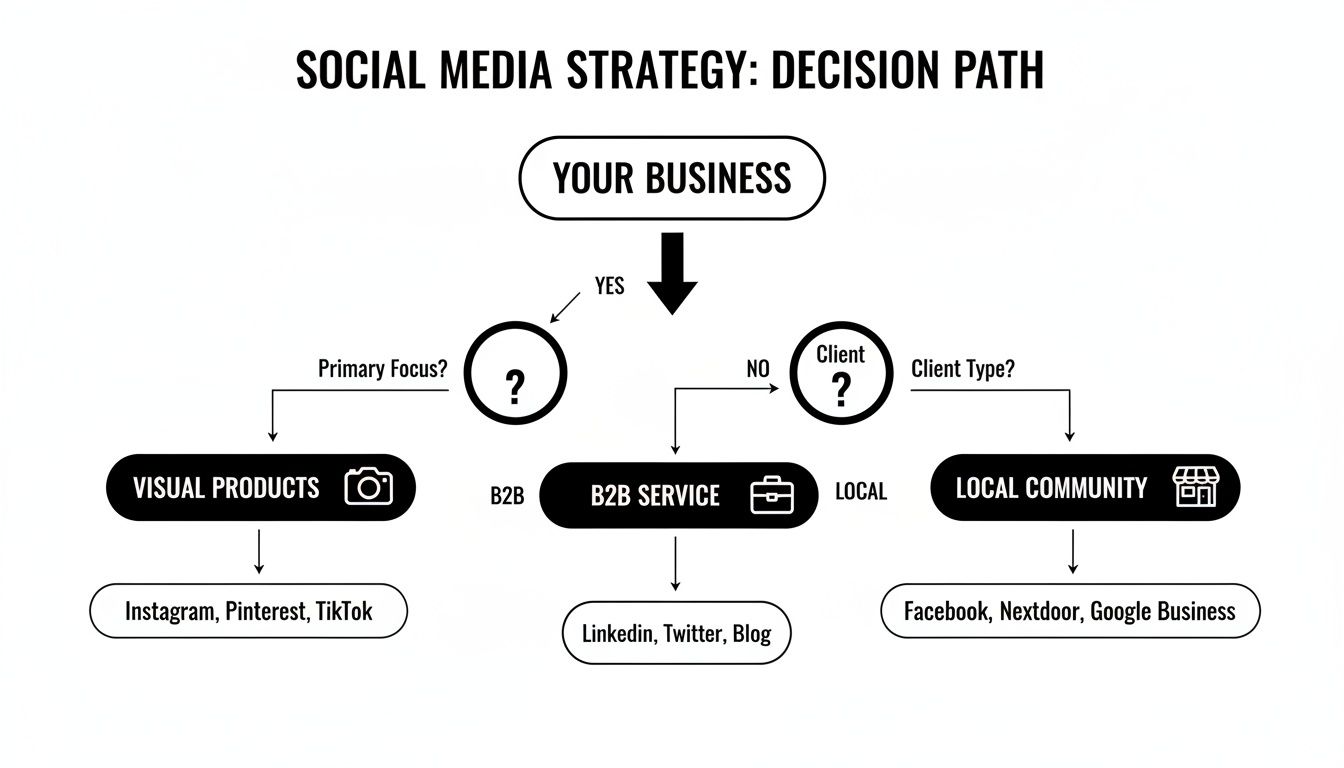
As you can see, your business model—whether you sell visual products, B2B services, or serve a local community—is the most important factor in deciding where to invest your time and energy.
Developing a Content Strategy That Converts
If you’ve set your social media goals, you’ve picked the destination. Now you need the fuel to get there, and that fuel is your content. Without a plan, you’ll end up scrambling for post ideas, which leads to inconsistent updates that don't connect with your audience.
A solid content strategy is your roadmap. It’s what turns random posts into a thoughtful conversation that actually drives your business forward.
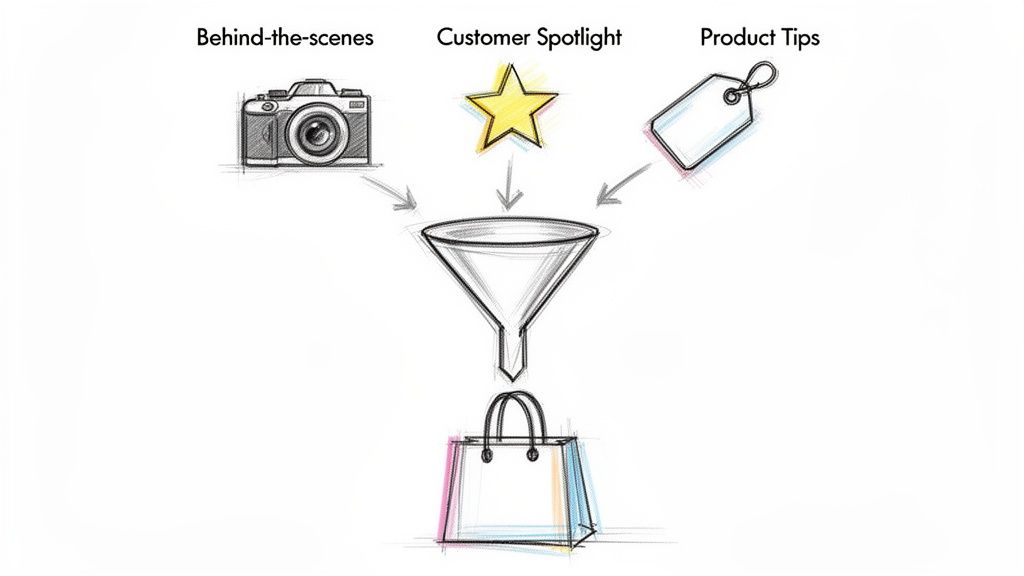
The best way to get out of that content chaos is to establish content pillars. These are 3-5 core themes your business will talk about again and again. Think of them like the main sections of your own small magazine—they give your feed structure and let your audience know what to expect.
When you stick to your pillars, you stop posting randomly and start building a brand that people trust and want to follow.
Building Your Content Pillars
Your content pillars should sit right at the intersection of your business goals and what your audience actually cares about. You don’t need a massive marketing team to pull this off, just a clear focus.
Here are a few content pillar ideas that work wonders for small businesses:
- Behind the Scenes: Show people the real work. This could be a shot of you packing an order, a quick tour of your workspace, or the process of making your product. It builds trust and makes your brand feel human.
- Customer Spotlights: Nothing sells like social proof. Feature happy customers using your products or services. It’s far more powerful than any ad you could ever run.
- Product Tips and How-Tos: Help your audience get more out of what you sell. If you own a coffee shop, that might mean showing them how to brew the perfect pour-over at home.
- Educational Content: Share what you know. Solve a problem for your audience. A financial planner could share quick budgeting hacks, or a landscaper could offer tips on seasonal plant care.
- Promotional Posts: This is where you announce your sales, new product drops, or special offers. These are essential, but you’ll want to sprinkle them in with your other content to avoid sounding too pushy.
A good guideline to follow is the 80/20 rule. Make 80% of your content valuable and engaging—think educational, entertaining, or behind-the-scenes stuff. Use the remaining 20% for direct promotions. This balance keeps people engaged without making them feel like they're constantly being sold to.
The Power of Authentic Content
In a feed full of glossy ads, realness is what grabs attention. People crave genuine connection, not airbrushed perfection. You don’t need a Hollywood budget or a professional photographer to create posts that land. In fact, sometimes the less polished a post feels, the more authentic it comes across.
One of the best ways to show up authentically is by using User-Generated Content (UGC). This is any content—photos, videos, reviews—created by your actual customers. Sharing UGC is a win-win: you get great content for your feed, and your customers feel valued and seen.
UGC has become a serious advantage for small businesses trying to get more from their social media efforts. Data from 2026 shows that ads using UGC get 4x higher click-through rates than standard branded content and can slash your cost-per-click by around 50%. This proves that authenticity is a huge asset, letting small businesses with tight budgets compete just by celebrating their customers. You can dig into more of these trends in the top 2026 social media insights that businesses can't afford to miss.
Creating Your Balanced Content Mix
Once you have your pillars defined, the next move is to mix up your content formats. Using a blend of images, videos, and text keeps your feed from getting stale and appeals to different preferences.
Here’s a weekly content mix could look like for a small e-commerce brand selling handmade candles:
- Monday (Product Tip): A short Reel showing the right way to trim a candle wick for a clean, long-lasting burn.
- Tuesday (Behind the Scenes): An Instagram Story poll asking followers to vote on the next new scent you should create.
- Wednesday (UGC): A gorgeous photo a customer shared, featuring your candle in their cozy living room.
- Thursday (Educational): A carousel post explaining the benefits of soy wax compared to paraffin.
- Friday (Promotional): A simple post announcing a weekend sale on your bestselling candle collection.
This mix gives value, builds community, and drives sales without ever feeling like a constant sales pitch. It’s a sustainable way to create content that turns casual followers into loyal fans.
4. Streamline Your Posting with a Smart Workflow
If you're a small business owner, your time is everything. Trying to come up with new posts and manually publish them across multiple platforms every single day is a fast track to burnout.
The answer isn't working harder—it's building a repeatable system.
This is where smart tools and a solid workflow come in. They help you stay consistent and professional without the daily scramble, turning social media from a chore into a manageable task you can knock out in just a few hours a week.
The Power of Batching and Scheduling
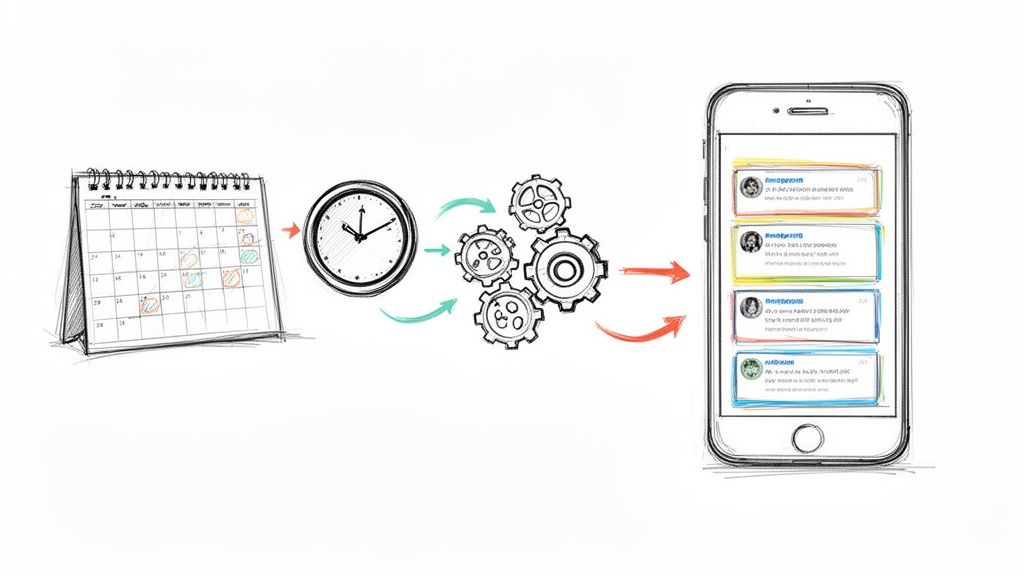
The trick to an efficient workflow is to stop thinking post-by-post. Instead, you'll want to embrace two simple concepts: content batching and scheduling.
- Content Batching: This just means you create your social media content for a set period—like a week or two—all in one go. You get into a creative rhythm, and it's way more productive than trying to invent a new post from scratch every morning.
- Scheduling: Once your posts are ready, you use a tool to schedule them to go live at the best times. This keeps your profiles active and engaging even when you’re deep in the day-to-day of running your business.
Putting these two together is the secret to managing social media for your small business without letting it take over your life.
A Simple Weekly Social Media Workflow
Here’s a practical weekly workflow you can start using right away. It’s designed to take just a few hours, freeing you up for the rest of the week.
- Monday (1 Hour) – Brainstorm & Plan: Block out one hour to plan the week's content. Look at your content pillars and decide which topics to hit. Use your content calendar to slot in what post goes live on which day.
- Tuesday (2 Hours) – Create & Batch: This is your creation session. Write all your captions, design your graphics, and edit any quick videos. Doing it all at once helps keep your look and feel consistent.
- Wednesday (30 Minutes) – Schedule It All: Hop into your scheduling tool and load up all the content you just made. Set each post for its specific day and time across your different platforms.
- Thursday & Friday (15 Minutes/Day) – Engage: With your posts running on autopilot, your only daily job is to check in for 15 minutes. Respond to comments, answer DMs, and connect with your followers.
This system turns social media from a daily, frantic grind into a structured, predictable task. By setting aside specific blocks of time, you get your schedule back and make sure your online presence feels strategic, not stressed.
Picking the Right Tools for the Job
Your tools are what make this efficient workflow possible. For a full breakdown of options, exploring the best social media management tools is a great next step.
Platforms like Postful are built to make this entire process feel effortless. You can go from a rough idea to a polished, scheduled post in minutes.
- AI-Powered Brainstorming: Stuck on what to say? Postful’s AI can help you brainstorm topics or turn a simple thought into well-written, engaging copy.
- Post Templates: Start with proven templates that guide you on what to post, taking the guesswork out of creating effective content.
- Simple Scheduling: The scheduler is clean and intuitive, letting you plan your content calendar with just a few clicks.
While Postful gives you an all-in-one solution, other great tools can also power your workflow:
- Buffer: Known for its clean interface and straightforward scheduling. It's a fantastic starting point if you're new to automation. Pricing: see website for details.
- Later: Has a strong focus on visual platforms like Instagram and includes a handy visual planner to see how your grid will look ahead of time. Pricing: see website for details.
If you're looking to build out your toolkit, we’ve gathered more great options in our guide to the best social media management tools. Finding the right platform is the final piece of the puzzle to take control of your social media and make it a consistent, stress-free part of your marketing.
Your Top Social Media Questions, Answered
Jumping into social media for your business brings up a lot of questions. I get it. Below, I’ve broken down some of the most common ones I hear from small business owners to give you clear, straightforward answers.
How Do I Choose the Right Social Media Platforms?
This is where most people get overwhelmed, but the answer is simpler than you think. Don't try to be everywhere. Instead, go where your customers already are.
For instance, if you sell beautiful handcrafted jewelry, a visual-first platform like Instagram or Pinterest is a natural fit. But if you’re a B2B consultant, you’ll find far more traction building connections on LinkedIn.
My advice? Start with just one or two platforms. Get really good at them, build a solid rhythm, and only then think about expanding.
Should I Use Paid Ads or Just Post Organically?
This isn't an either/or question. The best strategies use a mix of both.
Organic posting is your foundation. It’s how you build a real community, show off your brand’s personality, and earn trust with the people who already follow you. It’s all about relationship building.
But let's be honest, organic reach can be painfully slow. Think of paid ads as a megaphone. They guarantee your message gets in front of a brand new, highly specific audience you want to attract.
A smart approach uses both. Create great organic content for your current followers and use paid ads—even with a small budget—to bring new, ideal customers into your world.
Do I Need a Social Media Manager or Can I Use Tools?
This question really gets down to strategy versus execution. Here’s a simple way to think about it:
- Social media tools are your hammer and nails. Software like Postful helps you get the work done efficiently—scheduling posts, drafting ideas, and seeing what’s working.
- A social media manager is the carpenter. They’re the strategist who uses those tools to build the house. They create the content plan, talk with your community, and make sense of the data.
For most small businesses, starting with the right tools is the most practical first step. As you grow, you might decide to bring in a manager to take over the day-to-day strategy.
How Often Should I Post on Social Media?
Forget the myth that you need to post multiple times a day. That’s a fast track to burnout and a feed full of mediocre content.
Consistency is so much more important than frequency.
It’s far better to share three high-quality, genuinely helpful posts a week than to throw ten generic ones out there that nobody engages with. Start with a schedule you can actually stick to, like 2-3 times a week. Then, watch your analytics to see what resonates and adjust from there.
How Should I Handle Negative Comments or Reviews?
That first negative comment stings, I know. But it’s also a huge opportunity to show everyone how much you care about your customers. The absolute worst thing you can do is delete or ignore it.
Instead, respond publicly, professionally, and quickly.
- Acknowledge their concern so they feel heard.
- Apologize for their bad experience.
- Offer to take the conversation private (to a DM or email) to solve the problem for them.
This shows the unhappy customer—and everyone else watching—that you stand behind your business and are committed to making things right. That kind of transparency builds incredible trust.
Ready to turn all this hard work into more business? With Postful, you can go from a rough idea to a polished, scheduled social media post in minutes. Get AI-powered brainstorming, easy-to-use templates, and simple scheduling to make your social media finally work for you. Start reaching your audience today.