
In 2025, a strong social media presence isn't just about posting; it's about strategic action that drives real growth. For busy founders and side-hustlers, every minute counts. The pressure to be everywhere, create viral content, and constantly engage can feel overwhelming, often leading to burnout with little to show for it. This guide is built to change that dynamic.
We're cutting through the generic advice to deliver 10 essential social media best practices designed for maximum impact with minimum wasted effort. This isn't a collection of vague tips; it's a comprehensive roundup of actionable systems you can implement immediately. You will learn how to set clear goals, create content that resonates with specific audiences, and build a genuine community around your brand. We will also cover platform-specific tactics, data analysis, and workflow automation to boost your productivity.
Think of this as your operational blueprint for turning social media from a time-consuming chore into a powerful, predictable engine for your business. Each point includes step-by-step instructions, practical examples, and quick templates to streamline your process. For an even deeper dive into the overarching strategies for success in the coming year, consider these 10 Social Media Marketing Best Practices for 2025 as a complementary resource. Let’s move beyond the noise and build a social media presence that works as hard as you do.
1. Define Clear Social Media Goals and KPIs
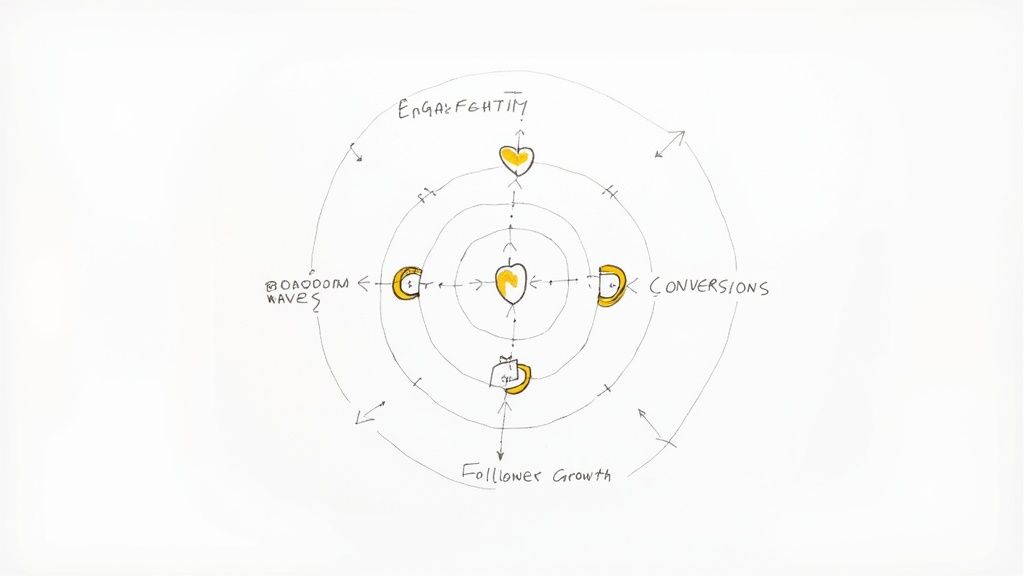
Jumping into social media without clear objectives is like setting sail without a map. To make your efforts count, you must first define what success looks like. This is a foundational step in any effective social media best practices playbook, transforming random posts into a strategic, results-driven campaign. Your goals should be specific, measurable, achievable, relevant, and time-bound (SMART).
These objectives connect your daily social media activities directly to your broader business ambitions, whether that's increasing revenue, building brand loyalty, or generating leads. Key Performance Indicators (KPIs) are the specific metrics you'll track to gauge progress against these goals.
Why It's a Top Priority
Setting clear goals provides direction, prevents wasted effort, and helps you articulate the value of your social media investment. It allows you to focus on activities that move the needle, rather than just creating content for the sake of it. For a startup founder or side-hustler with limited time, this focus is non-negotiable.
Key Insight: Without goals, you're just posting. With goals, you're building a business.
How to Implement This Practice
- Align with Business Objectives: What is your primary business goal right now? Is it lead generation, customer support, or brand awareness? Your social media goals must support it.
- Practical Example: If your business goal is to increase Q3 SaaS trial sign-ups by 20%, a corresponding social media goal could be "Generate 100 qualified leads via LinkedIn content and ads by the end of Q3."
- Select Relevant KPIs: Choose metrics that directly reflect your goals.
- Awareness: Track Reach and Impressions.
- Engagement: Monitor Likes, Comments, Shares, and Engagement Rate.
- Conversion: Measure Click-Through Rate (CTR), Website Traffic, and Leads Generated.
- Set Benchmarks and a Reporting Workflow: Use tools like Meta Business Suite or LinkedIn Analytics to establish your current performance. Then, set realistic growth targets.
- Productivity Tip: Create a simple spreadsheet or a dashboard in a tool like Looker Studio to track your KPIs weekly. This 30-minute task prevents you from getting lost in data and keeps your goals top-of-mind. For instance, aim to increase your Instagram engagement rate from 2% to 3% over the next quarter. Understanding how to measure these outcomes is crucial; you can discover more about how to calculate your social media ROI.
- Review and Adjust: Goals aren't set in stone. Review your KPIs monthly and your overarching goals quarterly. If a strategy isn't working, pivot based on the data.
2. Know Your Audience and Create Targeted Content
Posting content without a deep understanding of who you're talking to is a surefire way to get lost in the noise. One of the most critical social media best practices is to precisely define your target audience and create content that speaks directly to their needs, interests, and pain points. This approach shifts your strategy from broadcasting messages to building meaningful connections that drive engagement and loyalty.
Knowing your audience informs every decision you make, from the platforms you use and the tone of your captions to the formats you create and the times you post. It ensures your content is not just seen but is also relevant, valuable, and memorable to the people who matter most to your business.

Why It's a Top Priority
Targeted content increases relevance, which in turn boosts engagement, builds trust, and drives conversions. When your audience feels understood, they are far more likely to follow, interact with, and purchase from your brand. For a founder with a niche product, this hyper-focused approach creates a loyal community and maximizes the impact of every post.
Key Insight: Don't create content for everyone. Create content for someone. Specificity is your greatest asset.
How to Implement This Practice
- Conduct Audience Research: Dive into your existing data. Use the native analytics on platforms like Instagram Insights or LinkedIn Analytics to see the demographics (age, gender, location) and behaviors of your current followers.
- Create Detailed Buyer Personas: Go beyond demographics and build 2-3 detailed personas representing your ideal customers. Give them names, job titles, goals, and challenges. Understanding the nuances of each persona is a powerful tool; you can discover more about how to build an effective user persona.
- Practical Example: A persona for a productivity app could be "Freelance Felipe," a 32-year-old UX designer struggling with project management. His pain point is juggling multiple clients. He's active on LinkedIn and follows tech influencers on X. This tells you what content to create (e.g., "5 Ways to Streamline Client Feedback") and where to post it.
- Engage and Listen (Your Productivity Hack): Your audience is constantly telling you what they want.
- Monitor: Use a tool like TweetDeck or create keyword searches in your social media management app to track mentions of your brand and pain points in your industry. This is a goldmine for content ideas.
- Ask: Use polls on Instagram Stories ("What's your biggest productivity challenge?") and surveys to get direct feedback.
- Tailor Content to Personas and Platforms: Create content pillars that address the specific needs of each persona. GoPro, for instance, creates high-energy video content for action sports enthusiasts, which is a perfect fit for visually driven platforms like Instagram and TikTok.
3. Maintain Consistent Posting Schedule and Content Calendar
Consistency is the engine of social media growth. Showing up sporadically confuses your audience and tells algorithms you aren't a reliable source of content. Developing and adhering to a strategic content calendar ensures a regular, dependable brand presence without causing burnout, a common pain point for busy founders. This documented schedule helps maintain posting frequency, coordinate across platforms, and plan campaigns in advance.
A well-structured calendar transforms your social media from a reactive, last-minute scramble into a proactive, strategic operation. It allows you to align your daily posts with larger marketing initiatives, ensuring every piece of content serves a purpose. It's a cornerstone of effective social media best practices, providing a framework for steady growth.
Why It's a Top Priority
A content calendar removes the daily pressure of "what should I post today?" This frees up valuable mental energy to focus on bigger business challenges. It guarantees a steady stream of valuable content that keeps your audience engaged and your brand top-of-mind. For a side-hustler, this level of organization is the difference between a thriving social presence and a neglected one.
Key Insight: Random acts of content create random results. A plan delivers predictable growth.
How to Implement This Practice
- Plan in Batches (The Ultimate Workflow): Set aside 2-3 hours every two weeks to plan and create your content. This "batching" workflow is a massive productivity hack.
- Practical Example: During your content block, brainstorm ideas for your core pillars (e.g., Educational Tip, Behind-the-Scenes, Customer Story), write all the captions, and create the visuals in Canva.
- Use Scheduling Tools: Leverage tools like Buffer, Hootsuite, or Later to schedule your approved content. This ensures you post at optimal times based on your audience analytics without needing to be online 24/7. This is the key to maintaining consistency without sacrificing your personal time.
- Apply the 80/20 Rule: Dedicate 80% of your calendar to content that provides value (tips, insights, entertainment) and 20% to direct promotion (product features, sales). This builds community trust and prevents audience fatigue.
- Build in Flexibility: Your calendar is a guide, not a straitjacket. Leave a few open slots for timely, relevant content like trending topics or real-time marketing opportunities. This keeps your brand agile and relevant. You can explore how to build an effective social media content calendar to master this balance.
4. Create Engaging, Platform-Specific Content Formats
Treating all social media platforms as a single distribution channel is a recipe for low engagement. Each platform has its own algorithm, user expectations, and preferred content formats. A core tenet of social media best practices is to tailor your content to fit the native environment of each channel, rather than a one-size-fits-all approach. This means what works as a LinkedIn article won't succeed as a TikTok video, and a witty Twitter meme might fall flat on Instagram.
Successful brands optimize their message for each platform’s unique features. Think Instagram Reels, TikTok's short-form videos, LinkedIn carousels, and X (formerly Twitter) threads. This platform-specific approach respects the user experience and signals to the algorithm that your content is high-quality and relevant, maximizing both reach and engagement.

Why It's a Top Priority
Posting platform-native content significantly increases your chances of being seen and appreciated. Algorithms favor formats that keep users on their platform longer, such as in-app video editors and interactive stickers. For a founder or side-hustler, tailoring content ensures your limited time and resources are spent creating assets that actually perform, instead of being ignored.
Key Insight: Don’t just post content on a platform. Create content for the platform.
How to Implement This Practice
- Analyze Each Platform’s Strengths: Identify the dominant formats for your target audience on each channel. Is it vertical video on TikTok and Reels? Professional carousels on LinkedIn? Visually striking images on Pinterest?
- Adapt Your Core Message (A Repurposing Workflow): Instead of cross-posting the same file everywhere, repurpose your core message into native formats. This workflow maximizes the value of a single idea.
- Practical Example: A blog post on "5 Project Management Tips" becomes:
- LinkedIn: A formal article or a carousel slide deck.
- X (Twitter): A 5-tweet thread with each tip as a separate tweet.
- Instagram: A 5-slide carousel graphic and a 30-second Reel demonstrating one tip.
- Practical Example: A blog post on "5 Project Management Tips" becomes:
- Optimize for Mobile and Sound-Off Viewing: The vast majority of social media is consumed on mobile devices.
- Create vertical videos for platforms like TikTok, Instagram Stories/Reels, and YouTube Shorts.
- Use captions and text overlays with a tool like CapCut or Premiere Rush, as many users watch videos without sound.
- Leverage Interactive Features: Boost engagement by using platform-specific tools like polls, quizzes, question stickers, and live streams. For founders leveraging video in their content strategy, understanding proven social media video strategy examples can be transformative.
5. Engage Authentically and Build Community
Social media is a two-way street, not a broadcast monologue. Treating it as such is one of the most critical social media best practices for building a lasting brand. Authentic engagement means moving beyond transactional likes and follows to foster genuine connections. It's about responding to comments, answering questions thoughtfully, and actively participating in conversations to create a loyal, supportive community.
This human-centric approach transforms your followers from a passive audience into active brand advocates. When people feel seen and heard, they develop a deeper affinity for your brand, which directly impacts loyalty and algorithmic visibility. Platforms like Instagram and LinkedIn reward posts that generate meaningful conversation, pushing them to a wider audience.
Why It's a Top Priority
Authentic community building is your defense against fleeting trends and algorithm changes. A strong community provides invaluable feedback, generates user-generated content (UGC), and offers social proof that attracts new customers. For a founder or side-hustler, this organic word-of-mouth marketing is incredibly powerful and cost-effective.
Key Insight: Don't just collect followers; cultivate a community. A community buys from you, defends you, and champions your growth.
How to Implement This Practice
- Set an Engagement Workflow: Make responsiveness a priority. Dedicate two 15-minute blocks per day (e.g., morning and end-of-day) to respond to comments and DMs.
- Productivity Tip: Use your scheduling tool's inbox feature (like Buffer's Engage) to manage all comments in one place instead of jumping between apps. For common questions, create saved replies but always personalize them with the user's name or a specific detail from their comment.
- Spark Conversations: Don't just post and ghost. End your captions with open-ended questions to encourage responses.
- Practical Example: Instead of "Check out our new feature," ask, "We just launched our new 'Focus Mode.' What's the first task you'd use it for?"
- Humanize Your Responses: Avoid generic replies like "Thanks!" or "Great comment!" Instead, add personality. Duolingo is a master of this, using witty, on-brand humor to respond to fans, making each interaction memorable. Acknowledge the user's point and add to the conversation.
- Amplify User-Generated Content (UGC): Actively look for and share content created by your customers. Create a unique hashtag and encourage its use. When you re-share, always credit the original creator with an @mention. This not only provides you with authentic content but also makes your community members feel valued.
- Participate Beyond Your Page: Engage with other accounts in your niche, join relevant hashtag conversations, and comment on posts from industry leaders. This positions you as an active, knowledgeable member of the broader community, not just a seller.
6. Use Data Analytics to Inform Strategy and Optimization
Operating your social media based on guesswork is a fast track to wasted resources. The best social media practices are rooted in data, which provides objective feedback on what resonates with your audience. Leveraging platform analytics and third-party tools allows you to move beyond assumptions and make informed decisions that drive real results.
By analyzing metrics like engagement rates, reach, clicks, and conversions, you can understand which content formats, topics, and posting times perform best. This continuous feedback loop is what separates stagnant accounts from those that experience consistent, strategic growth.
Why It's a Top Priority
Data-driven decisions remove emotion and bias from your strategy, ensuring your efforts align with what your audience actually wants. For a founder or side-hustler, this means maximizing the return on every minute invested in social media. Analytics reveal what to double down on and what to discard, creating a more efficient and effective workflow.
Key Insight: Data tells you the story of your audience's behavior. Your job is to listen and adapt the narrative.
How to Implement This Practice
- Establish a Tracking Framework: Before you can analyze data, you must collect it properly. Use UTM parameters in your links (a free UTM builder from Google is perfect for this) to track traffic sources accurately in Google Analytics. Install the Meta Pixel or TikTok Pixel on your website to measure conversions driven directly from your social ads and posts.
- Schedule a Weekly Analytics Workflow: Don't wait for the end of the month. Block out 30 minutes on your calendar every Friday to review your key performance indicators (KPIs).
- Practical Example: During this review, ask three questions: 1. What was our best-performing post and why? 2. What was our worst-performing post and why? 3. What one thing will we do differently next week based on this data? This structured approach turns data into action.
- Focus on Actionable Metrics: Move past vanity metrics like raw follower count. Instead, prioritize metrics that indicate a healthy, engaged community and contribute to business goals.
- Engagement Rate: A better indicator of content quality than likes alone.
- Click-Through Rate (CTR): Shows if your call-to-action is compelling.
- Conversion Rate: Measures how many users took a desired action (e.g., sign-up, purchase).
- Implement A/B Testing: You don't have to guess what works best. Systematically test one variable at a time.
- Practical Example: On Instagram Stories, post two consecutive stories promoting the same link but with different images or call-to-action text (e.g., "Learn More" vs. "Get Started"). See which one gets more link taps and apply that learning to future posts.
7. Practice Transparency and Authenticity in Brand Communication
In a digital landscape saturated with polished, hyper-curated content, authenticity has become a powerful currency. Modern audiences crave genuine connection and are quick to spot inauthentic marketing. This social media best practice involves moving beyond perfectly crafted messages to share real, unvarnished aspects of your brand, from behind-the-scenes moments to your core values in action.
This approach builds a foundation of trust that transforms followers into a loyal community. When you are transparent about your processes, values, and even your mistakes, you create a more human and relatable brand identity. For a founder or side-hustler, this is a way to build a strong reputation that bigger, more corporate brands often struggle to achieve.
Why It's a Top Priority
Practicing transparency directly combats consumer skepticism and fosters deep-seated loyalty. It allows your brand to stand for something more than just its products, creating an emotional connection that is difficult for competitors to replicate. This authenticity is a key differentiator in crowded markets, making your brand more memorable and trustworthy.
Key Insight: Polished perfection sells a product. Raw authenticity builds a brand.
How to Implement This Practice
- Show the 'How' Behind the 'What': Take your audience behind the curtain. Share videos of your product being made, introduce team members, or post unpolished moments from a typical workday using Instagram Stories or TikTok.
- Practical Example: A solo founder of a coffee brand could post a Reel of them testing a new bean roast, explaining what they're looking for. This content is low-effort to produce but high-impact for building connection.
- Embrace Imperfection and Honesty: Don't be afraid to admit when you've made a mistake. Addressing issues openly and outlining your plan to resolve them can actually strengthen customer trust. Similarly, be transparent about partnerships and sponsored content by using clear labels like #ad or #sponsored.
- Lead with Your Values: Your brand's values should be more than just words on a website. Show how you live them.
- Practical Example: Patagonia doesn't just say it's eco-conscious; it posts content about its supply chain challenges, repair programs, and political activism, reinforcing its commitment to sustainability.
- Feature User-Generated Content (UGC): Showcase real customers using your products. Glossier excels at this by featuring customers with various skin types, including those with acne, which reinforces its message of real-life beauty and builds a powerful sense of community and relatability. This also reduces your content creation workload.
8. Implement Strategic Influencer and Partnership Collaborations
Tapping into established communities through collaborations is one of the most powerful social media best practices for accelerating growth. By partnering with influencers, creators, and complementary brands, you borrow their credibility and gain direct access to an engaged, relevant audience. This isn't about paying for a single shoutout; it's about building authentic relationships that drive genuine interest and trust.
Strategic partnerships extend your reach far beyond your own follower count. When done correctly, these collaborations feel less like advertising and more like a trusted recommendation from a friend, leading to higher-quality engagement and conversions. For founders and side-hustlers, this can be a highly efficient way to build brand authority without a massive ad budget.
Why It's a Top Priority
Collaborations provide social proof and cut through the noise of traditional advertising. A recommendation from a trusted creator or partner brand is often more persuasive than a self-promotional post. It validates your product or service and places it directly in front of a warm audience that is more likely to convert.
Key Insight: Don't just buy reach; build relationships. Authentic, long-term partnerships generate far greater returns than one-off transactional posts.
How to Implement This Practice
- Identify the Right Partners: Focus on alignment, not just follower count. Look for creators whose audience demographics and values mirror your ideal customer. A micro-influencer (10k-100k followers) with a highly engaged niche audience is often more valuable than a macro-influencer with millions of passive followers.
- Productivity Tool: Use tools like Upfluence or SparkToro to find potential partners based on audience data, saving hours of manual searching.
- Vet Potential Collaborators: Look beyond vanity metrics. Analyze their engagement rate (likes + comments / followers), comment quality, and past partnerships. Do their followers seem authentic? Do they align with your brand's values?
- Practical Example: A tool like HypeAuditor can quickly analyze an influencer's profile for signs of fake followers or engagement, preventing you from wasting your budget.
- Structure a Mutually Beneficial Offer: Your offer should provide clear value. This could be a flat fee, a commission-based affiliate partnership, or free products.
- Practical Example: For a new SaaS tool, offer a micro-influencer a free lifetime account plus a 20% affiliate commission for anyone who signs up through their link. This is a low-risk, high-reward model for both parties.
- Grant Creative Freedom within a Clear Brief: The best content comes from creators who know their audience. Provide a one-page brief with key messages, do's/don'ts, and goals, but allow them the creative freedom to present your product in their unique voice. This ensures the promotion feels authentic and resonates.
- Measure and Nurture the Relationship: Track the ROI of each collaboration using unique discount codes, UTM-tagged links, and affiliate tracking. Nurture high-performing partnerships by turning them into long-term brand ambassador programs, offering them exclusive perks and consistent work.
9. Prioritize Accessibility and Inclusive Content Design
Creating accessible social media content means ensuring everyone, including people with disabilities, can access and interact with your posts. This involves practices like adding captions to videos, writing descriptive alt text for images, and using clear language. Beyond a compliance or ethical imperative, this is a core component of effective social media best practices that expands your reach and improves overall content performance for all users.
Inclusive design benefits everyone. Captions help users watching in a noisy environment, while high-contrast colors make your graphics easier to read in bright sunlight. By embedding these principles, you demonstrate strong brand values and connect with a much broader audience.

Why It's a Top Priority
Neglecting accessibility excludes a significant portion of the population and can damage your brand's reputation. For a founder or side-hustler, accessible design is an efficiency hack; it makes your content more robust, SEO-friendly, and consumable by a wider audience without requiring separate assets. It future-proofs your content and builds goodwill.
Key Insight: Accessibility isn't an add-on; it's a fundamental part of good design that amplifies your message for everyone.
How to Implement This Practice
- Make Visuals Universally Understood (Simple Workflow): Build these steps into your content creation process.
- Add Captions to 100% of Videos: Use platforms' built-in tools (like Instagram's auto-captions) and review them for accuracy. This takes 2-3 minutes but dramatically increases viewership.
- Write Descriptive Alt Text: When uploading an image, always fill out the alt text field. Instead of "chart," write "Bar chart showing a 25% increase in Q3 user engagement compared to Q2."
- Ensure Design Readability: Your graphic design choices have a major impact.
- Use High-Contrast Colors: Before finalizing your brand palette, check your colors with a free tool like the WebAIM Contrast Checker. This ensures your text is readable for everyone.
- Choose Readable Fonts: Stick to clear, sans-serif fonts and ensure the text is a reasonable size (14pt minimum is a good guideline).
- Use Inclusive Language and Representation: Reflect the diversity of your audience.
- Practical Example: When creating graphics in Canva, consciously use templates and photos that feature people from various backgrounds, abilities, and identities.
- Use Clear Language: Avoid jargon. Write your captions for clarity. Use emojis to add emotion, but don't rely on them to convey critical information as they can be misinterpreted by screen readers.
10. Develop Crisis Management and Social Listening Protocols
On social media, your brand's reputation is built over months but can be damaged in minutes. Proactively monitoring brand mentions and having a prepared response plan for negative feedback isn't just defensive; it's a core component of maintaining trust. This social media best practice combines social listening to detect issues early with crisis protocols to ensure a calm, consistent, and effective response.
Social listening involves tracking conversations around your brand, competitors, and industry to gain insights and spot potential problems before they escalate. A crisis management protocol is your playbook for when things go wrong, outlining steps, roles, and messaging to navigate challenging situations. For a founder whose personal brand is tied to the business, this preparation is essential for protecting both.
Why It's a Top Priority
A crisis handled well can actually strengthen brand loyalty. A swift, transparent, and empathetic response shows customers you care and are accountable. Ignoring or poorly managing negative feedback can lead to viral outrage, customer loss, and long-term reputational harm. Social listening also provides invaluable, unfiltered customer feedback that can inform product development and marketing strategy.
Key Insight: The best time to plan for a social media crisis is before you have one.
How to Implement This Practice
- Set Up a Listening Dashboard: Use tools like Hootsuite, Sprout Social, or even free options like Google Alerts to create a dashboard that monitors your brand name, founder names, and key product terms.
- Productivity Tip: Set up email or Slack notifications for spikes in negative mentions so you can react quickly without having to manually check all the time.
- Create Response Templates: In a Google Doc, draft pre-approved responses for common negative scenarios (e.g., service outage, shipping delay, unhappy customer). This ensures a quick, on-brand initial response while you investigate.
- Practical Example Template: "Hi [User Name], thank you for flagging this. We're so sorry for the frustration this has caused. Our team is looking into the issue now and we'll share an update here as soon as we have one."
- Establish an Escalation Plan: Define who is responsible for responding and when an issue should be escalated.
- Simple Workflow: 1-2 negative comments: Social media manager responds using a template. 3-10 comments on the same issue: Escalate to the founder/marketing lead. 10+ comments or major issue: Activate full crisis plan.
- Practice Swift and Empathetic Responses: Acknowledge complaints quickly, even if you don't have an immediate solution. As KFC showed with its famous "FCK" apology for a chicken shortage, owning a mistake with humility and transparency can turn a crisis into a PR win.
10-Point Social Media Best Practices Comparison
| Item | Implementation Complexity 🔄 | Resource Requirements ⚡ | Expected Outcomes 📊⭐ | Ideal Use Cases 💡 | Key Advantages ⭐ |
|---|---|---|---|---|---|
| Define Clear Social Media Goals and KPIs | Medium — planning, stakeholder alignment | Low–Medium — analytics tools & meeting time | Measurable performance, clearer ROI, focused efforts | Strategy launches, executive reporting, budget allocation | ⭐ Accountability; data-driven decisions; ROI visibility |
| Know Your Audience and Create Targeted Content | Medium–High — ongoing research & segmentation | Medium — analytics, surveys, persona work | Higher relevance, engagement, and conversion | Personalization, ad targeting, content tailoring | ⭐ Increased engagement; reduced ad waste; stronger relevance |
| Maintain Consistent Posting Schedule and Content Calendar | Low–Medium — planning & approval workflows | Low–Medium — scheduling tools, team coordination | Consistent presence, better algorithm favorability, less fatigue | Ongoing brand presence, seasonal campaigns, multi-team ops | ⭐ Consistency; planning efficiency; content repurposing |
| Create Engaging, Platform-Specific Content Formats | High — format optimization per platform | High — production, editing, platform expertise | Higher engagement and reach; better platform fit | Video-first campaigns, cross-platform launches, trend-driven content | ⭐ Increased engagement; algorithm advantage; authentic fit |
| Engage Authentically and Build Community | High — continuous human-led interaction | High — community managers, time investment | Stronger loyalty, advocacy, improved organic visibility | Customer support via social, retention, community-led growth | ⭐ Brand loyalty; user-generated content; real feedback |
| Use Data Analytics to Inform Strategy and Optimization | High — tracking, attribution, interpretation | Medium–High — tools, analysts, tracking setup | Optimized spend, identified winners, measurable ROI | Performance optimization, A/B testing, scaling campaigns | ⭐ Data-backed decisions; reduced waste; trend identification |
| Practice Transparency and Authenticity in Brand Communication | Medium — cultural shift and consistent messaging | Low–Medium — storytelling resources, leadership buy-in | Increased trust, relatability, long-term reputation gains | Purpose-driven brands, PR recovery, employer branding | ⭐ Trust building; differentiation; stronger brand values |
| Implement Strategic Influencer and Partnership Collaborations | Medium — vetting, contracting, relationship mgmt | Medium–High — budgets, management time | Expanded reach, third-party credibility, amplified content | Product launches, niche audience reach, social proof campaigns | ⭐ Third-party validation; scalable UGC; targeted amplification |
| Prioritize Accessibility and Inclusive Content Design | Medium — additional production steps & guidelines | Low–Medium — captioning/alt tools, training | Broader reach, better engagement, legal/compliance benefits | Brands seeking inclusivity, regulated markets, large audiences | ⭐ Expanded audience; improved SEO; demonstrates inclusivity |
| Develop Crisis Management and Social Listening Protocols | High — monitoring, protocols, escalation workflows | Medium–High — listening tools, trained 24/7 team | Faster issue detection, consistent responses, reputational protection | High-risk industries, large public brands, reactive situations | ⭐ Early detection; consistent crisis response; reputation safeguarding |
Turn Best Practices into Consistent Habits
Navigating the world of social media can feel like trying to hit a constantly moving target. We've covered a comprehensive suite of social media best practices, from defining your core KPIs and understanding your audience to creating platform-specific content and implementing robust crisis management protocols. Each point, whether it’s maintaining a consistent content calendar or fostering authentic community engagement, represents a critical lever you can pull to drive meaningful growth for your brand.
However, knowledge alone isn't the key to success. The true differentiator for busy founders and side-hustlers is the ability to transform these best practices from a checklist of ideas into a set of ingrained, repeatable habits. The goal is not just to know what to do, but to build a system that makes doing it feel effortless and sustainable, even when you're juggling a dozen other responsibilities.
From Theory to Actionable Workflow
The real challenge lies in the execution. It's one thing to know you need to post consistently; it's another to actually generate, schedule, and publish high-quality content every day. It's great to understand the value of data, but finding the time to pull reports, analyze trends, and pivot your strategy can feel overwhelming. This is where your operational workflow becomes just as important as your creative strategy.
The most successful small business operators don't rely on willpower. They build systems. They lean on processes and tools that reduce friction and automate the repetitive tasks, freeing up their limited time for high-impact activities like genuine customer interaction and strategic planning. Adopting these social media best practices is not about adding more to your plate; it's about making what's already on your plate more effective and efficient.
Your Immediate Next Steps
To avoid the common pitfall of information overload, let's distill everything we've discussed into a simple, actionable plan you can start today.
- Conduct a 30-Minute Audit: Before you add anything new, see what's working. Look at your last month of posts. Which one got the most engagement? Which drove the most clicks? This quick analysis, guided by the data-driven principles we discussed, will give you immediate clarity on what your audience wants.
- Choose ONE Habit to Master This Week: Don't try to implement all ten best practices at once. Pick the one that addresses your biggest pain point. Is your engagement low? Focus solely on authentic community building for the next five days. Is your posting sporadic? Dedicate this week to building a simple content calendar in a spreadsheet or a tool like Notion.
- Template Your Core Content: Identify your most effective post formats. Was it a behind-the-scenes video, a customer testimonial graphic, or an insightful text-based post? Create simple, reusable templates for them in Canva or a similar tool. This single action can cut your content creation time in half and ensure brand consistency.
- Schedule a Weekly Review: Block out 45 minutes in your calendar every Friday to review your analytics, engage with comments you missed, and plan the core themes for the following week. Treating this as a non-negotiable meeting with yourself is the key to turning reactive social media management into a proactive growth engine.
Mastering these social media best practices is a journey of continuous improvement, not a one-time fix. By focusing on building consistent habits and leveraging smart workflows, you can create a powerful, efficient, and authentic social media presence that not only captures attention but also drives real, tangible results for your business.
Tired of the manual grind that comes with implementing these strategies? Postful is an AI-powered content partner designed for founders like you, helping you brainstorm, create, and schedule high-quality social media content in minutes, not hours. Join the waitlist for Postful to turn best practices into an effortless reality.