
Before you even think about chasing follower counts or viral trends, you have to pour the foundation. This is where so many businesses get it wrong. They jump straight into posting, throwing content at the wall to see what sticks, and end up wasting time on things that don't move the needle.
A strong foundation makes sure every post, every comment, and every dollar spent has a purpose. It’s the difference between guessing and growing.
Get to Know Your Audience (Really Know Them)
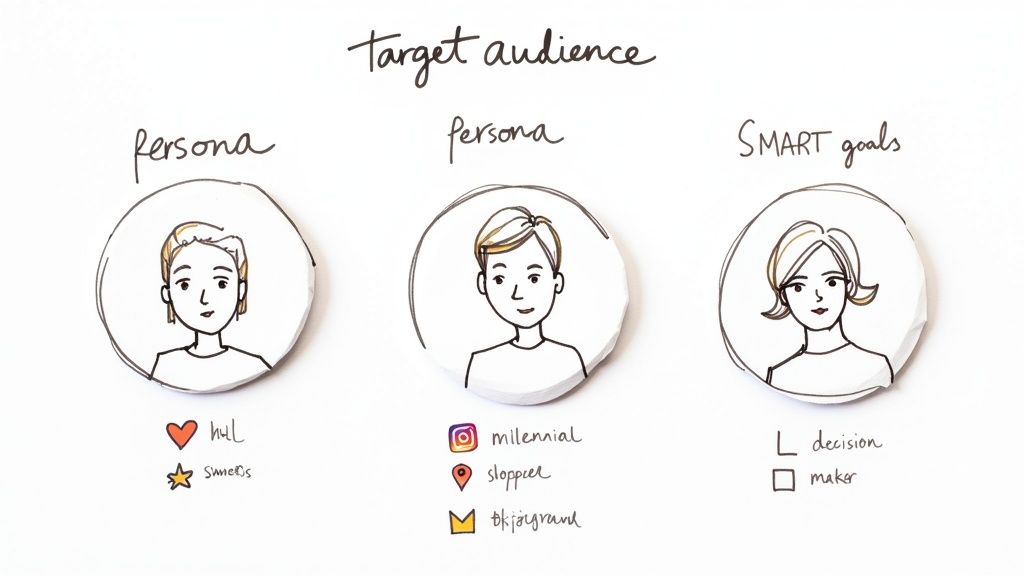
Most businesses stop at basic demographics. "Women aged 25-40" isn't a strategy; it's a starting point. To make content that truly connects, you need to build a detailed customer persona.
Practical Example: A boutique fitness studio isn't just targeting women. They’re targeting "Jessica," a 32-year-old project manager who listens to wellness podcasts on her commute, follows her favorite instructors on Instagram, and needs a high-energy morning class she can squeeze in before her first meeting.
That level of detail changes everything. It tells you what to post (behind-the-scenes class clips), what to say (captions about morning motivation), and where to say it (Instagram Reels and Stories).
Set Goals That Actually Mean Something
With a clear picture of "Jessica" in your mind, you can finally set meaningful goals. Forget vague ambitions like "get more followers." It's time to get specific with the S.M.A.R.T. framework (Specific, Measurable, Achievable, Relevant, Time-bound).
Practical Example:
- Vague Goal: "Get more engagement."
- S.M.A.R.T. Goal: "Increase Instagram Reels views by 20% among our 'Jessica' persona within the next quarter by posting three behind-the-scenes videos of our morning classes each week."
This goal gives you a clear target and a way to measure success. After all, a primary objective is often turning followers into customers, and that's where social media for lead generation comes in. Clear goals make that entire process trackable and something you can actually improve over time.
Choose Your Platforms Wisely
You don't need to be everywhere. In fact, you shouldn't be. Spreading your efforts too thin is a classic mistake that leads to burnout and mediocre content on every channel.
The key is to show up where your ideal customers already are.
Practical Example: A B2B software company selling to enterprise clients will find its audience on LinkedIn, not TikTok. On the other hand, a local bakery's mouth-watering visuals are a perfect match for Instagram and Facebook.
This decision tree breaks down how these foundational pieces fit together. It all starts with your audience.
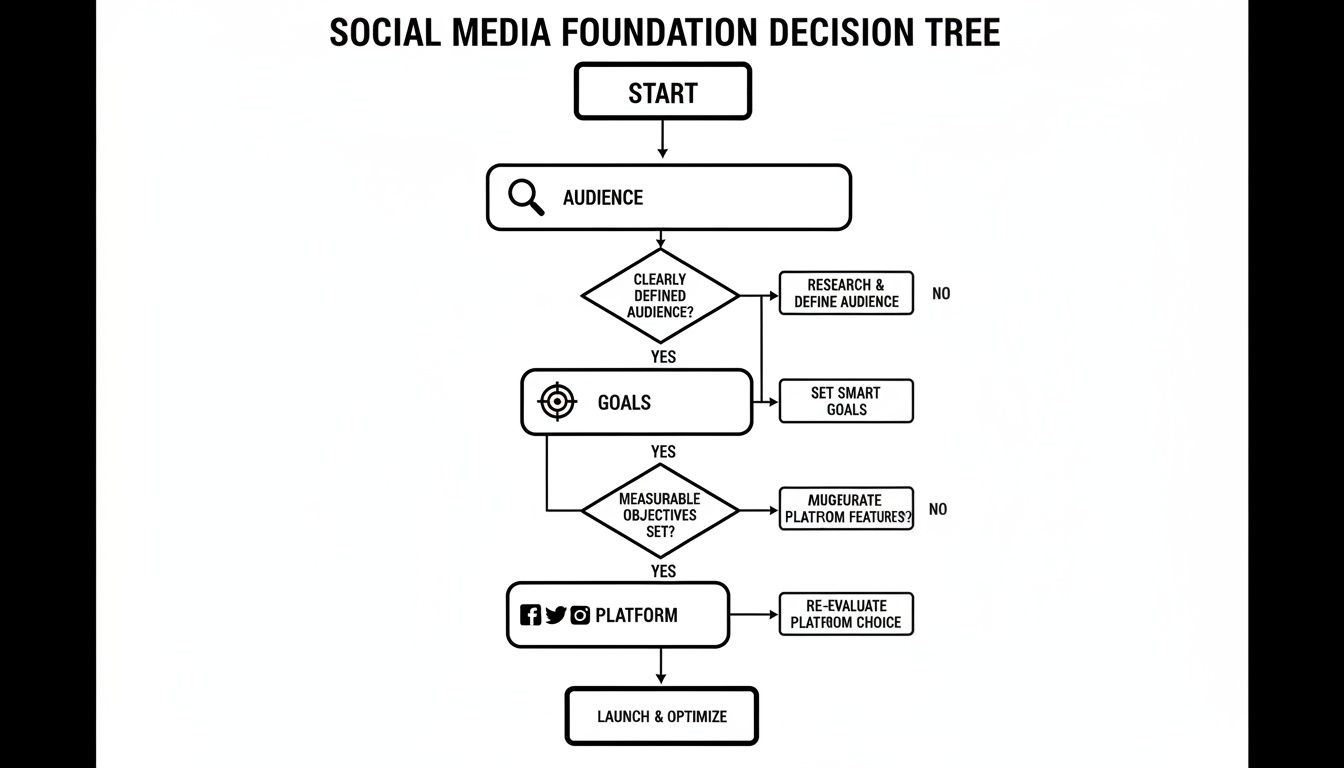
As you can see, understanding your audience informs your goals, and your goals dictate which platforms are worth your time.
To make this even easier, here’s a quick-glance table to help you match your business to the right channels.
Platform Selection Guide for Your Business
| Platform | Best For | Primary Audience | Key Content Format |
|---|---|---|---|
| B2B, professional networking, industry leadership | Professionals, B2B decision-makers, job seekers | Articles, text posts, professional videos, polls | |
| B2C, e-commerce, lifestyle, visual brands | Gen Z, Millennials (18-34) | Reels, Stories, high-quality images, carousels | |
| B2C, community building, local businesses | Broad, strong in Millennial & Gen X demographics | Videos, images, community posts, events, ads | |
| X (Twitter) | Real-time news, customer service, brand voice | Journalists, tech, politics, engaged communities | Short text, memes, threads, quick video clips |
| TikTok | B2C, brand awareness, user-generated content | Primarily Gen Z (16-24) | Short-form vertical video, trends, challenges |
| E-commerce, inspiration, visual discovery | Predominantly female, homeowners, hobbyists | High-quality vertical images (Pins), Idea Pins |
Choosing the right one or two platforms to dominate is far more effective than trying to be active on all of them. Once you have these foundational elements locked in, you’re ready to build a content strategy that works.
Developing a High-Performing Content Strategy
Alright, so you’ve figured out who you’re talking to and where they hang out online. Now for the big question: what are you actually going to say to them? This is where a rock-solid content strategy comes in. It’s the engine that powers your social media growth, turning random posts into a cohesive plan that builds real connections and drives action.
Without a clear plan, you end up scrambling for ideas. That leads to sporadic posting and, even worse, a feed that feels disjointed and uninteresting to your audience. A strategic approach ensures every single post has a purpose.
The Four Pillars of Great Content
To keep your feed from feeling like one long sales pitch, I always recommend building your content around four core pillars. This simple framework keeps things balanced, valuable, and genuinely interesting for your followers.
- Educate: Teach your audience something they didn't know. Practical Example: A SaaS company could create a slick LinkedIn carousel that breaks down a complex new feature into a few simple, easy-to-understand steps.
- Entertain: Make them laugh, smile, or feel something. Practical Example: A local coffee shop could post a funny, behind-the-scenes Reel of a barista’s disastrous (but hilarious) attempt at latte art.
- Inspire: Share success stories, powerful quotes, or user-generated content (UGC). Practical Example: A fitness coach could showcase a client's incredible transformation story (with their permission, of course) to motivate others.
- Convert: Gently guide your audience toward taking action. Practical Example: Think posts about special promotions, new product drops, or invites to an upcoming webinar.
A good rule of thumb here is the 80/20 rule. Aim for 80% of your content to be pure value (educating, entertaining, inspiring) and only 20% to be promotional. It's a game of give-and-take that builds trust, making your audience far more receptive when you finally ask for the sale.
Building a Practical Content Calendar
A content calendar is your secret weapon for consistency. It completely removes the daily "what on earth do I post today?" panic and lets you plan out campaigns, holidays, and content themes well in advance. And you don't need fancy, expensive software to get it done.
Productivity Tip: A simple content calendar is a game-changer. It transforms your strategy from a reactive scramble into a proactive, organized workflow, ensuring you stay on message and on schedule.
Tools like Trello, Asana, or even a well-organized Google Sheet can be incredibly effective. The real key is finding a workflow you'll actually stick with.
A Simple Trello Workflow That Just Works
- Start with a Board: Create a new board and call it something straightforward, like "Social Media Content."
- Create Your Lists: I like to use columns like "Content Ideas," "To Create," "Ready to Schedule," and "Published."
- Make Each Post a Card: Every card represents one social media post. Inside the card, drop the post copy, attach the visual, and add details like the platform and publish date.
- Drag and Drop: As you work on a post, just drag its card across the lists. It's a super visual way to see your entire pipeline at a glance and stay organized.
This kind of structured approach is the backbone of any effective social media content strategy, giving you the clarity you need to execute your plan without the daily chaos.
Brainstorming Ideas Your Audience Will Love
The secret to avoiding burnout? Never start from a blank page. If you're feeling stuck, here are a few proven techniques to keep the ideas flowing.
- Answer the Public: Jump on a free tool like AnswerThePublic. It shows you the actual questions people are searching for related to your industry. Boom—instant educational post ideas.
- Dig into Customer Feedback: Your emails, DMs, and reviews are a goldmine. What questions pop up over and over? What problems are your customers trying to solve? Answer them publicly.
- Spy on Your Competitors (Ethically!): See what’s working for others in your space. Don't just copy them, but look for trends. What topics and formats are getting a ton of engagement? Let that inspire your own unique take.
Practical Example: A local restaurant could create a branded hashtag (like #MyLocalEats) and repost the best photos from customers. This not only fills their content calendar with authentic, high-quality visuals but also builds an amazing community by turning happy diners into your biggest fans.
Using Short-Form Video to Skyrocket Engagement
Short-form video isn't just a trend anymore; it's the heartbeat of modern social media. Platforms like Instagram Reels, TikTok, and YouTube Shorts have completely rewired how people consume content, and they’re all hungry for quick, captivating videos. If you're trying to grow your social media presence, ignoring this format is like showing up to a concert without a ticket—you're missing the main event.
What makes these little videos so powerful is that they’re built for discovery. The algorithms are designed to push compelling content to brand-new audiences, giving you a direct line to potential followers who’ve never even heard of you. I’ve seen a single, well-made Reel reach thousands of non-followers, delivering the kind of organic reach that’s getting harder and harder to achieve with static posts.
Simple Frameworks for Creating Compelling Videos
You don't need a fancy production studio to make videos that work. Honestly, some of the most viral content out there is shot on a smartphone. The real secret is having a few simple, repeatable frameworks you can turn to again and again.
Here are three dead-simple video ideas any business can use:
- The Quick Tip or Hack: Share one valuable piece of advice related to your industry. Practical Example: A financial advisor could film a 30-second video on "One common money mistake to avoid in your 20s." It's fast, genuinely useful, and instantly positions you as an expert.
- A Behind-the-Scenes Glimpse: Show the human side of your business. Practical Example: A local restaurant could post a quick clip of chefs prepping for the dinner rush. A software company could show a fun moment from a team meeting. This stuff builds authenticity and trust like nothing else.
- The Before-and-After Transformation: This one is just so satisfying for viewers. Practical Example: A home organizer showing a cluttered space becoming a tidy one, or a marketing agency revealing a client's slick website redesign.
The goal is to grab attention within the first three seconds. Always start with a strong hook, get straight to the point, and wrap it up with a clear call-to-action, like "Follow for more tips!"
Trending Audio and Repurposing Your Content
One of the fastest ways to get more eyes on your video is by using trending audio. Sounds that are climbing the charts on TikTok or Reels often get an extra push from the algorithm, giving your content an instant boost.
Productivity Tip: Don’t overthink it. Often, the simplest videos paired with a popular sound perform the best. The key is to find a clever or relatable way to connect the audio to what you do.
Tools like CapCut make it incredibly easy to find and edit videos with trending sounds. A great little workflow is to spend 15 minutes each week just scrolling your feed to see what’s popular. Save the audio clips that could fit your brand. Practical Example: A real estate agent could use a trending sound about "dream homes" to create a quick property tour Reel.
To get the most bang for your buck, always repurpose your content. A video you create for TikTok can easily be posted as an Instagram Reel and a YouTube Short. This move triples your output with almost no extra work. If you want to dive deeper into that last platform, check out our guide on what are YouTube Shorts.
The data is clear: a video-first approach is non-negotiable. With 5.42 billion social media users globally, businesses have to focus on what actually works. A remarkable 78% of consumers prefer learning about new products through short videos, and video campaigns pull in 34% higher conversion rates than static ads. It’s no surprise that 93% of marketers plan to increase their social video efforts next year. You can dig into more of these numbers in the latest social media marketing statistics on dreamgrow.com.
Key Video Metrics to Track for Growth
To know if your video strategy is actually working, you have to track the right metrics. Forget the vanity numbers and focus on the data that signals real engagement and audience interest.
Here are the essential KPIs you should be watching:
- Watch Time & Retention Rate: How long are people actually sticking around? A high retention rate tells the algorithm your content is engaging, which can lead to it being shown to more people.
- Shares: When someone shares your video, it’s a massive endorsement. This is a powerful signal that your content truly connected with them.
- Saves: A save means your content was so valuable that someone wants to come back to it later. This is a huge win for educational or inspirational content.
- Reach (vs. Impressions): Impressions just count how many times your video was seen, but reach tells you how many unique people it got in front of. Tracking reach is how you know if you're successfully growing your audience.
Amplifying Reach with Paid Ads and Collaborations
Organic content is your foundation. It’s how you build trust and a real community around your brand. But when you’re ready to really step on the gas, paid ads and collaborations are your rocket fuel.
Think of your organic strategy as planting seeds one by one. Paid amplification is like turning on the sprinkler system to water the whole garden at once. It’s how you get in front of the thousands of ideal customers who don’t even know you exist yet.
This isn’t just a nice-to-have; it's essential for any business serious about growth. Social media ad spend is projected to hit $276.7 billion globally in 2025 for a reason. Done right, businesses see an average of $5.20 back for every $1 they put in. Combine smart ad spending with authentic collaborations, and you've got a powerful engine for scaling your business.
Getting Started with Social Media Ads
Diving into paid ads can feel like a lot, but the core idea is pretty straightforward. Platforms like Meta (for Facebook and Instagram) have made it surprisingly accessible for businesses of any size to jump in, even with a small budget.
A great place to start is with a simple campaign in Meta Ads Manager. This dashboard is your command center, giving you precise control over who sees your ads, how much you spend, and what you want to achieve.
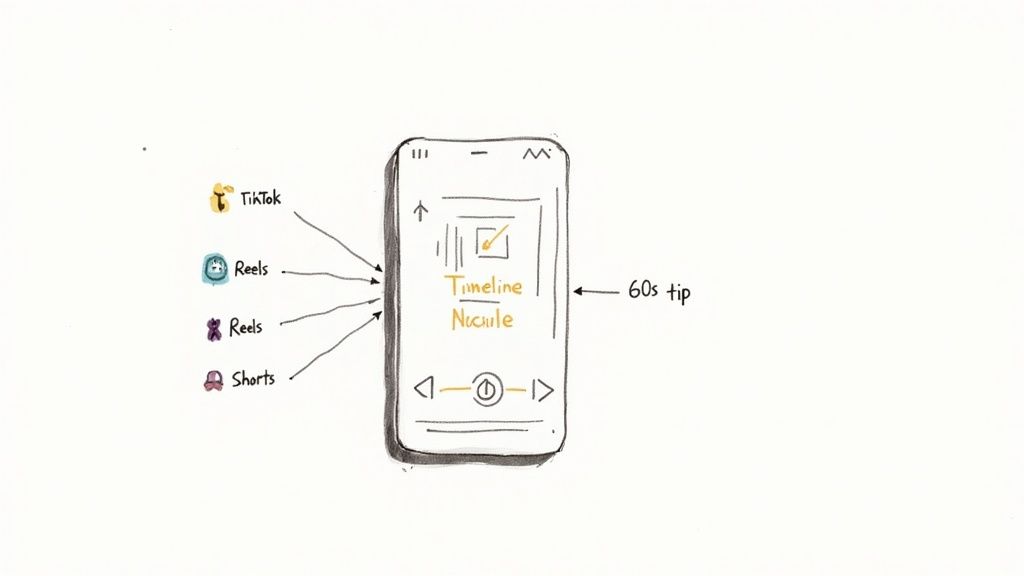
The first step in setting up a campaign is choosing your main goal—this is a critical choice that tells the algorithm exactly what you want to accomplish.
You can break your first campaign down into three simple parts:
- Choose Your Objective: Are you trying to get more website clicks, introduce your brand to new people, or capture leads? Picking the right objective (like "Traffic" or "Engagement") is crucial. Meta will then optimize your ad delivery to find people most likely to take that specific action.
- Define Your Audience: This is where the magic happens. You can target people based on their demographics, what they're interested in, and even their online behaviors. Productivity Tip: Create a Lookalike Audience by uploading your customer list, and Meta will find new users who are just like your best customers, saving you hours of guesswork.
- Set Your Budget: You don’t need a massive budget to get results. Start small. A budget of $10-$20 a day is more than enough to start testing and see what resonates. As you run campaigns, it's key to learn how to optimize Facebook Ads for better ROI so every dollar works harder for you.
Finding the Right Influencers for Your Brand
Influencer marketing isn't just for huge brands with celebrity-sized budgets. For most businesses, the real opportunity is with micro-influencers—creators with smaller, highly engaged followings, usually between 10,000 and 100,000 followers. Their audience genuinely trusts them, so a recommendation feels more like a tip from a friend than a corporate ad.
Finding them takes a little detective work. Start by searching hashtags in your niche or just look at who your ideal customers are already following and talking to.
Productivity Tip: The best collaborations come from genuine alignment, not just follower counts. Look for creators whose values and vibe match your own. That’s what makes a partnership feel authentic to their audience.
When you're vetting a potential partner, look past the follower number. Here are the metrics that actually matter:
- Engagement Rate: Do the math. Add up the likes and comments on their recent posts, divide by their follower count, and multiply by 100. A rate between 3-6% is generally considered pretty solid.
- Comment Quality: Are the comments real conversations or just a string of emojis and spam bots? Real chatter is a sign of a healthy, active community.
- Audience Demographics: Don't be afraid to ask the influencer for a screenshot of their audience analytics. You need to confirm their followers are actually your target customers.
Once you find someone who feels right, reach out with a personal and direct message. Ditch the generic templates. Mention a specific post you loved and explain clearly why you think a partnership would be a great fit for their audience. A simple, human message will always cut through the noise.
Building a Community to Drive Loyalty and Growth
Let's be real: growing on social media isn't about the follower count. That number is just a vanity metric if nobody actually cares what you have to say. The real goal is to shift from just broadcasting messages to building a genuine community.
When you pull that off, passive followers turn into your biggest advocates—the people who drive organic growth and stick around for the long haul. This happens when you start treating your social channels like a conversation, not a billboard.
The good news? You don't need to dedicate hours every day to make this happen. A simple, structured workflow is all it takes to build a powerful engagement habit.
Implement a Daily Engagement Routine
Consistency is everything. I've found that just 15-20 minutes of focused, proactive engagement each day makes a massive difference in how people connect with a brand. It's way more effective than random, half-hearted efforts when you have a spare moment.
Here’s a practical workflow you can steal and start using tomorrow:
- First 5 Minutes (Respond): Jump into your notifications and reply to every single new comment and DM. It's non-negotiable. Use their name, answer their question, and show you actually appreciate them taking the time to write.
- Next 5 Minutes (Engage Outward): Find 5-10 accounts in your niche or that your ideal customer follows. Drop a thoughtful, non-spammy comment on their posts. The idea is to add to the conversation, not just post a generic "Great post!"
- Final 5 Minutes (Connect with Your Fans): Look at who recently followed you or engages with your content often. Pop over to their profile and interact with one of their recent posts. This tiny act shows them you see them as a person, not just another number.
This short, daily habit does more than just signal to the algorithm that your account is active. More importantly, it shows your followers there’s a real human on the other side of the screen.
Spark Meaningful Conversations
If you want to unlock real engagement, you have to stop posting statements and start asking questions. Think of your captions as conversation starters that invite people to share their own experiences. Instead of just showing off your product, ask how your followers use it or what problem it solved for them.
A great post doesn't just get a "like"; it gets a response. Aim to create content that makes your followers pause their scroll and feel compelled to type out a reply.
Practical Example: A local coffee shop could post a photo of its new latte with a caption like, "Our new Toasted Marshmallow Latte is here! What's your all-time favorite seasonal drink?" That simple question flips a promo post into a fun, interactive chat.
You can also lean on the platform's built-in tools to make it easy for people to join in:
- Polls: Use Instagram or X (formerly Twitter) polls to let your audience vote on new product features, color options, or even what content they want you to create next.
- Quizzes: A fun, lighthearted quiz in your Stories works wonders. A fitness brand could do something like, "What's your workout style?"
- "This or That" Posts: So simple, but so effective for getting quick engagement. A bookstore could post a split image asking, "Physical books or e-readers?"
These tactics lower the barrier to entry, making it incredibly easy for anyone to engage with your brand in a way that feels natural and fun.
Measuring Success and Optimizing Your Strategy
Putting out great content and chatting with your community is a huge part of the puzzle, but it’s only half the battle. If you aren't measuring what’s working, you're flying blind.
This is the part of the process that separates businesses that are just on social media from those that are actually growing with social media. It’s how you stop guessing and start building a system that gets predictable results.
The first step? Stop obsessing over vanity metrics. A big follower count looks impressive, but it doesn't mean much if those followers aren't engaging, clicking, or buying. Real success is buried in the data that shows genuine audience interest and, ultimately, an impact on your bottom line.

Key Metrics That Actually Matter
To get a real feel for your performance, you need to zero in on Key Performance Indicators (KPIs) that connect directly to your business goals. The good news is you can find most of this data right inside the native analytics tools on platforms like Instagram and Facebook.
Here are the core metrics I always keep an eye on:
- Engagement Rate: This is the big one. It’s the percentage of your audience that actually interacts with your content. You calculate it by adding up your likes, comments, shares, and saves, dividing that by your follower count, and multiplying by 100. A healthy engagement rate is a direct sign that your content is hitting the mark.
- Click-Through Rate (CTR): This tells you how many people clicked a link in your post, bio, or ad. If your goal is to get people to your website, this metric is your best friend. A low CTR is usually a red flag that your call-to-action isn't strong enough or your offer isn't quite right.
- Conversion Rate: This is where the rubber meets the road. It tracks the percentage of people who take a specific action after clicking your link, like signing up for your email list or buying a product. This is the ultimate measure of whether your social media efforts are actually driving business.
Creating a Simple Monthly Performance Report
You don't need a fancy dashboard. Just set aside an hour at the end of each month to pull your data into a simple spreadsheet. This quick check-in is all you need to spot trends, see what’s resonating, and start making decisions based on data instead of a gut feeling.
Productivity Tip: Your monthly report is your strategic map. It shows you where you've been and, more importantly, gives you the insights needed to navigate where you're going next.
Practical Example: Let's say a local boutique notices their Instagram Reels showing "outfit of the day" videos get a 30% higher engagement rate than their polished product photos. Boom. That’s a crystal-clear signal from your data to make more of those videos.
This kind of simple analysis is how you learn, adapt, and get better over time. We dive deeper into this in our guide on how to measure social media ROI.
This regular check-in turns your social media from a constant guessing game into a system of continuous improvement. You'll know what to do more of, what to stop doing, and you’ll finally be able to prove that all your effort is paying off.
A Few Common Questions
Jumping into social media can feel like you're trying to solve a puzzle. Here are some of the most common questions that pop up, along with some straightforward, practical answers.
How Often Should I Post on Social Media?
Honestly, consistency is so much more important than frequency. It's easy to get caught up in chasing some magic number of posts, but the real goal is to find a rhythm you can stick with without burning out.
For platforms like Instagram and Facebook, a great place to start is 3-5 high-quality posts a week. If you're on a faster-paced channel like X (the platform formerly known as Twitter), you might find yourself posting daily. The main thing is to avoid the trap of posting just to post. One thoughtful, well-crafted piece that truly connects is worth more than five rushed updates that fall flat.
Productivity Tip: Check your platform’s analytics to see when your audience is most active. Scheduling your posts for those peak hours using a free tool like Meta Business Suite can give you a nice little boost in visibility right from the start.
What Are the Best Free Tools for Social Media Management?
You absolutely don't need a huge budget to build an effective workflow. There are some fantastic free tools out there that can help you stay organized and create professional-looking content.
Here’s a simple, powerful stack that won't cost you a penny:
- Scheduling: Meta Business Suite is a surprisingly robust—and completely free—tool for scheduling posts and Stories across Facebook and Instagram.
- Design: The free version of Canva is a creative powerhouse. You can whip up beautiful graphics and video templates without any prior design experience.
- Organization: Don't underestimate the power of a simple Trello board or Google Sheet. It's a free and incredibly effective way to map out your content calendar, jot down ideas, and keep track of your posts from draft to publish.
How Long Does It Take to See Real Growth?
Think of social media growth as a marathon, not a sprint. With consistent effort, you can definitely start seeing a bump in engagement within the first 3 months. But building real, sustainable growth takes a bit more time.
Generally, the more significant results—like a noticeable lift in followers, leads, and actual sales—start to show up around the 6 to 12-month mark. It all comes down to building momentum. You do that by consistently providing value, engaging with your community, and paying close attention to what's working. Just stay persistent and be ready to adapt based on what your audience responds to.
Ready to build a more consistent and effective social media presence with less effort? Postful provides ready-to-use templates and AI-powered brainstorming tools to help you grow your reach quickly and confidently. Join the waitlist today to secure early access.