

If you want to build a business that lasts, you have to get one thing right: customer trust. It’s the fastest way to turn skeptical buyers into a loyal community, especially when people are tired of flashy ads and empty promises.
The trick is to focus on three things: being consistent, transparent, and reliable. When you bake these qualities into every part of your business, trust stops being a vague idea and starts becoming your most valuable asset.
Why Customer Trust Is Everything
Trust is the new currency. With consumer confidence in traditional marketing hitting an all-time low, small businesses, creators, and even side-hustlers have a massive opening to build real connections. When customers trust you, they don’t just buy from you once—they come back, and they tell their friends.
The data backs this up. A 2025 study found that a staggering 94% of B2B marketers now believe trust is the single most important factor for success. It’s the same on the consumer side, where almost half of all U.S. shoppers actively seek out and reward brands that share their values—and they’re just as quick to drop brands that don’t. You can see more on what this means for businesses in this 2026 report on the state of trust.
Trust is the confidence people have in your brand's intention and ability to deliver on its promises. You earn it with every single interaction, from the quality of your product to the tone of your social media posts.
The Three Pillars of Customer Trust
Building a brand people trust doesn't take a huge marketing budget. It just takes a real commitment to a few core principles. I've found that if you can master these three, you'll create a loyal following and a much more resilient business.
This simple table breaks down what each pillar really means in day-to-day practice.
| Pillar | What It Means | Practical Example |
|---|---|---|
| Unwavering Consistency | Your brand looks, sounds, and feels the same everywhere. Your message and quality are always predictable. | Using a project management tool like Trello to manage a content calendar, ensuring you post on LinkedIn every Tuesday and Thursday at 9 AM. |
| Radical Transparency | You're open about your process, your values, and even your mistakes. You don’t hide behind corporate jargon. | A coffee shop posts an Instagram story explaining why a popular bean is temporarily unavailable due to a supply chain issue. |
| Proven Reliability | You simply do what you say you’re going to do. Your promises match your actions. | An e-commerce store sending an automated shipping confirmation email the moment a label is created, keeping the customer informed. |
Getting these pillars right shows customers you're a professional they can count on.
A single slip-up can hurt your reputation, but getting these things right consistently is how you build a real community. This is especially true if you're a solopreneur or running a side-hustle. Tools like Postful can help you nail that consistent and transparent communication on social media, building a strong foundation of trust from day one. Postful offers robust content scheduling features and AI assistance for brainstorming.
If you want to go deeper on this, check out this comprehensive guide on how to build trust with customers.
Build Predictability with Smart Content Workflows
If you only show up online sporadically, what message does that send? Your audience will assume your business runs the same way. An unpredictable posting schedule can make you seem disorganized, unreliable, or just not that serious about what you do. It’s one of the fastest ways to lose trust before you even have a chance to earn it.
The secret to building trust with your content isn’t about posting constantly—it’s about posting consistently.
A smart content workflow transforms this from a daily chore into a reliable system. It’s about becoming a predictable and trustworthy presence in your customers' feeds. When you show up when they expect you to, it signals that you're dependable and here for the long haul.
Define Your Content Buckets
The first thing you need to do is stop staring at a blank calendar. I’ve found the best way to do this is by creating a few core "content buckets"—simple themes you can cycle through each week. This approach makes planning so much easier and keeps your content balanced.
A freelance consultant or small business owner, for instance, could use buckets like these:
- Client Success: Showcase a recent client win or a powerful testimonial. This is all about social proof and showing your value in action.
- Behind-the-Scenes: Give people a glimpse of your process, your workspace, or a challenge you're working through. This humanizes your brand and forges a real connection.
- Quick Tip: Offer one small, actionable piece of advice from your area of expertise. It establishes your authority and gives your audience an immediate takeaway.
- Industry POV: Talk about a recent trend or news item, but add your unique perspective. This positions you as a thoughtful voice in your field.
With these buckets in place, you’re no longer asking, "What should I post today?" Instead, you’re asking, "What's a great quick tip for Tuesday?" It’s a small shift that makes a huge difference.
This is how consistency, transparency, and reliability all feed into each other to build lasting trust.
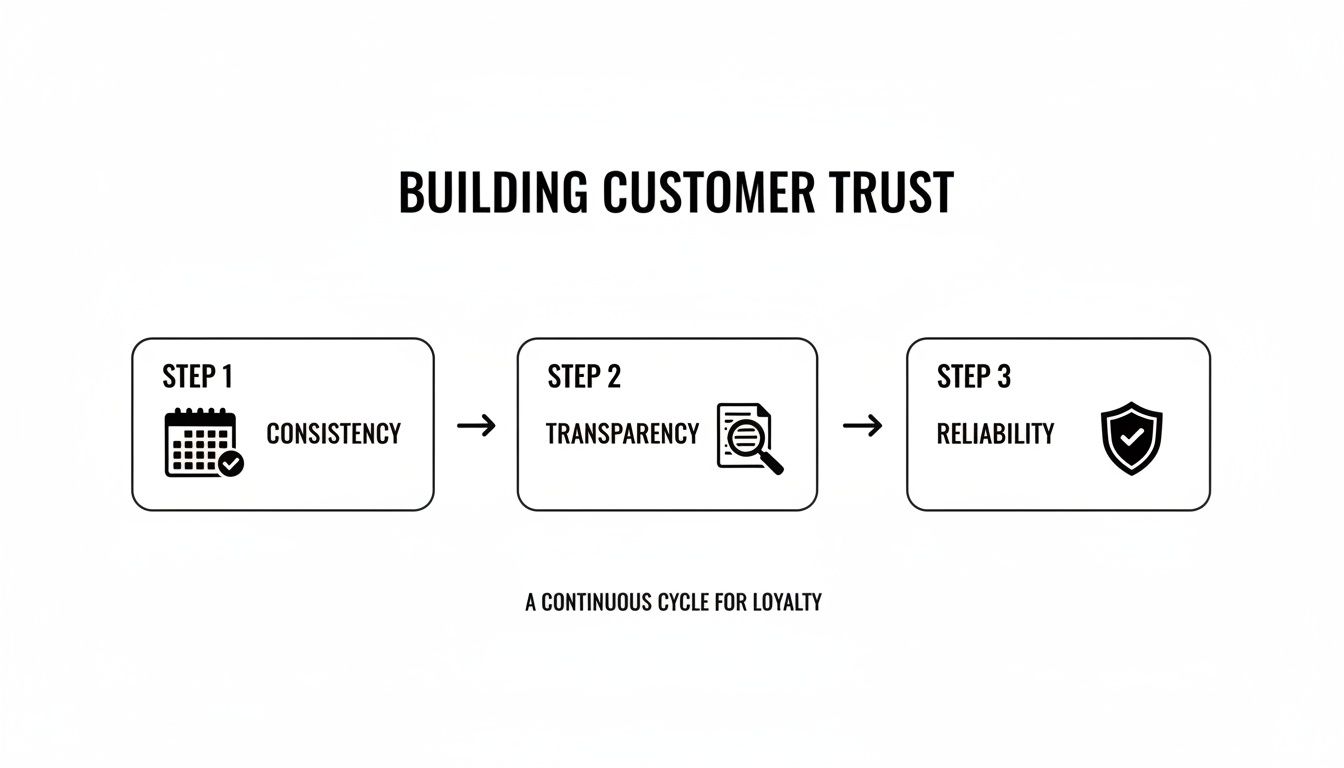
When you systematize your content around these pillars, you create a rhythm that customers learn to depend on.
Systematize Your Content Creation
Once you have your buckets, it's time to build a system that makes being consistent feel almost effortless. This is where a good productivity tool becomes a game-changer, especially for busy founders and small teams. An effective workflow lets you batch-create your content, so you can knock out an entire week or month of posts in a single afternoon.
For example, entrepreneurs can use a tool like Postful to map out a month's worth of social media in just a couple of hours. Its AI features can help brainstorm ideas for each of your content buckets, and the scheduler ensures a steady stream of posts goes live without you having to be online 24/7. You can see exactly how to set this up in our guide on creating a content calendar.
The goal isn't just to be present; it's to be predictably present. A consistent content schedule is a powerful, non-verbal promise to your audience that you are reliable.
This is especially critical today. A recent SBE Council "Check Up" survey found that 71% of small business owners boosted their financial performance by adopting new technologies like AI. For creators and founders trying to build an audience that's wary of sales pitches—where 80% of people ignore calls from unknown numbers—using tools to create an authentic, reliable presence is a massive advantage. You can check out the full 2026 SBE Council report to see how small businesses are getting ahead with technology.
A Simple Workflow to Get You Started
Here’s a practical weekly workflow I recommend to stay consistent without burning out. Just block out three hours.
- First Hour: Brainstorm & Draft. Dedicate one hour to brainstorming ideas for each content bucket. Use a notes app like Notion or Postful’s AI to get a list of topics. Then, write out some rough drafts directly in your scheduling tool.
- Second Hour: Create Visuals. Spend the next hour creating or finding your visuals. This could be a quick graphic in Canva, a photo from your phone, or a short video. Don't stress about perfection; aim for authenticity.
- Third Hour: Schedule & Forget. Plug all your drafted posts and visuals into your scheduling tool. Set each post for its day and time. That’s it.
Your content is now handled for the week. This simple three-hour block builds a predictable presence that shows customers you're a brand they can count on.
Practice Radical Transparency (Without Oversharing)
Let's clear something up: transparency isn't about airing your dirty laundry or live-streaming your board meetings. It's about being strategically open in the ways that actually matter to your customers. It’s about showing them you have nothing to hide—a simple act that builds incredible confidence.
This means sharing your process, your values, and yes, even your mistakes. When a recent study found that 87% of shoppers would pay more to buy from a brand they trust, it confirmed what we’ve seen for years: transparency is a direct line to earning that trust. It turns your brand from a faceless logo into a group of real people doing real work.

Translate Your Policies Into Plain English
One of the quickest wins for building trust is right under your nose: your privacy and return policies. Too often, these are impenetrable walls of legalese that feel designed to confuse, not clarify. This is a huge missed opportunity.
Think of these documents less like a legal defense and more like a conversation with a customer. Ditch the jargon and just be straight with people.
- Your Privacy Policy: Instead of dense clauses, just tell people what data you collect, why you need it, and how you keep it safe. Use simple headings like "What We Collect" and "How We Use Your Info" so people can scan it easily.
- Your Return Policy: Make it dead simple. A big, bold "30-Day, No-Questions-Asked Returns" headline is infinitely more reassuring than a long paragraph full of exceptions and conditions.
Don’t bury these pages. Link them clearly in your footer and even on your product pages. It’s an immediate signal that you respect your customers enough to be upfront.
How to Handle Feedback (The Good and The Bad)
The way you respond to public comments and reviews says everything about your brand's character. Every piece of feedback is a chance to show you’re listening and that you care.
When someone leaves a fantastic review, go beyond a simple "Thanks!" Acknowledge something specific they said.
For praise: "We're so glad you love the [product feature]! Our team spent a ton of time getting that just right, and it’s amazing to hear it’s making a difference. Thanks for being part of our community!"
That kind of personalized response shows a real person is on the other side and makes your customer feel genuinely seen.
Now, for the tough one. A negative review can feel like a punch in the gut, but getting defensive is the absolute worst thing you can do. See it as a public stage to prove you take responsibility.
For criticism: "I'm so sorry to hear about your experience with [the issue]. That's not the standard we aim for, and I completely understand your frustration. I’m sending you a DM right now so we can get this sorted out for you immediately."
This script does three critical things: it validates their feelings, takes ownership, and moves the nitty-gritty details to a private channel while showing everyone else you're on it. This single move can turn a critic into a loyal fan.
Share Your Process and Your "Why"
Finally, pull back the curtain a bit. People want to support businesses that align with their values, and you don’t need some massive social mission to connect with them.
Here are a few simple ways to share your process:
- Show your work. If you're a designer, post a time-lapse video of creating a logo in Figma. If you sell a physical product, share a quick video of your packing station, showing the care you put into each order.
- Explain your "why." Write a post about the problem you were trying to solve when you started your business. People connect with a mission.
- Own your mistakes. Shipment delayed? Don't go silent. Post an update explaining what happened, what you’re doing about it, and when customers can expect a resolution.
This kind of honesty is far more powerful than pretending everything is perfect all the time. Sharing these small moments makes your brand relatable and real—the kind of brand people are proud to trust.
Put Social Proof to Work and Build Credibility
You can talk all day about how great your brand is, but let's be honest—nothing builds trust faster than letting your happy customers do the talking for you. This is the whole idea behind social proof. People trust other people's experiences far more than they'll ever trust an ad.
When someone sees that others have already had a great experience with you, it instantly lowers their guard. It’s a powerful signal that says, "This is a safe choice." For a small business or a solopreneur, a single glowing testimonial can be more powerful than the most expensive marketing copy you could write.
Create a System for Collecting Reviews
The secret to great social proof isn't waiting around for it to magically appear. You have to be proactive and create a simple system to collect it. The absolute best time to ask for a review is right after you’ve delivered a fantastic result and the customer is feeling great about it.
Don’t overthink it. A friendly, automated email sent a few days after a purchase or project wrap-up works wonders.
Here’s a simple template I've seen work really well. Feel free to adapt it:
Subject: A quick question about your experience with [Your Brand]
Hi [Customer Name],
I hope you're loving your new [Product/Service].
We’re a small business, and feedback from customers like you means everything to us. It helps us improve and lets others know what they can expect.
If you have a moment, would you be willing to share your thoughts in a quick review?
[Link to Your Preferred Review Platform]
Thanks so much for your support!
Best,
[Your Name]
This approach is personal, direct, and makes it dead simple for them to help you out. A workflow like this ensures you’ve always got a fresh stream of testimonials to build your credibility.
Turn Customer Wins Into Case Studies
While short reviews are perfect for quick hits of trust, a case study tells a much deeper story. It’s your chance to show how you get results, not just that you get them. This is an absolute must-have for building trust with clients considering a bigger investment.
I've found a simple narrative structure is the most effective way to frame these:
- The Problem: Start by outlining the specific challenge the client was dealing with before they found you. What was their pain point?
- The Solution: Next, walk through how your product or service was the answer. Get specific about your process here.
- The Results: This is where you bring it home with concrete numbers. Did they save 20 hours a week? Did their revenue jump by 15%? Numbers make the success feel real.
- The Client's Words: Finish with a powerful quote from the client that sums up their experience and the impact you had.
This turns a simple success story into a persuasive narrative that proves your value, which is exactly what people are looking for. A recent 2026 report on customer priorities found that quality and genuine service are now more important than price for many consumers. That's a huge opening for small businesses that deliver, especially since 94% of them plan to grow by investing in exactly these kinds of efficiency tools.
Social Proof Strategy Comparison
To make the most of social proof, you need to know which type to use and when. Different formats have different strengths, and collecting them requires slightly different approaches.
| Social Proof Type | Best For | Collection Method | Where to Display |
|---|---|---|---|
| Testimonials/Quotes | Quick, scannable trust signals and overcoming specific objections. | Automated email follow-ups; direct outreach after positive interactions. | Homepage, product/service pages, social media posts, email footers. |
| Reviews & Ratings | Building general credibility and improving local search visibility. | Links on receipts; post-purchase email flows; QR codes in-store. | Product pages, Google Business Profile, third-party review sites. |
| Case Studies | In-depth storytelling for high-ticket items or B2B services. | Interviews with your most successful clients; post-project debriefs. | Dedicated "Case Studies" page, sales proposals, long-form blog posts. |
| User-Generated Content | Showing your product in real-world use; building community. | Branded hashtags; photo contests; encouraging social media tags. | Social media feeds (with credit), product galleries, ad campaigns. |
This table should give you a good starting point for thinking about how to mix and match different strategies. The key is to have a constant flow of different types of proof to appeal to different customers at various stages of their journey.
Show Off Your Social Proof Where It Matters Most
Collecting testimonials is only half the job. You have to put them where people will actually see them. Don't just stick them all on a single "Testimonials" page and call it a day. Sprinkle them throughout your entire customer journey.
- On your homepage: Place a powerful quote right under your main headline.
- On your product pages: Add specific reviews right next to the "Add to Cart" or "Buy Now" button.
- In your social media: Run a "Customer Spotlight" series sharing a great result.
For instance, a freelance consultant could use a tool like Postful to schedule a weekly spotlight. They can easily pair a great client outcome with a direct quote, creating high-trust content that consistently attracts new leads. If you want to dive deeper into this, check out our guide on what social proof is and why it matters.
By strategically placing these endorsements, you’re constantly reinforcing the message that your business is the right choice.
Measure Your Trust Score with Real Metrics
Trust might feel like a fuzzy concept, but its impact on your business is anything but. You can—and absolutely should—measure it with real data. Tracking the right key performance indicators (KPIs) gives you a tangible “Trust Score,” showing you exactly where your hard work is paying off.
This isn’t just a nice-to-have. With customer acquisition costs always climbing, loyalty is your most direct path to sustainable growth. Loyal customers don't just buy from you again; they spend more over time and become your best advocates. The numbers prove it.
Key Metrics to Start Tracking Now
So, how do you actually measure trust? You need a baseline. Let's break down three metrics that paint a clear picture of how much customers trust your brand. These aren't vanity numbers—they're direct signals of customer satisfaction and loyalty.
Customer Retention Rate (CRR): This is the big one. It shows you what percentage of your customers stick around over time. A high CRR is one of the strongest signs of trust. It means people had a good experience and felt confident enough to come back for more.
Net Promoter Score (NPS): This metric gets right to the point by asking one powerful question: "On a scale of 0-10, how likely are you to recommend our brand to a friend or colleague?" Their answers sort customers into Promoters, Passives, and Detractors, giving you a crystal-clear loyalty snapshot.
Social Media Engagement on Value-Driven Content: Forget just tracking likes. Look at the shares, saves, and especially the comments on your educational or behind-the-scenes posts. When people engage with content that isn't a direct sales pitch, it shows they genuinely trust and value what you have to say.
Putting Your Metrics into Action
Getting started is easier than you think. You don't need a fancy, expensive dashboard to begin measuring what truly matters.
For your Net Promoter Score, a simple survey is all it takes. You can whip one up in minutes with a free tool like Google Forms, which is an effective tool for creating simple surveys. To see how it all works and calculate your NPS score, you can find a great walkthrough that breaks it down step-by-step.
Calculating your Customer Retention Rate also uses a pretty straightforward formula. It helps you see the direct financial benefit of all your trust-building efforts. If you want to go deeper, our guide on customer retention strategies for small business has more practical steps you can take.
Tracking these metrics transforms trust from a vague goal into an actual strategy. When you see your NPS improve after being more transparent, or your retention rate climbs after a big push on customer service, you have undeniable proof that what you're doing is building a more resilient business.
By keeping an eye on these numbers, you can draw a direct line from your daily actions—like posting consistent content or being honest about a mistake—straight to your bottom line. This data empowers you to make smarter decisions and double down on what works.
Common Questions About Building Customer Trust
Building trust isn't a simple, one-off task; it's a journey full of practical hurdles. I get asked about this all the time. Here are my honest, straightforward answers to the most common questions business owners face when they're trying to earn their customers' trust.
How Long Does It Take to Build Trust With Customers?
There's no magic number here. Building customer trust is a marathon, not a sprint. You might see some encouraging signs—like better engagement or more positive comments—within a few months of consistent effort. But deep, lasting trust? That’s built over years of keeping your promises.
Think of every single interaction as a brick. A social media reply, a product that arrives on time, how you handle a complaint—each one adds another brick to your foundation. The key is to see it as an ongoing process, not a campaign with a finish line.
What Is the Single Most Important Action for Building Trust?
If I had to pick just one thing, it would be this: be relentlessly reliable. Ship when you say you will. Deliver the quality you promised. Answer questions promptly.
Reliability is the bedrock of trust. All other efforts, like transparency and social proof, crumble if your business isn't dependable at its core. An unreliable brand can never be a trusted one.
It's this consistency that ultimately convinces people you’re a safe bet and worthy of their loyalty. It’s not flashy, but it’s everything.
Can I Use AI to Build Trust or Does It Seem Inauthentic?
Absolutely. AI can be an incredible ally, but only if you use it as a productivity tool, not as a replacement for your own voice. The goal is to let technology handle the grunt work so you have more time for genuine human connection.
I use AI all the time, but strategically. Here's how you can, too:
- Brainstorming Content: Use AI to get ideas flowing for your content buckets when you feel stuck.
- Scheduling Posts: Automate your posting schedule. This helps you show up predictably for your audience, which builds a sense of reliability.
- Drafting Ideas: Turn a rough thought into a first draft. From there, you can edit it down and inject your own personality.
My rule of thumb is to let AI get you 80% of the way there. That last 20% is all you—your unique insights, your tone, your stories. That's the human element that makes it feel authentic.
How Can a New Business Build Trust With No Customers Yet?
When you're just starting out, you have to lean into transparency and 'borrowed' trust. You don't have a track record of customer reviews yet, so you need to find other ways to show you're credible.
Document your journey. Be open about why you started the business, what your mission is, and what happens behind the scenes. This kind of raw, open content helps people connect with the human behind the brand.
At the same time, you can collaborate with a micro-influencer or a complementary business in your niche. Find someone who already has an established, trusted audience. This gives you a bit of initial credibility while you work on earning your own, one customer at a time.
Ready to build a consistent, trustworthy brand presence without the burnout? Postful provides AI-powered brainstorming, simple scheduling, and easy content remixing to help you show up for your audience every day. Turn your work into more business by signing up for free early access.