Tag: content marketing

  • What Is Content Marketing Strategy? A Founder’s Guide to Growth

    What Is Content Marketing Strategy? A Founder’s Guide to Growth

    A content marketing strategy is the documented plan that answers why you create content, who it's for, and how it will actually help you hit your business goals. It's not just about cranking out blog posts or tweets; it's the high-level blueprint that gives every single piece of content a specific, measurable job to do.

    Your Navigational Chart for Business Growth
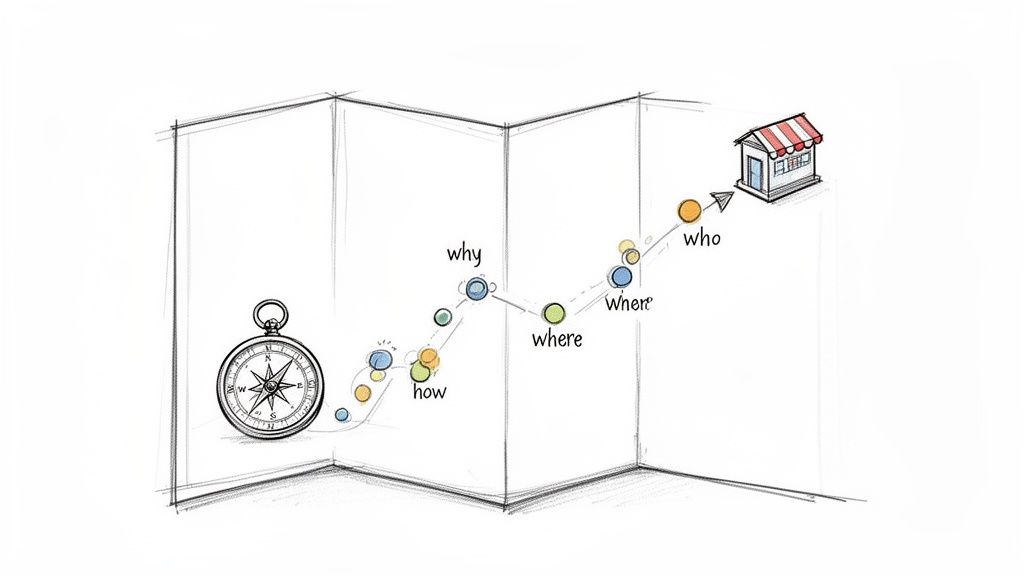
    A hand-drawn map with a compass guides a path of strategic questions toward a destination shop.

    Imagine trying to sail across an ocean with no map, no compass, and no destination in mind. You’d be busy adjusting the sails and steering the ship, but you'd be adrift—burning through time and resources without getting anywhere. That’s exactly what creating content without a strategy feels like.

    A lot of founders fall into the "random acts of content" trap. They post a blog here, a tweet there, and just hope for the best. A content marketing strategy is what replaces that hope with a clear, documented plan. It's the difference between being busy and being productive.

    A content marketing strategy is your answer to the question, "Why are we even doing this?" It forces you to connect every piece of content back to a real business outcome, turning your marketing from a shot in the dark into a predictable growth engine.

    This plan doesn't need to be some complicated, hundred-page document. For a lean startup, it can live on a single page. Its only purpose is to bring clarity and direction, making sure every marketing action you take moves you closer to your ultimate goal—whether that's more sales, better brand visibility, or a loyal community.

    To get started, we can break down a solid strategy into four core components. Think of them as the essential pillars holding everything up.

    The Four Pillars of a Content Marketing Strategy

    This table gives you a high-level look at the key questions your strategy needs to answer. We'll dive deep into each one throughout this guide.

    Pillar What It Answers Practical Example
    Audience & Goals Who are we trying to reach, and what do we want them to do? Reaching freelance graphic designers to generate 20 demo requests per month.
    Content Creation What kind of content will resonate with them and achieve our goals? Creating blog posts about "How to Price Design Projects" to solve their problems.
    Content Distribution Where and how will we get this content in front of them? Promoting the posts on LinkedIn and in design-focused online communities.
    Measurement & KPIs How will we know if any of this is actually working? Tracking demo sign-ups from blog traffic using Google Analytics goals.

    With these pillars in place, every marketing decision becomes simpler and more effective. You're no longer just guessing; you're executing a plan.

    Moving From Tactics to Strategy

    It’s incredibly easy to confuse content tactics with content strategy. Tactics are the individual actions you take, while the strategy is the overarching vision that guides every single one of those actions.

    • Tactic: Publishing three blog posts per week.
    • Strategy: Becoming the go-to educational resource for early-stage B2B SaaS founders to increase organic search traffic by 40% in six months and generate qualified leads.

    See the difference? The tactic is just an activity. The strategy connects that activity to a specific audience, a clear goal, and a measurable outcome. For startups with tight budgets and even tighter schedules, this distinction is everything. You just don't have time to waste on tactics that don't serve the bigger picture.

    For instance, the founder of a new project management tool could build a strategy around helping freelance graphic designers improve their client management skills. Their content would then zero in on designer pain points with articles like "5 Ways to Automate Client Onboarding" or "How to Create Project Timelines Clients Actually Understand."

    Every single piece of content reinforces their position as a helpful expert for that specific niche. As you build out your own plan, our guide to content marketing for startups offers a focused look at executing this for new ventures. This strategic approach ensures you aren't just creating more noise—you're building a valuable resource that naturally pulls in your ideal customers.

    Why Founders Need a Strategy Before Creating Any Content

    Jumping into content creation without a strategy is like trying to build a house without a blueprint. Sure, you can buy the best materials and hire a skilled crew, but you’ll end up with a chaotic, expensive mess that doesn't actually work.

    For founders, every hour and every dollar is precious. This kind of wasted effort isn't just a mistake—it's a potential death sentence for a growing business.

    A content marketing strategy isn’t some "nice-to-have" document you create once and forget about. It's the critical first step that turns your marketing from a cost center into a predictable way to bring in revenue. It ensures every single blog post, video, or social update has a specific job to do, tying your efforts directly to what matters most: your business goals.

    Stop Wasting Time and Start Building Assets

    Without a clear plan, founders almost always fall into the trap of "random acts of content." You write a blog post because you feel you should. You post on social media because someone said it was important. This burns through your most limited resources—time and focus—with very little to show for it.

    A strategy forces you to be intentional. Instead of asking, "What should I post today?" you start with much bigger questions that lead to work that actually moves the needle:

    • Who is my absolute ideal customer? Not a vague demographic, but a real person with a specific problem you are uniquely positioned to solve.
    • What business goal will this piece of content help me achieve? Is it about attracting investors, getting qualified leads, or maybe even reducing customer churn?
    • How will I know if this worked? What specific metric will I track to measure success?

    Productivity Tip: Create a simple content brief template in Notion or a Google Doc that forces you to answer these three questions before you write a single word. This five-minute workflow prevents hours of wasted effort on content that misses the mark.

    Answering these questions upfront stops you from creating content that serves no real purpose. Every article, every post becomes a valuable asset that works for your business 24/7, long after you hit "publish."

    A content strategy provides the focus needed to turn marketing activities into business outcomes. It’s the framework that separates founders who are just busy from founders who are building a sustainable growth engine.

    Tangible Business Outcomes of a Solid Strategy

    Investing time in a strategy isn't just about avoiding mistakes; it's about unlocking massive opportunities. The global content marketing market was valued at $413.2 billion in 2022 and is projected to skyrocket to a staggering $2 trillion by 2032. You can dig into the numbers in this in-depth analysis of content marketing trends.

    This explosive growth is proof: when done right, content delivers a powerful ROI. For a founder, a smart strategy can produce concrete, game-changing results.

    1. Builds Unshakeable Brand Authority: Consistently publishing valuable content positions you as the go-to expert in your niche. This authority not only attracts customers but also makes your startup far more appealing to potential investors and partners.
    2. Generates a Consistent Flow of Qualified Leads: When you create content that directly addresses your ideal customer's pain points, you attract people who are actively looking for your solution. This is the difference between chasing cold leads and having warm prospects come directly to you.
    3. Dominates Niche Search Rankings: A strategic approach to content is the backbone of modern SEO. It helps you rank for the keywords your customers are actually searching for, creating a reliable, long-term source of free organic traffic.
    4. Cultivates a Loyal Community: Great content builds a real relationship with your audience. It fosters trust and turns one-time customers into loyal advocates who champion your brand and fuel its growth for the long haul.

    The Six Building Blocks of a Winning Content Strategy

    A powerful content strategy isn't some abstract document you create once and forget. It's a practical blueprint made of distinct, interconnected pieces. Think of it like assembling a high-performance engine: each part has a specific job, and they all have to work together perfectly to get you where you want to go.

    For a founder or a small team, breaking it down into these six building blocks makes the whole process feel manageable, actionable, and a lot less intimidating. This framework turns your content from a bunch of random tasks into a cohesive system built for growth.

    Let's walk through each component, one by one.

    1. Pinpoint Your Ideal Audience

    Before you write a single word, you have to know exactly who you're talking to. Creating content without a clear audience is like shouting into a crowded room and just hoping the right person hears you. It’s a massive waste of time and energy.

    Your goal is to get past vague descriptions and build a simple, functional customer persona. This isn't some complex academic project; it's a practical tool to keep you laser-focused.

    Actionable Prompts for Your Persona:

    • Role & Industry: What's their job title? Where do they work? (e.g., "Founder at a marketing agency," "Freelance graphic designer").
    • Primary Goal: What’s the one big thing they're trying to accomplish in their job? (e.g., "Land more high-ticket clients," "Streamline project delivery").
    • Biggest Pain Point: What's the single biggest roadblock stopping them from hitting that goal? (e.g., "Struggles with inconsistent lead flow," "Wastes too much time on admin tasks").
    • Where They Learn: Where do they actually go for information? (e.g., LinkedIn, specific industry blogs, YouTube tutorials, podcasts).

    Productivity Tip: Don't get stuck here. Spend 30 minutes creating a "good enough" persona. You can refine it later based on real data and customer conversations. A simple bulleted list is more useful than a fancy document you never look at.

    This simple persona—let's call her "Melanie, the marketing agency founder"—instantly gives your content direction. Now you know her problems, and you know where to find her.

    2. Set Measurable SMART Goals

    Your content needs a job. Vague goals like "increase brand awareness" are impossible to track and usually lead nowhere. Instead, use the SMART framework to set clear, motivating targets that actually connect to your business.

    • Specific: What, exactly, do you want to achieve?
    • Measurable: How will you track progress?
    • Achievable: Is this realistic with the resources you have right now?
    • Relevant: Does this actually support a bigger business objective?
    • Time-bound: When will you get this done?

    Bad Goal: "Get more traffic to our website."
    SMART Goal: "Increase organic blog traffic by 25% over the next quarter by publishing eight SEO-optimized articles targeting long-tail keywords relevant to our ideal customer."

    That level of clarity is a game-changer. It tells you exactly what to work on and gives you a clear finish line to aim for.

    3. Choose Your Core Content Channels

    As a founder, you can't be everywhere at once. Trying to post on every social media platform is a fast track to burnout and mediocre results. The secret is to choose one or two core channels where your ideal audience hangs out and go all-in on them.

    Go back to your persona. If "Melanie" spends her time on LinkedIn and reads industry newsletters, then that’s where you need to be. Forget about TikTok or Pinterest if your audience isn't there.

    Practical Example: A B2B SaaS company targeting sales leaders might choose LinkedIn as their primary channel and an SEO-focused blog as their secondary. They can completely ignore platforms like Instagram and Facebook to conserve their resources and maximize impact where it counts.

    For many founders, especially those building a professional network, understanding how a platform really works—like with a comprehensive LinkedIn content strategy for 2025—is the key to growth. Mastering one channel is way more powerful than being just okay on five.

    4. Plan Your Content Formats and Pillars

    Okay, you know who you’re talking to and where you’ll find them. Now, what are you actually going to create? The formats you choose should match your audience's habits and your channels' strengths. LinkedIn, for instance, loves text posts and short videos, while a blog is the perfect home for deep-dive articles.

    To keep your content consistent and build real authority, organize everything around content pillars. These are just 3-5 broad topics that your brand will own. For a project management tool targeting freelancers, your pillars might be:

    • Client Management
    • Project Scoping & Pricing
    • Productivity Workflows
    • Financial Management for Freelancers

    These pillars become the foundation for all your ideas. If you want to go deeper, you can learn how to develop strong content pillars to guide your entire process. This approach ensures every single piece of content reinforces your expertise.

    5. Build a Realistic Content Calendar

    A content calendar is the tool that turns your strategy into reality. It’s a simple schedule that maps out what you’re publishing, where you're publishing it, and when. This isn't about creating some rigid, unbreakable plan; it's about building a system for consistency.

    Consistency is probably the single most important factor in content marketing. A calendar kills the daily stress of "What should I post today?" and opens the door for productive workflows like content batching—where you create a week's worth of posts in a single sitting.

    Here’s an example of what a simple calendar in a tool like Postful might look like.

    Productivity Workflow: Use a tool like Trello, Asana, or a dedicated content scheduler like Postful. Create columns for "Ideas," "In Progress," "Ready for Review," and "Scheduled." This visual workflow makes it easy to see your content pipeline at a glance and stay ahead of your publishing schedule.

    This kind of visual planner helps you see your entire schedule at a glance, making sure you have a good mix of topics and formats lined up.

    6. Define Your Key Metrics for ROI

    Finally, you need to know if any of this is actually working. Your key performance indicators (KPIs) should tie directly back to the SMART goals you set earlier. Don't get distracted by vanity metrics like "likes" unless they are a direct path to a real business outcome.

    Focus on the numbers that prove your return on investment (ROI):

    • For Traffic Goals: Track Organic Traffic, Unique Visitors, and Time on Page.
    • For Lead Generation Goals: Measure Email Signups, Gated Content Downloads, and Demo Requests.
    • For Authority Goals: Monitor Keyword Rankings, Backlinks Earned, and Social Media Shares.

    Productivity Tip: Create a simple monthly performance dashboard in a Google Sheet. Spend 30 minutes at the start of each month pulling in your key metrics from Google Analytics and your social platforms. This quick routine keeps you focused on what's working and prevents you from getting lost in data.

    This data is your feedback loop. It tells you what’s hitting the mark with your audience so you can do more of what works and cut what doesn't.

    Putting Your Content Strategy into Action

    A well-documented strategy is a powerful asset, but it’s worthless if it just collects dust. The real test is turning those ideas and plans into consistent, high-impact content.

    This is where many founders get stuck—the leap from planning to doing feels overwhelming. The secret is to think of your strategy as a recipe, and your execution as the actual cooking.

    To make this tangible, let’s see how different businesses would apply the building blocks we’ve discussed. A strategy isn't a one-size-fits-all template; it has to be shaped around your specific audience, goals, and resources.

    Examples of Content Strategies in Practice

    Here’s how three distinct businesses might define their content strategy, showing how the core components change based on context.

    1. The B2B SaaS Startup (Project Management Tool)

    • Audience: Overwhelmed freelance project managers struggling to scale their client work.
    • Goal: Generate 50 qualified demo requests per month through organic search within six months.
    • Channels: A highly focused SEO-driven blog and a strong presence on LinkedIn.
    • Content: In-depth, practical blog posts like "How to Create a Project Scope That Prevents Scope Creep" and "5 Client Onboarding Templates for Freelancers." On LinkedIn, they’d share bite-sized tips from these articles and engage in conversations within freelancer communities.

    2. The Freelance Consultant (Brand Strategist)

    • Audience: Early-stage DTC founders who need branding help but have a limited budget.
    • Goal: Build a waitlist of 10 potential clients for a new group coaching program over the next quarter.
    • Channels: A weekly email newsletter and short-form video on Instagram Reels.
    • Content: The newsletter would offer exclusive branding tips and case studies. Instagram Reels would feature quick, engaging videos like "3 Common Branding Mistakes New Founders Make" to drive newsletter sign-ups.

    3. The Direct-to-Consumer Brand (Sustainable Home Goods)

    • Audience: Eco-conscious millennials who value aesthetics and transparency in the products they buy.
    • Goal: Increase social media engagement by 30% and drive $10,000 in attributed sales from social channels.
    • Channels: Instagram and Pinterest.
    • Content: Visually stunning user-generated content, behind-the-scenes looks at their sustainable production process, and "how-to" guides for creating an eco-friendly home.

    Each of these examples connects a specific audience to a measurable goal using focused channels and relevant content formats. This targeted approach prevents wasted effort and ensures every piece of content has a clear purpose.

    A Simple Workflow for Consistent Execution

    Now that you see how a strategy looks in the real world, how do you execute it without getting bogged down? A simple, repeatable workflow is your best friend.

    This five-step cycle turns your strategy into a productive, ongoing process.
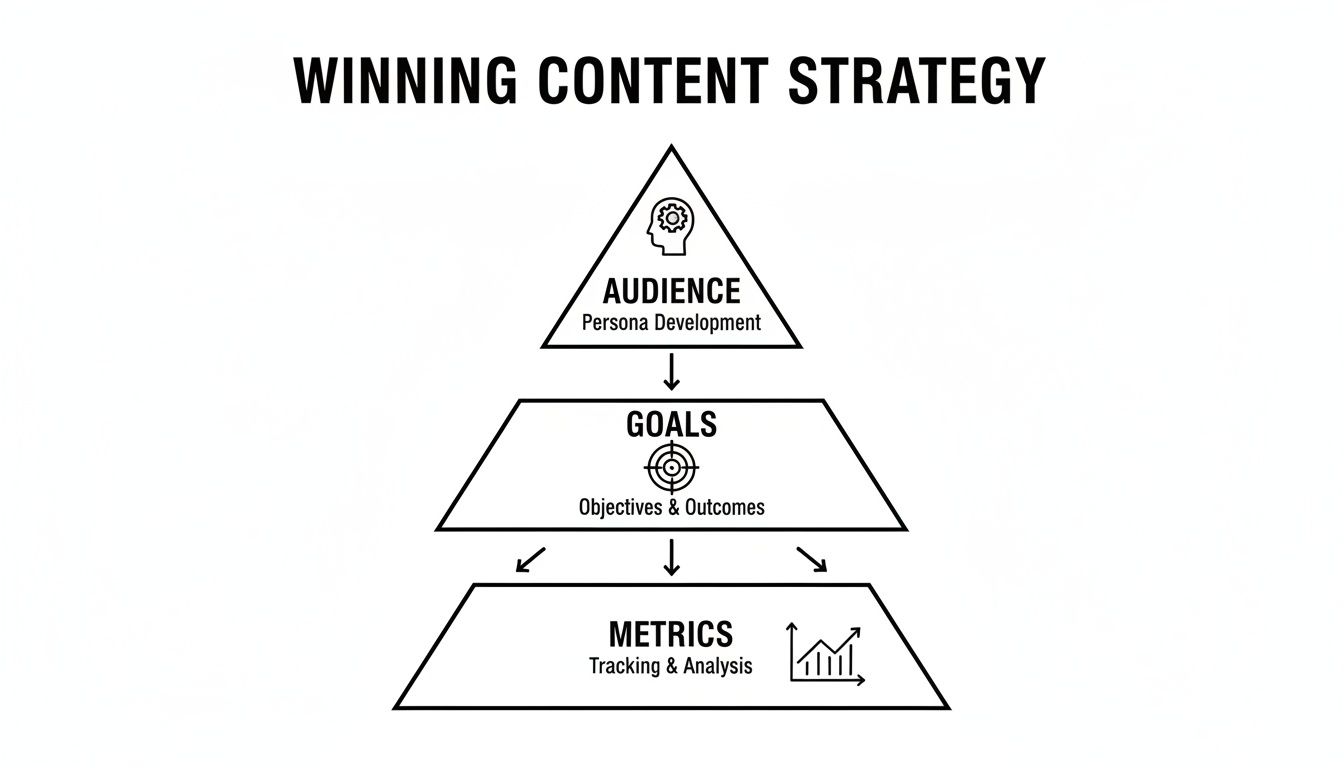
    A pyramid diagram illustrating a winning content strategy, starting with audience, then goals, and finally metrics for analysis.

    This visual just reinforces that everything flows from knowing exactly who you're serving. Without that foundation, your goals and metrics become meaningless.

    Here’s the workflow:

    1. Ideate: Brainstorm content ideas based on your content pillars and audience persona. What problems can you solve for them this week?
    2. Create: Develop the content. This could be writing a blog post, recording a video, or designing an infographic.
    3. Distribute: Publish your content on your chosen channels. This step also includes promotion—sharing it in your newsletter or with partners.
    4. Measure: Track your key metrics. Did the content help you move closer to your SMART goal?
    5. Iterate: Use the data you gathered to make your next piece of content even better. Double down on what works and cut what doesn’t.

    This isn’t a one-time process; it’s a continuous loop of learning and improvement.

    Boosting Productivity with Modern Tools

    For a founder or small team, executing this workflow consistently is the biggest challenge. This is where modern tools can be a massive productivity multiplier, automating the tedious stuff and freeing you up to focus on high-value work.

    A great strategy combined with the right tools creates leverage. You can achieve the impact of a much larger team by automating the manual work that causes burnout and inconsistency.

    Tools like Postful are designed to remove friction from this process. Instead of staring at a blank page, you can get curated content ideas tailored to your audience. When it’s time to create, you can use AI-powered brainstorming features to refine your message.

    Most importantly, you can schedule everything in advance, which is the key to maintaining a consistent presence without the daily grind. Efficient scheduling is made even simpler when you understand what is a content calendar and how to use one effectively.

    To really put your strategy into action, consider exploring the top AI tools for content marketing. By building a system around a clear workflow and the right tools, you can finally bridge the gap between having a strategy and seeing it deliver real, measurable results for your business.

    Common Mistakes That Wreck Content Strategies

    An illustration contrasting mistakes (crossed-out notes, warning sign, broken clock) with fixes (calendar, checkmark, organized files).

    Even the smartest strategy can fall apart when it runs into a few common, totally avoidable roadblocks. For founders already juggling a dozen other jobs, these pitfalls are especially painful because they burn up your two most valuable resources: time and focus.

    The good news? You don't have to learn these lessons the hard way. This section is your troubleshooting guide. We’ll break down the traps that derail most content plans and give you straightforward fixes to keep you moving forward.

    Mistake 1 Inconsistent Publishing

    The fastest way to lose momentum is to be inconsistent. Firing off three blog posts one week and then going completely silent for a month just confuses your audience and the search algorithms. People build trust through reliability, and algorithms reward a steady rhythm.

    This "feast or famine" posting schedule is almost always a symptom of a broken workflow. Without a system in place, creating content feels like a constant, last-minute scramble.

    The Fix Content Batching and Scheduling
    Stop trying to create content on the fly. Instead, block out a dedicated chunk of time each week or month to "batch" your work. For example, you could spend one afternoon writing four weekly blog posts or recording a handful of short-form videos.

    • Productivity Workflow: A tool like Postful is perfect for this. You can schedule your entire batch of content in a single session. This frees up your brain for the rest of the month, knowing your marketing is running on autopilot.
    • Practical Example: A SaaS founder could dedicate the first Monday of every month to writing and scheduling all of their LinkedIn posts for the next 30 days. It guarantees a consistent presence without the daily pressure.

    Mistake 2 Creating for the Wrong Audience

    This one is subtle, but it's a killer. You might be creating beautifully written, well-researched content, but if it doesn't solve a real problem for your ideal customer, it will land with a thud. This usually happens when founders write about what they think is interesting, not what their audience is actually searching for.

    Every single piece of content you produce has to answer your audience's unspoken question: "What's in it for me?"

    The Fix Revisit Your Persona Constantly
    Your customer persona isn't a "set it and forget it" document. It's a living guide. Before you start creating anything new, ask yourself these simple questions:

    • Does this solve a problem my ideal customer actually has right now?
    • Is this a topic they are actively looking for answers to?
    • Will this get them one step closer to one of their goals?

    This simple check gives every piece of content a clear purpose. It shifts your mindset from "I need to create content" to "I need to create a valuable resource that helps a specific person solve a specific problem."

    Mistake 3 Neglecting Content Distribution

    Hitting "publish" isn't the finish line—it's the starting gun. So many founders spend 90% of their energy creating content and only 10% promoting it. That ratio needs to be flipped. The "if you build it, they will come" fantasy just doesn't work anymore. A brilliant article that nobody ever sees is a wasted effort.

    Your distribution plan is just as critical as your creation plan. Ignoring it is one of the most common reasons an otherwise solid content strategy completely fails to get results.

    The Fix The 80/20 Rule of Promotion
    Adopt the 80/20 rule: spend 20% of your time on creation and 80% on distribution. This simple shift forces you to squeeze more value out of every single asset you produce.

    • Actionable Workflow: For every blog post you write, create a simple promotion checklist.
      1. Share it on your main social channels.
      2. Send it out to your email list.
      3. Chop up key insights into a LinkedIn carousel or an Instagram Reel.
      4. Drop a link in relevant online communities or forums where your audience hangs out.

    This systematic approach makes sure all your hard work actually reaches the people you created it for.

    Your Content Strategy Questions, Answered

    Even with the best blueprint, questions pop up. I get it. This last section is a quick-fire round to tackle the most common things I hear from founders and small teams as they start putting their content strategy into action.

    Let's clear up any lingering doubts so you can move forward.

    How Long Does This Actually Take?

    Let's be real: content marketing is a marathon, not a sprint. While you might get a few small wins early on, seeing real, meaningful results—like a steady flow of organic leads or top search rankings—usually takes 6 to 12 months of consistent work. You're building an asset, and that takes time.

    In those first few months, the key is to watch the leading indicators. These are the small signals telling you you're on the right track:

    • Is website traffic growing? Are more people finding your blog?
    • Is social engagement up? Are people commenting, sharing, and clicking?
    • Are you getting new email subscribers? Is your content valuable enough for them to sign up?

    Tracking these early metrics will keep you motivated while the big wins, like new customers, are building in the background. Remember, consistent effort over a long time beats short, intense bursts of activity every single time.

    How Much Should a Startup Budget for Content?

    There’s no magic number here. A common rule of thumb for small businesses is to put 10% to 30% of their total marketing budget toward content. But for a founder, the "budget" is usually more about time than money, especially when you're just starting out.

    The most important thing is to be realistic. It’s far better to pick one or two channels and be incredibly consistent there than to spread yourself thin across five.

    Focus your limited resources—whether that's your time or your cash—on creating genuinely valuable content for that single channel. Once you've mastered that, you can think about expanding. You can stretch your time budget a lot further by using tools that help you create and publish more efficiently.

    Content Strategy vs. Content Plan—What's the Difference?

    This is a classic point of confusion, but the distinction is simple and super important for staying organized. Think of it like building a house: the strategy is the architect's blueprint, while the plan is the construction crew's daily schedule.

    • A Content Strategy is your high-level vision. It’s the why, the who, and the what. It defines your goals, your audience, your core topics, and the unique value you're bringing to the table. This is your foundation—it shouldn't change much.
    • A Content Plan is the tactical execution. It's the how and the when. This is your content calendar, with specific topics, formats, keywords, and publish dates mapped out. Your plan is flexible and will evolve from week to week.

    Your strategy guides every decision you make in your plan. You absolutely need both. The strategy gives you direction, and the plan makes sure you actually get there.


    Ready to turn your strategy into consistent action? Postful is the AI-powered social media tool built for founders and doers. Stop staring at a blank page and start growing your reach with curated ideas and automated workflows. Join the waitlist at https://postful.ai to secure your early access.

  • What is a Thread on Social Media?

    What is a Thread on Social Media?

    This article was assisted with AI. We may include links to partners.

    A thread is a series of connected posts that together form a longer piece of content, allowing creators to share extended thoughts, stories, or explanations in a structured and engaging way.

    Unlike a single post, a thread links multiple updates together so followers can easily follow along with a narrative or breakdown. This format helps creators share in-depth insights without overwhelming audiences, building anticipation and deeper engagement across platforms like X (formerly Twitter), Instagram, and Threads by Meta.

    Why Threads Matter

    Threads are powerful because they:

    • Encourage longer engagement: Audiences scroll through multiple connected posts instead of skimming a single one.
    • Improve clarity: Breaking complex topics into smaller parts improves understanding and retention.
    • Build narrative momentum: Each post naturally leads to the next, keeping readers interested.
    • Increase reach: Every post in the thread can be liked, commented on, or shared, expanding visibility.
    • Establish authority: Sharing detailed, structured insights positions you as a thought leader.

    In short, threads let creators and brands tell richer stories, one post at a time.

    Examples Across Platforms

    X (Twitter)

    On X, a thread is a series of linked posts that expand on a topic. Creators use them to:

    • Break down tutorials or guides
    • Share minute-by-minute updates (e.g., news coverage)
    • Tell personal or professional stories
    • Build serialized educational content

    Example: A marketing consultant could post a 10-part thread on “How to Build a 30-Day Content Plan,” with each tweet covering one actionable step.

    Instagram and Threads by Meta

    On Instagram, threads take form through carousel posts (multi-image posts users swipe through) or Stories, both allow connected storytelling.
    On Threads (Meta’s text-based platform), sequential posts function much like on X, ideal for sharing commentary or micro-stories.

    Example:

    • A fashion brand uses a carousel post to showcase a new collection, each slide telling part of the brand story.
    • A personal trainer creates a Threads series walking followers through a 7-day fitness challenge.

    Why Threads Work

    Threads succeed because they align with how audiences consume content today, in short bursts with clear continuity.

    They combine storytelling with structure, making them effective for:

    • Educators who want to simplify complex concepts
    • Marketers building thought leadership
    • Small businesses sharing brand journeys or customer stories
    • Creators delivering serialized or episodic content

    Each post in a thread acts as a new opportunity for engagement (e.g. more likes, comments, and shares) amplifying reach over time.

    How to Craft Effective Threads

    1. Start with a strong hook: The first post should instantly grab attention and preview what’s to come.
    2. Build logically: Each subsequent post should flow naturally, adding depth without redundancy.
    3. Use visuals: Add images, infographics, or short videos to make content more engaging.
    4. Include clear takeaways: Summarize key points or lessons as you go.
    5. End with a CTA: Encourage replies, shares, or links to deeper content.

    Strategic Use of Hashtags and Mentions

    Enhance visibility by:

    • Including relevant hashtags to make your thread discoverable.
    • Tagging influencers or collaborators to extend reach.
    • Linking to related posts or previous threads to maintain continuity.

    A strategic combination of hashtags and mentions can multiply impressions and help your content reach new audiences.

    Measuring and Refining Your Thread Strategy

    Track key performance metrics such as:

    • Engagement rate per post (likes, replies, shares)
    • Average thread completion rate (how far users read)
    • Follower growth after a thread launch
    • Referral traffic if linking to external content

    Integrating Threads Into Your Content Strategy

    Threads shouldn’t exist in isolation; they’re most effective as part of your broader social media plan. Use them to:

    • Introduce long-form blog posts or case studies
    • Expand on key campaign messages
    • Share behind-the-scenes insights or customer journeys
    • Repurpose top-performing threads into carousels, reels, or short-form videos

    Key Takeaways

    • A thread is a series of connected posts used for storytelling, education, or commentary.
    • Threads drive engagement and retention by breaking information into digestible parts.
    • Platforms like X, Instagram, and Threads each support thread-style storytelling.
    • Use hooks, visuals, and clear CTAs to maximize impact.

    Try Postful today and create, schedule, and repurpose threads that tell your story and grow your audience across every channel.

  • What Is Brand Voice and How Do You Find Yours?

    What Is Brand Voice and How Do You Find Yours?

    Think of your brand's voice as its personality. It’s not about what you say, but how you say it. It’s the distinct style, the specific words you choose, and the overall feeling you leave with your audience. Is your brand the witty, sharp-tongued friend or the wise, reassuring mentor? That's brand voice in a nutshell.

    What Is Brand Voice and Why It Matters

    If your favorite brand were a person, who would they be? Are they rebellious and clever like Oatly? Or are they all about inspiration and drive, like Nike? That unique character is their brand voice. It’s the human touch that turns a faceless company into something relatable, something your audience can actually connect with.

    This isn't just about sounding good—it's a core part of your business strategy. A clear, consistent voice makes your brand instantly recognizable, sometimes even without your logo. That consistency builds trust, which is the foundation of any loyal community. In a market where everyone is shouting for attention, a memorable voice helps you cut through the noise and attract the right people.

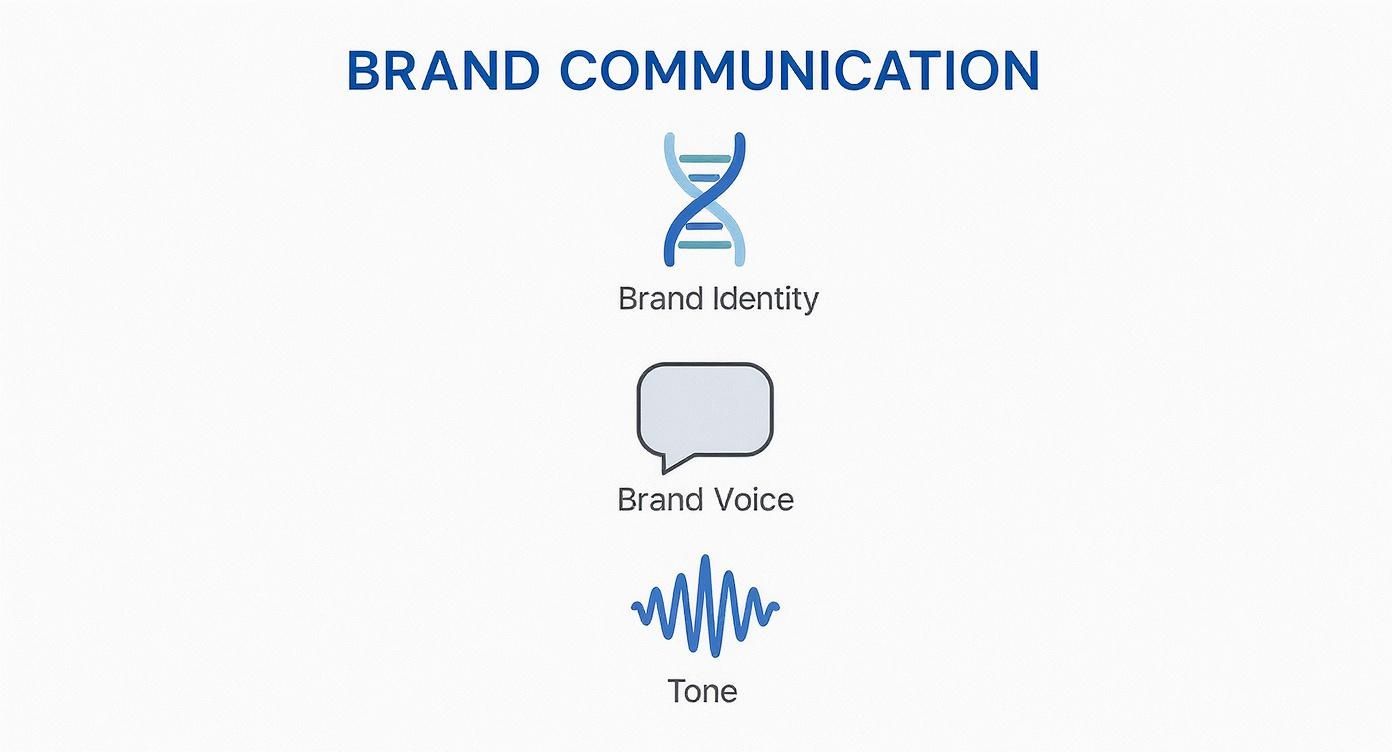
    This diagram shows how your brand voice fits into your bigger communication picture, starting with your core identity.

    A diagram illustrating brand communication components: Brand Identity, Brand Voice, and Tone with icons.

    As you can see, your fundamental Brand Identity (the who) informs your consistent Brand Voice (the how), which then adapts its Tone for different situations.

    The Real Impact of a Consistent Voice

    People often talk about consistency, but what does it actually do? When your social media posts, emails, and website all sound like they came from the same person, you create a seamless experience for your customers. It feels reliable and trustworthy.

    The numbers back this up. Businesses that maintain a consistent brand presentation can see their revenue jump by up to 33%. This happens because a clear, authentic voice makes customers feel more connected and confident in their choices.

    To help clear things up, here’s a quick breakdown of how brand voice, tone, and brand identity all work together. They're often mixed up, but each has a distinct role.

    Brand Voice vs Tone vs Brand Identity

    Concept What It Is Example
    Brand Identity The visual and foundational elements of your brand. Your logo, color palette, and core mission statement.
    Brand Voice Your brand’s consistent personality across all communication. A witty, clever, and informal personality (like Wendy's).
    Tone The emotional inflection of your voice, adapted for specific situations. Using an apologetic and serious tone to address a customer complaint.

    Think of it this way: Your identity is what you look like. Your voice is how you talk all the time. Your tone is how you adjust your voice when you're happy, serious, or excited.

    Ultimately, a strong brand voice is a must-have for your marketing. It's how you build real relationships, make your content hit harder, and is a key driver in how you can increase brand awareness over the long haul. Without it, your messages can feel disconnected and flat, making it nearly impossible to build a loyal following.

    How to Define Your Brand Voice in Four Steps

    Alright, let's get practical. It's one thing to talk about brand voice in theory, but it's another thing entirely to actually build one. A voice that lives only in a slide deck is a voice that nobody will ever use.

    So, here’s a straightforward, four-step process to help you workshop a brand voice that’s authentic, memorable, and dead simple for your team to use every single day.

    Just remember, your brand's voice doesn't come out of thin air. It’s a direct extension of your core strategy. A great perspective on how strategy translates into brand language points out that your voice should feel like a natural part of who you are as a business.

    Illustration of a person with thought bubbles representing a brand's voice elements: happiness, identity, and communication.

    Step 1: Start with Your Mission and Values

    Your brand voice has to be anchored to your “why.” If it isn’t, it will ring hollow and feel completely disconnected from everything else you do. So, the first move is to revisit your core mission and values—those guiding principles behind every decision you make.

    Get your team together and ask some big questions:

    • Beyond making money, why do we exist?
    • What promises are we making to the people we serve?
    • What are the core beliefs we’ll never, ever compromise on?

    Productivity Tip: Create a shared document (like a Google Doc or Notion page) with these questions and ask team members to add their thoughts before the meeting. This saves time and ensures you get more authentic, unfiltered ideas to kickstart the discussion.

    Step 2: Pinpoint Your Audience

    You can’t have a good conversation if you don’t know who you’re talking to. To craft a voice that truly connects, you have to get inside your audience's head. And I don’t just mean demographics like age or location. You need to go deeper.

    What do they care about? What keeps them up at night? How do they talk to their friends? Are they looking for a serious expert or a friendly guide who’s been in their shoes? Mapping this out gives you a clear picture of the person on the other side of the screen.

    Practical Example: A B2B software company might discover their audience (busy project managers) avoids corporate jargon and appreciates direct, benefit-driven language. They don't want to hear about "synergistic paradigms"; they want to know how the tool will save them 10 hours a week.

    If you want to get more structured with this, our guide on what is a user persona can help you build out a detailed profile.

    Step 3: Describe Your Brand as a Person

    This is the fun part, where your voice starts to feel real. If your brand walked into a room, who would it be? Use descriptive adjectives to bring its personality to life. Is it playful? Authoritative? A little quirky? Or maybe more serene?

    Pro Tip: Try a "This, Not That" exercise with your team. Is your brand more like a helpful librarian or a brilliant professor? A funny best friend or a cool older sibling? This comparative approach quickly helps you zero in on the right personality traits.

    Pick three or four core traits that really nail the essence of your brand. A fintech startup might go with: Empowering, Clear, and Trustworthy. A local coffee shop, on the other hand, might choose: Warm, Creative, and Community-Focused.

    Step 4: Create a Brand Voice Chart

    Now it’s time to turn those adjectives into a practical, everyday tool. A brand voice chart is your secret weapon for consistency. It’s a simple but incredibly powerful guide that gives your team clear do's and don'ts, taking all the guesswork out of content creation.

    This chart makes sure everyone—from the person running your social media to the one answering customer emails—is speaking the same language.

    Here’s a quick example for a brand whose voice is "Playful & Encouraging":

    We Are… We Are Not…
    Playful Silly
    ✓ Use witty wordplay and smart pop culture references. ✗ Use childish jokes or unprofessional slang.
    Encouraging Patronizing
    ✓ Celebrate small wins and cheer on progress. ✗ Talk down to users or oversimplify concepts.
    Enthusiastic Hyperbolic
    ✓ Use exclamation points and positive language. ✗ Make unrealistic promises or use excessive hype.

    This simple chart becomes your single source of truth. It transforms your brand voice from an abstract idea into a practical tool that makes your team more efficient and keeps your communication sharp and consistent across the board.

    Inspiring Brand Voice Examples from Top Companies

    Theory is one thing, but seeing a great brand voice in the wild is where it all clicks. When you see how successful companies craft their personalities, you get a real-world blueprint for building your own.

    Let's break down how three very different brands—Duolingo, Nike, and Oatly—use a unique voice to build massive, loyal followings.

    A powerful voice makes you instantly recognizable. Think about it: brands with a strong, consistent voice are 2.5 times more likely to be recognized by people without even seeing a logo. One survey found that a whopping 74% of people could identify a brand just from its content when the voice was clear. That’s how much personality matters. If you want to dive deeper, you can explore the research on brand voice recognition.

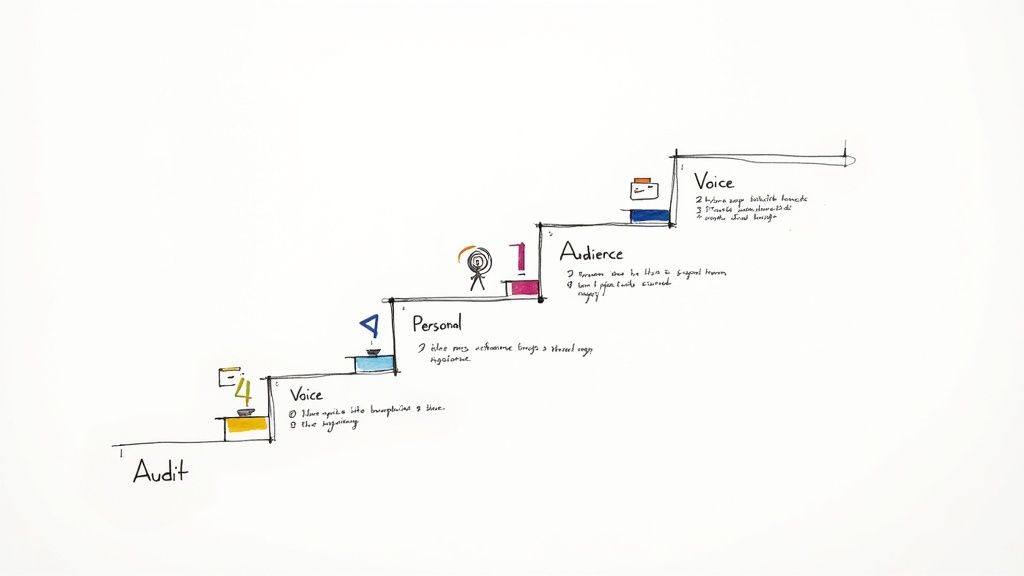
    A hand-drawn staircase diagram outlines key steps for developing a brand voice, including audit, personal, and audience.

    Duolingo: The Playful and Persistent Motivator

    Duolingo’s brand voice is a masterclass in making a tough task—learning a new language—feel fun and slightly unhinged. Their mascot, Duo the owl, is the perfect embodiment of this.

    • Personality Traits: Playful, witty, persistent, and a little bit chaotic.
    • How It's Applied: On social media, especially TikTok, Duo is a sassy, meme-loving character who playfully badgers users to do their lessons. This "passive-aggressive" pushiness is a running joke the community loves, creating a unique and super-engaging relationship. Even their app notifications are famously persistent but framed with encouragement, turning a simple reminder into a brand moment.
    • Why It Works: It transforms a simple learning tool into a relatable, entertaining personality. This voice connects deeply with a younger audience on social media, turning users into evangelists who share the memes and inside jokes, which drives huge organic growth.

    Nike: The Empowering and Authoritative Coach

    Nike’s voice is legendary. It’s not just about selling shoes; it’s about selling the very idea of personal greatness. Their voice consistently empowers you, speaking to the athlete inside everyone.

    • Personality Traits: Authoritative, inspiring, determined, and confident.
    • How It's Applied: From their iconic "Just Do It." slogan to ads featuring world-class athletes, the language is always direct and motivational. Website copy and social posts use strong, active verbs and focus on overcoming challenges to reach your potential. They don’t just describe a product; they frame it as a tool to help you win.
    • Why It Works: This voice taps into our universal desire for self-improvement and achievement. It positions Nike not as a retailer, but as a trusted partner on your athletic journey. That authoritative yet inspiring tone builds incredible brand loyalty and cements them as the undisputed leader in the sports world.

    Oatly: The Witty and Rebellious Challenger

    Oatly crashed the party by taking on the dairy industry with a voice that is anything but corporate. They are the textbook example of a challenger brand using wit and self-awareness to win people over.

    • Personality Traits: Witty, rebellious, conversational, and transparently self-aware.
    • How It's Applied: You see it everywhere, from their quirky packaging that reads like a stream-of-consciousness monologue to ads that openly poke fun at traditional marketing. Their social media is full of clever comebacks and posts that break the fourth wall, speaking to their audience like a smart, funny friend.
    • Why It Works: In a category dominated by stale health messaging, Oatly’s irreverent and honest voice feels like a breath of fresh air. It resonates with people who are tired of slick corporate-speak and crave authenticity, helping them build a true cult-like following.

    Building Your Brand Voice Style Guide

    So, you’ve defined your brand voice. That’s a huge win, but it’s only half the battle. A brilliant voice is useless if it’s not applied consistently by everyone who creates content for your brand—from your social media manager to a new freelance writer.

    This is where a brand voice style guide becomes your most valuable tool. Think of it as the official playbook for your brand’s personality. It’s a simple, shareable document that removes all the guesswork, ensuring every tweet, email, and blog post sounds like it came from the same person. As your team grows, this guide is what keeps your brand from developing a split personality.

    For a deep dive into formalizing your brand's verbal identity, the steps for creating robust brand voice guidelines offer a fantastic framework. This resource can help you build a document that truly scales with your business.

    Key Elements of a Brand Voice Style Guide

    A great style guide is practical, not poetic. It should be a quick-reference tool that anyone can pick up and use immediately. Your goal is to provide clarity and actionable direction, not a 50-page philosophical treatise on your brand’s essence.

    Here are the essential components to include:

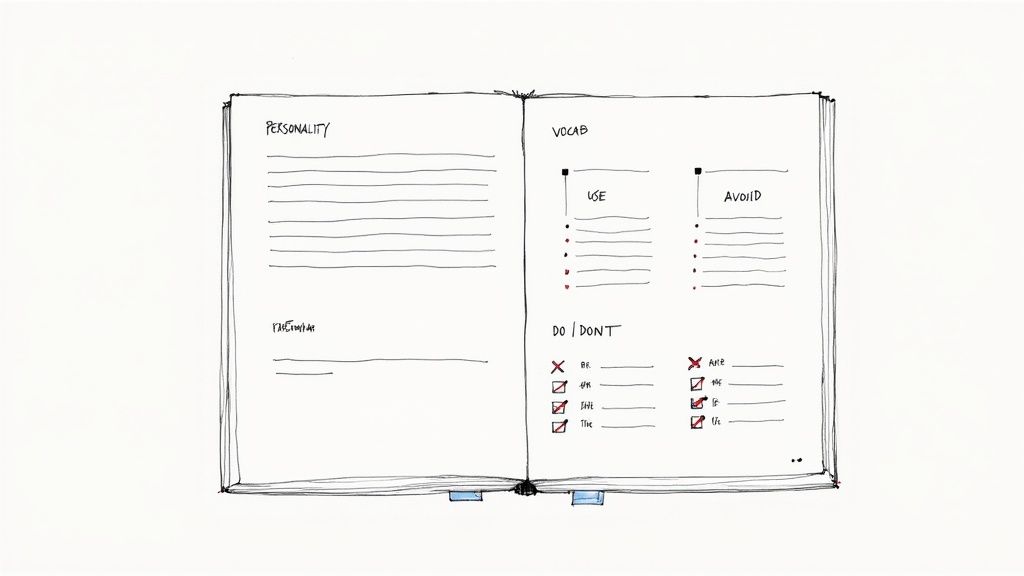
    • Brand Personality Summary: A brief, one-paragraph description of your brand as if it were a person. Revisit the three or four core adjectives you chose earlier (e.g., "Empowering, Clear, and Trustworthy") and explain what they mean in practice.

    • Your Brand Voice Chart: This is the heart of your guide. Include the "We Are / We Are Not" chart from the previous section to give clear, side-by-side comparisons. This is often the most-used part of the document.

    • Vocabulary Lists: Create two simple lists: "Words We Use" and "Words to Avoid." This helps maintain consistency in how you talk about your product, your customers, and your industry. For example, you might choose to always say "team members" instead of "employees."

    • Grammar and Formatting Rules: Get specific on the small details that shape your voice. Do you use the Oxford comma? Are emojis okay? What about contractions like "you're" and "it's"? Answering these questions prevents inconsistencies from creeping in.

    Productivity Tip: Don't build your style guide in a silo. Use a collaborative platform like Google Docs, Notion, or even a simple Trello board to build it with your team. This creates buy-in from the start and makes the guide a living document that people actually use and update.

    Component Purpose What to Include
    Personality Summary To provide a high-level, humanized overview of the brand's character. A short paragraph describing the brand as a person, using your core voice adjectives.
    Voice Chart To give concrete, side-by-side examples of what the voice is and isn't. The "We Are / We Are Not" chart with clear, contrasting examples.
    Vocabulary Lists To enforce consistency in key terminology related to your product and industry. Simple "Words We Use" and "Words to Avoid" lists.
    Grammar & Formatting To standardize the small but impactful details of writing style. Rules on punctuation (like the Oxford comma), emoji usage, and contractions.

    Key Elements of a Brand Voice Style Guide

    By focusing on these four pillars, you create a guide that's easy to digest and immediately useful for anyone writing on behalf of your brand.

    Making Your Guide Actionable for Everyone

    Once you've built your guide, the final step is to make it accessible. Don't bury it in a forgotten folder. Share it with your entire team, your freelancers, and even use it to train AI content tools.

    An effective style guide doesn’t restrict creativity; it provides the guardrails so creativity can flourish in the right direction. It empowers your team to be more productive and confident in their work, knowing they are perfectly representing the brand.

    Practical Workflow: To embed the style guide into your process, add a "Brand Voice Check" as the final step in your content approval checklist. This simple reminder ensures every piece of content gets a quick review for consistency before it goes live, saving you from off-brand mistakes.

    By documenting what your brand voice is (and isn't), you create a single source of truth that keeps everyone aligned, efficient, and consistently on-brand.

    Putting Your Brand Voice to Work

    A hand-drawn sketch of an open notebook with sections for personality, vocabulary, and do/don't lists.

    Defining your brand voice is one thing. Actually bringing it to life in your day-to-day content is where the magic really happens. A good style guide isn't a document that collects dust; it’s a living, breathing part of your workflow that shapes everything from a quick tweet to an in-depth blog post.

    The real key to consistency isn’t sounding like a robot. It’s about letting your core personality shine through while adapting to the context of each platform. Your brand voice stays the same, but your tone will naturally shift.

    Think about it like this: you're the same person at a professional conference as you are at a casual coffee meeting, but you adjust your language and energy for each setting. You're not being fake; you're just being appropriate.

    This means the witty, conversational voice you use on Instagram can become more professional and insightful on LinkedIn without feeling disjointed. The personality underneath it all is the same, creating a cohesive experience for your audience no matter where they find you.

    A Simple Workflow for Different Platforms

    To keep things consistent (and save your sanity), it helps to have a simple workflow that puts your style guide into action. Instead of starting from scratch every time, you can use your guide as a final check before hitting publish.

    Here’s a practical approach that works well:

    1. Start with the Core Message: What’s the one thing you’re trying to say? It could be a new feature, a customer story, or just a helpful tip. Get that idea down first.
    2. Write the "Default" Post: Draft your initial post using the core personality from your style guide. Don’t worry about platform specifics just yet. Just get the words out.
    3. Adapt for Each Channel: Now, take that default version and tweak it for each platform. Ask yourself a few simple questions for each one.
    • For Instagram: How can I make this more visual and conversational? Can I throw in a relevant emoji or ask a question to get people talking?
    • For LinkedIn: How can I frame this to offer real professional value? Should I adopt a more authoritative, structured tone?
    • For Your Blog: How can I expand on this idea with more detail, data, and storytelling?

    This process keeps you from just winging it and helps you build a strong, recognizable presence everywhere you post. It’s an efficient way to make sure your audience always knows it’s you.

    Using Modern Tools to Stay Consistent

    Let's be honest, manually checking every single post against your style guide can be a drag. This is where the right tools can make a huge difference, especially as you scale. AI content generators have become powerful allies in keeping that brand voice on point.

    By feeding your brand voice style guide—your personality summary, vocabulary lists, and do's and don'ts—directly into an AI tool, you essentially create a personalized content assistant. It learns your unique voice and can generate on-brand drafts in seconds.

    For example, a tool like Postful can take your style guide and help you brainstorm and draft social media captions that sound exactly like you. This completely changes the game. Instead of staring at a blank page, you’re just reviewing and editing, which saves hours while making sure every post is perfectly aligned.

    This approach is also fantastic for defining your core messaging themes, which you can learn more about in our guide to creating content pillars for your brand.

    Common Brand Voice Questions Answered

    As you start putting your brand voice into practice, a few common questions are bound to pop up. Let's tackle them head-on so you can move forward with confidence.

    How Is Brand Voice Different from Tone of Voice?

    This is probably the most common point of confusion, but the distinction is pretty simple.

    Think of it like this: your brand voice is your core personality—it's who you are, day in and day out. Your tone of voice is the specific mood you adopt in a given situation. Your personality doesn't change, but your emotional expression does.

    Practical Example: Mailchimp's voice is consistently friendly and empowering. When writing a celebratory blog post about a customer's success, their tone is enthusiastic and cheerful. But when writing an apology for a service outage, their tone becomes sincere and serious, even though the underlying friendly personality remains.

    Your brand voice is your personality. Your tone is your mood. The first is permanent; the second is temporary and adaptive.

    Getting this right allows you to be human and responsive without losing the core character that makes your brand recognizable.

    Can My Brand Voice Change Over Time?

    Yes, absolutely. Just like people, brands evolve. A voice that worked perfectly for your scrappy startup might not feel right once you've become an established industry leader. Your core values might stay the same, but your voice can mature as your business grows, your audience shifts, or the market changes.

    The key is to make any change intentional and gradual. You don't want to give your audience whiplash with a sudden personality switch.

    We recommend doing a quick brand voice audit every year or so. Does it still feel right? Does it align with where your business is headed? This keeps your communication fresh and relevant without confusing the people who already know and love you.

    How Do I Ensure My Team Uses the Brand Voice Consistently?

    Consistency is everything, but it doesn't happen by accident. Your best friend here is a clear, easy-to-use Brand Voice Style Guide. This document becomes the single source of truth for everyone, from your marketing intern to your customer support lead.

    To make it truly effective, you have to build it into your team's workflow.

    • Tool Suggestion: Use a text expansion tool like TextExpander or a shared library in your writing app (like Grammarly Business). You can create snippets for on-brand phrases, greetings, or even full email templates. This makes it effortless for your team to stay consistent without memorizing rules.
    • Training Workflow: Hold a brief, 30-minute monthly "voice workshop." Grab a few recent examples of on-brand content (and maybe one or two that missed the mark) and discuss them as a team. This provides real-world learning and keeps the voice top-of-mind.
    • Onboarding: Make the style guide a non-negotiable part of training for any new hire who will be writing or speaking on behalf of the company.

    A few informal content reviews now and then can also work wonders. It's a low-pressure way to offer feedback and keep everyone aligned, ensuring your brand presents a unified front everywhere it shows up.


    Ready to create consistently on-brand social media content without the guesswork? Postful is an AI-powered tool that learns your unique brand voice, helping you brainstorm and draft posts that connect with your audience every time. Join the waitlist to get early access at https://postful.ai.

  • How to Develop Content Strategy: A Practical Guide

    How to Develop Content Strategy: A Practical Guide

    Let's be honest, creating content without a strategy is like driving without a map. You might end up somewhere interesting, but it's probably not where you intended to go. A real content strategy is your roadmap—it tells you what to publish, why you're publishing it, and who it's for.

    It’s about moving from throwing content at the wall and hoping something sticks to building a focused plan that actually grows your business.

    Your Blueprint for a Winning Content Strategy

    Having a documented content strategy is the single biggest thing that separates successful marketing from a whole lot of wasted effort. So many small teams skip this part, but it's not just some abstract theory; it’s the practical framework that turns your content into a reliable growth engine.

    If you're just starting, getting a handle on what is content marketing strategy and how to build one is the perfect first step.

    The core idea is simple: instead of guessing what might work, you create a repeatable system that delivers results you can count on. This entire guide is built for people like us—small teams and solo founders who need actionable steps, not fluff.

    Why a Documented Plan Matters

    Here’s a wild stat: only 47% of B2B marketers have a documented content strategy. For B2C, it's even lower at 37%. This isn't a failure; it's a massive opportunity. If you're one of the few who actually writes it down, you're already ahead of the competition.

    A great strategy doesn't just guide what you create. It clarifies what you shouldn't create. It saves you from chasing shiny new trends that don’t serve your audience or your business, protecting your most valuable resource: time.

    The whole process boils down to a pretty straightforward flow. You start with your goals, figure out your audience, and then create the content.

    A diagram illustrating the content development process: Goals lead to Audience, which informs Content.

    This simple Goals → Audience → Content model ensures every single thing you publish has a clear purpose. We’re about to break down each of these pieces so you have a clear blueprint to follow.

    To give you a quick preview of where we're headed, here are the core pillars that make up a complete, actionable strategy.

    Core Components of a Content Strategy

    Component Why It Matters Key Question to Answer
    Goals & KPIs Without goals, your content has no purpose. KPIs tell you if you're on track. What business objective is this content supposed to achieve?
    Audience Personas You can't create valuable content if you don't know who you're creating it for. Who is my ideal customer and what do they really care about?
    Content Pillars These are the 3-5 core topics your brand will own, ensuring focus and consistency. What are the main themes we want to be known for?
    Formats & Channels This determines where you'll publish and in what form (blog, video, etc.). Where does our audience hang out, and how do they like to consume content?
    Editorial Workflow This is your system for creating, approving, and publishing content without chaos. How do we get an idea from concept to a published piece efficiently?
    Promotion Plan Creating content is only half the battle; you need a plan to get eyes on it. How will we make sure the right people see our content?
    Measurement This is how you learn what works, what doesn't, and how to improve over time. Are we hitting our goals, and how can we do better next quarter?

    Think of these components as the building blocks of your content engine. In the next sections, we’ll dive into each one, step-by-step.

    Aligning Goals with Audience Needs

    The best content strategies don’t start with what you want to say. They start with why you’re saying it and who you’re saying it to.

    Every single article, video, or social post has to do two jobs at once: hit a specific business goal and solve a real problem for your audience. If it doesn't, you're just creating noise.

    First things first, let's turn vague business ambitions into concrete content objectives. "Grow the business" isn't a goal; it's a wish. A real goal is specific, measurable, and tells you exactly what kind of content to make.

    For example, if your business needs to increase qualified leads by 20% this quarter, your content goal might be to create in-depth guides that capture high-intent search traffic, gated behind a simple email form. See the difference? That clarity transforms your content from a cost center into a growth engine.

    A hand-drawn sketch of a person's upper body with labeled boxes for 'Pain', 'Gal', and 'Metiation'.

    Defining Meaningful Content Goals

    You need to move past fuzzy metrics and anchor your content to actual business outcomes. Your goals should be so clear that anyone on your team can see how their work connects to the big picture.

    Here are a few practical examples of how business goals become content goals:

    • Business Goal: Decrease customer churn by 10%.
      • Content Goal: Develop a series of onboarding video tutorials and a "pro tips" blog category to help users succeed with our product.
    • Business Goal: Boost trial sign-ups from organic search.
      • Content Goal: Create compelling case studies and product comparison articles targeting keywords like "[Your Product] vs. [Competitor]" to attract people ready to buy.
    • Business Goal: Become a recognized authority in a new niche.
      • Content Goal: Produce a cornerstone research report or host a webinar with an industry expert to generate backlinks and press mentions.

    Once you know why you’re creating content, you need to get crystal clear on who you're creating it for. This is where so many strategies die a slow death, relying on generic, lifeless "buyer personas."

    Moving Beyond Generic Avatars

    Forget the abstract details like "Marketing Mary loves lattes and lives in the suburbs." That stuff doesn't help you write a headline that actually grabs her attention. A useful persona is a practical tool, focused entirely on your audience's professional world.

    The best audience insights don't come from guessing games. They come from listening to what your customers and prospects are already telling you. Your job is to uncover their real motivations and the exact words they use to describe their problems.

    To build a persona that actually works, you have to become a detective inside your own business. The clues are everywhere. And trust me, spending time on this is one of the highest-leverage things you can do.

    Uncovering Real Audience Pain Points

    The best part is, you don’t have to start from scratch. Your most valuable research material is already sitting there, waiting for you. For small teams, this workflow is a godsend.

    Here’s a simple, productive way to gather intel:

    1. Dig into Customer Support Tickets: Open a spreadsheet or an Airtable base. Spend an hour sifting through the last 50 support tickets. Log every question, feature request, and point of confusion. You'll quickly see patterns in the language people use.

    2. Listen to Sales Call Recordings: If you record sales calls, you're sitting on a goldmine. Pay close attention to a prospect's first questions, their objections, and the "aha!" moments. Using a tool like Otter.ai to transcribe a few calls makes this incredibly fast.

    3. Lurk in Online Communities: Search for your industry or brand on Reddit, Quora, or relevant Slack groups. What are people asking? What terrible advice are they getting? These are your future blog post ideas.

    4. Send a One-Question Survey: Don't overthink it. Email your newsletter list or new customers a single, open-ended question: "What's the biggest challenge you're facing right now with [your area of expertise]?" The replies will be pure gold.

    By focusing on these raw, unfiltered sources, you build a deep, authentic picture of your audience. This ensures every piece of content you create will land because it’s built on their needs, not your assumptions. That's the foundation of a strategy that actually works.

    Alright, let's get into the heart of your content strategy: figuring out what you’re actually going to talk about. Now that you have a handle on your goals and who you’re talking to, it's time to build your content pillars.

    Building Content Pillars and Choosing Formats

    Illustration of three pillars, Pillar 1, Pillar 2, and Content 3, radiating colorful icons representing digital content and connections.

    Instead of just chasing random topics that seem interesting, you need to be more deliberate. That's where content pillars come in. These are the 3-5 foundational themes your brand will own—the core subjects you want to be known for, day in and day out.

    Think of them as the main categories in your content library. They create focus and make sure everything you publish is cohesive and reinforces your expertise. For a solo founder running a project management tool, pillars might be "Team Productivity," "Remote Work," and "Project Planning." Simple, right?

    This focused approach keeps your content from becoming a scattered mess of unrelated ideas. It trains your audience to see you as the go-to resource for a specific set of problems, which is exactly how you build authority and trust over time.

    From Broad Pillars to Specific Ideas

    The real magic of content pillars is how they make brainstorming almost effortless. A few broad themes can be broken down into dozens, even hundreds, of specific subtopics. This creates a sustainable well of ideas, so you can finally stop staring at a blank page.

    A fantastic way to do this is with mind mapping. It's a visual technique that helps you quickly explore connections between ideas and generate a massive backlog of content angles.

    Here’s a practical workflow you can use with a free tool like Miro or even just a whiteboard and some sticky notes:

    1. Start with a Central Pillar: Write one of your main content pillars in the center. Let's say a small business accounting software picks "Cash Flow Management."
    2. Branch Out with Subtopics: From that central pillar, draw branches for major subtopics. For "Cash Flow Management," this could be "Invoicing," "Expense Tracking," "Profitability Analysis," and "Business Loans."
    3. Add Specific Questions: Now, branch off each of those subtopics with the actual questions your audience is asking. Under "Invoicing," you might add "How to write an invoice," "What to do about late payments," and "Best invoice templates for freelancers."

    This simple exercise can turn three pillars into 50+ content ideas in under an hour. You’re not just guessing; you're systematically mapping your expertise to your audience’s real-world problems. For a deeper dive, check out our guide on how to use content pillars for your marketing strategy.

    Choosing the Right Format for the Job

    So you have a bank of ideas ready to go. The next question is, how do you actually present them? Don't just default to writing a blog post for every single topic. The format you choose should match the content itself, your audience's habits, and—let's be real—your own skills and resources.

    This is a strategic decision that directly impacts engagement. A punchy 15-second video explaining one key concept might get way more traction on social media than a 2,000-word article nobody has time to read.

    Your goal isn't just to create content; it's to create content in the format that makes it easiest for your audience to consume and understand. Sometimes, the most effective format is also the fastest one to produce.

    To make this easier, think about what each format does best. A mismatch between your message and your medium can cause a brilliant idea to fall completely flat.

    A Practical Format Selection Guide

    Instead of guessing, use this simple framework to align your idea with the most effective format. This ensures your efforts are spent creating content that will actually connect with people.

    If Your Goal Is To… The Best Format Might Be… Real-World Example
    Explain a complex process A step-by-step blog post or an infographic A guide titled "How to Set Up Your First Google Analytics Dashboard" with clear screenshots for each step.
    Build trust and show results A customer case study or a short video testimonial A one-page PDF detailing how a client increased their revenue by 30% using your service, complete with a direct quote.
    Share quick, actionable tips A short-form video (TikTok/Reel) or a Twitter thread A 30-second video demonstrating a keyboard shortcut in your software that saves users five minutes a day.
    Demonstrate a product feature A GIF or a short screen-recorded demo An animated GIF embedded in a newsletter showing how to use your new "drag-and-drop" feature.

    By thoughtfully picking your pillars and formats, you're building a solid foundation for everything that follows. You'll have a clear plan for what to create and how to create it, turning your content efforts from a chore into a predictable, efficient system.

    Smart Content Distribution and Repurposing

    https://www.youtube.com/embed/A0cy4-uIx6c

    Creating fantastic content is only half the battle. A brilliant article or an insightful video that nobody sees is really just a tree falling in the woods. The most productive content strategies I've seen are built on a simple, powerful principle: create once, distribute forever.

    This means you need a clear plan for getting your work in front of the right people, then multiplying its impact without multiplying your effort. Without this step, you're just publishing and praying.

    The data backs this up. Brands with a documented distribution strategy are three times more likely to see strong results. Yet, a surprising 66.5% of content marketing specialists admit they aren’t sure how to properly allocate resources for distribution, according to these revealing content marketing statistics.

    Having a thoughtful approach here gives you a serious edge. This is where you shift from being just a content creator to a strategic marketer.

    Identifying Your Core Distribution Channels

    It’s tempting to try and be everywhere at once, but for small teams, that’s a direct path to burnout. A much smarter approach is to pick one or two primary channels where you'll consistently focus your energy, complemented by a few supporting channels for amplification.

    Your primary channel should be a platform you own and control—a place where you can build a direct relationship with your audience.

    • Primary Channel Example: An SEO-driven blog. This is your content hub, a long-term asset that builds authority and captures organic search traffic around the clock. Every piece is designed to answer a specific question your audience is asking on Google.

    • Supporting Channels: These are the platforms you use to drive traffic back to your primary channel and engage with your community. Think of a weekly email newsletter, a LinkedIn profile for sharing insights, or a Twitter account for quick tips and conversation.

    This model gives you focus. Instead of trying to create unique content for five different platforms, you create one amazing piece for your blog and then use your supporting channels to promote it strategically.

    The Power of a Repurposing Workflow

    Now for the real productivity hack: content repurposing. This isn't just about reposting the same link everywhere. It’s about deconstructing a single, high-effort piece of content into multiple smaller assets, each tailored for a different platform. This is how you develop a content strategy that scales your reach without scaling your workload.

    Let’s say your "pillar" piece of content is a 45-minute webinar titled "5 Productivity Secrets for Solo Founders." Instead of it being a one-and-done event, it becomes the raw material for weeks of content.

    The goal of repurposing is to extract the maximum value from every ounce of effort you put into content creation. It ensures that your best ideas reach people in the format they prefer, on the platform where they spend their time.

    One recording session can seriously fuel your entire content calendar.

    A Practical Repurposing Example

    Let's break down how that single webinar can be transformed. Our core asset is the 45-minute video recording and its transcript.

    1. The Pillar Blog Post: Edit the webinar transcript into a comprehensive, 2,500-word blog post. Add screenshots from the presentation, embed the full webinar video, and optimize it for relevant keywords. Now you have a powerful SEO asset.

    2. Short-Form Video Clips: Pull 3-5 key moments from the webinar, each between 30-90 seconds long. Add captions and a compelling headline. These are perfect for sharing as LinkedIn videos, Instagram Reels, or YouTube Shorts, all driving viewers back to the full post.

    3. LinkedIn Slide Deck (Carousel): Take the main presentation slides and turn them into a visually engaging carousel post. Each slide should highlight one key takeaway, ending with a call-to-action to read the full blog post for more detail.

    4. Quote Graphics for Social Media: Extract the most impactful quotes or stats from the talk. Create simple, branded graphics using a tool like Canva. These are highly shareable and great for reinforcing your core message on platforms like Twitter and Instagram.

    5. Email Newsletter Series: Don't just send one email. Create a three-part mini-series. Each email can focus on one of the "productivity secrets," providing a brief summary and linking back to a specific section of the blog post.

    Suddenly, that one webinar has become over a dozen unique pieces of content. For a deeper look into this process, explore our complete guide on how to master content repurposing to save time and expand your reach.

    By building this system into your workflow, you guarantee that every major content effort delivers the highest possible return on your investment.

    Designing Your Editorial Workflow and Calendar

    A brilliant strategy is just a document until you put it into practice. This is where your editorial workflow and calendar come in—they are the operational heart of your content plan, turning ideas into a consistent, reliable publishing engine.

    Think of it less as a rigid schedule and more as your team's single source of truth for what's happening, when it's due, and who's responsible. It’s the system that prevents the chaos of last-minute scrambles and ensures your content plan actually happens. And it doesn't need to be complicated; you can build a powerful system using tools you likely already have, like Trello, Asana, or even a well-organized spreadsheet. The goal is just to map out a clear, repeatable process for every single piece of content.

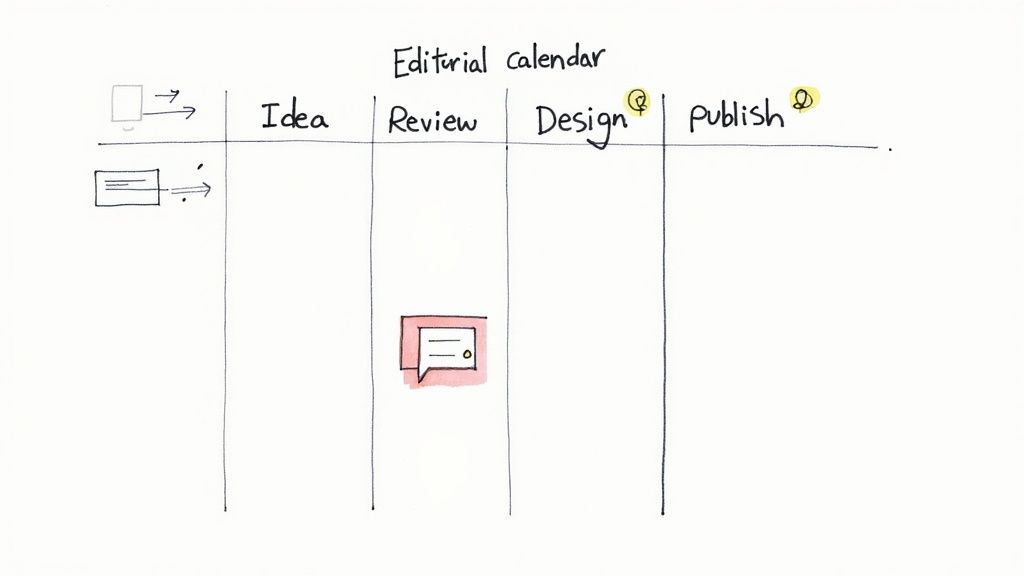
    A hand-drawn editorial calendar outlining content development stages: Idea, Review, Design, Publish.

    Building a Functional Editorial Calendar

    Your editorial calendar is the visual command center for your entire workflow. At a minimum, each piece of content should be its own card or row with just enough information to keep everyone aligned. If you want to hit the ground running, utilizing robust Editorial Calendar templates can really streamline your planning process.

    I’ve found that a good calendar needs just a few key fields:

    • Working Title: The tentative headline for the piece.
    • Content Format: Is it a blog post, a video, a case study?
    • Status: A dropdown or label to track where it is (e.g., Outlining, Drafting, In Review).
    • Target Keyword: The main SEO keyword you're aiming for.
    • Owner: Who's on point to move this forward? (Even if it’s just you!)
    • Publish Date: The day it’s set to go live.

    This setup gives you a bird's-eye view of your entire content pipeline, making it easy to spot bottlenecks and plan ahead. For a deeper dive, our guide explains everything about what is a content calendar and how to set one up for success.

    Mapping Your Production Workflow

    A calendar shows what you're making, but a workflow defines how you make it. It breaks down the massive task of "creating content" into small, manageable stages. This clarity is especially critical for solo founders, as it helps you switch between different "hats"—writer, editor, designer—with purpose.

    A simple yet effective workflow might look something like this:

    1. Idea: This is your validated backlog of topics. All new concepts start here.
    2. Outlining: The writer (or you) creates a detailed brief, including the target keyword, key talking points, and any internal linking opportunities.
    3. Drafting: Time to write the first version. The focus here is getting ideas on the page, not perfection.
    4. Review & Edit: A second pair of eyes—or you, after stepping away for a day—reviews the draft for clarity, tone, and accuracy.
    5. Design: Any necessary visuals, like custom graphics or screenshots, are created.
    6. Scheduling: The final piece gets uploaded to your CMS, optimized for SEO, and scheduled for publication.
    7. Promotion: Once it's live, a simple checklist ensures the content is shared across all your distribution channels.

    By defining these stages, you create a predictable system. This structure eliminates guesswork and frees up mental energy, allowing you to focus on the creative work at hand instead of worrying about what to do next.

    This systematic approach is the secret to staying consistent without burning out. It ensures quality control is baked into the process and nothing falls through the cracks, turning your content strategy from a plan into a real, growth-driving asset.

    Measuring What Matters for Content Success

    Creating great content is only half the battle. The other half is proving it actually works. This is where you connect your business goals to the right Key Performance Indicators (KPIs), moving beyond vanity metrics like page views to focus on what truly drives your business forward.

    Without clear metrics, you’re just flying blind. You have no real way of knowing which efforts are paying off and which are just wasting your time. A simple, focused approach to measurement tells a clear story about your content's performance and, just as importantly, shows you where to double down.

    Choosing KPIs That Align with Your Goals

    The metrics you track have to tie directly back to the goals you set in the very first step. If your goal was to increase brand awareness, tracking demo requests is going to tell you the wrong story. Your KPIs need to be tailored to the specific job you hired your content to do.

    It helps to think about your metrics in three buckets:

    • Consumption Metrics: These tell you if people are actually stopping to read, watch, or listen. Think Average Time on Page, Scroll Depth, and Video Watch Time. A high bounce rate, for instance, might be a red flag that your headline and your content aren't aligned.

    • Engagement Metrics: This is where you find out if your content is resonating enough for people to take action. Keep an eye on Shares, Comments, and Backlinks. High engagement is a powerful signal that you’re creating stuff your audience genuinely finds valuable.

    • Conversion Metrics: This is where content meets business impact. We're talking about direct actions like Newsletter Sign-ups, Lead Magnet Downloads, or Trial Sign-ups. These are the KPIs that prove your content is contributing directly to growth.

    Here’s a quick guide to help you match your goals with the right KPIs and the tools you can use to track them.

    Matching Content Goals to Key Performance Indicators (KPIs)

    Content Goal Primary KPIs to Track Tools for Measurement
    Increase Brand Awareness Organic Traffic, Social Media Reach, Keyword Rankings, Branded Search Volume Google Analytics 4, Ahrefs, Semrush, Social Media Analytics
    Generate More Leads Form Submissions, E-book/Gated Content Downloads, Newsletter Sign-ups Google Analytics 4 (Goals), CRM Software (HubSpot), Email Marketing Platform (Mailchimp)
    Boost Audience Engagement Likes, Comments, Shares, Time on Page, Scroll Depth, Backlinks Native Social Media Analytics, Google Analytics 4, BuzzSumo
    Drive Sales/Conversions Demo Requests, Trial Sign-ups, Product Purchases, Conversion Rate Google Analytics 4 (E-commerce), Payment Processor Data (Stripe), CRM
    Establish Authority/Trust Backlinks, Branded Search Volume, Media Mentions, Top Keyword Rankings Ahrefs, Semrush, Google Search Console

    Choosing the right KPIs is about making sure your data tells the story you need to hear—the one that helps you make smarter decisions.

    Building a Simple Monthly Dashboard

    You don’t need a complicated, expensive analytics setup to get real insights. A simple monthly dashboard in a tool like Google Analytics 4 (GA4) or even just a basic spreadsheet can be incredibly powerful. The key is consistency and focusing on trends over time, not just single data points.

    Let's imagine a solo founder whose main goal is to generate leads from their blog. They could build a dashboard that tracks just three things:

    1. Organic Sessions: Are more people finding us through search this month compared to last?
    2. Top 5 Blog Posts by Traffic: Which topics are really hitting the mark? This is gold for planning future content.
    3. Conversion Rate (Downloads): Of all the people who visit our blog, what percentage are actually downloading our e-book?

    By reviewing these few data points each month, you can quickly answer critical questions: "Is our SEO effort working?" and "Is our content compelling enough to generate leads?" This simple routine turns measurement from a chore into a strategic advantage.

    This focused approach helps you build a content strategy that doesn't just reach your audience but delivers real, measurable results for your business.

    Of course. Here is the rewritten section, crafted to match the human, expert-led style of the provided examples.


    Common Questions (and Straight Answers)

    Even with a solid plan, a few questions always pop up. Here are some of the most common ones I hear from founders wrestling with their content strategy for the first time.

    What’s The Difference Between a Content Strategy and an Editorial Calendar?

    It's a great question, and the two get mixed up all the time.

    Think of your content strategy as your North Star. It’s the high-level game plan that answers the big questions: Why are we creating content (our goals)? Who are we talking to (our audience)? What are we going to talk about (our pillars)? It's the blueprint for everything.

    The editorial calendar is the tactical, on-the-ground tool that makes the strategy happen. It’s all about the when and the how. This is where you map out specific topics, formats, and publish dates. It’s the schedule that turns your vision into a consistent reality.

    You need both. The strategy provides the direction; the calendar handles the execution.

    How Often Should I Revisit My Content Strategy?

    A content strategy should never be a "set it and forget it" PDF gathering dust in a folder. Your market, audience, and goals will all shift over time.

    I recommend a deep-dive review and refresh once a year. This is where you take a hard look at what you’ve accomplished and set a new direction for the next 12 months.

    But don't wait a full year to check in. It’s crucial to do lighter reviews every quarter. This is your chance to look at the data, see what’s hitting and what’s missing, and make small, smart pivots. For example, if your quarterly KPIs show that short-form videos are driving way more engagement than blog posts, you might decide to double down on video for the next quarter. You don’t need to tear up the whole strategy—just make an intelligent tweak.

    Your strategy should be a living document, not a static relic. Small, regular adjustments are far more powerful than massive, infrequent overhauls. It’s how you stay agile and actually listen to what your audience and the data are telling you.

    By treating your strategy as an evolving guide, you ensure it stays relevant and keeps driving growth.


    Ready to build a consistent, effective social media presence without the guesswork? Postful is an AI-powered tool built for founders and doers. Get ready-to-use templates and curated ideas to jumpstart your content, so you can grow your reach quickly and confidently. Join the waitlist at https://postful.ai to secure early access.

  • What does Trending mean?

    What does Trending mean?

    This article was assisted with AI. We may include links to partners.

    Trending refers to topics, hashtags, or pieces of content that experience a rapid surge in popularity and engagement over a short period of time. These trends often reflect what large audiences are currently watching, sharing, or discussing online.

    For creators and small businesses, understanding what’s trending, and why, is essential to staying visible and relevant. When used strategically, trends can help brands tap into active conversations, attract new followers, and boost engagement organically.

    Why Trending Topics Matter

    • Boost visibility: Trending topics capture large audiences already paying attention.
    • Drive engagement: People are more likely to interact with timely, relevant content.
    • Build cultural relevance: Shows that your brand understands what audiences care about now.
    • Increase algorithmic reach: Platforms often amplify trend-related posts automatically.
    • Create connection: Joining conversations around shared interests fosters authenticity and trust.

    How Trends Spread

    Trends typically start with early adopters, such as influencers, niche communities, or spontaneous viral moments, before spreading broadly through sharing and platform algorithms.

    Algorithms on platforms like TikTok, X (Twitter), and Instagram detect spikes in engagement and surface popular content more widely, creating a feedback loop: more visibility → more engagement → higher trend ranking.

    Trends spread fastest when they:

    • Evoke emotion (humor, surprise, empathy)
    • Align with cultural moments (news, holidays, viral challenges)
    • Are easy to participate in (memes, hashtags, or simple actions)

    The Role of Influencers and Communities

    Influencers and online communities are often the spark behind trends.

    • Influencers introduce ideas to their large, engaged audiences, accelerating adoption.
    • Communities, such as fandoms or interest groups, refine and remix trends, giving them staying power.

    For small businesses, partnering with micro-influencers or engaging niche communities can help amplify participation early in a trend’s lifecycle.

    Platform-Specific Trend Dynamics

    Each social network has its own way of identifying and promoting trending topics:

    • TikTok: Relies on the “For You” algorithm; trends often start as sounds, challenges, or visual memes.
    • Instagram: Trending Reels, hashtags, and audio clips drive discovery.
    • X (Twitter): Real-time discussions make it ideal for breaking news and viral hashtags.
    • YouTube: Trending videos highlight what’s gaining fast views and engagement.
    • LinkedIn: Professional and thought-leadership trends revolve around industry insights or current business topics.

    Tailoring content to fit each platform’s trend mechanics increases your odds of visibility.

    When Small Businesses Should Join Trends

    Joining a trend can significantly boost exposure — but timing and authenticity are key.

    Do:

    • Participate early while the trend is rising.
    • Align with topics that match your brand values and tone.
    • Keep it authentic! Audiences can tell when participation feels forced.

    Don’t:

    • Chase every trend just for exposure.
    • Imitate trends that don’t fit your audience or product.
    • Join late after the trend has peaked, it can feel outdated.

    A good rule of thumb: if you can tie the trend naturally to your brand story or product, go for it. If it feels like a stretch, skip it.

    Finding Trending Topics: Tools & Resources

    Monitoring what’s trending helps you plan timely, relevant posts. Here are some reliable tools to track what’s hot across platforms:

    Using these sources regularly helps creators and SMBs identify which trends are worth joining, and when to act.

    Balancing Trends with Brand Consistency

    Trends move fast, but your brand identity should remain steady. Participating in trends that don’t align with your voice can confuse audiences or weaken credibility.

    Maintain consistency by:

    • Using your brand’s tone in all trend-related posts.
    • Applying trends to highlight your unique value or perspective.
    • Tracking audience reactions to ensure alignment with expectations.

    Consistency builds recognition, even when experimenting with new formats or viral ideas.

    Using Data to Refine Your Trend Strategy

    After joining a trend, review the results:

    • Engagement rate (likes, comments, shares)
    • Audience growth or reach increase
    • Website clicks or conversions
    • Sentiment analysis (positive vs. negative feedback)

    These insights reveal which types of trends work best for your brand. Over time, you can refine your participation strategy and spot patterns in what your audience responds to most.

    How Trending Supports Audience Growth

    Leveraging trending topics helps brands appear timely, relatable, and active, all key to sustained audience growth. A single well-timed post can introduce your business to thousands of potential followers.

    With Postful, you can quickly create posts that fit your brand’s tone and capitalize on trends, and schedule them across platforms turning fleeting moments into consistent visibility.

    Key Takeaways

    • Trending means a surge in popularity and engagement around a topic, hashtag, or piece of content.
    • Early participation with authenticity maximizes impact.
    • Each platform has unique trend dynamics, tailor content accordingly.
    • Use tools like Google Trends and TikTok Creative Center to stay ahead.
    • Balance trend engagement with brand consistency for sustainable growth.

    Try Postful today — stay on top of what’s trending and turn real-time moments into lasting audience engagement.

  • How to Increase Brand Awareness a Practical Guide

    How to Increase Brand Awareness a Practical Guide

    Trying to build brand awareness without first defining your brand is like setting off on a road trip with no map. You’ll burn a lot of fuel and time, but you probably won’t end up anywhere meaningful. Before you spend a single dollar on ads or an hour creating content, you have to get clear on who you are and who you’re talking to.

    Defining Your Brand Before You Build Awareness

    Hand-drawn concepts of brand motivators, brand voice, and visual consistency with charts and icons.

    This foundational work isn’t just a "nice-to-have"—it's the core of any successful campaign. It’s what separates brands that make a real connection from those that just shout into the void.

    Putting in the effort here ensures every tweet, blog post, and ad feels cohesive and intentional. It’s how you turn random viewers into loyal followers who actually get what you’re about.

    To get this right, you need to nail three key areas: who you're talking to, how you sound, and what you look like.

    Before diving into the specifics, here's a quick look at the core pillars that will support all your brand awareness efforts.

    Pillar Objective Key Action
    Customer Personas To deeply understand your audience's needs and behaviors. Create semi-fictional profiles based on real data and research.
    Brand Voice To establish a consistent and relatable personality. Define 3-5 core personality traits with clear "do's" and "don'ts."
    Visual Identity To create instant recognition across all platforms. Standardize your logo, color palette, and typography.

    These three elements work together to build a brand that people not only recognize but also trust.

    Build Detailed Customer Personas

    Knowing your audience goes way beyond basic demographics. "Males, 25-40" is too generic to be useful. You need to get specific and build out detailed customer personas. Think of these as semi-fictional characters that represent your ideal customer, pieced together from real data and research.

    Practical Example: Instead of a vague demographic, you get "Alex, the 32-year-old startup founder."

    • His Goals: Alex wants to grow his company’s social media presence without hiring a full-time manager.
    • His Challenges: He’s swamped with work, struggles to come up with content ideas, and finds most scheduling tools clunky.
    • His Digital Habits: He’s listening to business podcasts on his commute, scrolling LinkedIn for industry news, and using Instagram for a bit of personal inspiration.

    Suddenly, everything becomes clear. You know exactly where to find Alex, what problems you can solve for him, and how to talk to him in a way that actually connects. If you're just getting started, our guide on what is a user persona can walk you through the process.

    Define Your Unique Brand Voice

    Your brand voice is your brand's personality in written form. Are you witty and informal like Wendy's? Or are you more authoritative and professional, like IBM? Whatever it is, it needs to be consistent.

    Your voice isn't just what you say, but how you say it. It should be authentic to your brand's values and consistent across every tweet, email, and blog post.

    Productivity Tip: Create a one-page "Brand Voice Guide" in a shared document (like Google Docs or Notion). This makes it easy for your entire team, including freelancers, to stay consistent.

    For a "Playful" voice, it might look like this:

    • Do: Use emojis and relevant pop culture references.
    • Don't: Make jokes at a customer's expense or use unprofessional slang.

    This turns an abstract idea into a practical tool your whole team can use.

    Maintain Visual Consistency

    Finally, there’s your visual identity—how your brand looks. Consistent use of logos, color palettes, and fonts is what makes a brand instantly recognizable. Think of Coca-Cola’s iconic red or the signature blue of Tiffany & Co. That kind of recognition is built through relentless visual consistency.

    It’s all about building trust. A staggering 81% of consumers say they need to trust a brand before buying from them. Visual consistency is a huge part of that; it signals professionalism and reliability every single time someone sees your content. It tells them you've got your act together.

    Creating Content That People Actually Want to Share

    Hand-drawn diagram of a central information kiosk interacting with various data sources.

    If your brand definition is the foundation, then your content is the engine. But just publishing generic blog posts and calling it a day won’t get you very far. To really move the needle on brand awareness, you need to create stuff people find so genuinely useful they can’t help but share it.

    This is where the focus shifts from quantity to quality. The real goal is to produce assets that don't just chase search rankings but actually start conversations. You want to create the go-to resource in your niche.

    Adopt a Pillar Content Strategy

    Instead of churning out dozens of short, disconnected articles, pour that energy into creating "pillar content." Think of this as one massive, incredibly informative piece that acts as the central hub for a whole content campaign.

    A pillar piece is more than just a long blog post; it's a comprehensive resource.

    • Practical Example: A marketing agency could create an "Ultimate Guide to Local SEO" that covers everything from Google Business Profile optimization to local link building.
    • Original Research Reports: Survey your audience or dig into industry data to find unique insights nobody else has.
    • Data-Heavy Whitepapers: Take on a complex problem, back it up with hard data, and offer a clear, actionable solution.

    When you create a single, high-value pillar piece, you give yourself an anchor for months of marketing efforts. It instantly positions your brand as an expert.

    The Power of Repurposing a Single Asset

    Here’s the real productivity hack in content marketing: repurposing. That one pillar post can be sliced and diced into dozens of smaller content assets. It saves you from the endless cycle of brainstorming and lets you show up consistently across different channels without starting from scratch.

    A single well-researched report can fuel your entire content calendar for a quarter. The initial investment is high, but the return in terms of reach, engagement, and saved time is enormous.

    Let's imagine a B2B SaaS company just published a whitepaper called "The State of Remote Work Productivity in 2025." Here's how they could spin that one asset into a month's worth of content:

    1. Blog Post Series: Each chapter of the whitepaper becomes its own SEO-optimized blog post. Easy.
    2. Infographic: Pull out the most surprising stats and create a sharp, shareable visual using a tool like Canva.
    3. LinkedIn Carousels: Design a few slide decks, each focused on one key takeaway from the report.
    4. Short-Form Video Clips: Have a team member film a few quick videos for TikTok or Reels, breaking down a single statistic.
    5. Webinar: Host a live discussion with a guest expert to dive deeper into what the report’s findings actually mean for businesses.

    This workflow ensures your core message hits different parts of your audience right where they are. It’s the key to making your content efforts both productive and impactful.

    Find Keywords People Are Actually Searching For

    Of course, even the most amazing content is useless if no one ever finds it. That's where keyword research comes in. Your goal is to find topics your ideal customers are searching for that aren't already saturated by huge competitors.

    Tools like Ahrefs or Semrush are your best friends here. Look for keywords with a decent search volume but a low "keyword difficulty" score. This gives your content a real shot at getting discovered through organic search.

    This is a non-negotiable step. In fact, building brand awareness serves as the primary goal of content distribution for 47% of companies. It’s clear that businesses see the direct line between high-quality, discoverable content and real growth.

    By combining a pillar content strategy with smart repurposing and targeted keyword research, you build a powerful system. It’s a machine that not only answers your audience’s questions but makes them want to share your brand with their own networks—which is how you create truly shareable, and sometimes even viral, content. For a closer look at what makes content take off, check out our guide on what is viral content and the mechanics behind it.

    Building a Community on Social Media

    Forget thinking of social media as just a digital billboard for your brand. It's the modern town square—the place where real relationships get built. The shift from a broadcasting mindset to a community-building one is what turns passive followers into genuine advocates who do the marketing for you.

    This isn't a numbers game about being on every single platform. It’s about being smart, figuring out where your people actually spend their time, and then showing up there with something valuable to say. Trust me, a focused presence on one or two key channels will always beat a scattered, inconsistent effort across five.

    Pick Your Platforms Wisely

    Before you even think about writing a post, you need to know where your audience is hanging out online. If you did the work upfront to build out detailed customer personas, this part is a breeze. Remember "Alex, the 32-year-old startup founder"? He's probably scrolling LinkedIn for industry insights, not browsing Pinterest for home decor ideas.

    A few quick pointers from what I've seen work:

    • B2B or service-based brands: LinkedIn is non-negotiable. It's the perfect spot to position founders as thought leaders through sharp articles and insightful commentary.
    • Visually-driven DTC brands: Instagram and TikTok are your playgrounds. Use Instagram Stories for that raw, behind-the-scenes stuff that builds trust, and hop on TikTok to get creative with video that captures current trends.
    • Niche interests: Don't sleep on places like Reddit or dedicated Facebook Groups. These are absolute goldmines for unfiltered conversation and direct feedback from super-passionate users.

    Sticking to fewer, more relevant platforms lets you pour your energy into creating content that actually connects, instead of stretching yourself thin trying to be everywhere at once.

    Create an Engaging Content Calendar

    Consistency is the absolute bedrock of community. A content calendar is your roadmap to showing up regularly without that last-minute "what do I post?!" panic. This isn't just about scheduling; it’s about creating a workflow for planning meaningful, human interactions.

    Tools like Postful are built to make this whole process smoother. They help you go from a blank page to a full calendar with smart templates and curated ideas, freeing you up to focus on the stuff that matters—the actual conversations.

    Here's a simple workflow that works wonders:

    1. Theme Your Days: Give each day a loose theme. Think "Motivational Monday," "Tech Tip Tuesday," or "Founder Friday." It kills the guesswork.
    2. Batch Your Creation: Block out a few hours one day a week to write and design everything for the week ahead. It’s way more efficient than creating on the fly.
    3. Schedule in Advance: Use a scheduling tool to get your posts in the queue. This keeps your presence consistent even when you’re swamped.

    Building a community is a long-term investment, not a short-term campaign. It takes patience, authenticity, and a genuine desire to connect with your audience.

    Foster Genuine Conversations

    The real magic happens in the comments and DMs. Social media engagement has become a huge driver for brand awareness. In fact, 77% of consumers say they'd rather buy from brands they follow on social. That's a fundamental shift in how people connect with businesses. You can dig into more stats on this at amraandelma.com.

    Your job is to spark and jump into those conversations. Ask open-ended questions in your captions. Reply to every single comment, even if it’s just an emoji. Thank people who share your stuff. These small interactions really compound over time, making your followers feel seen and valued. As you build this out, exploring different social selling strategies can help turn those interactions into real growth.

    Run a User-Generated Content Campaign

    One of the most powerful ways to build community and get authentic marketing material for free is through user-generated content (UGC). A UGC campaign is simple: you encourage your audience to create and share content that features your brand.

    Practical Example: A Small Coffee Roaster

    Let's say a local coffee roaster wants to build some buzz online. They could run a campaign called #MyMorningBrew.

    • The Ask: "Share a photo of your morning coffee ritual with our beans! Tag us and use #MyMorningBrew for a chance to be featured and win a free month of coffee."
    • The Execution: They'd promote the campaign on Instagram and Facebook. Then, they’d share the best submissions on their Stories and feed every day, always giving credit to the original creator.
    • The Result: Suddenly, they have dozens of authentic, high-quality photos from actual customers. Not only does this give them a ton of content to use, but it also builds a real community around their brand. When followers see real people enjoying the product, it’s infinitely more persuasive than any polished ad could ever be.

    Amplifying Growth with Strategic Partnerships

    Trying to build a brand all on your own is a slow, painful grind. Think of strategic partnerships as a powerful shortcut—a way to get in front of new, relevant audiences that would otherwise take you months or years to build from scratch. You're essentially borrowing the trust that another brand or creator has already worked hard to earn.

    The whole thing hinges on authenticity. A poorly matched partnership can do more harm than good, coming across as a desperate cash grab to both your audience and theirs. But when you find the right fit? The results can be explosive.

    Choosing the Right Collaboration Model

    Not all partnerships are built the same. The right approach for you will depend entirely on your goals, your budget, and the kind of audience you're trying to reach.

    Most of the time, you'll be looking at one of three models:

    • Influencer Marketing: This is all about working with creators who have an engaged following. And no, it’s not just about mega-influencers with millions of followers. Partnering with micro-influencers (those with smaller, super-dedicated audiences) often drives way higher engagement and more genuine reviews.
    • Co-Branded Content: Here, two non-competing brands team up to create something valuable together. Think webinars, research reports, or in-depth guides. You get to split the workload, and both brands benefit from cross-promotion to each other's audiences. It's a classic win-win.
    • Affiliate Programs: This is a pure performance-based model. You give partners (your affiliates) a commission for every sale or lead they send your way. It’s a lower-risk way to drive both awareness and direct revenue since you only pay for results.

    These partnerships can seriously fast-track your community-building efforts by introducing your brand to an already engaged group of people.

    Three white cards with blue icons: Content (calendar), Engage (chat bubble), and Advocate (megaphone).

    This really boils community growth down to its core elements: creating content, engaging with people, and turning followers into advocates. A good partnership supercharges all three.

    To help you decide which path makes the most sense, I've put together a quick comparison of the most common partnership strategies.

    Partnership Strategy Comparison

    Partnership Type Best For Typical Budget Key Metric
    Influencer Marketing Reaching niche, highly-engaged audiences quickly. $100 – $10,000+ per creator, based on follower count. Engagement Rate, Reach, Referral Traffic
    Co-Branded Content Building authority and generating high-quality leads. $500 – $20,000+ (can be offset by shared costs). Lead Generation, Downloads, Brand Mentions
    Affiliate Programs Driving direct sales with a performance-based model. 10-30% commission on sales. Low upfront cost. Conversion Rate, Revenue, Customer Lifetime Value (CLV)
    Brand-to-Brand Collabs Creating unique products or experiences. Highly variable, often involves shared revenue/costs. Co-branded Sales, Media Buzz, Social Shares

    Each model offers a unique way to tap into a new audience. Affiliate programs are great for bootstrapped brands focused on sales, while co-branded content is perfect for B2B companies looking to establish thought leadership.

    Finding and Vetting Potential Partners

    Finding the right partner feels more like an art than a science, but having a solid process makes all the difference. Your goal is to find a perfect match in values, audience demographics, and content style.

    The best partnerships feel natural because they are. Never force a collaboration just for the reach. Your audience can spot an inauthentic endorsement from a mile away, and it's one of the fastest ways to erode the trust you've built.

    Before you even think about sending that first email, run every potential partner through this simple checklist:

    1. Audience Alignment: Do their followers look like your ideal customer? Dig deeper than just the follower count—read the comments and see who is actually engaging.
    2. Value Congruence: Do their mission and values line up with yours? A brand focused on sustainability probably shouldn't partner with one known for fast fashion. It just feels off.
    3. Engagement Rate: A huge follower count with barely any likes or comments is a major red flag. You want partners whose audience genuinely listens to what they have to say.
    4. Content Quality: Is their content professional, well-made, and something you'd be proud to have your brand associated with?

    Crafting Outreach That Actually Gets a Reply

    Creators and brands get absolutely buried in partnership pitches every day. Most are generic, copy-pasted emails that get deleted on sight. If you want to stand out, your outreach has to be personal, to the point, and focused on what's in it for them.

    Here’s a practical email template that breaks through the noise:

    Subject: Collab idea: [Your Brand] x [Partner's Brand]

    Hi [Partner's Name],

    I've been following your work on [Platform] for a while and loved your recent [mention a specific piece of content, e.g., 'post on productivity hacks']. The way you explained [specific detail] really hit home.

    My name is [Your Name], and I'm with [Your Brand], where we [one-sentence pitch of your brand's mission]. I’m seeing a ton of overlap in our audiences—both are full of [describe shared audience, e.g., 'ambitious startup founders'].

    I have an idea for a collaboration that I think your audience would get a lot of value from: [briefly state the collaboration idea, e.g., 'a co-hosted webinar on scaling social media'].

    Are you open to a quick 15-minute chat next week to talk it over?

    Best,
    [Your Name]

    This works because it proves you've done your homework, immediately shows the mutual value, and makes it incredibly easy for them to say "yes." It's the first step toward building a real relationship, not just a transaction.

    Using Paid Ads to Accelerate Your Reach

    A stylized illustration showing a map with location pins, a megaphone, and digital advertisement banners, representing location-based marketing.

    While organic growth builds a solid foundation, paid media is the accelerator. Think of it as putting rocket fuel in your brand's engine. Paid advertising lets you bypass the slow burn of organic reach and get your message directly in front of the right people, right now.

    The trick is to approach paid ads with a brand-building mindset, not just a sales-driven one. Your main goal here is awareness and familiarity—getting your brand known at the top of the funnel. You're not necessarily gunning for an immediate click-to-buy; you're trying to earn a spot in your audience's mind.

    Choosing Your Platform and Objective

    Before you spend a dime, you have to match your platform to your audience and your goals. Just like with organic social, trying to be everywhere at once is a recipe for a wasted budget. Focus your efforts where they'll actually make an impact.

    • Meta (Facebook & Instagram): Perfect for B2C brands or local service businesses. The visual nature of these platforms, combined with their deep demographic and interest-based targeting, makes them ideal for telling compelling brand stories.
    • LinkedIn: The undisputed king for B2B. If you need to reach specific job titles, industries, or company sizes, LinkedIn's targeting is second to none. It’s the place to share your expertise and build professional credibility.

    Once you’ve picked your platform, you need to select the right campaign objective. Most ad platforms will ask what you want to achieve. For brand building, you’ll want to focus on objectives like "Brand Awareness" or "Reach." These are optimized to show your ad to as many relevant people as possible for the lowest cost.

    When you're running awareness campaigns, your most important metric isn't conversions; it's cost per 1,000 impressions (CPM). The goal is to get your brand seen by the right people as efficiently as possible, building that crucial recognition over time.

    Smart Budgeting and Precise Targeting

    You don't need a massive budget to get results from paid ads, but you do need to be smart about how you spend it. I always recommend starting small. Test different audiences and creative, see what sticks, and then scale up what's working.

    The real magic of paid ads is in precise audience targeting. This is where those customer personas you built come back into play. Instead of guessing, you can build audiences based on actual data.

    Practical Example: A Local Service Business

    Let's imagine a high-end landscaping company in Denver. They want to get their name out there among homeowners in affluent neighborhoods.

    • Platform: Facebook & Instagram.
    • Targeting: They can create an audience of users who live in specific zip codes (think Cherry Creek or Washington Park), are homeowners, and have shown interest in "gardening," "home improvement," or even luxury brands like "Restoration Hardware."
    • Ad Creative: A beautiful video carousel showing off their best garden transformations in those exact neighborhoods. The copy isn't a hard sell; it focuses on creating a "personal backyard oasis."

    This hyper-local approach means every single ad dollar is spent reaching a potential customer, helping them effectively own their target service area. The screenshot below shows the kind of platform you'd use to manage these campaigns.

    A stylized illustration showing a map with location pins, a megaphone, and digital advertisement banners, representing location-based marketing.

    This interface gives you the tools to reach customers with precision, whether they're across the street or across the country.

    Creating Ad Creative That Tells a Story

    For brand awareness, your ad creative needs to do more than just announce a product—it needs to tell a story and create an emotional connection. Forget the sterile product shots. Think bigger.

    Practical Example: A B2B Tech Startup

    A new project management SaaS startup wants to get on the radar of decision-makers at mid-sized tech companies.

    • Platform: LinkedIn.
    • Targeting: They target users with job titles like "Project Manager," "Head of Operations," or "CTO" at software companies with 50-500 employees.
    • Ad Creative: Instead of a dry feature list, they run a short video ad. It starts with a frazzled manager buried in spreadsheets, then cuts to a calm, organized team collaborating seamlessly with their software. The final shot? The manager leaving work on time, smiling. The copy is simple: "Give your team their time back."

    This ad doesn't sell features; it sells a feeling and a solution to a common pain point. This is how you build a memorable brand identity that stands for something more than just its software. By focusing on storytelling and sharp targeting, you turn paid ads from a simple sales tool into a powerful engine for brand awareness.

    How to Measure Brand Awareness Effectively

    You’re putting in the work to get your brand out there, which is awesome. But if you aren’t measuring what’s happening, you’re basically flying blind. Tracking your progress is the only way you’ll ever know what’s actually working, justify the time and money you’re spending, and make smarter bets down the road.

    https://www.youtube.com/embed/KXDfv7N91jo

    Truly effective measurement isn't about staring at a single vanity metric. It’s about mixing hard data with real human feedback to get a complete picture of your brand's footprint.

    Tracking the Quantitative Metrics

    Let's start with the numbers. Quantitative data gives you the objective proof you need to track growth. These are the metrics you can pull straight from your analytics tools to see if more people are discovering and talking about you.

    • Direct Website Traffic: This is a huge one. When someone takes the time to type your URL directly into their browser, it’s a powerful signal that they know your brand by name. Keep an eye on this in Google Analytics; a steady climb is a great sign that your brand recall is improving.
    • Social Media Reach & Impressions: These metrics show you how many unique people saw your content (reach) and the total number of times it was shown (impressions). While they don't directly prove awareness on their own, growing numbers mean your content is successfully breaking out to new audiences.
    • Share of Voice (SoV): This is all about context. SoV tells you how much of the conversation in your industry belongs to you compared to your competitors. To really get a handle on your market presence, you need to understand metrics like Share of Voice marketing. Tools like Mention or Brand24 can automate this for you so you're not stuck crunching numbers manually.

    Measuring brand awareness isn’t just about proving ROI. It’s about building a feedback loop that sharpens your strategy. It shows you what’s hitting the mark so you can do more of it, and what’s falling flat so you can cut it loose.

    Gathering Qualitative Insights

    Numbers are essential, but they don't paint the whole picture. Qualitative feedback is where you learn how people feel about your brand—which is just as important as knowing that they see it.

    This is where you graduate from basic analytics to understanding genuine brand sentiment.

    Monitor Brand Mentions and Sentiment

    You need to know what people are saying about you online, as it happens. Setting up alerts for your brand name is like having a real-time pulse on public perception.

    • Free Tools: A simple Google Alert is a fantastic, no-cost way to get email notifications whenever your brand gets mentioned. It's easy to set up and gets the job done.
    • Paid Tools: If you're ready to level up, platforms like Sprout Social or BuzzSumo offer much deeper tracking. They can even perform sentiment analysis to tell you if mentions are positive, negative, or neutral.

    Here’s a simple workflow: create alerts for your brand name, your main products, and even your founder’s name. Once a week, sit down and review what people are saying. You’ll spot trends, catch customer feedback before it snowballs, and even find potential brand advocates. This turns passive data into a proactive tool for shaping your brand's reputation.

    And if you want to go deeper on social metrics, our guide on how to measure social media engagement has a full framework to help you out.


    Ready to build a consistent social media presence without the grind? Postful provides AI-powered templates and brainstorming tools that help you create engaging content faster. Join the waitlist today and secure your spot to grow your reach with less effort.

  • What is User-Generated Content (UGC)?

    What is User-Generated Content (UGC)?

    This article was assisted with AI. We may include links to partners.

    User-Generated Content (UGC) refers to any form of content—such as photos, videos, reviews, or social posts—created and shared by customers or fans rather than by the brand itself. This content reflects real experiences, opinions, and interactions from everyday users.

    In today’s marketing landscape, UGC is one of the most trusted and cost-effective ways to promote a brand. It gives potential customers an authentic look at products in real life, helping them make informed decisions while building community and credibility around a business.

    Why User-Generated Content Matters

    • Builds trust: People trust peers more than ads. UGC serves as powerful social proof.
    • Boosts engagement: Featuring users’ content creates belonging and encourages participation.
    • Expands reach: Users sharing your brand expose it to new audiences organically.
    • Cost-effective: Reduces the need for constant branded content creation.
    • Improves SEO and conversions: Reviews and mentions enhance visibility and influence purchases.

    How UGC Builds Trust and Credibility

    Trust is the foundation of effective marketing, and UGC delivers it naturally. When customers share genuine photos, videos, or reviews, it signals authenticity that paid ads can’t replicate. Seeing real people use your product validates its quality and usefulness.

    Credibility grows further when the content comes from verified customers or respected creators. Reposting or featuring this content on your brand channels reinforces transparency and shows that you value your community’s voice.

    Strengthening Customer Relationships

    Sharing user-generated content transforms marketing into a two-way conversation. Recognizing customer contributions, whether through reposts, replies, or features, makes people feel valued. That recognition builds emotional loyalty and increases repeat engagement.

    Brands that regularly highlight user stories turn casual customers into active advocates. Each shared post becomes both a thank-you and an invitation for others to join in.

    Real-World Examples for Small Businesses

    Local café: Encourages customers to post photos of their drinks with a branded hashtag. Reposts boost engagement and attract new visitors.
    Online boutique: Features customer outfit photos on Instagram and product pages to show how clothes look in real life.
    Fitness studio: Runs a #MyFirst5K challenge encouraging members to share their progress, building community while inspiring prospects.
    Home service provider: Highlights before-and-after project photos from clients, showing real results that boost credibility.

    How to Maximize the Impact of UGC

    • Curate across channels: Feature user content on your website, email, and social media to amplify reach.
    • Give clear prompts: Offer themes or hashtags that align with your brand identity.
    • Maintain authenticity: Encourage real stories over overly polished submissions.
    • Recognize contributors: Tag and thank creators publicly to deepen loyalty.
    • Incentivize participation: Offer discounts, contests, or recognition to motivate engagement.

    Measuring UGC Effectiveness

    Track metrics that reflect real impact:

    • Engagement rate (likes, shares, comments)
    • Conversion lift from UGC-influenced campaigns
    • Website traffic from shared posts
    • Customer sentiment and reviews

    Tools like analytics dashboards or social listening platforms can help you understand which types of user content resonate most, and guide future campaigns.

    How UGC Supports Audience Growth

    UGC doesn’t just fill your content calendar—it strengthens your brand’s relationship with its audience. Each shared photo, review, or story extends your reach, adds authenticity, and fuels consistent engagement.

    With Postful, you can easily repurpose user-generated content into new posts, remix reviews into shareable visuals, and schedule recognition campaigns that keep your community active and growing.


    Key Takeaways

    • User-generated content builds trust, authenticity, and engagement.
    • Featuring customer content humanizes your brand and strengthens community ties.
    • Encouraging and rewarding participation keeps your audience active.
    • Measuring results helps refine campaigns for ongoing growth.
    • Tools like Postful make it easy to manage, remix, and share UGC across networks.

    Try Postful today and transform customer stories into powerful social posts that grow your brand authentically.

  • 8 Thought Leadership Content Examples to Boost Your Authority and Productivity

    8 Thought Leadership Content Examples to Boost Your Authority and Productivity

    Thought leadership is more than a buzzword; it's a practical business strategy for building authority and trust. It isn’t about having all the answers, but about sharing a unique, valuable perspective that helps your audience see their challenges and opportunities in a new light. For founders and small business creators, this means moving beyond simple marketing content and becoming a go-to resource in your niche. When executed effectively, it attracts high-quality leads, builds brand equity, and establishes you as an indispensable voice in your industry.

    This article isn't a theoretical guide. It's a curated collection of powerful thought leadership content examples designed to give you a blueprint for action. We will deconstruct ten specific examples across various formats-from long-form articles and research reports to engaging LinkedIn threads and executive podcasts. Our goal is to demystify what makes this content successful and show you how to replicate that success without a massive team or budget.

    For each example, we'll break down the strategy and provide a "Productivity Playbook" with actionable takeaways. This includes:

    • Strategic Analysis: Why the content works and the core principle behind its impact.
    • Replicable Tactics: Specific techniques you can immediately apply to your own content.
    • Productivity Workflows: Tools, templates, and step-by-step processes to help you create high-impact content efficiently.

    Let’s move beyond the abstract and dive into tangible examples you can learn from and adapt for your own brand starting today.

    1. Long-Form Articles: The Cornerstone of Deep Expertise

    Long-form articles are detailed, comprehensive written pieces, typically over 2,000 words. They serve as a foundational format for thought leadership, allowing you to explore complex topics, present original data, or offer a contrarian viewpoint with the depth it deserves. Unlike a quick blog post, these articles establish authority by demonstrating rigorous, nuanced thinking.

    This format is one of the most powerful thought leadership content examples because it acts as a central hub for your ideas. You can atomize a single long-form article into dozens of smaller content pieces like LinkedIn posts, Twitter threads, and short-form videos, maximizing your content's reach and impact.

    Example: Wait But Why's "The AI Revolution"

    Tim Urban's deep dive into artificial intelligence is a masterclass in making a highly complex topic accessible and engaging. Instead of just stating facts, he uses storytelling, simple analogies (like the "AI-in-a-box" experiment), and his signature stick-figure illustrations to guide the reader through a difficult subject.

    Productivity Playbook: How to Replicate This

    • Tactic 1: Analogy and Storytelling. Urban doesn't just explain machine learning; he tells a story about an "AI Genie" to make the concept of exponential growth tangible. This narrative hook simplifies complexity and makes the content memorable.
    • Tactic 2: Visual Simplification. The simple, hand-drawn visuals break down dense information, making the article less intimidating and easier to follow. You don't need to be a graphic designer; simple diagrams or charts created in tools like Canva or Excalidraw can achieve a similar effect.
    • Tactic 3: Building a Definitive Resource. The article is so comprehensive that it became a go-to resource for anyone trying to understand AI's potential impact. It answers questions the audience didn't even know they had.
    • Productivity Workflow:
      1. Choose a Core Topic: Pick a complex but crucial topic in your niche.
      2. Mind Map with Analogies: Use a tool like Miro or a whiteboard to map out the topic's components. For each component, brainstorm 2-3 simple analogies (e.g., "Explaining SEO is like being a city planner for the internet").
      3. Outline for Depth: Structure your article to be the most comprehensive guide available for a beginner. Use a clear H2/H3 structure.
      4. Draft & Visualize: Write the content, then use a tool like Canva to create one simple visual for each major section to break up the text and clarify your points.

    2. Executive Podcasts: Building Authority Through Conversation

    Executive podcasts are audio-driven series where leaders and experts engage in conversations about industry trends, personal journeys, and specialized knowledge. This format builds a uniquely intimate connection with the audience, allowing listeners to absorb deep insights passively during commutes, workouts, or daily routines. It transforms abstract authority into a relatable, human voice.

    As one of the most personal thought leadership content examples, a podcast allows you to guide a narrative and associate your brand with other industry leaders. By hosting insightful conversations, you are not just sharing information; you are curating a hub of expertise and positioning yourself at the center of your industry’s most important discussions.

    Example: Masters of Scale with Reid Hoffman

    Reid Hoffman, co-founder of LinkedIn, uses this podcast to explore how iconic companies grow from zero to a gazillion. Each episode tests a theory of scale by featuring legendary leaders, blending Hoffman's narration with interview clips, music, and sound effects to create a highly produced, cinematic listening experience.

    Productivity Playbook: How to Replicate This

    • Tactic 1: Thematic Storytelling. Each episode is built around a single, clear "theory" of scale (e.g., "The imperfect is perfect"). This narrative framework gives the conversation a purpose and provides a clear, memorable lesson for the listener, unlike a generic, unstructured interview.
    • Tactic 2: High-Production Value. The show uses sound design, music, and edited clips to create a dynamic audio experience that feels more like a documentary than a simple chat. This elevates the content and keeps listeners engaged from start to finish.
    • Tactic 3: Borrowed Credibility. By interviewing iconic founders like Mark Zuckerberg and Sara Blakely, Hoffman borrows their authority and massively expands his reach. The guest's reputation validates the podcast's premise and attracts their established audience.
    • Productivity Workflow:
      1. Define a Core Show Theme: Instead of "interviews with experts," choose a specific theme like "Deconstructing Marketing Fails" or "SaaS Founder Journeys."
      2. Batch Your Outreach: Create an email template and reach out to 10 potential guests at once. Highlight your show's unique theme to stand out.
      3. Use Efficient Tools: Record high-quality audio remotely using Riverside.fm. Use Descript for easy, text-based editing (it feels like editing a document). Add royalty-free intro/outro music from a site like Epidemic Sound.
      4. Create Templates: Develop a standard question outline for every episode to ensure you cover key points, even as the conversation flows naturally.

    3. Research Reports & Whitepapers: The Data-Backed Authority

    Research reports and whitepapers are authoritative, data-driven documents that establish expertise through original research and analysis. They go beyond opinions to present new findings, proprietary data, or in-depth industry benchmarks, positioning the author as a primary source of valuable information. This format is a powerful engine for generating leads and earning media attention.

    These reports are a prime example of cornerstone content among thought leadership content examples. A single, well-researched report can fuel an entire quarter's worth of marketing content. The findings can be repurposed into blog posts, infographics, webinar presentations, and social media updates, creating a cohesive and authoritative campaign. To maximize this potential, explore a comprehensive guide on content repurposing.

    Research Reports & Whitepapers

    Example: McKinsey Global Institute's "The future of work after COVID-19"

    McKinsey's report on the post-COVID work landscape is a stellar example of institutional thought leadership. It doesn't just present data; it synthesizes trends across eight countries to deliver a forward-looking perspective on remote work, e-commerce, and automation. The report provides clear, actionable insights for business leaders and policymakers.

    Productivity Playbook: How to Replicate This

    • Tactic 1: Original Data Synthesis. The report combines multiple data sources to create a unique, proprietary analysis of workforce trends. This makes it impossible to replicate and establishes McKinsey as the definitive source on the topic.
    • Tactic 2: Executive Summary as a Gateway. The report features a concise, powerful executive summary that can be consumed in minutes. This summary acts as standalone content, perfect for time-poor executives and for sharing on platforms like LinkedIn.
    • Tactic 3: Compelling Data Visualization. The use of clear, well-designed charts and heatmaps makes complex data immediately understandable. These visuals are highly shareable and serve as mini-content pieces on their own.
    • Productivity Workflow:
      1. Launch a "State of the Industry" Survey: You don't need a huge budget. Use Typeform or SurveyMonkey to poll your email list, LinkedIn audience, or customer base about a key trend.
      2. Analyze and Find the "Hook": Export the results to Google Sheets. Look for one or two surprising or counterintuitive data points. This is the core story of your report.
      3. Visualize with Templates: Use Canva's infographic and chart templates to create professional-looking visuals for your key findings. No design skills needed.
      4. Write Around the Visuals: Structure your report with an executive summary, your key visual charts, and a brief methodology section. This makes the creation process faster and more focused.

    4. Video Content & Webinars: Building Trust Through Visual Connection

    Video content, including educational YouTube videos, webinars, and live streams, brings a human element to thought leadership. It allows you to build a direct, personal connection with your audience by conveying expertise not just through words, but also through tone, body language, and visual demonstrations.

    This format excels at making complex ideas more digestible and showing practical applications in real-time. As one of the most engaging thought leadership content examples, video allows you to establish authority while building a loyal community that feels like they know you personally, creating a powerful foundation of trust.

    Example: Ali Abdaal's YouTube Channel

    Ali Abdaal, a doctor turned productivity expert, uses his YouTube channel to deconstruct topics like learning, finance, and entrepreneurship. His videos blend evidence-based research with personal experience, presented in a friendly, approachable style that has attracted millions of subscribers. He doesn't just lecture; he shows viewers how to implement his advice.

    Productivity Playbook: How to Replicate This

    • Tactic 1: The "Show, Don't Just Tell" Principle. When discussing a digital tool like Notion, Abdaal uses screen recordings to walk viewers through his exact setup and workflow. This visual proof makes his advice immediately practical and easy to follow.
    • Tactic 2: Framework-Based Teaching. He often structures his videos around simple, memorable frameworks (e.g., "The 3-2-1 Method for Productivity"). This gives the audience a clear, repeatable system to apply in their own lives, making the content more "sticky."
    • Tactic 3: Relatability and Authenticity. Abdaal openly shares his own struggles and journey, from medical school to building his business. This vulnerability breaks down the expert-audience barrier and makes his success feel attainable.
    • Productivity Workflow:
      1. Identify a High-Value Workflow: Choose one specific process you've mastered (e.g., "My 15-minute weekly planning system in Asana" or "How I set up a client project in Figma").
      2. Record with Simple Tools: Use Loom or OBS Studio (free) to record your screen and voice. You don't need a fancy camera; a good USB microphone is more important.
      3. Use a Simple Editing Flow: Edit out mistakes using a tool like CapCut or Descript. Add simple title cards and bullet points on screen to highlight key steps.
      4. Create a Reusable Template: Build a project template in your video editor with your intro/outro and branding to speed up future video creation.

    5. Speaking Engagements & Conference Presentations

    Speaking engagements place you directly in front of a captive audience, transforming your digital authority into real-world influence. Whether it's a keynote at a major industry event like SXSW or a breakout session at a niche virtual summit, live presentations cement your expertise through direct interaction and performance. They are a powerful stage for sharing bold ideas and connecting with your audience on a human level.

    This format is one of the most impactful thought leadership content examples because it creates an unmissable authority signal. Being selected to speak at a respected conference provides immediate third-party validation, and the content from a single talk can be repurposed into dozens of assets, from video clips for LinkedIn to a detailed article on your blog.

    Example: Brené Brown's "The Power of Vulnerability" TED Talk

    Brené Brown’s 2010 TED Talk is a masterclass in combining rigorous academic research with deeply personal, relatable storytelling. She doesn't just present data on shame and vulnerability; she shares her own breakdown-turned-breakthrough, making a complex academic subject universally human and emotionally resonant.

    Productivity Playbook: How to Replicate This

    • Tactic 1: Blend Data with Personal Narrative. Brown masterfully weaves her research findings with a personal story about her own struggles. This approach makes the data memorable and gives her expert conclusions an emotional core that connects with the audience.
    • Tactic 2: Embrace Authenticity and Humor. She uses self-deprecating humor and admits her own resistance to her findings ("I am a researcher-storyteller… the story is just data with a soul"). This vulnerability builds immediate trust and makes her message more persuasive.
    • Tactic 3: Structure Around a Single, Powerful Idea. The entire talk is built around one core concept: vulnerability is not a weakness but the birthplace of courage, creativity, and connection. This singular focus makes the presentation clear, powerful, and easy for the audience to remember and share.
    • Productivity Workflow:
      1. Develop a "Signature Talk": Don't create a new presentation for every opportunity. Focus on perfecting one 20-minute talk based on your core expertise.
      2. Create a Pitch Kit: Prepare a one-page document with your headshot, a short bio, your talk title, and 3-5 key takeaways. This makes it easy for event organizers to say "yes."
      3. Use a Slide Template: Design a clean, professional slide deck using Canva or Pitch.com. Re-use this template for consistency and speed.
      4. Record and Repurpose: Always ask for a recording of your talk. A single 20-minute presentation can be sliced into 5-10 short video clips for social media.

    6. Opinion Pieces & Bylined Articles

    Opinion pieces, or bylined articles, are articles you write that are published in an external, respected publication under your name. This format leverages the credibility and audience of established industry journals, news outlets, and trade publications to amplify your voice and validate your expertise.

    This method is one of the most effective thought leadership content examples for building authority quickly. Instead of just claiming you're an expert on your own blog, a respected third party like Harvard Business Review or TechCrunch is co-signing your ideas, instantly elevating your status and exposing your work to a massive, relevant new audience.

    Example: Shreyas Doshi's "How to be a strategic product manager" in The Next Web

    Product leader Shreyas Doshi is a master of building influence on platforms like Twitter, but he strategically places bylined articles in publications like The Next Web to reach audiences outside his direct following. This article isn't just a generic take; it provides a specific, actionable framework for a common professional struggle.

    Productivity Playbook: How to Replicate This

    • Tactic 1: Borrowed Authority. By publishing on a well-known tech site, Doshi immediately gains the trust of its readers. The publication's brand acts as a powerful social proof, making the audience more receptive to his message than if it were on his personal blog.
    • Tactic 2: Niche-Specific, High-Value Frameworks. The article presents a clear, opinionated framework for a specific role (product manager). It doesn't just offer advice; it provides a structured mental model that readers can immediately apply to their work, making the content highly practical and shareable.
    • Tactic 3: Timely and Evergreen Appeal. While strategic thinking is always relevant (evergreen), the piece connects with the current industry-wide push for product managers to be more than just feature-builders. This blend of timelessness and relevance gives the article both immediate impact and long-term value.
    • Productivity Workflow:
      1. Create a Target List: Identify 5-10 industry publications your ideal customer reads. Find the editor's name or "contributor guidelines" page.
      2. Develop a Pitch Template: Write a concise email pitch (under 150 words) with a compelling title, a one-sentence summary, and three bullet points outlining the article's value.
      3. Repurpose Existing Content: Your best blog post or LinkedIn article can be adapted into a guest post. This saves time and ensures you're pitching a proven idea.
      4. Track Your Pitches: Use a simple spreadsheet or Trello board to track which publications you've pitched, the date, and any follow-up actions.

    7. Social Media Thought Leadership (LinkedIn, Twitter, etc.)

    Social media platforms like LinkedIn and Twitter/X have become primary arenas for real-time thought leadership. This format involves sharing concise, high-value insights, engaging in public discussions, and building a following through consistent, authentic interaction. It democratizes expertise, allowing individuals to establish authority without the need for a traditional publisher.

    This approach is one of the most dynamic thought leadership content examples because it fosters direct community engagement. Instead of broadcasting from a distance, you can participate in conversations, get immediate feedback, and build relationships directly with your audience, turning passive followers into a loyal community.

    Example: Naval Ravikant's "How to Get Rich" Tweetstorm

    Naval Ravikant’s legendary tweetstorm on wealth creation is a masterclass in using a constrained format for profound impact. He distilled complex principles of wealth, leverage, and mindset into a series of easily digestible tweets. The thread went viral, was repurposed into podcasts and blog posts, and cemented his status as a leading thinker in the startup and philosophy space.

    Productivity Playbook: How to Replicate This

    • Tactic 1: Principle-Based Content. Each tweet in the thread is a standalone, evergreen principle (e.g., "Seek wealth, not money or status."). This makes the content highly shareable and timeless, as individual points can be quoted and discussed on their own.
    • Tactic 2: High-Density Insights. Naval packs profound ideas into very few words. There is no fluff. This respects the reader's time and makes every post feel like a valuable nugget of wisdom, encouraging them to follow for more.
    • Tactic 3: Building a Foundational "Canon". The thread became a cornerstone piece of content that he and others constantly refer back to. It’s a definitive resource that he "owns" on the platform, creating a powerful intellectual asset. Establishing a professional presence is key; learn more about how to create a business profile on LinkedIn to build your own platform.
    • Productivity Workflow:
      1. Start a "Swipe File": Use a notes app like Notion or Evernote to capture interesting ideas, quotes, and observations throughout your day. This is your raw material.
      2. Time-Block for Creation: Dedicate 30 minutes twice a week to turn your swipe file notes into short-form posts.
      3. Schedule in Batches: Use a social media scheduler (like Buffer or Hypefury) to schedule a week's worth of content in one sitting. This ensures consistency without daily pressure.
      4. Follow a Simple Framework: Use proven frameworks like "Problem-Agitate-Solve" or "Contrarian Take + Justification" to structure your posts quickly.

    8. Book Publishing & Authorship

    Publishing a book is the ultimate credibility signal. It solidifies your ideas into a permanent, authoritative format that signals deep commitment and expertise. A book acts as a high-value business card, opening doors to speaking engagements, high-level consulting, and new business opportunities that a blog post simply cannot.

    This format is one of the most powerful thought leadership content examples because it transforms your intellectual property into a tangible asset. It serves as the definitive source of your unique framework or methodology, providing a comprehensive resource that your audience can study, reference, and share for years to come. For founders, understanding how to start a business book can be the ultimate play in demonstrating deep expertise and monetizing insights.

    Example: The Lean Startup by Eric Ries

    Eric Ries didn't just write a book; he codified a movement. "The Lean Startup" took principles from lean manufacturing and applied them to innovation, creating a new vocabulary (like "MVP" and "pivot") that has since become standard in the tech and startup world. It's a prime example of a book that creates a category and defines its author as the central figure within it.

    Productivity Playbook: How to Replicate This

    • Tactic 1: Codify a Methodology. Ries didn't just share tips; he created a structured, replicable framework (Build-Measure-Learn). This gives readers a clear system to follow, making the ideas incredibly practical and sticky.
    • Tactic 2: Validate with a Community. Before the book, the "Lean Startup" concept was tested and refined through Ries's blog and talks. This built an engaged audience and validated the ideas, ensuring a successful launch.
    • Tactic 3: Use Concrete Case Studies. The book is filled with real-world examples from his own startup, IMVU, and others. These stories prove the methodology isn't just theory; it works in practice, which builds immense trust with the reader.
    • Productivity Workflow:
      1. Write the Blog Series First: Don't start with a book. Write 10-12 in-depth blog posts that cover the core chapters of your proposed book. This validates the ideas and makes the drafting process feel less daunting.
      2. Use AI for Structuring: Use a tool like ChatGPT to help you organize your blog posts into a logical book outline. Ask it to "act as a developmental editor" and suggest a table of contents.
      3. Set a Daily Word Count: Commit to writing just 250-500 words per day. This is less intimidating than "write a book" and builds momentum through consistency. Use a tool like Scrivener to organize chapters.
      4. Dictate Your First Draft: If you struggle with writing, use a voice-to-text app like Otter.ai to dictate your chapters. Speaking is often faster and more natural than typing.

    9. Industry Newsletters & Email Content

    Industry newsletters are recurring email publications that deliver curated insights, original analysis, and commentary directly to a subscriber's inbox. This format is a powerful vehicle for thought leadership because it builds a direct, owned relationship with your audience, bypassing the unpredictability of social media algorithms. It fosters loyalty and establishes you as a go-to expert who consistently delivers value.

    This format is one of the most effective thought leadership content examples because it creates a habit with your audience. A high-quality newsletter becomes a trusted, anticipated resource, making it an ideal platform for sharing deeper insights, launching products, or driving traffic to other core content assets.

    Example: Lenny's Newsletter by Lenny Rachitsky

    Lenny Rachitsky, a former product lead at Airbnb, has built a must-read newsletter for product managers, growth marketers, and founders. He provides deeply researched, tactical advice on building and growing a tech business, often featuring insights from other top industry experts. His content is so valuable that a significant portion of it is behind a paywall, demonstrating the power of niche expertise.

    Productivity Playbook: How to Replicate This

    • Tactic 1: Deeply Researched, Niche-Specific Advice. Lenny doesn't offer generic business tips. He provides actionable frameworks on topics like "How to kickstart and scale a consumer business" or "Choosing your north-star metric." This specificity attracts a dedicated, high-value audience.
    • Tactic 2: Leverage a "Guest Expert" Model. Many of his most popular posts are collaborations with other experts, which both enhances the content's credibility and expands his reach to their audiences. This is a smart growth and authority-building loop.
    • Tactic 3: Consistent, Predictable Value. Subscribers know they will receive a high-quality, in-depth article on a relevant topic every week. This consistency builds trust and anticipation. Managing this requires careful planning; you can learn more about how a content calendar helps organize this workflow.
    • Productivity Workflow:
      1. Choose a Simple Format: Don't overcomplicate it. Start with a simple format like "1 Big Idea, 3 Links, 1 Tool of the Week." This is fast to create and provides consistent value.
      2. Use Curation Tools: Use a feed reader like Feedly to aggregate news from your industry. This makes finding high-quality links to share much faster.
      3. Create Reusable Templates: Build a template in your email service provider (like ConvertKit or Beehiiv) with your branding and sections pre-defined. Each week, you just fill in the blanks.
      4. Write "in the Gaps": Write your newsletter content throughout the week in a simple Google Doc as you come across ideas, instead of trying to write it all at once before your deadline.

    10. Case Studies & Success Stories: The Ultimate Proof of Expertise

    Case studies are detailed, evidence-backed stories that showcase how you or your product solved a specific problem for a client. They move beyond theory and provide tangible proof of your expertise and value proposition. By documenting real-world challenges, solutions, and quantifiable results, case studies build trust and credibility in a way no other content format can.

    Case Studies & Success Stories

    This format is one of the most compelling thought leadership content examples because it transforms your claims into proven facts. A well-crafted case study not only serves as a powerful sales tool but also educates your audience on how to solve similar problems, positioning you as a practical, results-driven authority.

    Example: Basecamp's Customer Stories

    Basecamp excels at turning customer success into relatable, inspiring narratives. Instead of dry, jargon-filled reports, their case studies read like interviews with real people running real businesses. They focus on the human side of the challenge, like overcoming chaos or improving team communication, making the impact of their tool feel personal and significant.

    Productivity Playbook: How to Replicate This

    • Tactic 1: Focus on the "Before and After." Basecamp clearly articulates the chaotic state of a business before using their tool and contrasts it with the organized, calm state after. This simple narrative structure makes the value proposition immediately clear and emotionally resonant.
    • Tactic 2: Use Authentic Customer Voice. The stories are filled with direct quotes and told from the customer's perspective. This lends authenticity and social proof, as prospective customers see themselves in the stories of their peers.
    • Tactic 3: Quantify the Transformation. While focusing on the story, Basecamp still weaves in key metrics, like "cut down on meetings" or "everything is in one place." These tangible outcomes provide the rational justification needed to support the emotional story.
    • Productivity Workflow:
      1. Automate the Request: When a project concludes successfully, use an automated email to ask satisfied clients if they'd be willing to be featured. Include a link to a simple form with questions.
      2. Use an Interview Template: Conduct a 15-minute recorded call (using Zoom or Riverside.fm) with a standard set of questions: What was the biggest challenge? What was the solution like? What are the top 3 results?
      3. Leverage Transcription: Use a service like Otter.ai to transcribe the call. Pull out the best direct quotes—this is much faster than writing from scratch.
      4. Build a Case Study Template: Create a document template with the sections: Challenge, Solution, Results, and a space for a key "pull quote." This streamlines the writing process for every new case study.

    10 Thought Leadership Content Formats Compared

    Content Type 🔄 Complexity ⚡ Resources 📊 Expected Outcomes Ideal Use Cases ⭐ Key Advantages & 💡 Tip
    Long-Form Articles & Essays 🔄🔄🔄 High time & research ⚡⚡ Moderate–high (writers, research, visuals) 📊 Strong SEO, backlinks, lasting authority Pillar content, deep analysis, repurposing ⭐ Deep credibility & evergreen value. 💡 Include original data and clear subheadings.
    Executive Podcasts 🔄🔄 Moderate (scheduling + production) ⚡⚡ Moderate (audio gear, editing, guests) 📊 High engagement & listener loyalty Personal brand building, interviews, long-form insights ⭐ Builds personal connection and loyalty. 💡 Use notable guests and provide transcripts.
    Research Reports & Whitepapers 🔄🔄🔄 High (methodology & review) ⚡⚡⚡ High (data access, statisticians, design) 📊 Data-driven credibility; lead gen via gating Industry benchmarks, original research, PR outreach ⭐ Authoritative citations and media pickup. 💡 Invest in original research and strong visuals.
    Video Content & Webinars 🔄🔄🔄 High (production & editing) ⚡⚡⚡ High (equipment, editors, platforms) 📊 Highest engagement; strong YouTube SEO Demos, training, personality-led thought leadership ⭐ High engagement and brand humanization. 💡 Prioritize audio quality and strong hooks.
    Speaking Engagements & Conferences 🔄🔄 Moderate–high (application + prep) ⚡⚡ Moderate (travel, materials, media kit) 📊 Immediate credibility, networking, press opportunities Keynotes, industry visibility, partnership building ⭐ Direct credibility and media exposure. 💡 Apply early and repurpose presentations.
    Opinion Pieces & Bylined Articles 🔄 Low–moderate (writing + pitching) ⚡ Low (writing time; editorial relationships) 📊 Third‑party validation and new audience reach Timely commentary, thought leadership in trade media ⭐ Third‑party credibility and reach. 💡 Pitch timely angles and follow outlet guidelines.
    Social Media Thought Leadership 🔄 Low (low setup, high cadence) ⚡ Low (time-intensive, minimal cost) 📊 Rapid audience growth; real-time engagement Community building, short insights, viral threads ⭐ Direct engagement and low barrier to entry. 💡 Master one platform and post consistently.
    Book Publishing & Authorship 🔄🔄🔄 Very high (writing + publishing) ⚡⚡⚡ Very high (editing, design, marketing) 📊 Ultimate credibility; long-term authority & opportunities Comprehensive subject authority, keynote/speaking boosts ⭐ Highest authority marker and legacy. 💡 Validate concept and plan launch strategy early.
    Industry Newsletters & Email Content 🔄🔄 Moderate (cadence & curation) ⚡⚡ Moderate (platform, content, list growth) 📊 High ROI; owned audience and deep engagement Subscriber education, recurring insights, product announcements ⭐ Direct owned channel with strong ROI. 💡 Keep issues concise and deliver unique value.
    Case Studies & Success Stories 🔄🔄 Moderate (data collection & approvals) ⚡ Low–moderate (interviews, design) 📊 Persuasive proof; sales enablement; qualified leads Sales collateral, proof of concept, industry-specific demos ⭐ Concrete social proof and credibility. 💡 Quantify results and obtain client permission.

    From Examples to Execution: Your Thought Leadership Flywheel

    We've explored a wide spectrum of powerful thought leadership content examples, from Rand Fishkin's transparent long-form essays to Adam Grant's insightful social media threads and the deep data dives of industry research reports. Across every format, a single, unifying thread emerges: effective thought leadership is not about a singular act of genius. It's about consistently and generously sharing valuable insights with a specific audience.

    The goal isn't to create one perfect, viral masterpiece. For busy founders, marketers, and small business operators, that approach is a recipe for burnout. The true path to establishing authority lies in building an efficient, repeatable system for generating and distributing your unique perspective. It’s about turning the sporadic effort of content creation into a sustainable engine for growth.

    The Power of the Content Flywheel

    The secret to sustainable thought leadership is the concept of a 'content flywheel'. Instead of creating ten different pieces of content on ten different topics, you start with one substantial "pillar" piece and systematically atomize it into smaller, repurposed assets. This model respects your most valuable resource: time.

    Imagine you invest the effort to create a comprehensive research report or an in-depth whitepaper, as we discussed. That’s your pillar. From that single asset, your flywheel can spin off:

    • A 10-part LinkedIn thread summarizing the key data points.
    • Three short-form videos for TikTok or Instagram Reels, each highlighting one surprising statistic.
    • A webinar presentation where you walk through the findings and host a live Q&A.
    • Four dedicated newsletter editions, each exploring a different chapter or theme from the report.
    • A bylined article for an industry publication, offering a unique angle on your research.

    This approach transforms one major effort into weeks or even months of high-value content, maximizing the return on your initial investment of time and expertise. You're not just creating content; you're building an interconnected ecosystem of ideas that reinforces your authority across multiple platforms. This is how you move from being a sporadic contributor to a consistent, recognized voice in your field.

    Your Actionable Next Steps

    Reviewing these thought leadership content examples can feel overwhelming, but progress starts with a single step. The key is to move from passive inspiration to active creation. Don't try to master all ten formats at once. Choose the one that best aligns with your strengths and your audience's preferences.

    1. Select Your Format: Are you a natural writer? Start with a long-form article. A data wizard? A research report is your launchpad. A compelling speaker? Record a video or plan a webinar.
    2. Identify Your Core Idea: What is a common problem your customers face that you have a unique solution or perspective on? What contrarian view do you hold that challenges the status quo in your industry?
    3. Time-Block the Work: Schedule 90 minutes in your calendar this week. Use that time to outline your pillar piece. The next block can be for drafting, and the one after for editing. Break the process down into manageable, non-intimidating tasks.

    For many businesses, starting with customer results is the most direct path. Turning a successful project into a compelling narrative is a powerful form of thought leadership that demonstrates your expertise rather than just claiming it. For those looking to turn results into compelling narratives, exploring resources like an ultimate case study template can provide a structured framework to ensure your success stories land with maximum impact.

    The journey to becoming a thought leader is a marathon, not a sprint. It’s built on the compound interest of consistently showing up, sharing what you know, and adding value to your community. Pick your first piece, commit to the process, and start building your flywheel today.


    Ready to build your thought leadership flywheel on LinkedIn but short on time? Postful helps you turn your core ideas into engaging posts and carousels in minutes using AI. Stop staring at a blank screen and start building your authority by visiting Postful to see how you can streamline your content creation.

  • How to Get More Clients on Thumbtack and Similar Lead Platforms

    How to Get More Clients on Thumbtack and Similar Lead Platforms

    This article was assisted with AI. We may include links to partners.

    Every day, thousands of service professionals log into platforms like Thumbtack, Angi, and TaskRabbit hoping to land new clients. Thumbtack alone processes around 30,000 projects daily and has matched over 60 million projects to date, backed by more than 6 million 5-star customer reviews. This volume shows just how vibrant and competitive these marketplaces are for local service providers.

    But with so many professionals vying for attention, how do you stand out and consistently attract clients? It’s not just about being skilled at your trade; it’s about marketing yourself effectively within these platforms and beyond. This guide dives into actionable strategies to help you get more clients on Thumbtack and similar lead platforms, turning your daily work into a powerful marketing tool.

    Optimize Your Profile to Capture Attention

    Your profile is your storefront on these platforms. It’s often the first impression potential clients get, so it needs to be polished, professional, and persuasive. A comprehensive profile that clearly communicates your expertise, experience, and unique value can significantly increase your chances of winning projects.

    Section Image

    Start by uploading high-quality photos of your completed projects. Before-and-after images are particularly effective—they visually demonstrate your skills and the tangible results you deliver. Make sure your descriptions are clear and client-focused, highlighting benefits rather than just listing services. Consider using captions that tell a story about each project, detailing the challenges faced and how you overcame them, which can further engage potential clients and showcase your problem-solving abilities.

    Additionally, actively seek out and showcase customer reviews. According to Pocketsuite, maintaining a strong review profile enhances your visibility and builds trust with prospective clients. Encourage satisfied customers to leave detailed feedback, and respond professionally to all reviews to show you care about client satisfaction. Consider creating a dedicated section in your profile for testimonials, where you can highlight particularly glowing reviews or case studies that illustrate your success stories.

    Use Keywords Strategically

    Think about the terms your ideal clients might use when searching for services. Incorporate those keywords naturally into your profile description and service listings. This improves your chances of appearing in relevant searches within the platform. For example, if you’re a handyman specializing in kitchen remodeling, include phrases like “kitchen renovation,” “cabinet installation,” and “countertop repair.”

    Moreover, don’t overlook the power of local SEO. If you operate in a specific geographic area, include location-based keywords to attract clients in your vicinity. Phrases like “Los Angeles kitchen remodeling” or “New York City handyman services” can help you connect with local clients searching for services nearby. Additionally, consider writing blog posts or articles related to your field and sharing them on your profile. This not only showcases your expertise but also provides valuable content that can attract more visitors to your profile, further enhancing your credibility and visibility in the marketplace.

    Leverage Network Referrals and Build Relationships

    While lead platforms provide a steady stream of potential clients, the most reliable source of new business often comes from referrals. A study by Fractionus found that 92.8% of professionals acquire clients through network referrals. This highlights the importance of nurturing relationships both on and off these platforms.

    Section Image

    After completing a job, ask clients if they know anyone else who might benefit from your services. Word-of-mouth remains powerful, and happy clients are often eager to recommend trusted professionals. You can also build your network by connecting with other service providers in complementary fields—like landscapers partnering with painters or electricians collaborating with plumbers—to exchange referrals. These strategic partnerships can create a mutually beneficial ecosystem where each professional supports the growth of the others, ultimately leading to a more robust client base.

    Don’t underestimate the value of consistent communication. Follow up with past clients periodically with updates, helpful tips, or special offers. This keeps you top of mind when they or someone they know needs your services again. Additionally, consider hosting events or workshops that showcase your expertise while providing value to your network. These gatherings can serve as a platform for clients to bring along friends or colleagues who may be in need of your services, further expanding your reach and reinforcing your reputation as a knowledgeable and approachable professional.

    Moreover, leveraging social media can amplify your referral efforts. Share success stories, client testimonials, and behind-the-scenes glimpses of your work on platforms like Instagram or LinkedIn. Engaging content not only showcases your skills but also encourages your satisfied clients to share your posts within their networks, creating a ripple effect that can lead to new opportunities. Remember, the more visible you are in your community—both online and offline—the more likely you are to attract referrals that can propel your business forward.

    Turn Your Work Into Marketing Content

    Many service pros document their projects with photos or notes but stop there. Repurposing this content into marketing materials can dramatically boost your visibility without adding much extra work. Platforms like Thumbtack operate in over 700 categories across all 50 U.S. states, offering a vast audience for your content when used strategically. By tapping into this audience, you can not only showcase your skills but also connect with potential clients who may not have discovered you otherwise.

    For example, share before-and-after photos on social media channels like Instagram or LinkedIn, accompanied by brief stories about the project challenges and solutions. This not only showcases your expertise but also builds trust and credibility with potential clients who see your work in action. Engaging captions can invite followers to ask questions or share their own experiences, fostering a community around your brand. Additionally, consider using relevant hashtags to increase your reach and attract followers who are specifically interested in your services.

    Tools like Postful can automate this process by turning your job documentation into scheduled social media posts, saving time and ensuring a consistent online presence. This approach helps bridge the gap between lead platforms and your broader marketing efforts, making it easier to grow your brand organically. Furthermore, by analyzing the engagement metrics from these posts, you can refine your content strategy over time, focusing on what resonates most with your audience and adjusting your approach accordingly.

    Collect and Highlight Reviews Publicly

    Reviews aren’t just for the platform—they’re powerful social proof you can share elsewhere. Featuring glowing testimonials on your website or social media profiles reassures prospects that you deliver quality work. It also encourages more clients to leave feedback, creating a virtuous cycle of trust and visibility. Consider creating a dedicated section on your website for client testimonials, complete with photos and project details, to give potential clients a more comprehensive view of your capabilities.

    Additionally, you can leverage video testimonials, which can be particularly impactful. A short video clip of a satisfied client discussing their experience can convey authenticity and emotion that written reviews may lack. Sharing these videos on platforms like YouTube or embedding them in your website can enhance your marketing strategy, making your services more relatable and trustworthy. Engaging with clients who leave reviews by thanking them publicly can also foster loyalty and encourage others to share their positive experiences, further amplifying your reach and reputation in the industry.

    Understand Market Trends and Adapt

    Staying informed about industry trends can help you position your services more effectively. For instance, a recent Thumbtack survey found that 40% of Millennials plan to leave full-time jobs to freelance within five years. This shift means more clients seeking flexible, independent professionals-and more competition among service providers.

    Similarly, interest in skilled trades is rising among younger generations. Thumbtack’s report shows that 55% of Gen Zers are considering careers in trades, up 12% from the previous year, partly driven by social media influence. This growing workforce could mean more professionals joining lead platforms, increasing competition but also expanding the market overall.

    To stay ahead, focus on differentiating your services. Specialize in niche areas or offer exceptional customer service to create memorable experiences. Keep refining your marketing tactics based on what resonates with your target audience.

    Maximize Your Lead Generation with Smart Strategies

    Generating leads on platforms like Thumbtack isn’t just about waiting for clients to find you-it requires proactive effort. Setting up a detailed profile is just the start. Regularly updating your offerings, responding quickly to inquiries, and bidding competitively can improve your chances of landing jobs.

    Section Image

    According to TechCrunch, Thumbtack has over 200,000 professional contractors signed up, matching more than 5 million projects annually. This level of competition means you must be strategic to stand out.

    One effective tactic is to focus on building a strong reputation within your categories. Consistently deliver high-quality work to earn 5-star reviews, and use those reviews to boost your profile ranking. Platforms often prioritize professionals with better ratings and responsiveness.

    Another tip is to tailor your bids and messages to each client’s specific needs rather than sending generic responses. Personalized communication shows you understand their project and are ready to provide a custom solution.

    Use Data to Refine Your Approach

    Track which types of projects you win most often and which client interactions lead to bookings. Use this data to focus your efforts on the most profitable niches or client segments. Over time, this targeted approach will increase your conversion rate and reduce wasted time on less promising leads.

    Conclusion: Build Beyond the Platform

    Lead platforms like Thumbtack offer an incredible opportunity to connect with clients and grow your business. But relying solely on these platforms can limit your control and predictability. The most successful service professionals use them as a starting point, then expand their marketing efforts to build a sustainable brand.

    By optimizing your profile, leveraging referrals, repurposing your project content, and staying attuned to market trends, you can attract more clients consistently. Remember, marketing doesn’t have to be complicated or time-consuming-small, practical steps can make a big difference.

    Tools that automate social media posting from your daily work can save time and amplify your reach. As you grow your audience organically, you’ll create a steady flow of repeat clients and referrals, reducing dependence on lead platforms alone.

    Start turning your everyday jobs into marketing opportunities today, and watch your client base expand.

    Take Your Social Media to the Next Level with Postful

    Ready to transform your everyday work into a powerful marketing engine? With Postful, you can effortlessly grow your audience and keep your social media presence strong and consistent. Let our AI-powered tool generate, refine, and remix your content, saving you time and helping you stay authentic to your brand. Whether you’re starting with templates or repurposing your project content, Postful is your partner in building a sustainable brand beyond the lead platforms. Sign up for Postful today and start making social media work for you.