
This article was assisted with AI. We may include links to partners.
A solid small business social media strategy isn’t just about posting pretty pictures. It’s a game plan, a roadmap that connects every single thing you do on social media back to real, tangible business goals. We’re talking about generating leads, boosting sales, and getting your brand name out there—not just chasing vanity metrics.
Build Your Social Media Foundation for Success
Before you even think about drafting a single post or picking a platform, we need to lay some groundwork. A winning social media presence is built on a solid foundation of clear, measurable business outcomes. This initial planning stage is hands-down the most important part of your strategy, and it ensures every action you take has a purpose.
Without clear goals, you’re just shouting into the void. You might feel busy, but are you actually getting anywhere? This is where we turn vague ideas into powerful business tools.
Set SMART Goals, Not Vague Wishes
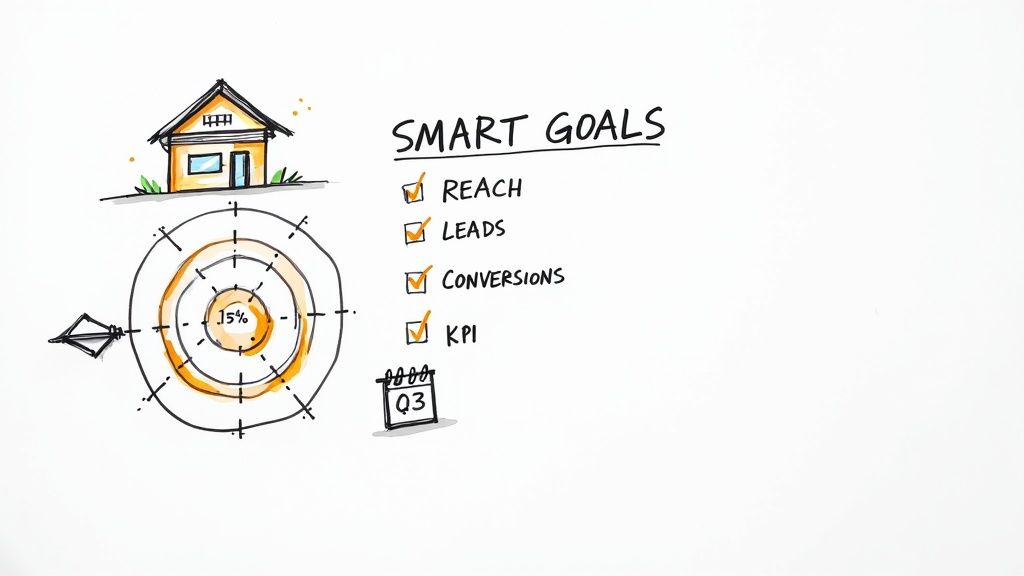
For your goals to actually work, they need to be specific and something you can act on. I’ve always found the SMART framework to be a refreshingly simple but incredibly powerful way to do this. It’s a gut check to make sure your objectives are:
- Specific: Nail down exactly what you want to achieve.
- Measurable: How will you track your progress? Slap a number on it.
- Achievable: Be realistic. Set goals you can actually hit with your current resources.
- Relevant: Does this goal actually matter to your bigger business objectives?
- Time-bound: Give yourself a deadline.
Let’s look at a real-world example. A vague goal like “I want to grow my business on Instagram” is pretty useless. A SMART goal, on the other hand, gives you a target to aim for.
Practical Example: Local Bakery
Instead of saying, “I want to sell more cakes,” a much better SMART goal would be: “Increase online cake orders by 15% through Instagram promotions and targeted ads within the next quarter (Q3).” See the difference? It’s specific (online cake orders), measurable (15% increase), achievable, relevant to revenue, and has a clear deadline (Q3).
This works just as well for service-based businesses, too. The focus might shift, but the principle is identical.
Practical Example: B2B Consultant
“Get more clients from LinkedIn” is a weak goal. Let’s make it SMART: “Generate 10 qualified leads per month by sharing case studies and engaging in relevant industry groups on LinkedIn for the next six months.”
This kind of clarity turns your social media from a daily chore into a strategic asset that actually grows your business.
Identify Your Key Performance Indicators
Once you’ve got your SMART goals locked in, you need a way to track them. That’s where Key Performance Indicators (KPIs) come into play. Think of KPIs as the specific numbers you watch to see if you’re on the right track.
The KPIs you choose should be a direct reflection of your goals. It’s a simple matching game.
- If your goal is brand awareness, you’ll be watching KPIs like Reach (how many unique people see your stuff) and Impressions (the total number of times your content is shown).
- If you’re trying to generate leads, your key metrics will be Click-Through Rate (CTR) on your links and the Conversion Rate on your landing pages.
- And if you’re focused on building a community, you’ll obsess over Engagement Rate (likes, comments, shares) and Follower Growth Rate.
Setting this up from day one makes it so much easier to see what’s working and what’s a waste of time. It lets you pivot your strategy based on hard data, not just a gut feeling. This foundation informs everything that comes next.
And if you’re trying to build a strong social presence without breaking the bank, you might find some valuable tips for advertising a small business on a budget.
Pinpoint and Understand Your Ideal Customer
Posting on social media without knowing who you’re talking to is like shouting into a void. To get any real traction, you have to move past generic updates and start having real conversations. That means transforming your audience from a faceless crowd into individuals you actually understand.
This is where customer personas come in. A persona is basically a detailed, semi-fictional profile of your ideal customer. It’s not just about demographics; it’s about figuring out their goals, their frustrations, and what really makes them tick. Crafting these profiles turns your content from a shot in the dark into something that genuinely connects.
Digging for Data You Already Have
You don’t need a huge research budget to get started. The clues you need are probably hiding in the tools and data you already use every day. The trick is to combine the numbers (quantitative data) with the human stories (qualitative data).
Here’s a productive workflow for gathering data:
- Survey Your Existing Customers: Whip up a short, 5-question survey with a tool like Google Forms or SurveyMonkey. Ask about their biggest challenges, which social platforms they scroll through daily, and what kind of content they actually find useful.
Productivity Tip: To boost responses, offer a small incentive, like a 10% discount code for completing the survey.
- Dive into Google Analytics: Your website’s Google Analytics is a goldmine. Head over to the Audience reports to see demographics like age, gender, and location. You can also uncover their interests and what devices they use, which tells you a lot about their lifestyle and daily habits.
- Analyze Your Social Media Followers: Every major platform has its own analytics. Instagram Insights, Facebook Audience Insights, and LinkedIn Analytics all give you a demographic breakdown of your current followers. This is the fastest way to see who is already paying attention to your brand.
Once you pull these sources together, you’ll start seeing patterns. You might discover that 70% of your website visitors are women aged 25-40 browsing on their phones, or that your most engaged Instagram followers are all passionate about sustainable living. Those are the breadcrumbs you follow.
Building Your Customer Persona
With data in hand, it’s time to bring your persona to life. Give them a name, a job, and a backstory. This little bit of storytelling makes it so much easier to create content that speaks their language. If this is new territory for you, our guide on what is a user persona is a great place to start.
Let’s imagine a B2B software company that sells productivity tools.
Persona Example: ‘Marketing Manager Mary’
- Who is she? Mary is a 35-year-old Marketing Manager at a mid-sized tech company.
- Her Goals: She’s trying to boost her team’s efficiency and, most importantly, prove the ROI of her marketing efforts to her boss.
- Her Pain Points: She feels buried under a scattered workflow, struggles with remote team collaboration, and never has enough time for big-picture strategy.
- Social Habits: You’ll find her on LinkedIn during her lunch break, following industry leaders and looking for articles on productivity hacks. Instagram is just for her personal life.
Suddenly, you’re not creating content for “B2B professionals” anymore. You’re creating it for Mary. You know to focus your efforts on LinkedIn, share tips on streamlining workflows, and use language that addresses her specific challenges. It completely changes the game.
Tune In with Social Listening
Creating a persona is a fantastic starting point, but people change. That’s why social listening has to be an ongoing part of your strategy. It’s just the practice of monitoring social media for mentions of your brand, your competitors, and keywords relevant to what you do.
You can automate a lot of this with tools like Sprout Social, Hootsuite, or even the free Google Alerts.
Productivity Workflow: Set up alerts for your business name, your top 2-3 competitors, and a few core industry keywords. Spend just 15 minutes each morning reviewing the alerts. This simple habit keeps you plugged into what your audience actually cares about right now, making sure your content stays fresh and valuable.
This ongoing process helps you:
- Track Brand Mentions: See what people are saying about you in real-time.
- Identify Pain Points: Notice recurring questions? You’ve just found your next content topic.
- Monitor Competitors: Keep an eye on what others are doing well and where they’re dropping the ball.
Choose the Right Social Media Platforms
Trying to be everywhere at once is a classic recipe for burnout, not a solid social media strategy. The real goal isn’t to plant a flag on every platform; it’s to show up where it actually matters. When you’re a small business, your time and resources are precious. Pouring them into the right channels is where you’ll see a real impact.
It all comes down to matching the platform’s vibe and audience with that customer persona you worked on. Think about where your ideal customer—say, ‘Marketing Manager Mary’—genuinely hangs out online. A mismatch here means your brilliant content just ends up shouting into the void.
Aligning Platforms with Business Goals
First thing’s first: connect your platform choice back to the goals you already set. Are you trying to sell visual products? Generate B2B leads? Or maybe just build a tight-knit local community? Each platform has its own superpower.
Practical Example: Handmade Jewelry Business
Your goal is to showcase intricate designs and drive sales. The most powerful platforms will be highly visual.
- Instagram: A no-brainer. It’s perfect for stunning photos, behind-the-scenes Reels of your process, and collaborating with style influencers.
- Pinterest: This is where people go to plan and dream. It’s ideal for creating inspiration boards and driving traffic straight to your product pages, catching users when they’re already in a buying mindset.
On the flip side, a financial advisory firm needs to build trust and authority. Their content is more educational and professional. Trying to make a splash on TikTok would be a huge waste of energy. Their best bet is LinkedIn, where they can share market analysis, publish articles, and network with other professionals to land high-quality B2B leads.
This decision tree offers a great way to map out your options, see what competitors are up to, and check your choices against your own analytics.
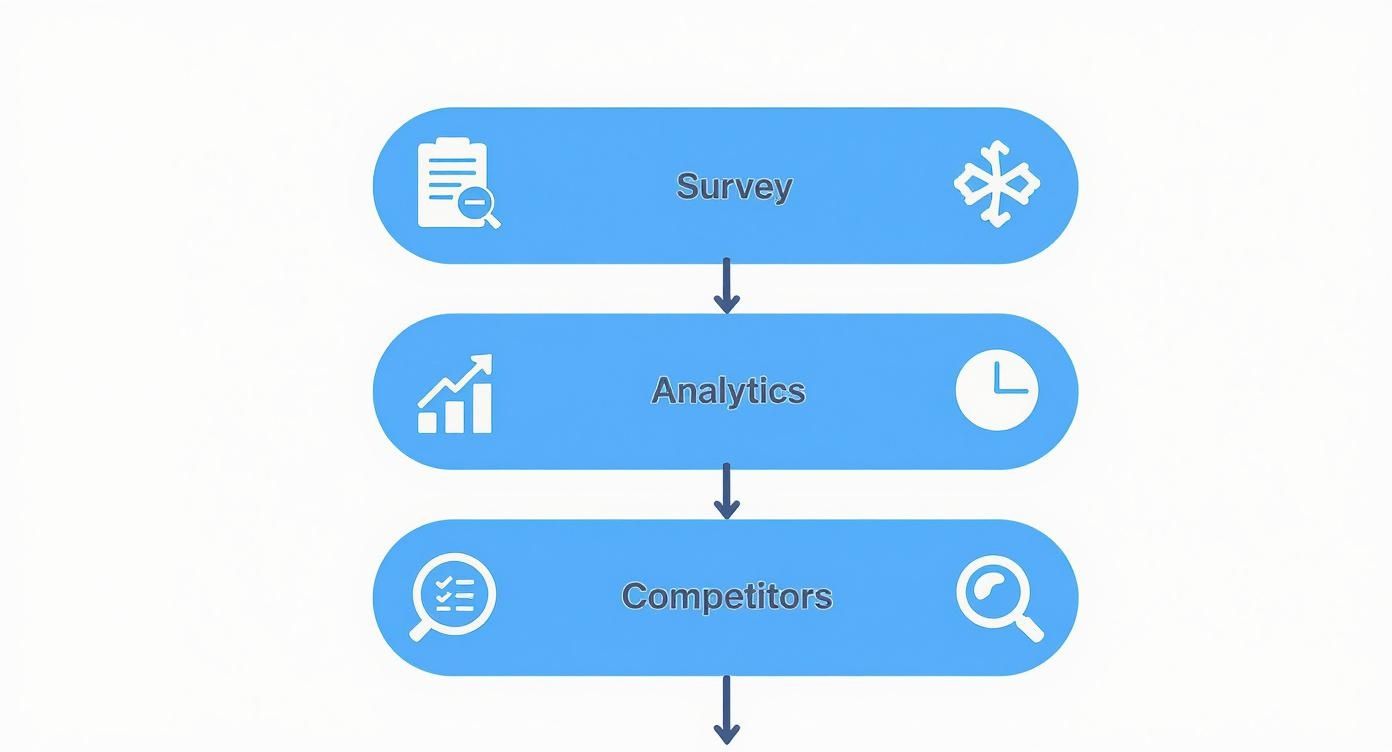
As you can see, it’s a clear path from customer research to analyzing the competition, helping you land on a platform choice that’s backed by data, not just a gut feeling.
A Deeper Look at the Top Platforms
Let’s get into the weeds on the most popular platforms for small businesses. Remember, the goal is to pick one or two and get really good at them before you even think about expanding.
In 2025, people spend an average of 2 hours and 21 minutes a day on social media, with 63.9% of the world’s population scrolling through these apps. This is a massive opportunity for small businesses to connect directly with customers. According to research from Sprout Social, the top channels for businesses this year are YouTube, Instagram, and TikTok—all driven by visual content and short-form video.
With that in mind, let’s see how the main players stack up. To make it easier, I’ve broken down the key platforms into a simple comparison chart.
Social Media Platform Comparison for Small Businesses
This table gives a quick snapshot to help you decide where to focus your energy.
| Platform | Primary Audience | Best For | Ideal Business Type |
|---|---|---|---|
| Gen X & Boomers | Building local community, customer service, targeted ads | Local services, restaurants, retail, community groups | |
| Millennials & Gen Z | Visual storytelling, e-commerce, influencer marketing | Fashion, food, travel, beauty, product-based businesses | |
| Professionals & B2B | Lead generation, networking, establishing authority | B2B services, consulting, tech, professional recruiting | |
| TikTok | Gen Z & Younger Millennials | Short-form video, trend-jacking, brand personality | E-commerce, entertainment, brands with a quirky vibe |
| Predominantly Female | Driving website traffic, visual discovery, inspiration | DIY, home decor, wedding, food, fashion, retail |
Each platform has a distinct personality and user base. A local diner will find a home on Facebook, using Groups and Events to build a loyal following. A fashion boutique, however, belongs on Instagram, where aesthetics and visual storytelling reign supreme.
Your platform choice is a foundational piece of your entire strategy. By being selective, you make sure every single post you create has the best possible shot at reaching the right person and helping your business grow.
Develop a Content Strategy That Actually Converts
Great content is the engine that powers your whole social media machine. It’s the bridge between your brand and your audience, and when you get it right, it turns passive scrollers into loyal customers. A solid small business social media strategy is all about creating content that doesn’t just fill a calendar—it actually grabs attention and makes people act.
The real trick is finding that sweet spot between promoting your business and providing genuine value. Small businesses have fully embraced social media as a key part of their marketing—in fact, 96% now use these platforms to connect with customers. This isn’t surprising, given how well you can target specific audiences and the huge potential for growth. To stand out, you need a plan that’s both creative and sustainable.
Build Your Strategy Around Content Pillars
The best way I’ve found to keep content focused and consistent is by using content pillars. These are just the main themes or topics you’ll talk about again and again. Think of them as the foundational columns holding up your entire strategy, making sure you never stray too far from your core message.
Instead of just posting whatever pops into your head, pillars give you a reliable structure. Most businesses I’ve worked with find success by blending a few key types.
- Educational Content: This is where you teach your audience something useful. It’s how you become the go-to expert and build trust.
- Entertaining/Inspirational Content: Here’s where you let your brand’s personality shine. This content is all about making your audience feel something—joy, motivation, or a sense of community.
- Promotional Content: This is your direct sell. We’re talking special offers, new product announcements, and customer testimonials.
- Community-Building Content: This content is all about engagement. Spark conversations with questions, run polls, and feature user-generated content.
A good rule of thumb is the 80/20 principle: 80% of your content should provide value (educational, entertaining), while only 20% is directly promotional. This stops your feed from feeling like one long, boring sales pitch.
From Pillars to Practical Posts
So, how does this look in the real world? Let’s say you own a local coffee shop. Your content pillars might be something like “Coffee Education,” “Behind the Scenes,” and “Community Spotlight.”
Practical Example: The Neighborhood Coffee Shop
- Educational: A quick video explaining the difference between a latte and a flat white.
- Entertaining: A cool time-lapse of your best barista creating some mesmerizing latte art.
- Promotional: A simple graphic announcing a “buy one, get one free” deal on cold brew this Friday.
- Community: A photo featuring a “customer of the week” enjoying their favorite drink.
This mix keeps your feed fresh and gives people multiple reasons to follow you. They might come for the coffee tips, but they’ll stay for the friendly, local vibe. Visuals are key here, and social media videos have become absolutely essential for grabbing attention and getting your message across quickly.
Boost Productivity with a Content Calendar
Ideas are great, but execution is everything. As a busy small business owner, a content calendar is a non-negotiable tool for staying organized and consistent. It’s a simple system that turns your strategy from a bunch of ideas into a clear, actionable plan.
You don’t need anything fancy to get started. A basic spreadsheet or a free tool can work wonders.
- Trello: Set up a board with lists like “Ideas,” “In Progress,” “Ready to Schedule,” and “Published.” Each post is a card you can drag through the workflow.
- Asana: Map out your content for the month in a project. You can assign tasks for creating graphics, writing captions, and scheduling each post.
- Google Sheets: Create a simple spreadsheet with columns for the date, platform, content pillar, caption, and a link to the visual. It’s low-tech but incredibly effective.
Simple Content Calendar Workflow:
- Monthly Brainstorm: Block out an hour at the end of each month to brainstorm ideas for the next month, guided by your content pillars.
- Batch Creation: This is a game-changer. Set aside a few hours one day a week to create content in batches. Film a few short videos, design several graphics, and write a week’s worth of captions all at once. It’s so much more efficient than trying to create something new every single day.
- Schedule Everything: Use a scheduling tool to load up all your posts for the week ahead. This frees up your mental energy so you can focus on what really matters: engaging with your audience in real-time.
This system creates a process you can actually stick with. It ensures you’re consistently putting out high-quality content that aligns with your goals, turning your social media presence into a reliable engine for business growth.
Measure What Matters and Refine Your Approach
Your social media plan shouldn’t be a “set it and forget it” document collecting dust in a folder. Think of it as a living, breathing guide that gets smarter as you learn what your audience actually responds to. This is where data becomes your secret weapon for growth.
Without it, you’re just guessing. But when you start tracking your performance, you can stop wasting time on what isn’t working and double down on the content that actually drives results. This is how a good small business social media strategy evolves into a great one.
Demystifying Key Social Media Metrics
Diving into your analytics can feel like staring at a wall of numbers. The trick is to ignore the noise and focus only on the metrics tied to the goals you set earlier. These are the numbers that tell you the story of what’s working.
Let’s cut through the jargon and look at what really matters for a small business:
- Engagement Rate: This is so much more than likes. It’s a true measure of how involved your audience is with your content—we’re talking comments, shares, and saves. A high engagement rate means your content is genuinely connecting, not just getting scrolled past.
- Click-Through Rate (CTR): This one’s simple: how many people clicked the link in your post, bio, or ad? If your goal is to get people to your website, this is a critical sign of whether your call-to-action is strong enough to make them act.
- Conversion Rate: This is the bottom-line metric. It tracks the percentage of people who take a specific action after clicking your link, like buying a product, signing up for your newsletter, or booking a consultation.
You don’t need fancy tools to start. These core metrics are available right inside the native analytics of every major platform, from Instagram Insights to Facebook Business Suite. Making it a habit to check these dashboards weekly will give you instant feedback on your efforts.
Turning Insights into Action
Data is pointless if you don’t do anything with it. The real magic happens when you spot a trend and use it to steer your strategy. This cycle of review and refinement is what makes your social media more effective over time.
Let’s say you run a small e-commerce shop selling custom pet portraits. You’ve been posting a mix of finished portraits and short videos of your painting process.
Practical Example: E-commerce Store Pivot
After a month, you dive into your Instagram Insights. You see that your video Reels get, on average, double the comments and shares compared to static photos. Even better, a time-lapse Reel of a golden retriever portrait drove 30% more profile visits than any other post that week.The insight is crystal clear: your audience loves seeing how the art is made. Your action plan is to shift your content mix to 70% video and 30% static images, focusing on creating more of the behind-the-scenes content that you now know captures attention.
This is exactly how you let data guide your creative decisions instead of just going with your gut.
Experiment and Refine with A/B Testing
Another powerful way to sharpen your strategy is through A/B testing. All this means is testing two slightly different versions of a post to see which one performs better. It’s a simple but incredibly effective way to learn what truly resonates.
Productivity Tip: You don’t need complex software. To A/B test a caption on Instagram, post the same image with different text a week apart (at the same time of day). Track which one gets more engagement. This low-tech test can reveal whether your audience prefers questions, short tips, or longer stories.
You can A/B test almost anything:
- Captions: A short, punchy caption vs. a longer, story-driven one.
- Calls-to-Action (CTAs): Does “Shop Now” get more clicks than “Learn More”?
- Visuals: The same product photographed against two different backgrounds.
- Post Times: An identical post scheduled for 9 a.m. vs. 6 p.m. to find your audience’s sweet spot.
Even tiny tweaks can lead to big improvements. This habit of testing and learning helps you get the most out of your time and budget, which is especially important as more businesses put money into social ads.
The impact of social advertising on small businesses is undeniable, with global ad spending projected to hit a staggering $276.7 billion in 2025. With 83% of that spending expected to be on mobile by 2029, optimizing your content for what works is no longer optional. You can discover more about these social media statistics to see the full picture.
A Few Common Social Media Questions
When you’re running a business, social media can feel like a whole separate job. You’ve got questions, and we’ve heard most of them before. Here are some quick, practical answers to the things small business owners ask us all the time.
How Much Should a Small Business Actually Budget for Social Media?
This is the million-dollar question, but the answer isn’t a magic number. A good starting point for many is 5-15% of their overall marketing budget, which should cover both content and any paid ads you want to run.
But here’s a more practical way to think about it: work backward from your goals.
Practical Example: Let’s say you want 20 new leads a month from social media. If you know from past experience that a Facebook ad costs you about $25 per lead, then you need a bare minimum of $500 a month just for ads to hit your target. Start small, prove the return, and then scale up.
Don’t forget to account for tools that save you time, like schedulers or content creation apps. They’re part of the budget, too, and often pay for themselves in reclaimed hours.
Seriously, How Often Do I Need to Post?
Consistency will always beat frequency. It’s so much better to share three high-quality, genuinely useful posts a week than to spam your followers with seven low-effort ones that nobody engages with.
Every platform is a little different, and you’ll have to see what your specific audience responds to. But if you need a place to start, here’s a rough guide:
- Facebook: 3-5 times per week
- Instagram (Feed): 3-5 times per week
- Instagram (Stories/Reels): A few times a week is great, but more if you’ve got good stuff to share
- LinkedIn: 2-3 times per week
- TikTok: 4-6 times per week
Productivity Tip: Pick a schedule that feels doable for you, then use a scheduling tool to lock it in. This prevents the daily stress of figuring out what to post and ensures you stay consistent, which the algorithms love.
What Am I Supposed to Do About Negative Comments?
First, take a breath. Don’t panic, and definitely don’t delete the comment (unless it’s spam or truly offensive). A negative comment, handled well, is a golden opportunity to show everyone you’re a business that listens and cares.
Here’s a simple playbook for these moments:
- Reply quickly and publicly. The first step is to just acknowledge their issue so everyone else sees you’re on it. Something as simple as, “We’re so sorry to hear you had this experience. We’d like to make it right,” works wonders.
- Move the conversation to a private channel. Next, offer to sort out the specifics in a direct message or over email. This keeps a long, messy back-and-forth off your public page and respects the customer’s privacy.
- Actually learn from it. Was this a one-time fluke or a sign of a bigger problem? Use that feedback to make your business better. That’s how you turn a complaint into a win.
Ready to build a consistent, effective social media presence without the grind? Postful is your AI-powered partner for creating and scheduling high-quality content that connects with your audience. Join the waitlist today to get early access and simplify your social media workflow. Secure your spot on the Postful waitlist.