
Let's be honest: "personal branding" can sound like a fluffy, nice-to-have marketing term. But for entrepreneurs, it’s not just a buzzword—it's a core business strategy. It's how you deliberately shape the way people see you, your expertise, and your story so that the right opportunities and clients come looking for you. This is your secret weapon for standing out and winning against bigger, more established players.
Why Your Personal Brand Is Your Greatest Business Asset
In a market overflowing with options, your personal brand is what makes someone choose you. It’s the human element that convinces a potential client to trust you, even if you charge more than the competition. It’s what turns a one-time transaction into a long-term relationship with a loyal advocate.
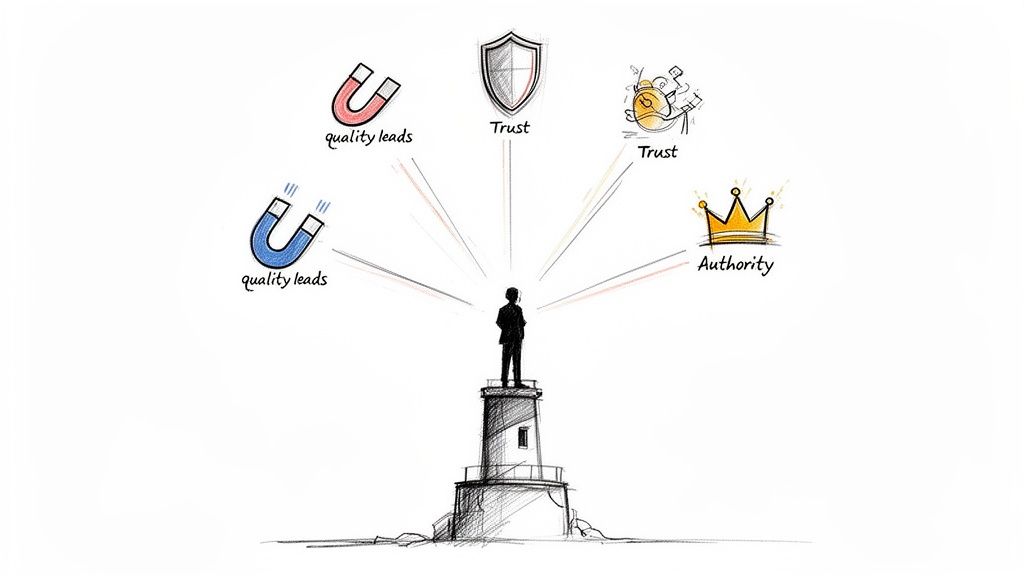
Think of it this way: your business has a product or service. Your personal brand is the story, the trust, and the authority that makes people want to buy it. This is the fundamental difference between founders who seem to attract clients effortlessly and those who are constantly struggling to find their next project.
The Business Impact of Strategic Personal Branding
A strong personal brand doesn't just feel good; it delivers real, measurable results. Here’s a quick look at how investing in your personal brand directly impacts your bottom line.
| Key Benefit | Practical Example |
|---|---|
| Higher-Quality Leads | A web designer shares case studies of her work on LinkedIn. She attracts pre-qualified clients who understand her style and are ready to hire her, skipping lengthy sales pitches. |
| Unwavering Customer Trust | An e-commerce founder posts behind-the-scenes videos of her sustainable sourcing. Customers feel connected to her mission and choose her brand over cheaper, faceless alternatives. |
| Market Authority | A financial advisor consistently posts tips on X about investing for solopreneurs. He becomes the go-to expert, allowing him to command premium rates for his consulting services. |
| Increased Resilience | During an economic downturn, a business coach with a strong, engaged community on Instagram continues to fill her programs because her followers trust her guidance. |
When you consistently share your unique perspective and knowledge, you’re not just posting online—you’re building a powerful pipeline of future customers who already see you as the expert.
Your brand is what you stand for—the package of character traits and capabilities that make you who you are, expressed in a way that others can understand right away. It’s the strategic projection of your most authentic self.
This isn't about faking it. It's about strategically showcasing who you already are. For instance, a freelance e-commerce consultant can share small wins and case studies on X (formerly Twitter). This builds their reputation, attracting online store owners who need exactly what they offer. The result? High-quality inbound leads without spending a dime on ads.
A Massive Opportunity Hiding in Plain Sight
Here’s the thing: everyone knows personal branding is powerful, but very few entrepreneurs are actually doing it with any real strategy.
Recent research reveals a massive disconnect: while 70% of consumers say personal branding is important, only a tiny 15% of professionals have a defined plan. This gap is a golden opportunity for anyone willing to be intentional.
By building a clear, authentic brand, you immediately place yourself in the top tier of your industry. That's where tools like Postful come in, helping you bridge that awareness-to-action gap by making consistent content creation and scheduling almost effortless.
Productivity Tip: To start being intentional, block just one hour on your calendar this week for "Brand Strategy." Use that time to define one core message you want to be known for. This single action puts you ahead of the majority who post without a plan.
Laying the Groundwork for Your Authentic Brand
It’s tempting to jump right into creating content, but hold on. Before you write a single post, you need to lay a solid foundation. This is the strategic core of your personal brand—the introspective work that defines who you are, what you stand for, and, most importantly, who you’re here to serve.
This isn’t about logos or color palettes. It’s about getting clear on your authentic self so you can attract the right people and opportunities, almost like magic.
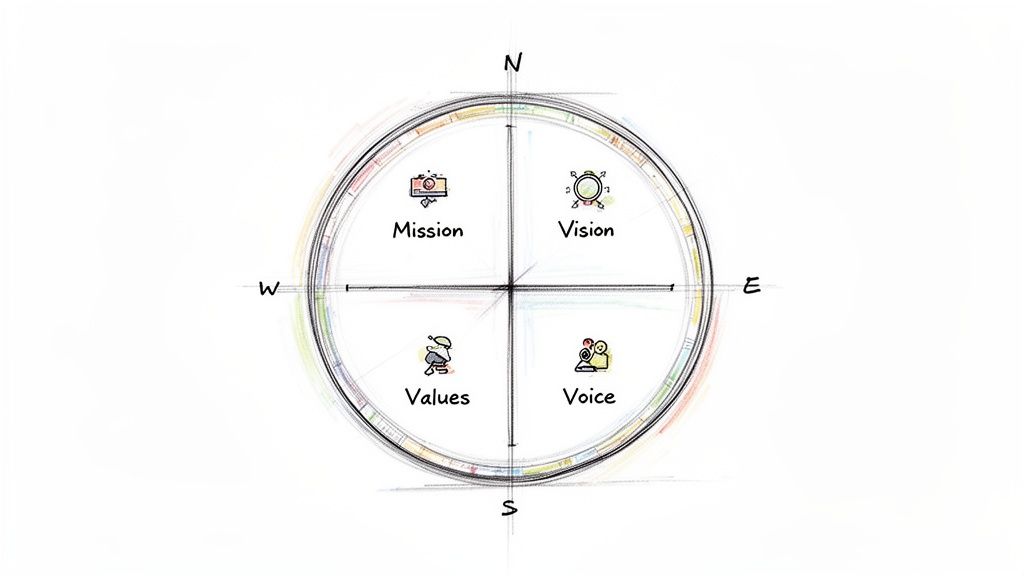
Think of this process as building your brand’s internal compass. It’s the tool that will guide every decision you make, from the topics you talk about to the tone of your emails. Once you have this clarity, your brand stops feeling like work and starts becoming a magnet for your ideal clients.
Find Your Unique Value Proposition
Your unique value proposition (UVP) is just a fancy way of asking: "Why should someone follow me or hire me over anyone else?" It's the clear, concise statement that explains what makes you different.
To nail down your UVP, look for the sweet spot where three things intersect:
- What you're passionate about: What topics light you up? What problems do you genuinely love to solve for others?
- What you're genuinely good at: Where does your real-world expertise lie? What results can you consistently deliver?
- What your ideal audience actually needs: What are the specific pain points and goals of the people you want to help?
For instance, a freelance developer who loves helping early-stage companies might land on this UVP: "I help non-technical founders build scalable MVP backends so they can launch faster and with more confidence." It’s specific, it’s valuable, and it speaks directly to a niche audience that needs exactly that.
Build Your Brand Compass
Your Brand Compass is a simple framework I use to codify the heart of a brand. It keeps you consistent and, more importantly, authentic.
- Mission: This is your "why." What’s the ultimate purpose driving your work?
- Example: To empower small business owners with the financial literacy to build generational wealth.
- Vision: What future are you trying to create for your clients or your industry?
- Example: A world where every entrepreneur feels confident managing their business finances.
- Values: Name 3-5 non-negotiable principles that guide your decisions and actions.
- Example: Simplicity, Empowerment, Transparency, Integrity.
- Voice: How do you sound when you communicate? Are you witty, empathetic, direct, or more educational?
- Example: Empathetic and educational, breaking down complex topics into simple, actionable steps.
This exercise is your defense against simply mimicking what everyone else is doing. It grounds your personal branding for entrepreneurs in something real and sustainable: your own identity.
The most effective personal brands aren't about projecting a perfect image. They are about strategically revealing your authentic self and the value you bring, creating a reputation that accurately reflects who you are.
This kind of authenticity builds deep, meaningful connections. The data backs this up, with one survey showing that 77% of respondents believe personal branding has positively impacted their career by tying trust and visibility directly to professional growth. You can explore more about how trust impacts business at WeAreTenet.com.
Nail Your Core Message
Your core message is the big idea you want to own—the common thread tying all your content together. It’s not a tagline. It’s the fundamental perspective you want to share with the world.
When your message is clear, content creation becomes infinitely easier. If you’re ever stuck staring at a blank page trying to write a bio or a social post, it’s usually because your core message is fuzzy. To sharpen yours, check out our deep dive on what brand messaging is and how to create it.
A great way to test your message is by writing your professional bio. It's a cornerstone of your personal brand that has to communicate your expertise and connect with your audience in just a few lines. For writers and authors, BarkerBooks has an excellent guide on How to Write an Author Bio That Sells Books.
Putting in this foundational work upfront sets you up for long-term success. You’ll go from wondering what to post next to having a clear, guiding strategy that makes creating content feel natural and, dare I say, fun.
Developing Your Content and Channel Strategy
Okay, you’ve laid the groundwork for your brand. Now for the fun part: turning that strategy into content that actually gets seen and felt. Building a powerful personal brand as an entrepreneur comes down to sharing valuable stuff, consistently. But just "being active online" is a recipe for burnout, not a business strategy.
You need a system. A real content machine that takes your expertise and turns it into a magnet for your ideal audience.
This is where so many founders get stuck. They either try to be everywhere at once and burn out, or they post randomly with no real goal. The trick is to focus your energy. Do less, but do it better. That means creating the right content for the right channels—the ones where your people actually hang out.
The Four Pillars of Content
To keep your content from feeling one-note (and to gently guide your audience from "who are you?" to "I need to hire you"), you should think in terms of four content pillars. Each one has a specific job to do.
This visual breaks down how the pillars—Educate, Entertain, Inspire, and Convert—fit together to create a balanced strategy.
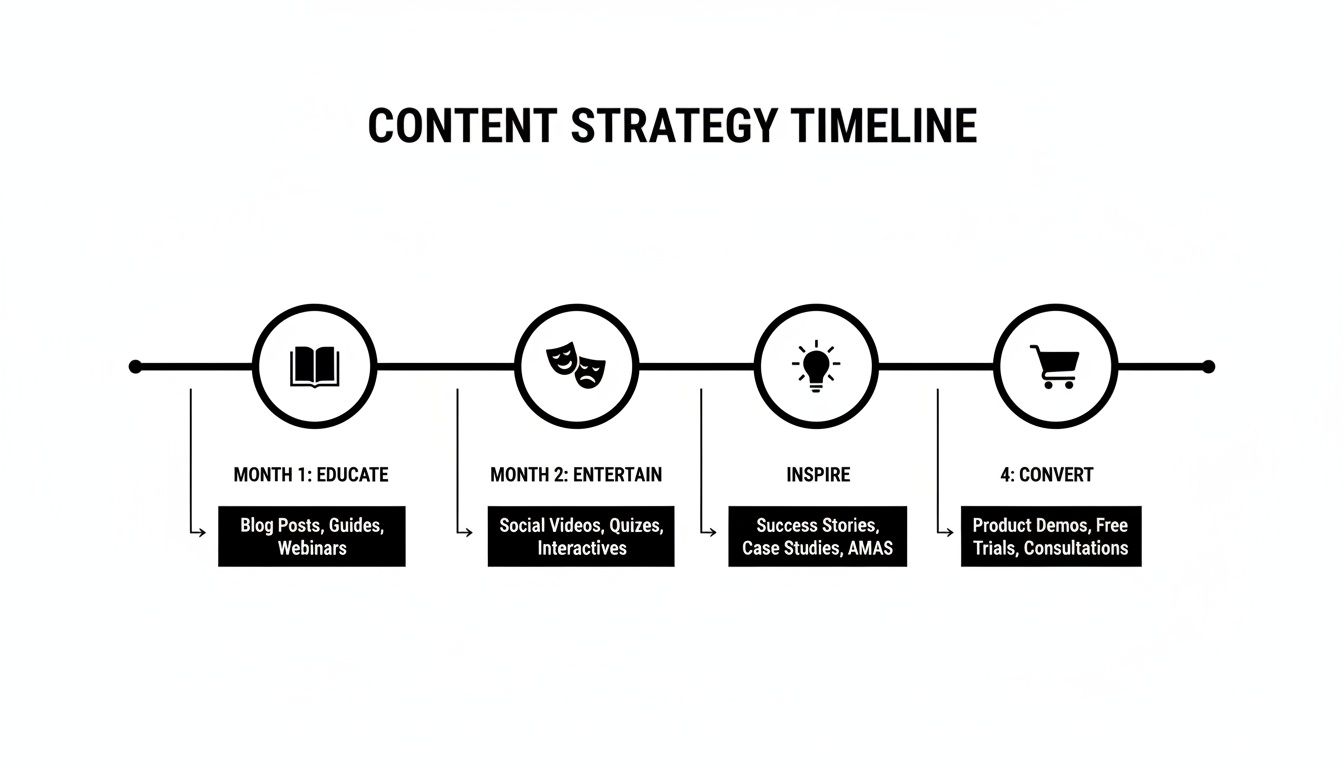
As you can see, a winning strategy always starts by giving value—educating and inspiring—long before it ever asks for a sale.
Here’s how to put these into practice:
- Educate: This is your bread and butter. Think "how-to" guides, simple breakdowns of complex topics, or quick, actionable tips. For a social media consultant, this could be a LinkedIn post on "3 Ways to Improve Your Instagram Bio Today." You're teaching, which builds authority.
- Entertain: Let your personality show. This is where you share behind-the-scenes moments, a funny observation about your industry, or a personal story. This kind of content builds a human connection and makes you memorable.
- Inspire: Share your "why." Post client success stories or motivational insights from your own journey. This pillar creates an emotional bond and shows your audience what’s possible if they follow your advice or work with you.
- Convert: This is where you make a direct ask. It might be promoting a discovery call, a new service, or a free download. This content lands best when it’s a small slice of your overall strategy, because it’s standing on the trust you’ve built with the other three pillars.
Choosing Your Channels Wisely
You don't need to be everywhere. In fact, you shouldn't be. The smartest move is to pick one or two channels where your ideal audience is already spending their time and go deep.
Being a "master of one" channel is far more effective than being a "jack of all" platforms. Deep engagement on a single, relevant network will always outperform shallow presence across five.
This little matrix can help you decide where to plant your flag:
| Channel | Best For | Audience Mindset | Practical Example |
|---|---|---|---|
| B2B networking, professional services, thought leadership | Professional development, industry news, career growth | A SaaS founder shares a detailed article on LinkedIn about how her team overcame a product development hurdle. | |
| X (Twitter) | Real-time updates, industry news, community building | Quick insights, networking, discovering trends | A VC investor posts a thread of quick takes on emerging tech trends, sparking conversations with founders. |
| Visual-first brands, e-commerce, lifestyle services | Inspiration, entertainment, product discovery | A nutritionist shares an Instagram Reel of a quick, healthy recipe, showing her expertise in a visual, engaging way. | |
| TikTok | Creative brands, reaching a younger demographic | Entertainment, quick learning, discovering trends | A career coach creates a 30-second TikTok video debunking a common myth about job interviews. |
As you nail down your channels, think about how a winning thought leadership content strategy can really set you apart. Your content is the number one way you prove you know your stuff.
Streamlining Your Workflow with Productivity Tools
Creating unique content for multiple platforms can absolutely feel like a full-time job. This is where a smart workflow and the right tools become a game-changer for personal branding for entrepreneurs.
One of the most effective workflows I've seen is the "create once, distribute many" model. You create one big "core" piece of content and then slice and dice it for different channels.
For example, a financial advisor could write a 500-word blog post on "Retirement Planning for Freelancers." From that one piece, they can:
- Turn the main points into a 5-part LinkedIn carousel.
- Pull out three key stats for separate posts on X.
- Record a 60-second video for Instagram Reels summarizing the main tip.
This approach saves an incredible amount of time. Tools like Postful are built for this, helping you use AI to brainstorm ideas, turn one idea into multiple post formats, and schedule it all from one spot. For more frameworks, you can check out our guide on how to develop a content strategy.
And remember, your personal voice is your biggest advantage. Research shows that 76% of people trust content from individuals more than posts from a corporate brand account. For an entrepreneur, that's huge—your personal take can get eight times more engagement than a generic brand post. It’s a massive leg up. You can learn more about these personal branding statistics and how to make them work for you.
Your 90-Day Personal Brand Launch Plan
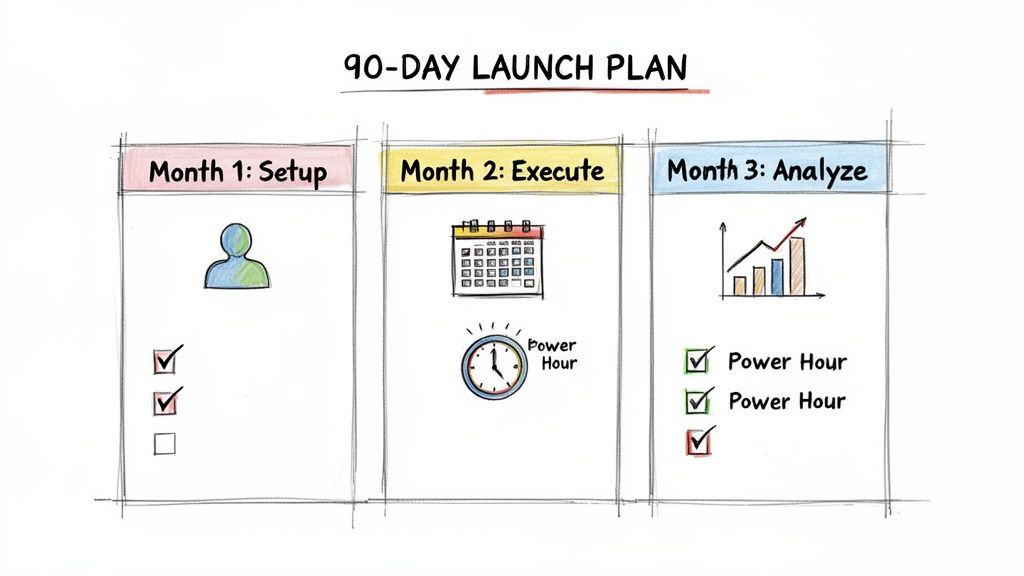
You’ve got your strategy nailed down. Now it’s time to turn those ideas into action. This is where we break down the entire launch into a simple, 90-day plan to build momentum and get real results from day one.
A plan is what separates the people who get traction from those who don't. Without a documented approach, most entrepreneurs see almost no engagement. But those with a clear structure? They thrive.
Think about it: 72% of adults in the US are on social media. Consistent posting is your ticket to reaching them, and smart tools are what make that consistency possible. This is where something like Postful becomes a game-changer; its templates, AI brainstorming, and simple scheduling let you execute your strategy without the headache. You can check out more on the power of a planned approach from WeAreTenet.com.
Month 1: The Setup Phase
Your first 30 days are all about building the launchpad. The goal here isn't perfection; it's preparation. You want to polish your digital presence, create your first batch of content, and lock in a posting rhythm you can actually maintain. This upfront work is what saves you from the frantic, last-minute posting that leads to burnout.
Your key moves in Month 1:
- Optimize Your Profiles: Go through every social profile you plan to use. Make sure your bio nails your value proposition, your headshot is professional and consistent, and you have a clear call-to-action, like a link to your website or newsletter.
- Create Your First Content Batch: Brainstorm and create your first 12 to 15 pieces of content. Try to get a mix of your four content pillars: Educate, Entertain, Inspire, and Convert. This batch is your buffer, so you’re never scrambling for what to post next.
- Set a Realistic Schedule: Decide how often you’ll post on each channel. A great place to start is 3-4 times per week on your main channel. Remember, consistency always beats frequency.
Don’t get hung up on perfection this month. Focus on completion. Just getting your profiles set up and your first batch of content scheduled is a huge win. You can always tweak and improve as you learn.
For example, a business coach in Month 1 would update their LinkedIn with a headline like, "Helping SaaS Founders Scale to their First $1M ARR." Then they'd write three educational posts, four quick tips, three client success stories, and two posts pointing to a free webinar.
Month 2: Consistent Execution and Engagement
With your foundation in place, Month 2 is all about discipline. This is where you fire up the content engine and—just as important—start building actual relationships. Getting seen is one thing; getting known requires engagement.
Your key moves in Month 2:
- Stick to the Schedule: Post the content you created last month, right on schedule. Using a scheduling tool is non-negotiable here; it ensures your content goes out on time, even when you're swamped.
- Engage Actively: Set aside 15-20 minutes every single day to connect with people. This means leaving thoughtful comments on posts from your peers and ideal clients, answering questions in relevant groups, and replying to every single comment on your own posts.
- Listen and Learn: Pay close attention to what’s working. Which posts get the most comments and shares? What questions are people asking in your DMs? This feedback is pure gold for your future content.
Think of your content as the conversation starter. The real brand building happens in the replies and the DMs. This is how you shift from just being a content creator to becoming a trusted resource in your space.
Month 3: Analysis and Scaling
By Month 3, you have data. Now you can stop guessing and start making informed decisions. This month is all about reviewing what worked, refining your strategy, and finding ways to grow your impact without adding more to your plate.
Your key moves in Month 3:
- Review Your Analytics: Dive into your data from the last 60 days. Pinpoint your top 3-5 performing posts based on engagement and profile clicks.
- Double Down and Repurpose: Take your best-performing content and find new ways to say it. A hit LinkedIn post can easily become a script for a short video, a multi-part thread for X (formerly Twitter), or a quick carousel for Instagram.
- Plan Your Next 90 Days: Use what you've learned to map out your content themes and goals for the next quarter. You're no longer operating on hope; you're operating from a position of knowledge.
The Weekly Power Hour Workflow
To make all of this sustainable, I recommend blocking out one "Power Hour" on your calendar each week. This is your non-negotiable time dedicated to personal brand growth.
Here’s a simple workflow to follow:
- Brainstorm (15 mins): Look at your content pillars and jot down ideas for the week ahead. Use audience feedback and questions from the previous week for inspiration.
- Create & Batch (30 mins): Write your posts for the week. Focus on creating 3-4 high-quality pieces instead of seven mediocre ones.
- Schedule (15 mins): Load everything into a scheduling tool like Postful. Set it to go live on your chosen days and times.
This simple, repeatable workflow is the key to consistent personal branding for entrepreneurs. It turns what feels like a huge task into a manageable, 60-minute weekly habit that drives incredible results over the long run.
Measuring Your Brand's Impact and Scaling Influence
You’ve done the hard work of building your foundation and shipping content for 90 days. But is any of it actually working? How do you know if your personal branding for entrepreneurs is making a real difference?
It comes down to tracking the right numbers—and they’re probably not the ones you think.
Likes and follower counts feel good, but they're vanity metrics. They don't pay the bills. The real measure of your brand's impact is how well you guide someone from a casual scroller to a paying customer. It's time to stop chasing vanity and start focusing on the KPIs that actually signal business growth.
Focusing on KPIs That Matter
Instead of getting hung up on follower growth, you need to track the metrics that show genuine intent. These are the numbers that tell you if you're building real authority and creating opportunities.
Here are the metrics I watch closely:
- Profile Visits: How many people were interested enough in your content to click on your profile? This is a core indicator of growing curiosity.
- Website Clicks: Are people leaving the social platform to check out your website or portfolio? This is a huge signal of a high-quality lead.
- Inbound Leads & DMs: Keep an eye on how many direct messages or contact form submissions you get that mention your content. The quality of these messages is often far more important than the quantity.
- Engagement Rate (Beyond Likes): Focus on comments, shares, and saves. These actions mean your audience found your content valuable enough to act on or come back to.
A sudden spike in profile visits and website clicks after you post something is a direct message from your audience: "We want more of this." That’s your cue to double down on that topic or format.
This shift toward business-focused KPIs is a powerful one. Personal branding is growing 25% faster than corporate marketing efforts, according to 2026 data. This is what it’s all about—scheduling content and watching qualified leads come to you. You can discover more insights about personal branding trends at WeAreTenet.com.
Smart Strategies for Scaling Your Influence
Once you have some momentum, the goal is to scale your impact without burning out. It’s not about making more content; it’s about making your content work harder for you. This is where smart repurposing and collaboration come in.
A single great piece of content is a goldmine. Don't let it be a one-hit wonder.
Practical Repurposing Workflow
Let’s say you wrote a solid 800-word blog post on "5 Common Mistakes New Freelancers Make." Here's how you can spin that into a week's worth of content:
- Create a Video Script: Boil the post down into a 2-minute script. You can record it for YouTube and also create a vertical version for Instagram Reels or TikTok.
- Design an Instagram Carousel: Turn each of the five mistakes into a separate slide for a carousel. Make sure the first slide has a strong hook.
- Write a LinkedIn Post: Take the intro and conclusion and adapt them into a text-only post for LinkedIn. Ask your network to add their own "mistake #6" in the comments to get a conversation started.
- Craft a Viral Thread: Break each mistake down into a separate post for an X (formerly Twitter) thread. Use emojis and short, punchy sentences to keep it scannable.
This "create once, distribute many" approach is how you stay consistent without spending all day creating. Tools like Postful are built for this—they help you easily remix and schedule your best ideas across different networks.
Leveraging Your Brand for New Opportunities
As your authority grows, your options expand. Your personal brand becomes a launchpad for what's next. This is how you turn that early traction into something sustainable.
Think about these next-level moves:
- Peer Collaborations: Team up with other entrepreneurs in your space. Host a joint webinar, swap guest posts, or do an Instagram Live together. This exposes you to their audience and builds your credibility.
- Launch New Offers: Use the trust you’ve earned to introduce a new product or service—maybe a small digital product, a group coaching program, or a premium consulting package.
- Secure Speaking Gigs: A strong online presence is the best way to get invited onto podcasts or to speak at events, which further cements your expert status.
Common Personal Branding Questions Answered
Even the best strategy runs into real-world questions. As you start building your personal brand, you’re bound to hit a few roadblocks or moments of uncertainty.
Here are a few of the most common questions I hear from entrepreneurs, along with some straight-ahead answers to keep you moving.
How Much Time Do I Need To Commit To Personal Branding Each Week?
This is probably the biggest question I get. And the answer is usually a relief: it's not about spending endless hours, but about being consistent.
When you're first starting out, set aside about 3-4 hours per week. This will cover your initial strategy, setting up your profiles, and getting into a rhythm.
Once you have a system down, you can easily maintain and grow your brand in just 2-3 hours a week. The trick is building a smart workflow.
I tell everyone to try a weekly "Power Hour." Set aside 60 uninterrupted minutes to plan, create, and schedule your content for the week. Then, all you need is 15-20 minutes a day to engage with your audience. It’s about working smarter, not just grinding harder.
This approach makes personal branding for entrepreneurs feel less like another huge project and more like a manageable, high-impact habit.
What If I Am Not An Expert Yet?
This is a huge mental hurdle for so many people, but you absolutely can—and should—start building your brand now. You don't need to be the world's leading authority to provide value. It’s a myth. Your brand is about sharing your unique journey, not pretending you have all the answers.
Instead of playing the "expert," try one of these roles:
- The Curious Learner: Document what you're learning as you go. Share your wins, your mistakes, and the a-ha moments. People love following a journey.
- The Relatable Guide: Position yourself just a few steps ahead of your audience. If you just figured out a tough problem, turn around and teach others how to solve it.
This "building in public" approach builds incredible trust and a loyal community. People connect with authenticity, not a flawless facade.
How Do I Handle Negative Comments Or Criticism Online?
If you're putting yourself out there, negative feedback is going to happen. It's just part of the deal. Having a plan for it protects your energy and your brand’s reputation.
First, take a breath and assess the comment. Is it genuine criticism, or just a troll looking for a fight?
- For trolls: The best move is to ignore, delete, and block. Don't give them the attention they're after.
- For constructive criticism: Treat it as a gift. Thank the person for their input, address their point professionally, and if it makes sense, calmly explain your perspective.
Whatever you do, don't get dragged into a public argument. A calm, respectful reply can actually make your brand look stronger and more professional.
Can I Automate My Brand With AI Or Does It Have To Be Personal?
Great question. The best way to think about this is using AI as a co-pilot, not an autopilot.
The "personal" in personal branding is your authentic voice, your stories, and your unique point of view. That’s the part you can’t—and shouldn't—automate. It’s what makes people connect with you.
Where AI becomes incredibly useful is in scaling your efforts. Think of it as a super-powered assistant. For example, you can use AI to:
- Brainstorm dozens of content ideas from one of your core topics.
- Rewrite a single idea for different platforms—like a formal post for LinkedIn and a casual version for X.
- Spin off multiple post variations from a piece of content that performed well.
The strategy and the voice are all you. The AI is there to help you execute faster and more efficiently. For instance, Buffer is a powerful tool for social media scheduling and analytics that helps streamline your content distribution. Pricing: see website for details.
With Postful, you get an AI co-pilot designed specifically for busy entrepreneurs. Turn one idea into a dozen posts, use smart templates, and schedule everything in minutes. You get to focus on your business while your brand keeps growing. Start reaching your audience for free at Postful.ai.