
When you hear “marketing automation,” it’s easy to picture a complex, enterprise-level system that only massive corporations can afford. But for founders and solo operators, it’s actually your secret weapon. It’s a way to automate those repetitive marketing jobs, nurture leads 24/7, and actually compete without a huge team or budget.
Why Automation Is Your Unfair Advantage
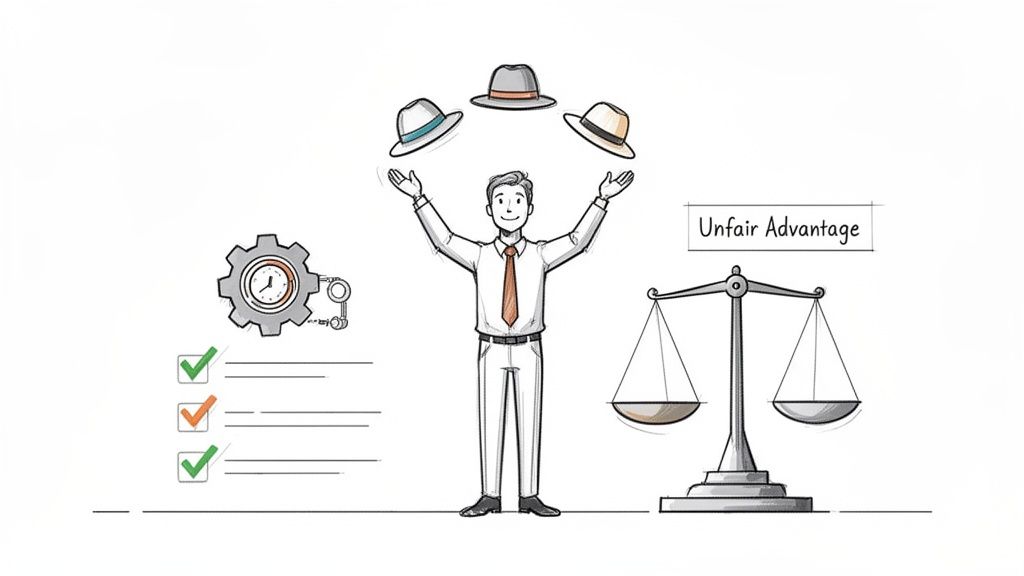
If you’re running a small business, you’re wearing a lot of hats. You’re handling product, customer service, sales, and marketing—often all in the same day. But what if you had a tireless assistant working for you around the clock, never dropping the ball on a follow-up or a social media post?
That’s what marketing automation is. It’s not about replacing the human element; it’s about amplifying your efforts so you can get back to what you do best—building real relationships and growing your business.
This isn’t just about clawing back a few hours. It’s about leveling the playing field, allowing you to run sophisticated campaigns that used to be out of reach for anyone without a massive marketing department.
The Real-World Impact on Your Bottom Line
Let’s look at the numbers, because they tell the real story. Marketing automation can deliver a staggering $5.44 return for every $1 invested—a 544% ROI over three years. That’s not just a fancy statistic; it’s proven math that turns a small budget into a revenue engine.
And it gets better. Businesses that jump in often see an 80% surge in leads and 77% higher conversion rates. That translates directly to more eyes on your brand, more clicks, and more sales, all without the constant manual grind.
Let’s take a quick look at some of the ways automation can immediately impact your daily operations.
How Automation Can Transform Your Business
| Business Area | How Automation Helps You | Practical Example for a Small Business |
|---|---|---|
| Lead Nurturing | Automatically follow up with new leads via email or social DMs, keeping them engaged without manual effort. | A freelance graphic designer’s website offers a “Branding Checklist.” When someone downloads it, an automated 3-email sequence kicks off, sharing tips on logo design and color psychology before offering a free 15-minute brand consultation. |
| Social Media | Schedule a month’s worth of content in one sitting, so your profiles stay active and consistent even when you’re busy. | A local coffee shop owner spends two hours every Monday scheduling daily posts for the week in a tool like Postful, including “Meet the Barista” features, a “Drink of the Week” promotion, and links to their blog about coffee sourcing. |
| Customer Service | Instantly answer common questions with automated chatbots or email responses, freeing you up for more complex issues. | An e-commerce store selling handmade candles sets up a website chatbot. When a visitor asks “Where is my order?”, the bot prompts for the order number and automatically provides the tracking status, reducing support tickets by 30%. |
| Sales | Automatically score leads based on their activity (like visiting your pricing page) so you know who to focus on. | A small SaaS company tags a lead as “hot” if they download a case study, visit the pricing page twice, and watch a demo video. This automatically alerts the founder to reach out with a personal email. |
The key takeaway is that automation lets you build systems that work for you, not the other way around. It creates a predictable engine for growth.
Shifting Your Mindset from ‘Too Complicated’ to ‘Essential’
A lot of founders get stuck here, thinking automation is too expensive or will take weeks to set up. The truth is, modern tools are built for people just like us. They’re intuitive, affordable, and you can get started in an afternoon.
Here’s a practical look at the productivity edge it gives you:
- A Consistent Presence: Automatically schedule your social media posts. Your brand stays active and engaged, even on your craziest days.
- Personalized Communication: Send targeted emails to different customer groups based on what they’ve done. It makes your marketing feel like it was written just for them.
- Lead Nurturing on Autopilot: Guide prospects from “just looking” to “ready to buy” with automated follow-up sequences that build trust over time.
Of course, beyond the general principles, knowing what works on specific channels is crucial. For instance, if you want to grow with TikTok marketing for small business, you need a system to keep up with the fast-paced nature of the platform. Automation makes that manageable.
The goal here is to shift your thinking from “This is too complex” to “How can I afford not to do this?” The rest of this guide is designed to give you actionable steps to make that leap.
Laying the Groundwork for Automation That Actually Works
Jumping into a new marketing automation tool without a plan is like trying to build a house without a blueprint. You might end up with something, but it probably won’t be the business you envisioned. Before you spend a dollar or an hour on software, laying the right foundation ensures every automated action you take is purposeful and drives real results.
This initial work is what keeps you from over-investing in a complicated system you don’t actually need. It’s all about being strategic, lean, and effective right from the start.
Get Crystal Clear on Your Goals
First things first: we need to move from vague wishes to specific, measurable objectives. “Get more leads” isn’t a goal; it’s a hope. A real goal gives you a target to aim for and a clear way to know if you’ve hit it.
Think in terms of concrete outcomes. You want your goals to be SMART—Specific, Measurable, Achievable, Relevant, and Time-bound.
Instead of: “Increase website traffic.”
Try: “Increase organic traffic from our blog by 15% in the next quarter by publishing and promoting four new pillar posts.”
Instead of: “Improve our email marketing.”
Try: “Boost the click-through rate on our welcome email series from 3% to 5% within 60 days by A/B testing two different calls-to-action.”
This kind of clarity is absolutely critical for small businesses. It makes sure your limited resources are focused on activities that directly contribute to growth, making it easy to justify the time and money spent on marketing automation for small business.
Map Out Your Customer’s Journey
Once you have your goals locked in, you need to understand the path your customers take—from complete stranger to loyal fan. This is your customer journey map. It doesn’t need to be some complex diagram; a simple sketch on a whiteboard is a perfect place to start.
Just identify the key stages your customers move through:
- Awareness: How do they first discover you? Example: A user finds your blog post “10 Tips for Beginner Gardeners” through a Google search.
- Consideration: What happens when they show some interest? Example: They enjoy the post and sign up for your “Weekly Gardening Tips” newsletter to get a free “Frost Date Calendar.”
- Conversion: What’s the final step to becoming a customer? Example: After receiving a few valuable newsletters, they click a link to buy your “Organic Starter Seed Kit.”
- Loyalty: How do you keep them engaged after the sale? Example: A month after their purchase, they receive an automated email with tips on transplanting seedlings, along with a 10% off coupon for their next order.
Mapping this out instantly reveals the perfect spots to insert automation. For instance, a new newsletter subscriber (in the Consideration stage) should automatically get a welcome email series. It just makes sense.
Key Takeaway: Understanding your customer’s journey allows you to deliver the right message at the right moment. This makes your marketing feel helpful, not intrusive—and that’s where automation truly shines.
Create Simple, Powerful Audience Segments
Sending the same message to everyone is a recipe for being ignored. To get real engagement, you need to break your audience into smaller, more targeted groups. This is what lets you personalize your communication, which is a massive driver of conversions.
You can start with really simple segments based on what people do or what they’re interested in:
- New Subscribers: People who just joined your email list. Action: Send them your 3-part welcome series.
- Potential Customers: Anyone who has checked out your pricing page but hasn’t bought anything yet. Action: Trigger a short email sequence with a customer testimonial and an offer for a free demo.
- First-Time Buyers: Customers who have made exactly one purchase. Action: After 30 days, send an automated email asking for a review and suggesting a complementary product.
- Repeat Customers: Your loyal fans who keep coming back for more. Action: Add them to a “VIP” list that gets early access to new products and exclusive discounts.
This level of focus is exactly why 76% of marketers rely on automation to connect with their customers. For founders using a tool like Postful, this translates into real results; 79% automate their customer journeys, blending email and social media to nurture leads without lifting a finger.
Think about it: triggered emails, like an abandoned cart reminder, now drive 75% of all email revenue. Those kinds of workflows boast conversion rates between 1-15%—a huge win for a small operation.
Alright, you’ve got the strategy sorted. Now for the fun part: making things happen. This is where the magic of marketing automation for small business really clicks—building simple, repeatable systems that grind away for you 24/7. We’re going to focus on three workflows that pack a punch and get you some quick wins right out of the gate.
Forget building a dozen complex sequences. The key is to start small. These first few workflows will take essential tasks off your plate, freeing up your time while making sure your audience gets a consistent, professional experience.
Think of it like this: your goals tell you what to do, the customer journey shows you when to do it, and the right tools make it all happen automatically.
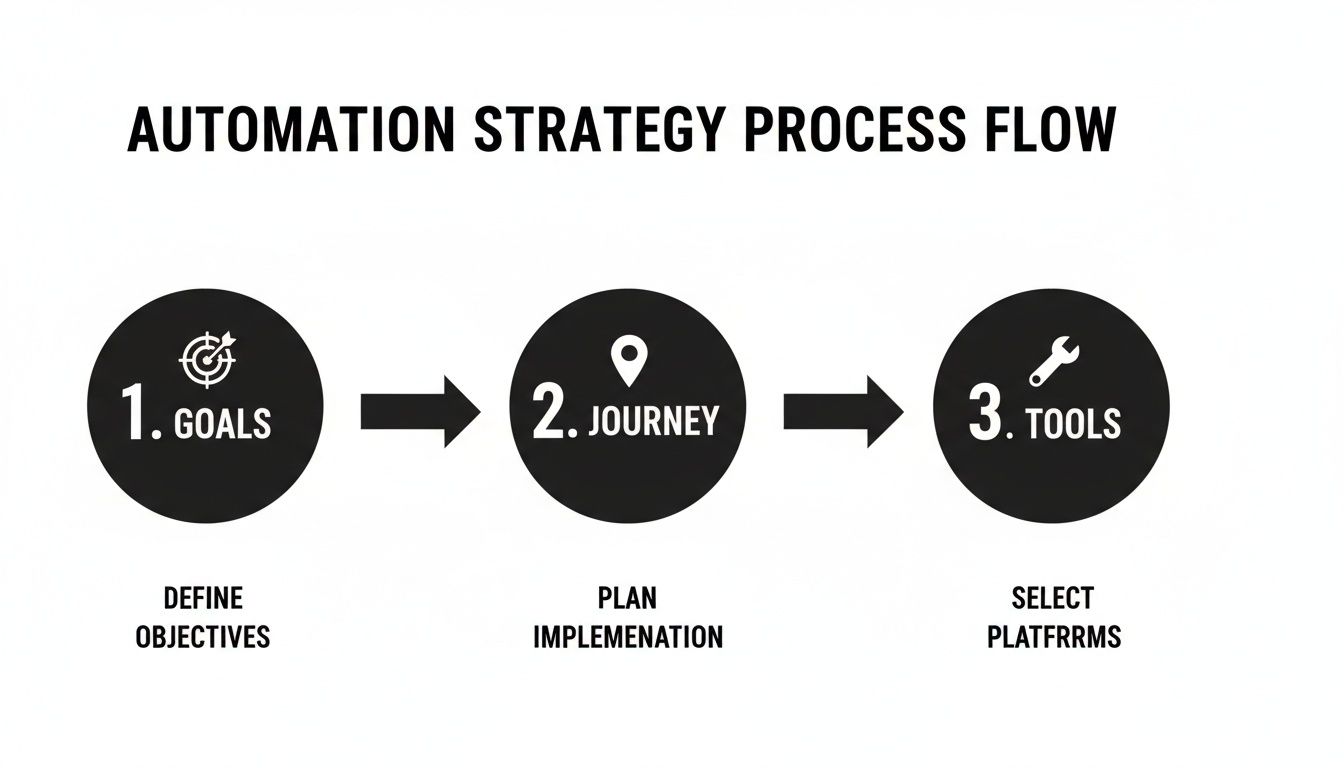
This simple flow is a great reminder that good automation starts with a clear plan, not just fancy tech.
Getting started can feel like the hardest part, so I’ve put together a quick comparison of three essential workflows. These are designed to be high-impact and easy to implement, giving you the best bang for your buck right away.
Three Essential Automation Workflows to Start With
| Workflow | Primary Goal | Recommended Tools | Estimated Weekly Time Saved |
|---|---|---|---|
| Welcome Email Series | Make a great first impression and build an early relationship with new subscribers. | Mailchimp, ConvertKit | 1-2 hours |
| Social Media Scheduling | Maintain a consistent, active presence on social platforms without the daily grind. | Postful, Buffer | 3-5 hours |
| Lead Nurture Follow-up | Stay top-of-mind with prospects who’ve shown interest and guide them toward a sale. | ActiveCampaign, HubSpot | 2-3 hours |
Each of these targets a different, crucial part of your marketing. By automating them, you’re not just saving time; you’re building a reliable engine for growth.
The Welcome Email Series That Creates Fans
That first interaction with a new subscriber? It’s everything. A welcome email series is your golden opportunity to make a killer first impression, set the right expectations, and start building a real connection. Don't just send a single "thanks for subscribing" email and call it a day—a short, multi-part series is way more effective at pulling them into your world.
Here’s a practical three-email workflow for a personal trainer who offers a free "7-Day Workout Plan" PDF:
- Email 1 (Sent Immediately): Deliver the goods. Subject: Here’s Your 7-Day Workout Plan! The email includes a direct link to the PDF and a personal welcome: "Hi [First Name], thanks for grabbing the plan! I'm excited to help you get started on your fitness journey."
- Email 2 (Sent 2 Days Later): Provide pure value. Subject: The #1 Mistake People Make on Day 3. This email shares a quick tip about maintaining motivation and links to a short video demonstrating proper form for a key exercise in the plan.
- Email 3 (Sent 4 Days Later): Start a conversation. Subject: How’s it going, [First Name]? The email asks a simple question: "What's the biggest challenge you're facing with your fitness goals right now? Hit reply and let me know—I read every response." This opens the door for a personal connection.
Productivity Workflow in a Tool like ConvertKit:
Trigger: Subscriber is tagged with "Downloaded 7-Day Plan."
Action: Instantly send "Welcome Email #1."
Delay: Wait 2 days.
Action: Send "Value-Add Email #2."
Delay: Wait 2 days.
Action: Send "Engagement Email #3."
Automate Your Social Media Presence
On social media, consistency is king. But as a founder wearing a million hats, posting great content every single day feels downright impossible. This is exactly where automation becomes your secret weapon, keeping your brand visible and active even when you're buried in other work.
A tool like Postful lets you schedule a whole week—or even a month—of content in one sitting. This isn't just a time-saver; it’s a strategic advantage. You can build out content around launches, promotions, or holidays, creating a story that unfolds over time.
Here's a productivity-focused social media workflow:
- Batch Your Content (Time: 2 hours): Block out time on your calendar for "Content Creation." During this block, write 10-15 social posts for the week. Use a simple spreadsheet with columns for "Text," "Image/Video Link," and "Scheduled Date."
- Schedule Everything (Time: 30 minutes): Use a scheduler's bulk upload feature to load all your posts at once. Set your evergreen content (like tips or FAQs) to repeat every few months to get more mileage out of it.
- Engage in Real-Time (Time: 15 minutes/day): The scheduling is automated, but the engagement is manual. Use the scheduler's "inbox" feature to quickly respond to all comments and DMs from one place, rather than logging into each platform separately.
This simple routine turns social media from a relentless daily chore into a manageable, strategic part of your business.
The Simple Lead Nurturing Sequence
So, what happens after someone downloads your brilliant checklist or guide? For most businesses, the answer is a whole lot of nothing. That's a huge missed opportunity. A lead nurturing workflow automatically follows up with these interested folks, gently keeping your business on their radar.
This doesn’t have to be some overly aggressive, 10-part sales pitch. A simple, helpful sequence can work wonders for building trust. The data doesn't lie: small businesses that use automation see 80% more leads and 77% higher conversions. It's more common than you think, too, with 47% of small businesses already automating some of their marketing. If you want to dive deeper, you can review more statistics on marketing automation effectiveness.
Let’s map out a workflow for a B2B consultant who offers a "Beginner's Guide to SEO":
- Trigger: A user fills out the form for the SEO guide.
- Immediate Action: An email fires off instantly, delivering the guide with the subject: "Your SEO Guide is Here!"
- Delay: Wait 3 days.
- Next Action: Send a follow-up with the subject "Got 5 Mins for a Quick SEO Win?" The email links to a blog post titled "How to Find 10 Easy Keywords for Your Business."
- Delay: Wait 4 days.
- Final Action: Send one last email with the subject: "Ready to put that SEO guide to work?" The body text is a soft call-to-action: "If you'd like a free 15-minute website audit to find your biggest SEO opportunities, you can book a time on my calendar here."
This approach nurtures interest without being annoying, positioning you as the helpful expert they need. By starting with these three workflows, you’ll build a powerful, automated foundation that lets you focus on growing your business.
Creating Content That Fuels Your Automation Engine
Your automated workflows are like a high-performance engine, but they can't run on an empty tank. Content is the fuel. Every automated email, social post, and nurturing sequence needs something valuable to deliver, and for a busy founder, the thought of constantly feeding that machine is exhausting.
The secret isn't to create more; it's to create smarter. Building a library of reusable, evergreen content turns content creation from a daily chore into a one-time investment that pays off for months. It's a total game-changer.
Adopt the "Create Once, Publish Everywhere" Mindset
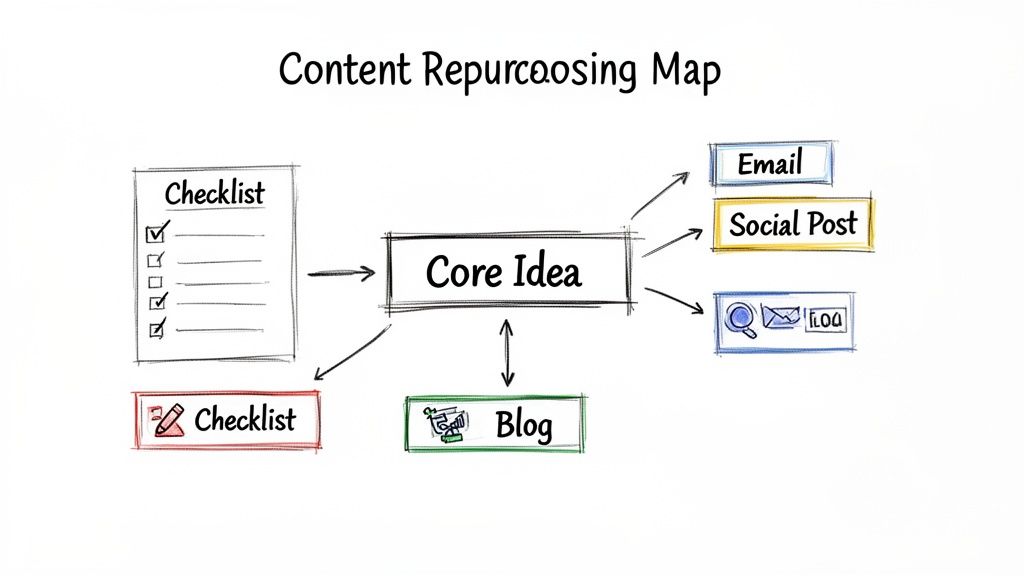
The most productive founders don't invent unique content for every single channel. That's a fast track to burnout. Instead, they start with one core, high-value piece and strategically repurpose it into dozens of smaller assets.
Practical Example: You record a 20-minute video interview with an industry expert.
- Full-Length Video: Upload to YouTube and embed it in a blog post.
- Audio: Strip the audio and publish it as a podcast episode.
- Blog Post: Get the video transcribed (using a cheap service like Otter.ai) and turn it into a detailed article.
- Key Quotes: Pull out 5-10 powerful quotes from the expert. Turn each into a graphic for Instagram and LinkedIn.
- Short Video Clips: Edit 3-4 interesting 60-second segments from the video for TikTok and Instagram Reels.
- Email Newsletter: Summarize the top 3 takeaways from the interview for your email list, with a link to the full video.
This is exactly what working smarter looks like. You do the heavy lifting once, then slice, dice, and distribute that value across all your automated channels for weeks.
Build Your Evergreen Content Library
Evergreen content stays relevant and valuable long after you hit "publish." It's the foundation of your content library because you can use it repeatedly in your automated workflows without it feeling dated. Think of it as your "set it and forget it" arsenal.
Here are three essential types of evergreen assets every small business should create to fuel its automation:
- A Core Lead Magnet: This is a high-value resource you offer in exchange for an email. It doesn't need to be a 50-page ebook—in fact, simple and actionable resources often perform best. Example: A web developer creates a "10-Point Pre-Launch Website Checklist" PDF that every potential client can use.
- A Pillar Blog Post: This is a long-form, in-depth article that covers a major topic in your niche from top to bottom. Example: A financial advisor writes "The Ultimate Guide to Retirement Planning for Freelancers," covering everything from setting up a SEP IRA to estimating expenses.
- A Welcome Email Sequence: Write a series of three to five emails that every new subscriber gets automatically. This sequence should introduce your brand, deliver immediate value, and set expectations. Since it’s evergreen, it works for you 24/7 with zero extra effort.
Productivity Tip: When you're brainstorming content, always ask yourself, "Will this still be useful to my audience in six months?" If the answer is yes, you've found a great candidate for your evergreen library.
Create Reusable Templates and Frameworks
Templates are the ultimate productivity hack, period. Instead of staring at a blank screen, you start with a proven structure, which can easily cut your content creation time in half. This is especially true for social media, where consistency is everything.
Practical Example: Social Media Post Templates in Notion or Google Docs
- "Quick Tip" Template:
- Hook: Start with "🔥 Quick Tip:" or "Here's a simple hack for…"
- Body: Explain the tip in 1-2 sentences. Use bullet points for steps.
- CTA: End with "What's your favorite tip for [Topic]? Let me know below! 👇"
- "Myth vs. Fact" Template:
- Myth: "❌ Myth: You need to post 5 times a day on Instagram."
- Fact: "✅ Fact: Consistency beats frequency. Posting 3 high-quality posts a week is better than 5 rushed ones."
- CTA: "Tag someone who needs to hear this!"
The goal is to systematize your creativity. To keep things fresh, you can even sprinkle in some fun visuals like Marketing Memes to grab attention and add personality.
By building this content engine, your marketing automation for small business goes from a concept to a powerful, self-sustaining system. You’ll spend less time on the content treadmill and more time connecting with the leads your automated machine brings in.
How to Measure What Matters
Getting your first workflows up and running is a huge win. But the real magic of marketing automation for small business isn't just setting it and forgetting it—it's understanding what’s actually moving the needle.
You don't need a data science degree or some overly complicated analytics dashboard. The key is to focus on a few specific metrics that tell the story of your hard work. This isn't just about getting a report card; it's how you turn your automation from a simple task-doer into a predictable engine for growth.
Connecting Metrics to Your Workflows
The quickest way to get lost in a sea of data is to look at everything at once. Instead, tie your metrics directly to the workflows you’ve built. Each workflow has a job to do, and a few specific numbers will tell you if it's doing that job well.
Let’s connect some key performance indicators (KPIs) to the workflows we’ve been talking about.
- Your Welcome Email Series: The two numbers that matter most are Open Rate and Click-Through Rate (CTR). Productivity Goal: Aim for an open rate above 30% and a CTR above 3%. If you're not hitting that, it's a signal to tweak your subject lines or email copy.
- Your Social Media Scheduling: Keep an eye on your Engagement Rate (likes, comments, shares) and Reach. Productivity Goal: Identify the top 20% of your scheduled posts by engagement each month. Use those formats and topics as templates for next month's content.
- Your Lead Nurturing Sequence: The most important metric here is the Conversion Rate—the percentage of people who complete the desired action (e.g., book a call). Productivity Goal: Track how many people who enter the sequence become a qualified sales lead. If the rate is below 2%, your call-to-action or your offer may need to be stronger.
Interpreting the Data and Taking Action
Seeing the numbers is the easy part. Knowing what to do with them is what separates the pros from the amateurs. Data is only useful if it pushes you to make things better.
Let's walk through a real-world productivity scenario.
Scenario: Your Welcome Email Has a Low Click-Through Rate
You see your welcome email has a fantastic open rate of 45%, but the CTR is stuck at a measly 1%. Ouch. People are interested enough to open it, but they aren't clicking the link to your most popular blog post.Actionable Workflow: This is a classic sign of a weak call-to-action (CTA). Time for a simple A/B test.
- Duplicate your welcome email in your email marketing tool.
- In the copy, change only the CTA button. Pit the original "Read More" (Version A) against something more benefit-driven, like "Discover the 5-Step Guide" (Version B).
- Let the test run for 200 new subscribers.
- Check the results. Whichever version has a higher CTR becomes your new permanent welcome email.
Testing small, specific changes like this is how you systematically improve performance without having to scrap your entire workflow. It’s all about making small, informed tweaks.
Proving Your Return on Investment
For a small business, every dollar and every hour is precious. That's why proving the return on investment (ROI) of your automation is so critical. It’s how you justify spending time and resources on these systems.
A simple, powerful way to do this is with tracking links. By properly setting up your campaigns with Google Analytics UTM parameters, you can see exactly where your traffic and sales are coming from.
For instance, when you see that your automated lead nurturing sequence brought in 10 new client consultations last month, you can draw a direct line from that workflow to actual revenue. This changes the conversation from, "I think this is working," to, "I know this workflow generated $X in new business last month."
That kind of clarity is incredibly empowering. It shows you what to fix, what to scale, and how to turn your automation efforts into a cornerstone of your business.
Common Automation Traps to Watch Out For
Stepping into marketing automation feels like getting a superpower, but even superheroes can stumble. Lots of small businesses dive in with the best intentions, only to see their efforts fall flat. Let's make sure you're not one of them by sidestepping the most common mistakes right from the start.
Learning from these pitfalls isn't just about dodging failure; it's about building a smarter, more profitable automation strategy from day one.
The 'Set It and Forget It' Trap
The biggest myth about automation is that you can just flip a switch and walk away. Sure, it handles the repetitive stuff, but it's not a self-piloting system that runs perfectly forever. Campaigns get stale, links break, and what your audience needs will definitely change over time.
A workflow that was a smash hit three months ago might completely underwhelm today. Forgetting to check in is like never changing the oil in your car—eventually, the engine is going to seize up.
Productivity Fix: Schedule a recurring 30-minute "Automation Audit" on your calendar for the first Monday of every month. Use a simple checklist:
- Check open/click rates for top 3 email workflows. Are they stable?
- Test the links in your welcome email. Do they still work?
- Review your highest and lowest performing social posts from last month. What can you learn?
Sounding Like a Robot
Automation is a tool to make you more efficient, not an excuse to sound impersonal. When your automated messages are cold, generic, and totally devoid of personality, you're not building relationships—you're just filling an inbox. People can spot a robotic, one-size-fits-all email from a mile away, and it’s a fast track to the unsubscribe button. In fact, 80% of consumers are more likely to buy from brands that offer personalized experiences.
Productivity Fix: Use personalization tokens for more than just [First Name]. If you know a customer's industry, their last purchase, or a specific interest, use that data to make your message feel like it was written just for them.
- Generic: "Check out our new products!"
- Personalized: "Hi [First Name], since you loved our [Last Product Purchased], we thought you'd be interested in our new [Related Product Category] collection!"
Always write your automated copy in a natural, conversational tone. Read it out loud. If it sounds like something you'd never actually say, rewrite it.
Key Takeaway: Your goal with marketing automation for small business is to automate the delivery, not the relationship. The human touch should always come through in your messaging, even if a machine is doing the sending.
Overcomplicating Your Workflows
It’s so tempting to build these intricate, multi-branching workflows that try to account for every possible customer action. But for a small team, complexity is the enemy of actually getting things done. An overly complicated system is a nightmare to build, impossible to troubleshoot, and usually leads to getting stuck in "analysis paralysis."
You really don’t need a 27-step email sequence to welcome a new subscriber. A simple, effective three-part series will get the job done without giving you a massive headache.
Productivity Fix: Start with the simplest possible version of any workflow.
- For a welcome series: Just begin with three emails.
- For a lead nurture sequence: Start with two follow-ups.
- For an abandoned cart: Just send one reminder email 4 hours after abandonment. Don't build a 5-email sequence with custom coupons from the start.
Once you have data showing the simple version is working, then you can strategically add more layers. Don't try to build a mansion when a solid foundation is all you need to get started. By steering clear of these common errors, your automation will be a source of growth and efficiency, not frustration.
Ready to automate your social media the smart way? With Postful, you get AI-powered tools and ready-to-use templates that make creating and scheduling content simple and fast. Stop staring at a blank page and start growing your reach with a consistent, professional presence. Try it for free and see how easy it is to focus on what you do best. Get started today at postful.ai.