
To land a click, your headline needs to do three things really well: be crystal clear, offer a specific benefit, and spark just a little curiosity. Nail this combo, and you start turning mindless scrollers into actual readers. Miss it, and you’re just part of the noise.
Why Your Headlines Aren't Connecting
In a feed that never ends, a generic headline is a death sentence for your content. For founders, creators, and marketers, this isn't just about writing—it's a business problem. Your headline is the one thing standing between your audience and your brilliant article, insightful social post, or high-converting ad.
If the headline is weak, all the work you poured into the content behind it is wasted. It doesn't matter how great your ideas are if nobody gets past the first five words. That directly hits your clicks, your engagement, and ultimately, your bottom line.
The Upside of a Crowded Feed
Sure, the fight for attention is tougher than ever, but that’s also where the opportunity lies. A truly great headline doesn't just compete; it dominates. Take a look at a platform like X (formerly Twitter), where posts saw an average of 2,121 impressions in 2025—a massive 75.8% jump from the year before. The secret? Headlines that cut through the noise with concise, provocative, and often number-driven hooks that make people stop and look.
With average engagement rates hovering between 1.4-2.8% across platforms in 2025, that window to grab someone is tiny. You can dig into more social media engagement insights to see just how fierce the competition is.
The purpose of the headline is to get the first sentence read. The purpose of the first sentence is to get the second sentence read. Once you understand this, you can see how a weak headline collapses the entire chain of engagement before it even begins.
A Better Way to Write Headlines
Here’s the good news: you don’t need to spend hours agonizing over the perfect headline. The process can be a hell of a lot simpler. By building a solid workflow and using the right tools, you can consistently craft headlines that don't just get attention but drive real results.
For example, a productive workflow could be:
- Brainstorm (10 mins): Use a tool like ChatGPT or Jasper to generate 20 headline ideas based on your core topic.
- Refine (5 mins): Pick the top 3-5 that feel strongest and rewrite them using the formulas in this guide.
- Test (Ongoing): Use one as your blog title, and the others for social media posts, and see which performs best.
This guide will walk you through exactly how to build a process like this.
The Secrets of a Headline That Actually Gets Clicks
Every headline that manages to stop a reader mid-scroll is built on the same handful of principles. It's tempting to just aim for something "catchy," but if you focus on these core pillars, you'll see consistently better results.
Think of them as the DNA of a great headline: a clear promise, a real benefit, and just enough curiosity to make them need to know more.
Getting these right is what turns your headlines from simple labels into powerful hooks. It’s the difference between announcing what something is versus showing what it does for the reader. In a world drowning in content, that shift is everything.
Make a Clear Promise
Your headline has to make a dead-simple promise about the value waiting inside. Vague, artsy headlines don't work here—the reader needs to know exactly what they’re getting in the first few seconds. A clear promise sets an expectation and builds trust right away.
Take this common example:
-
Before: "New Software Update"
-
This is an announcement, not a promise. It’s boring and gives no one a reason to care.
-
After: "Our New Update Saves You 5 Hours a Week"
-
Now we're talking. This version makes a specific, quantifiable promise. The reader instantly gets the value and can decide if it’s for them.
The foundation of writing better headlines lies in your ability to effectively and creatively generate a multitude of ideas, which then allows you to identify the core elements that resonate. Learning how to brainstorm and generate great ideas is a skill that directly feeds into this process.
Show a Tangible Benefit
Beyond the promise, a great headline highlights a specific, real-world benefit. How will their life or work actually get better? This is where you connect your content directly to a reader’s goals or frustrations.
- Weak Benefit: "Improve Your Marketing" (Way too generic)
- Strong Benefit: "Double Your Email Open Rates With This Simple Trick" (Specific, desirable, and feels achievable)
The goal is to frame the content around your reader's success, not your topic. For founders and marketers, that means translating features into outcomes they actually care about—like saving time, cutting costs, or boosting revenue.
Spark Curiosity (Without Being Deceptive)
Finally, you need to add a little something that makes the reader just have to find out what's next. Curiosity is what drives clicks, but you have to handle it carefully to avoid falling into the clickbait trap.
The key is to open up a small "information gap." You can do this by hinting at a secret, a surprising fact, or an uncommon solution—but without overpromising or being dishonest.
Here’s a practical example: "The One Productivity App We Uninstalled This Year"
This headline works because it challenges a common assumption (that you should always be adding more tools). It implies there's a story and a lesson learned, making you want to click to find out why.
If you want to dig deeper into the fundamentals, these copywriting tips for beginners are a great place to start building on these principles.
Headline Formulas That Consistently Deliver Results
Staring at a blank page is a creativity killer. Instead of trying to reinvent the wheel every time, why not start with a structure that's already proven to work? That’s where headline formulas come in.
Think of them less like rigid rules and more like frameworks for your ideas. They’re a reliable starting point because they tap directly into powerful psychological triggers—things like curiosity, urgency, self-interest, and that nagging fear of missing out (FOMO).
This visual guide breaks down the three core elements that make these formulas so effective: the promise, the benefit, and the spark of curiosity.
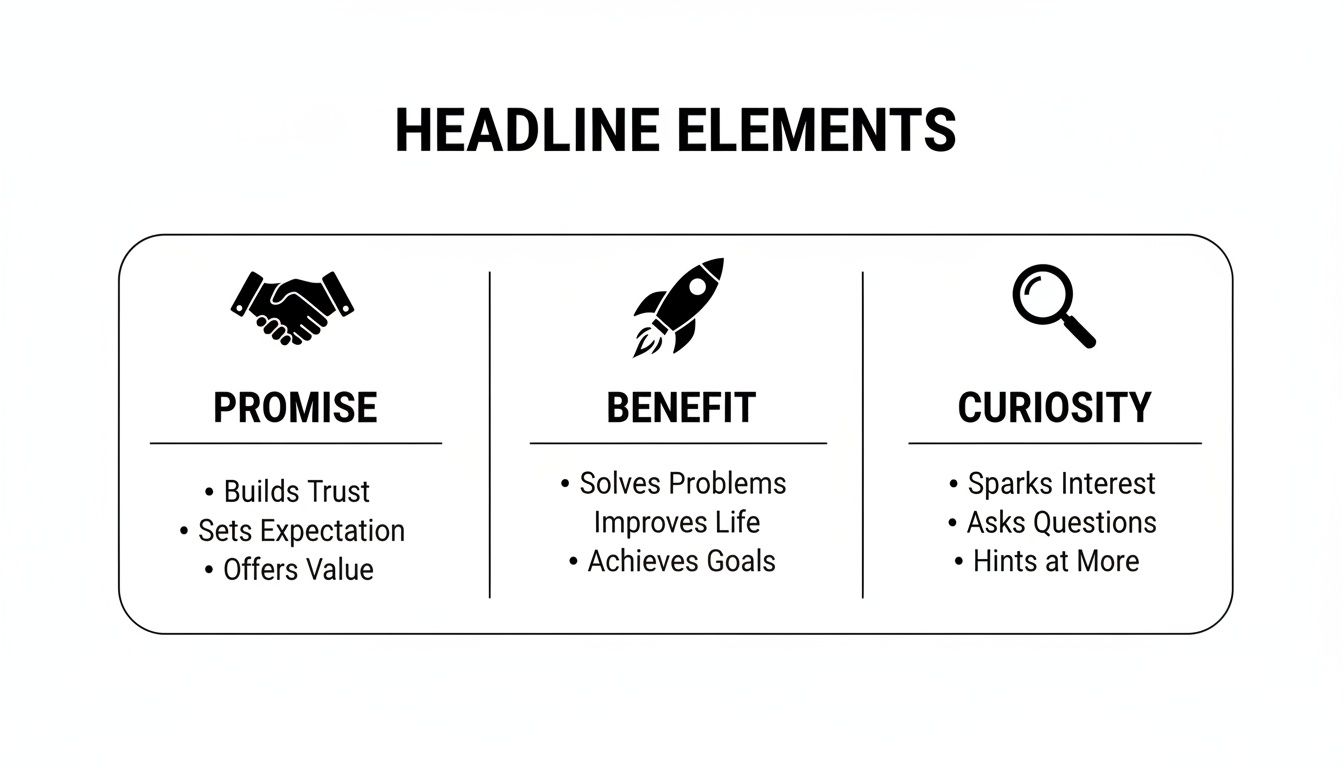
As you can see, the best headlines don't just lean on one element. They weave these triggers together to give someone a compelling reason to stop scrolling and click.
Headline Formula Cheat Sheet
To make this even easier, I've put together a quick cheat sheet. It breaks down some of the most reliable formulas I've used, explains why they connect with an audience, and gives you a hint on when to pull them out of your toolkit.
| Formula Type | Example for a Founder | Why It Works | Best For |
|---|---|---|---|
| The Question | “Are You Making This $10,000 Pricing Mistake?” | Creates an “information gap” and taps into fear of loss. It forces a self-check. | Blog posts, emails, and social media hooks that challenge a common assumption. |
| The Mistake | “5 Productivity Traps That Secretly Drain Your Team’s Energy” | Builds relatability and positions your content as a preventative solution. | How-to guides, listicles, and content aimed at solving a specific pain point. |
| The Bold Promise | “How to Write a Week’s Worth of Social Posts in Under an Hour” | Direct and benefit-driven. The specific numbers make the claim tangible and believable. | Landing pages, ad copy, and articles promising a clear, efficient result. |
| The Surprising Stat | “Why 87% of SaaS Startups Fail to Secure Series A Funding” | Grabs attention with authority. The number adds credibility and sparks curiosity. | Data-driven articles, industry reports, and thought leadership pieces. |
These aren’t the only formulas, of course, but they’re a fantastic starting point for almost any piece of content you’re creating. Let’s dig a little deeper into what makes them tick.
Use Questions to Create an Information Gap
When you ask a direct question, you immediately engage the reader’s brain. It creates a tiny moment of self-reflection and an “information gap” they feel compelled to close.
- Structure: Are you making [common mistake]? or Do you know the secret to [achieving goal]?
- Practical Example: “Are You Making This $10,000 Pricing Mistake?”
- Why It Works: It hits on self-interest and fear. No founder wants to be the one leaving that much money on the table, so the headline creates an urgent need to find out if they’re making that exact error.
Highlight Common Mistakes
Nobody likes feeling like they’re falling behind or making a rookie error. Headlines that call out common mistakes tap into our natural desire for self-improvement and our aversion to being “that person” who gets it wrong. This instantly positions your content as the solution.
- Structure: The [Number] [Topic] Mistakes Almost Everyone Makes
- Practical Example: “The 5 Productivity Mistakes That Are Secretly Draining Your Energy”
- Why It Works: It creates relatability and offers a clear benefit. Readers see a reflection of their own struggles in the problem and feel motivated to learn the fix you’re offering.
By framing your content around a mistake, you’re not just sharing information; you’re providing a preventative cure. This makes your advice feel more urgent and actionable, boosting its perceived value before anyone even reads the first paragraph.
Make a Bold and Specific Promise
This one gets right to the point. It tells the reader exactly what tangible result they can expect. The trick is to be specific and believable. “Get Better at Marketing” is vague and weak. “Triple Your Landing Page Conversions in 30 Days”? Now that’s a powerful promise.
- Structure: How to [Achieve a Desirable Outcome] in [Specific Timeframe or with a Specific Method]
- Practical Example: “How to Write a Week’s Worth of Social Media Posts in Under an Hour”
- Why It Works: It speaks directly to the reader’s desire for efficiency and concrete results. The specific numbers make the claim feel credible and the benefit feels real.
Leverage Surprising Statistics
Numbers are an instant credibility booster. When a statistic is surprising or challenges a common belief, it creates a hook that’s almost impossible to ignore. People are naturally curious and want to understand the “why” behind the data.
- Structure: Why [Surprising Percentage]% of [Group] Fail at [Activity]
- Practical Example: “Why 87% of SaaS Startups Fail to Secure Series A Funding”
- Why It Works: This is a perfect blend of authority and curiosity. The statistic validates that the topic is important, and the reader immediately wants to learn the underlying reasons so they can avoid becoming another number in that statistic.
How to Adapt Headlines for Different Platforms
A killer headline on one platform can completely tank on another. It’s a hard lesson many of us learn. The audience, the algorithm, and even the user’s mindset are totally different depending on where you post. If you really want to write better headlines, you have to get a feel for these nuances and tweak your message to fit the context.
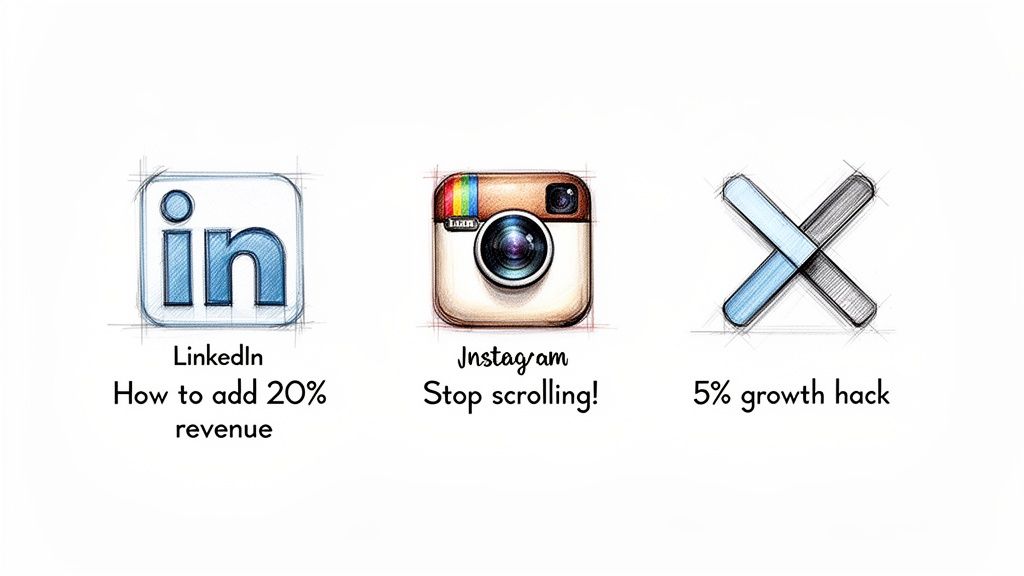
What gets a nod of approval on a professional network like LinkedIn is worlds away from what stops the scroll on Instagram. A one-size-fits-all approach is just a recipe for low engagement.
Tailoring Your Hook for LinkedIn
On LinkedIn, people are in a work state of mind. They’re hunting for career insights, industry trends, and advice they can actually use. Your headlines need to reflect that by being packed with value and showing you know your stuff.
Forget the clickbait. Aim to spark a thoughtful conversation instead. Think of your headline as a professional insight or a hard-won lesson you’re sharing.
- Weak Headline: “My Newest Business Trick”
- Strong Headline: “The Counterintuitive Strategy That Grew Our MRR by 15% in Q2″
See the difference? The second one is specific, uses professional language (MRR, Q2), and promises a real business outcome—perfect for the LinkedIn crowd. If you want to dig deeper, we have a whole guide on how to write engaging LinkedIn posts.
Creating Scroll-Stopping Headlines for Instagram
Instagram is a fast-paced, visual battlefield. Your headline—usually the first line of your caption or the text overlay on a Reel—has to be a short, punchy hook. Its only job is to get someone to stop scrolling and either watch your video or swipe your carousel.
The data backs this up. Carousel posts on Instagram nail a 1.92% average engagement rate, beating out single images and videos. Why? A strong headline on that first slide makes people need to see what’s next.
On Instagram, your headline has to land its punch in the first few words. Seriously. Assume they’ll only see that first line before flicking their thumb. Clarity and impact are everything.
Here are a few practical examples that work well on the ‘gram:
- For a Reel: “3 Founder Habits to Quit Now”
- For a Carousel: “Swipe to see the exact cold email that landed us 5 meetings.”
Mastering Brevity and Impact on X
On X (formerly Twitter), brevity is king. You have seconds—if that—to make an impression in a firehose of a feed. The best headlines here front-load the most interesting bit, often using data, a surprising statement, or a direct question.
When you’re thinking about adapting headlines, it helps to look at what’s already working. Take marketing memes, for example. They succeed because they deliver a relatable message in a split second. That’s the exact principle you need for writing on X.
Here’s how I’d rework a blog post title for the platform:
- Original Blog Title: “A Comprehensive Guide to Improving Your Team’s Remote Productivity”
- X Headline: “We cut our team’s meeting time by 50%. Here’s the 3-step framework we used. Thread 🧵👇”
This version is direct, uses a powerful number, and even adopts platform lingo like the thread emoji to signal there’s more value to come. That’s how you get the click.
A Simple Framework for Testing Your Headlines
Writing a handful of strong headline options is a huge step forward. But the real growth comes from knowing which one actually performs best with your audience. Data beats guesswork every single time. A simple testing workflow will dramatically improve your productivity and results.
The good news? You don’t need complex marketing software to start testing. You can run simple, effective A/B tests using the tools you already have. The goal here is to get feedback from the real world, not just your own intuition. This is how you learn to write better headlines for the long haul.
Quick and Scrappy A/B Testing Methods
Forget expensive platforms. You can get valuable data with a few clever, low-effort tactics. These methods are perfect for busy founders who need answers fast without a complicated setup.
Here are a few practical ways I like to test headlines:
- The Two-Tweet Method: This one’s a classic. Write two separate tweets, each with a different headline, but both linking to the same article. Post them a few hours apart and see which one gets more clicks and engagement. Simple.
- Instagram Story Polls: Create a simple graphic with two headline options and use the poll sticker to ask your followers, “Which headline would you click?” It’s a direct, no-fuss way to gauge which hook resonates most.
- Email Subject Line Test: Most email marketing platforms (like Mailchimp or ConvertKit) offer simple A/B testing for subject lines. Send one headline to 10% of your list and the second to another 10%. The winner automatically gets sent to the remaining 80%.
Your audience will always be the best judge of a good headline. Instead of debating internally, let their clicks and engagement give you the definitive answer. This small shift in workflow can lead to significant gains over time.
Key Metrics to Actually Watch
Once you start testing, you need to know what to look for. Don’t get lost in vanity metrics; focus on the data that tells you if your headline is doing its job.
- Click-Through Rate (CTR): This is the big one. It’s the percentage of people who saw your headline and actually clicked it. A high CTR means your headline successfully sparked curiosity and promised value.
- Engagement Rate: This includes likes, comments, shares, and saves. High engagement suggests your headline not only earned a click but also resonated enough to inspire action, which is a powerful signal.
Tracking these numbers helps you build a data-informed strategy. If you want to get really clean data for your tests, check out our guide on how to use Google Analytics UTM parameters. It’s a game-changer for making better decisions.
Your Top Headline Questions, Answered
Even with a solid framework, writing headlines in the real world brings up a ton of questions. Let’s tackle some of the most common ones I hear from founders and marketers.
Think of this as your go-to cheat sheet for those tricky “what if” moments.
How Long Should My Headline Be?
There’s no magic number, but the sweet spot is usually 6 to 12 words. That gives you enough room to land your message without overwhelming someone who’s just scrolling by.
But length is all about context. Here are some practical examples:
- Blog Posts (for Google): Keep your SEO title tag under 60 characters. Anything longer gets awkwardly cut off in search results, and you lose your punch. For instance, “A Comprehensive Guide on How to Write Better Headlines” might become “How to Write Better Headlines (Simple 4-Step Guide).”
- Social Media (X, LinkedIn): Get to the point—fast. The first 3-5 words do all the heavy lifting. People are scrolling, not reading novels, so you have to hook them immediately.
- Email Subject Lines: Shorter is almost always better, especially on mobile. Stick to under 40 characters if you can. For example, “Newsletter: How to Write Better Headlines” becomes “Your guide to better headlines.”
What’s the Difference Between a Headline and a Title Tag?
This is a huge one, especially if you care about getting traffic from Google. They might look the same, but they have completely different jobs. A productive workflow means optimizing both.
Your headline (the H1 tag) is what people see at the top of your actual article. They’re already on your page. Your headline’s job is to grab their collar and say, “Stick around, you need to read this.”
Your title tag is what shows up in the browser tab and, more importantly, as that clickable blue link on Google’s search results page. Its only goal is to win the click against all the other search results. Your H1 can get creative, but your title tag needs to be laser-focused on keywords and clarity to pull in that search traffic.
I like to think of it this way: The title tag is the ad on the street, and the headline is the welcome mat at the door. One gets them to show up, the other invites them inside.
Is It Okay to Use Negative Headlines?
Absolutely. In fact, they can be incredibly powerful when you use them the right way.
Headlines like “Stop Making These 5 Sales Mistakes” work because they tap into deep-seated psychological triggers like loss aversion. We’re wired to avoid pain more than we are to seek pleasure. A negative headline creates an immediate sense of urgency and curiosity.
The key is not to overdo it. If all your headlines are negative, you’ll just exhaust your audience. Save them for when you’re solving a real, costly problem for your reader.
For example, a headline like “The One Thing Sabotaging Your Productivity” is brilliant because it opens an information gap. The reader’s brain immediately goes, “Is it me? Am I doing that?” It frames your content as an essential fix, not just another piece of advice.
Ready to stop guessing and start creating headlines that connect? Postful gives you the tools and templates you need to craft compelling social media content in minutes, not hours. Grow your reach confidently and consistently, and get back to focusing on what you do best. Get started for free at Postful.