
So, you want to turn your social media presence into a real income stream. It’s absolutely possible, but it’s about more than just posting content. The real key is building an engaged community around a specific topic and consistently giving them something valuable. That’s how you go from just having followers to having actual customers.
Laying the Groundwork for Monetization
Before you even think about making your first dollar, you have to build a solid foundation. Too many creators get caught up chasing viral trends, hoping one big hit will solve everything. But sustainable income doesn't come from a flash-in-the-pan moment; it comes from building a real business.
This whole process starts with picking a profitable niche that you actually care about and that people are willing to spend money on.
Your niche is your territory—the specific topic you want to be known for. Don't just be a "fitness" creator. Instead, drill down to something specific like "kettlebell workouts for busy parents" or "plant-based meal prep for runners." That kind of focus is a magnet for a dedicated, loyal audience.
Pinpoint a Profitable Niche
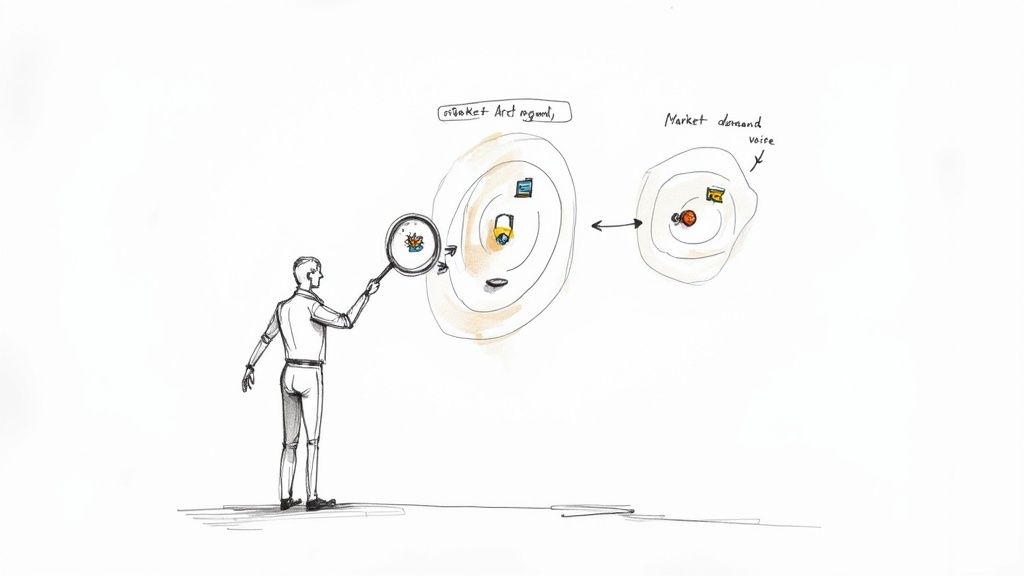
The sweet spot for a great niche is where three things overlap:
- Your Passion: What could you talk about all day, every day, without getting bored? Authenticity is everything on social media, and you can't fake genuine enthusiasm for long.
- Audience Demand: Are people actually looking for content or solutions on this topic? Practical Example: Use a tool like AnswerThePublic or browse subreddits related to your interests. If you're a photographer, search r/photography and look for recurring questions like "How do I edit moody portraits?" or "What's the best budget lens for a Canon?" This is direct proof of audience demand.
- Monetization Potential: Can you actually make money here? Look around. Are other creators or brands selling products, services, or sponsorships in this space? If they are, that’s a great sign that there's a market.
A huge mistake I see people make is choosing a niche that's way too broad. Sure, "travel" sounds fun, but it's an incredibly crowded space. Something more focused like "budget backpacking in Southeast Asia" or "luxury travel for couples over 50" lets you cut through the noise and become the go-to expert much faster.
Understand Your Audience Deeply
Once you've locked in your niche, the next step is to get inside the heads of the people in it. This isn't just about basic demographics like age and location. You need to dig deeper and figure out their real problems, their biggest goals, and what they secretly wish for.
To make money on social media, you have to be a problem-solver. That means getting to know your followers inside and out. If you need a more detailed process for this, we have a whole guide on how to define what is a target audience.
What's keeping them up at night? What are they really trying to achieve? Think about it: a fitness coach isn't just selling workout plans; they're selling confidence. A financial advisor isn't just selling stock picks; they're selling peace of mind.
To get started, create a simple "audience persona" by answering a few questions:
- What's their single biggest challenge related to your niche?
- What's their ultimate dream outcome?
- What have they already tried that failed?
Practical Example: A social media manager targeting small business owners might find their audience's biggest challenge is "not enough time," their dream outcome is "consistent leads without effort," and their failed attempt was "posting randomly when they remembered." This insight is pure gold. It’s what you’ll use to create content and offers that feel like they were made specifically for your audience—the kind of stuff they’ll be more than happy to pay for.
Alright, you've built a solid foundation and a loyal audience. Now for the fun part: getting paid.
There isn't a single "best" way to monetize your social media presence. The most successful creators I know don't just pick one path; they build a diversified income portfolio. Think of it like investing—you wouldn't put all your money into one stock, right? The same principle applies here.
Relying on a single platform's creator fund or one big brand deal is just too risky. Algorithms change, partnerships end. By blending different strategies, you create a much more stable, predictable income that can weather those inevitable ups and downs.
Your Authentic Side Hustle: Affiliate Marketing
Affiliate marketing is almost always the easiest place to start. You don't have to create a product from scratch. Instead, you just promote the products and services you already use and genuinely love. When someone buys through your unique link, you get a commission. Simple as that.
The whole thing hinges on authenticity. Only recommend stuff you actually stand behind.
Practical Example: A tech reviewer on YouTube who’s obsessed with a certain microphone can drop their Amazon Associates link in the video description. They're not just pushing a product; they're sharing a tool that helps them create better content, which is genuinely valuable to their audience of aspiring creators. It’s a natural fit that builds trust and generates income without feeling like a sleazy sales pitch.
Landing Those Big-Ticket Brand Sponsorships
This is where you can really start to see your influence pay off. A brand pays you to create content featuring their product or service. The influencer marketing world is absolutely booming—it's projected to jump from $24 billion in 2024 to a staggering $32.55 billion in 2025. If you want to dig into the numbers, Sprout Social's research page has some great data.
To land these deals, you have to prove your worth. Brands care less about a massive follower count and more about an engaged community that trusts what you say. Once you're ready to get started, our guide on what is a sponsored post breaks down all the fundamentals.
Productivity Tip: Don't just wait for brands to come to you. Create a "dream 100" list of brands you'd love to work with. Put together a simple, one-page media kit using a template from Canva with your audience demographics, engagement rates, and a few examples of your best work. Proactively reaching out shows you mean business and can open doors you didn't even know were there.
Building Your Own Thing: Products and Services
Selling your own products—digital or physical—is where the real magic happens. It offers the highest profit margins and gives you complete control. You're no longer just a promoter; you're the owner. This is how you package your unique expertise into something tangible.
- Digital Products: These are amazing because you can sell them an infinite number of times. Practical Example: A productivity coach could sell a pre-built Notion template for project management, or a photographer could package up their custom Lightroom presets for creating a specific photo aesthetic.
- Physical Products: This could be anything from branded t-shirts to specialized gear. Practical Example: A fitness influencer known for their intense home workouts might create and sell their own line of high-quality resistance bands.
As you map out your strategy, don't forget to think outside the box. Some creators are finding success by leveraging content libraries for new revenue streams and brand relationships.
Ultimately, the best plan is usually a mix. Start with something low-lift like affiliate marketing, then as your audience grows, you can build up to launching your very own products.
Designing Your Content-to-Conversion Funnel
Just posting content and hoping for the best is like shouting into the void. Sure, you might make some noise, but you won't get consistent results. If you really want to monetize, you need a deliberate system—a funnel that guides followers from being casual viewers to becoming loyal customers.
Instead of creating random posts, think of your content in three distinct stages. Each stage has a specific job to do, ensuring every piece of content you publish serves a purpose on the path to revenue.
Capture Attention at the Top of the Funnel
The first stage is all about broad appeal and discovery. Your goal here isn't to sell anything yet. It's to attract as many people from your target audience as possible. This is where you create content that is highly shareable, entertaining, or solves a small, common problem.
Practical Example: A personal finance creator could post a 30-second Instagram Reel on a "simple budgeting hack using a free app" or a viral-style tweet about a common money mistake everyone makes. The content is quick, easy to digest, and piques curiosity, giving people a reason to hit that "follow" button.
Build Trust in the Middle of the Funnel
Once you have their attention, the next step is to build trust and establish your authority. This mid-funnel content goes deeper, showcasing your expertise and giving your audience a reason to believe what you have to say. It’s how you turn casual followers into a genuine community.
What does this look like in practice?
- In-depth tutorials: A graphic designer could create a detailed Instagram carousel showing how to nail a specific Canva feature for creating professional-looking graphics.
- Behind-the-scenes looks: A small business owner might share an Instagram Story detailing their workflow for packaging and shipping products with care.
- Answering audience questions: You could host a live Q&A session on YouTube to directly address your followers' most pressing challenges about your niche.
This is the content that makes your audience see you as the go-to expert.
Drive Action at the Bottom of the Funnel
Finally, the bottom of the funnel is where the conversion happens. You’ve captured their attention and built their trust—now it’s time to make a direct offer. This content is specifically designed to lead your most engaged followers toward a paid product, service, or affiliate link.
This is how different monetization models connect within a simple, repeatable process.
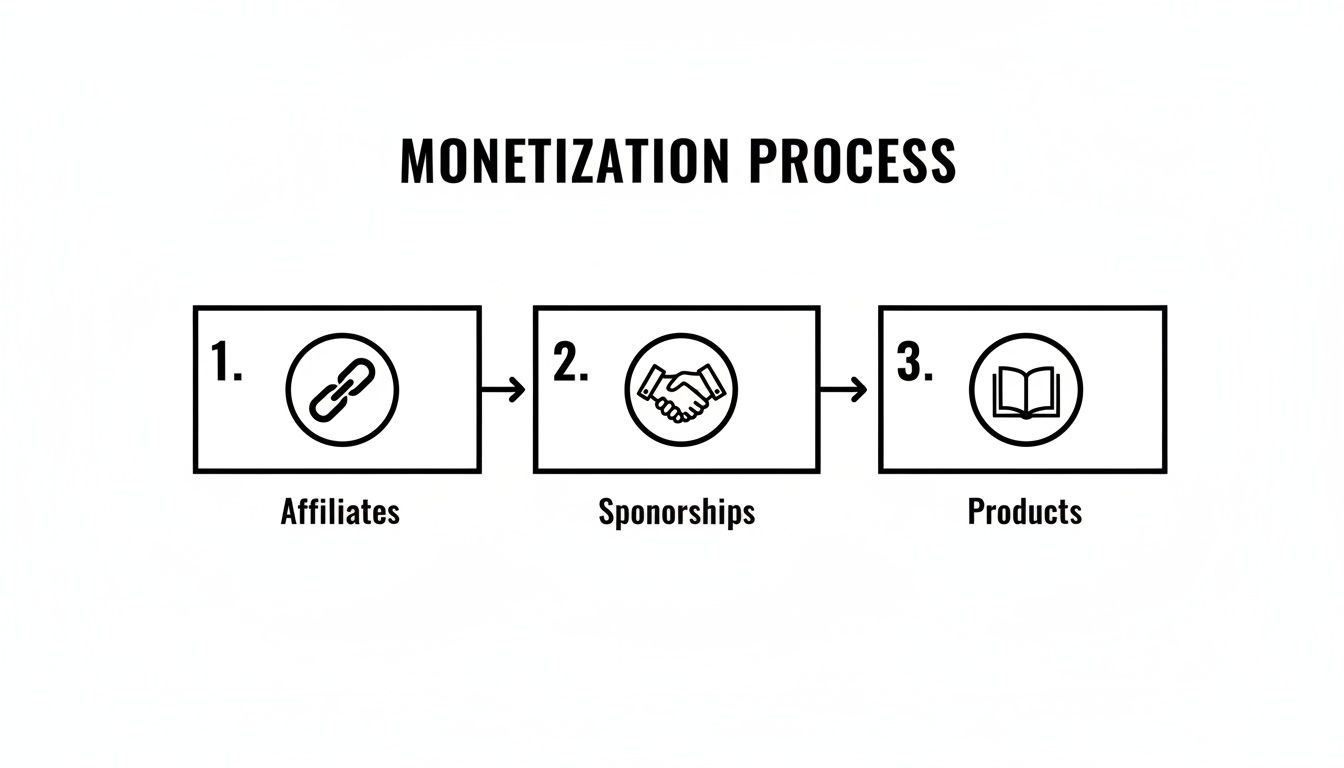
Each step represents a core monetization path you can guide your audience toward at the end of your funnel.
Practical Example: Let’s take a food blogger. They shared viral 15-second recipe clips (top-funnel) and detailed 10-minute cooking tutorial videos (mid-funnel). Now, they might launch a digital cookbook. Their bottom-funnel content would be a direct promotion—perhaps a webinar on "5 Meal Prep Secrets for a Busy Week" that ends with a special offer on the cookbook.
The calls-to-action here are crystal clear and direct: “Click the link in my bio to buy” or “Enroll in the course now.” You've earned the right to ask.
How to Price Your Work and Negotiate with Brands
Let's talk about the trickiest part of turning your social media hustle into a real business: figuring out what to charge. It’s the single biggest hurdle I see creators face. So many talented people get stuck here and end up massively undercharging just because they don't know where to start.
We're going to fix that. No more guessing. Your rates shouldn't be a number you pull out of thin air. They should be a confident reflection of the real value you bring to the table.
Calculating Your Rates with Confidence
You might have heard of the one-cent-per-follower rule—basically, charging $100 for every 10,000 followers. It's a decent starting point, a quick gut check, but it's far from the full picture. Honestly, follower count is a vanity metric. The real value is in engagement.
To land on a number that actually makes sense, you need to look a little deeper.
- Engagement Rate: A creator with 10,000 followers who hang on their every word is way more valuable to a brand than someone with 100,000 passive followers who barely notice their posts. Productivity Tip: Don't calculate this manually every time. Most social media scheduling tools have analytics dashboards that show your average engagement rate, saving you time.
- Industry Benchmarks: Rates are all over the place depending on your niche. A creator in finance or B2B tech can almost always charge more than a lifestyle creator. Why? Because the products they're promoting often have a much higher price tag. Practical Example: A sponsored post for a financial app might pay $2,000, while a post for a clothing brand with a similar audience size might pay $500.
- Scope of Work: What are you actually delivering? A single, disappearing Instagram Story isn't worth the same as a full-blown campaign with a Reel, a carousel post, and a "link in bio" for a week. Productivity Tip: Create tiered packages (e.g., Bronze, Silver, Gold) with clear deliverables and prices. This simplifies negotiation and helps brands see the value at each level.
Remember, you're not just selling a post. You're selling access to an audience you’ve spent months or years building trust with. You're selling your creative eye, your production skills, and the data to back it up. Price all of that, not just the final file.
Mastering the Art of Negotiation
Think of negotiation as a conversation, not a battle. When a brand reaches out, their first offer is almost never their best and final. Your job is to find that sweet spot where everyone feels like they're walking away with a win.
If a brand comes in with a budget that feels way too low, don't just shut them down. That closes the door.
Instead, try reframing the conversation. Something like this works well:
"Thank you for the offer! My standard rate for a package like this is [Your Rate], which factors in things like my average engagement rate of X% and the production involved. Is there any flexibility on your end to get closer to that?"
This simple script immediately shifts the dynamic. You're not just another creator they can lowball; you're a professional partner who knows their worth. It opens up a dialogue and shows you mean business.
Practical Example: If a brand's budget is firm, you can offer to adjust the scope to fit it. You could say, "I understand the budget constraints. To meet your price point of [Brand's Budget], I can offer a package with one Instagram Story series instead of the Reel. Would that work for you?" This keeps the conversation moving and often salvages a deal that might have otherwise fallen apart.
The Tools and Workflows You Need to Actually Scale Your Income
Let's be real: trying to do everything manually on social media is a one-way ticket to burnout. If you're serious about making money, you have to work smarter, not harder. That means building good systems and using the right tools to create, automate, and analyze your content at scale.
This is your playbook for turning a social media account into a real, streamlined business. It's time to ditch the random posting and build a monetization machine that runs smoothly, freeing you up to focus on what you do best.
Automate Your Content to Stay Consistent
Consistency is the engine of social media growth, but it shouldn't chain you to your phone. This is where content scheduling platforms become non-negotiable. They let you batch-create your content in focused sprints and then automatically drip it out all week long.
Productivity Workflow Example:
- Monday (Ideation): Spend one hour brainstorming content ideas for the week. Use an AI tool to generate topics based on your niche.
- Tuesday (Creation): Block three hours to create all the visuals and write all the captions. This is your "deep work" day.
- Wednesday (Scheduling): Spend one hour loading everything into a scheduling tool and setting it to post automatically for the rest of the week.
- Thurs/Fri (Engagement): With content running on autopilot, you can focus on replying to comments and DMs—the activities that build community and drive sales.
AI-powered tools are completely changing the game. Platforms like Postful can help you brainstorm post ideas, draft compelling copy, and even repurpose one piece of content across multiple platforms. This kind of AI assistance can literally cut your content creation time in half, turning a single idea into a week's worth of posts.
Here's a simple sketch of the workflow successful creators use to balance content creation with making money.
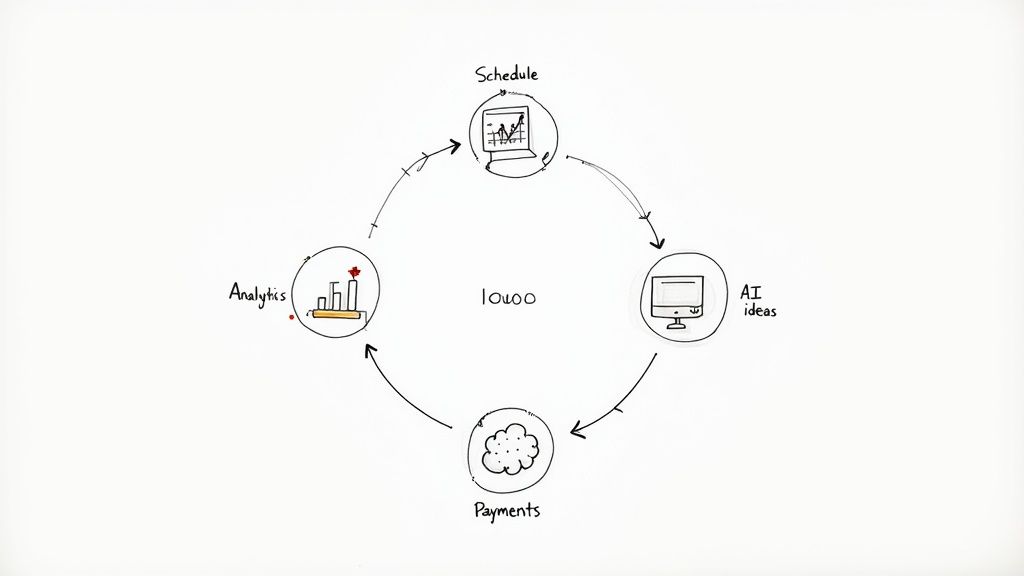
As you can see, it's a cycle. Scheduling, AI-driven ideas, payment processing, and analytics all feed into each other, creating a system that builds on itself.
Streamline How You Get Paid
Once the money starts coming in, so does the admin work. Trying to manage DMs, track leads, and process payments by hand gets chaotic fast. You need a system to handle the money side of things.
- Payment Processors: Tools like Stripe or PayPal are essential. They let you create simple payment links for one-off services or integrate with platforms to sell digital products.
- CRM Systems: If you're selling high-ticket services like coaching, a free Customer Relationship Management (CRM) tool like the one from HubSpot will help you manage your sales pipeline and keep track of every client interaction.
- Membership Management: For creators building recurring revenue, knowing how to manage a membership system is everything. This guide on how to Master Notion Membership Management offers a brilliant, low-cost framework for setting this up without expensive software.
The goal here is to automate as much of the admin and content delivery as you can. The less time you spend on manual tasks, the more time you have for creating great content and talking to your community—the stuff that actually drives revenue.
The market backs this up. Global spending on social media ads is projected to hit $276.7 billion in 2025. On top of that, 93% of marketers are putting their budgets into social platforms first. By setting up the right tools, you're positioning yourself to get a piece of that pie.
Common Questions About Making Money on Social Media
Jumping into social media monetization for the first time always brings up a ton of questions. Let's be honest, it can feel a bit overwhelming. Getting some clear, no-fluff answers helps you cut through the noise and avoid the mistakes most people make right out of the gate.
Here are the questions I see pop up most often.
How Many Followers Do I Need to Start Making Money?
You're going to hear this a lot, but there really is no magic number. You can absolutely start making money with a small, fired-up audience.
In fact, brands are often scrambling to find micro-influencers (those with 1,000-10,000 followers) specifically because they have such a tight-knit community and a high level of trust. That's your superpower.
Practical Example: A creator with 2,000 followers who specializes in gluten-free baking could partner with a small gluten-free flour brand. Even if a post only generates 10 sales, those are highly targeted customers the brand couldn't easily reach. You can start with affiliate marketing or offer a niche service right away.
What Is the Easiest Way to Get Started?
For most creators, affiliate marketing is the path of least resistance. It's the simplest and lowest-risk way to dip your toes into monetization. You don't have to create a product, and you get to test what your audience actually cares about.
Productivity Tip: Don't just randomly drop links. Create a dedicated "Resources" page on a simple website or use a "link in bio" tool to organize all your affiliate links in one place. You can then direct your audience there, making it an evergreen source of potential income. This is much more efficient than finding and pasting a link into every single post.
The whole game is authenticity. Only promote what you'd actually tell a friend to buy. People can sniff out a phony sales pitch from a mile away, and losing their trust is the quickest way to kill your momentum.
How Do I Handle Taxes from Social Media Income?
Okay, this is the boring but critical part that too many people ignore until it's too late. Any money you make—from brand deals, affiliate links, your own products—is generally considered self-employment income.
You absolutely have to track every dollar coming in. You'll likely need to pay quarterly estimated taxes to avoid a nasty surprise (and penalties) when you file at the end of the year. A good rule of thumb is to set aside 25-30% of everything you earn just for taxes. Productivity Tip: Use accounting software like QuickBooks Self-Employed or FreshBooks from day one. They can connect to your bank account, automatically track income and expenses, and even help you estimate your quarterly tax payments. This saves hours of headache later.
Should I Monetize Multiple Social Media Platforms?
Yes, absolutely. This is just smart business. Putting all your eggs in one basket is a huge risk.
Algorithms change overnight. Policies get updated. Platforms fall out of fashion. These are things you have zero control over. Spreading yourself across a few platforms diversifies your risk and your income.
The trick is to play to each platform's strengths. Don't just copy and paste.
- Practical Example: A business coach could share a quick productivity tip on TikTok, expand on it in a professional text post on LinkedIn, and then do a deep-dive 15-minute tutorial on the topic for YouTube. Each piece of content is tailored to the platform but reinforces the same core expertise, creating multiple paths that all lead back to their coaching services.
This lets you hit different segments of your audience and build multiple paths that all lead back to what you're selling. It makes your whole operation much more stable and resilient.
Ready to build a consistent social media presence without the grind? Postful is your AI-powered partner for creating high-quality content that connects with your audience. Join the waitlist today to get early access and see how simple growing your reach can be. Visit us at https://postful.ai to secure your spot.