
Going viral isn’t about luck. It’s about understanding what makes people tick.
The real secret is building content that triggers high-arousal emotions, provides social currency, or offers genuine utility. When you nail one of those, people feel an almost involuntary urge to share it. This is where you shift from ‘hoping for a hit’ to ‘engineering for engagement’—and it’s the key to unlocking massive reach.
Decoding the DNA of Viral Content
Let’s get one thing straight: virality isn’t some lottery ticket won only by huge brands or lucky influencers. It’s a science, rooted in human psychology. It’s less about a perfectly polished video and more about a raw, authentic connection that sparks an immediate emotional reaction.
Once you learn how to tap into these core psychological drivers, you stop guessing and start building content with intention. Your goal isn’t just to create a post; you’re trying to start a conversation people can’t resist joining.
The Power of High-Arousal Emotions
Content that spreads like wildfire almost always plugs into what psychologists call high-arousal emotions. These are the feelings that jolt us into action, making us want to do something—like smash that share button.
We’re talking about feelings that go beyond just “happy” or “sad.” Think about:
- Awe: Content that’s breathtaking or makes you feel part of something bigger. A drone shot of a stunning, undiscovered landscape does this perfectly.
- Humor: Laughter is a powerful connector. A genuinely funny, relatable sketch about the struggles of working from home creates an instant bond.
- Anger or Frustration: You have to be careful here, but content highlighting a shared frustration can be incredibly unifying. A post about a common industry problem everyone complains about but no one solves can get massive engagement.
- Surprise: Unexpected twists, shocking statistics, or counter-intuitive advice make people stop their scroll. A video revealing a “secret” feature on a popular app is a classic example.
Key Takeaway: Your content doesn’t just need to be good; it needs to make people feel something intensely. An emotional response is the fuel for a share.
Providing Social Currency and Genuine Utility
Emotion is huge, but two other powerful triggers drive virality: social currency and utility. Deep down, people share things that make them look good, smart, or helpful to their own network.
Social currency is all about giving your audience something that elevates their status when they share it. It could be insider knowledge, a clever take on a current event, or access to a cool new trend. By sharing your post, they’re signaling their own intelligence and good taste.
Utility, on the other hand, is just about being genuinely useful. Content that solves a common problem, teaches a valuable skill, or simplifies a complex topic has a high chance of being not just shared, but saved for later. For a masterclass in practical, shareable ideas, check out these 12 essential social media content ideas to go viral.
This brings us to a crucial point. In 2025, with 5.42 billion people scrolling social media, short-form video is the undisputed king. A staggering 78% of people prefer learning about products through short videos, and 93% of marketers are dumping more budget into video for exactly this reason. It’s the perfect format for delivering those quick emotional hits and useful tips.
To help you put these psychological triggers into practice, I’ve put together a quick reference table. Think of it as a cheat sheet for brainstorming your next piece of content.
Actionable Viral Triggers for Your Next Post
A practical guide to the psychological hooks that drive shares, complete with specific ideas for founders and creators.
| Viral Trigger | What It Means | A Practical Idea You Can Use |
|---|---|---|
| Awe | Creating a sense of wonder or inspiration. | Share a stunning visual from a recent trip or a mind-blowing stat about your industry’s future. |
| Humor | Making people laugh with relatable content. | Create a short skit about a common frustration your audience faces (e.g., “5 stages of debugging code”). |
| Anger/Frustration | Tapping into a shared pain point or injustice. | Write a post titled “The one piece of bad advice everyone in [Your Industry] needs to ignore.” |
| Surprise | Revealing something unexpected or counter-intuitive. | Film a quick video showing a little-known hack for a popular tool your customers use daily. |
| Social Currency | Making sharers look smart, in-the-know, or cool. | Post a controversial but well-argued “hot take” on a trending topic in your niche. |
| Utility | Providing genuinely useful, problem-solving info. | Create a simple checklist or a 30-second tutorial that solves a small but annoying problem for your audience. |
Ultimately, virality boils down to this: if you can make your audience feel something powerful or provide them with tangible value, you have a solid foundation for a hit.
You can dive deeper into these fundamentals by checking out our complete guide on what is viral content.
Building Your Viral Content Engine
A single viral hit feels great, but the real goal is to build a system that consistently spits out content with massive potential. It’s time to stop hoping for a lucky break and start engineering your own. This isn’t about chasing every trend; it’s about building a focused, efficient workflow that turns one solid idea into a month’s worth of content tailored for every platform.
The first move is to get hyper-specific. Forget broad targets like “entrepreneurs.” A much stronger niche is something like, “bootstrapped SaaS founders struggling with user acquisition.” That kind of focus lets you create content that feels like a one-on-one conversation, which is exactly the kind of stuff people feel compelled to share.
The Pillar and Post Workflow
A core piece of this engine is what I call the Pillar and Post model. It’s all about working smarter, not harder, helping you create a ton of high-quality content with a fraction of the effort. For busy founders or small teams, it’s an absolute game-changer.
Here’s the breakdown:
- Create a Pillar Piece: Start with one substantial, in-depth piece of content that delivers immense value to your niche. This could be a long-form blog post, a detailed guide, a webinar, or a deep-dive YouTube video. For our SaaS founder, a perfect pillar would be a guide like, “The Bootstrapper’s Playbook for Acquiring Your First 100 Users.”
- Break It Down into Posts: Once the pillar is done, you chop it up into dozens of smaller, platform-native “posts.” That one guide becomes a content goldmine.
For instance, that user acquisition guide could easily be repurposed into:
- Five TikToks/Reels: Each video highlights one killer tactic from the guide, complete with on-screen text and a trending sound.
- Three X Threads: Turn a juicy section like “Cold Outreach That Actually Works” into a detailed thread with real screenshots.
- Two LinkedIn Carousels: A visual summary of the “10 biggest mistakes founders make” is perfect for LinkedIn and drives people back to the full guide.
- Ten Quote Graphics: Pull the most punchy sentences and turn them into shareable images for Instagram and X.
You can manage this whole process—from brainstorming the pillar to scheduling all the micro-content—with tools like Postful, which helps you plan and automate everything. It keeps you consistent without the daily grind.
The basic flow for creating viral content is a simple but powerful three-step process.
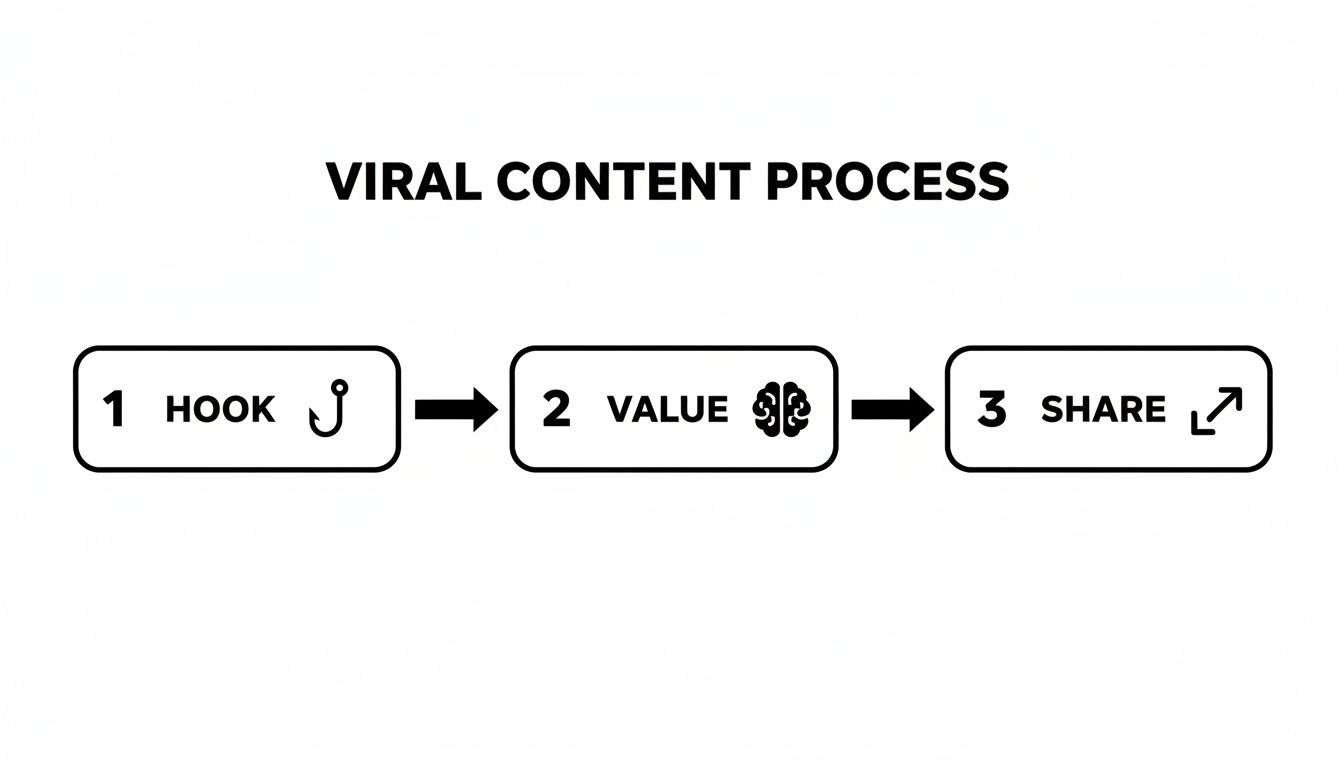
As you can see, every successful piece needs to first hook the viewer, then deliver real value, and finally, make it incredibly easy and compelling for them to share.
Actionable Formats That Spark Conversation
Beyond the workflow, certain content formats are just built to go viral because they’re designed to generate engagement. You can’t just post information; you have to package it in a way that invites people to jump in.
Pro Tip: Don’t be afraid to take a stand. Content with a strong, even controversial, point of view gets discussed and shared far more than something neutral and forgettable. The goal is to start a conversation.
Try working these proven formats into your strategy:
- Strategic Trendjacking: This is more than just slapping a trending audio on your video. It’s about cleverly connecting a current trend or meme back to your specific niche. A founder could use the “distracted boyfriend” meme to show someone choosing a flashy new marketing channel over a proven, effective one.
- User-Generated Content (UGC) Campaigns: Get your audience to make content for you. Run a contest asking users to share how they use your product or a tip related to your industry. You get authentic content, and you build a powerful community around your brand. It’s a win-win.
- Brand-Safe Controversial Takes: Have a strong opinion on a common industry practice? Share it. A post titled, “Why ‘Growth Hacking’ Is a Lie and What to Do Instead,” is guaranteed to grab more eyeballs and spark more debate than generic marketing tips. Just make sure you back up your take with solid reasoning so the controversy is productive, not just noise.
Mastering the Unwritten Rules of Each Platform
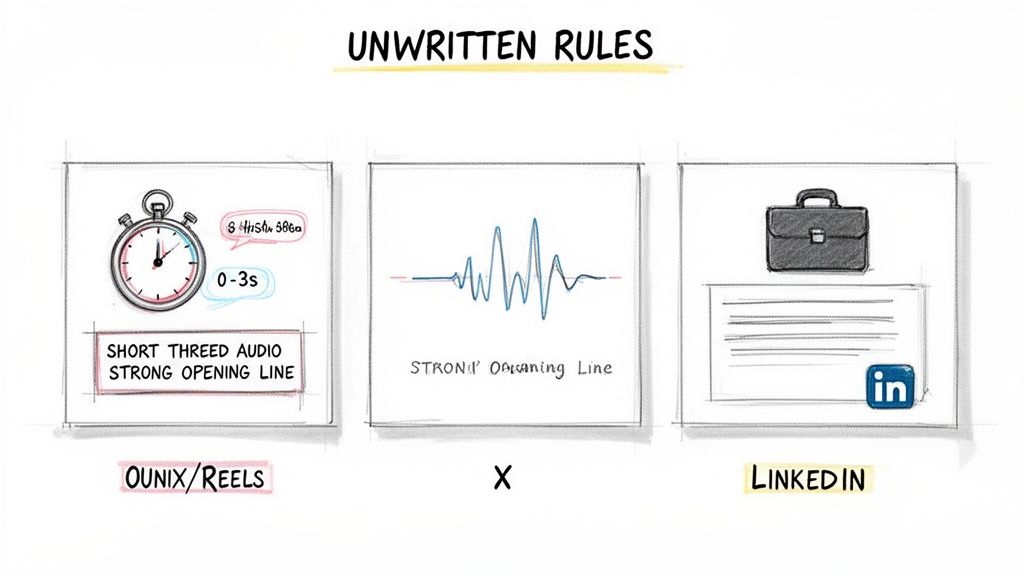
Coming up with a potentially viral idea is only half the job. Where you post it—and how you tailor it—is just as critical. Every social platform has its own distinct culture, algorithm, and set of unwritten rules.
Ignoring them is like showing up to a party in the wrong dress code. You’ll stand out, but for all the wrong reasons.
To really get how virality works, you have to become a native speaker of each platform’s language. A brilliant LinkedIn post will almost certainly bomb on TikTok if you just copy and paste it. This is what separates creators who see consistent reach from those who are just shouting into the void.
TikTok and Instagram Reels: The First Three Seconds Are Everything
With short-form video, you don’t have the luxury of a slow intro. You have about three seconds to stop the scroll, which means your hook isn’t just important—it’s everything. It has to be immediate, powerful, and intriguing.
Your hook isn’t just what you say first; it’s the entire visual package. The real magic happens when you combine a killer opening line with a visually arresting shot and a compelling text overlay.
Here are a few hook strategies I’ve seen work wonders:
- A bold claim: “This is the one marketing mistake 99% of founders make.”
- A relatable problem: “You’re wasting hours every week on this one simple task.”
- Pure curiosity: “I found a secret tool that feels illegal to know.”
Once they’re hooked, use the platform’s native features to your advantage. Animate text overlays to keep their eyes moving and engaged. And while trending audio is a huge signal to the algorithm, don’t just slap it on anything. The best creators find a sound that actually elevates their message, rather than forcing a fit. For a deeper dive, there are some great dedicated strategies for viral short-form content.
Here’s a real-world example: A small skincare brand went viral not with a polished ad, but with a simple, up-close video of their product’s texture. The text overlay read: “Why nobody is buying our best-selling face cream.” The hook was irresistible. It drove millions of views and sold out the product in days. They spoke the native language of TikTok: raw, intriguing, and value-first.
X: The Art of the Compelling Thread
On X (formerly Twitter), virality is often built one tweet at a time in a well-crafted thread. A single tweet is limited, but a thread lets you tell a story, break down a complex idea, or walk someone through a process. The trick is structuring it to be as readable and engaging as possible.
Think of your first tweet as your headline and hook rolled into one. It has to be strong enough to make someone click “Show more.” Use a bold statement or promise incredible value.
From there, it’s all about readability. Keep each tweet short. Use plenty of white space and line breaks to make it feel less like a wall of text on a small screen. And don’t forget to embed relevant images, GIFs, or short videos to break things up and add context.
LinkedIn: Storytelling for the Professional World
LinkedIn is so much more than a digital resume. It’s a place where personal stories, vulnerable insights, and truly helpful content can take off. Going viral here isn’t about memes or trending sounds; it’s about professional relatability and tangible value.
Text-only posts often do incredibly well because they feel personal and are quick to digest. The key is to start with a strong, relatable opening line that nails a common professional struggle or a surprising lesson.
A structure that consistently works:
- The Hook: A personal, relatable opener. (e.g., “I bombed a major presentation last week.”)
- The Story: Briefly set the scene and explain the conflict.
- The Lesson: Share the key takeaway you learned from the experience.
- The Call to Engagement: End with a question. (e.g., “What’s the biggest lesson you’ve learned from a failure?”)
Simple carousels, which are just PDFs uploaded as posts, are also a fantastic way to share educational content. Each slide delivers one key idea, making complex topics easy to digest and even easier to share.
By respecting the unique culture of each platform, you dramatically increase your chances of not just being seen, but being shared.
Your First-Hour Content Promotion Playbook
Hitting publish isn’t the finish line—it’s the starting pistol. The first 60 minutes after your content goes live are absolutely crucial. This is your window to send the right signals to the algorithm, showing that people find your stuff valuable and giving it the initial push it needs to take off.
Too many creators just post and pray. But the difference between a lucky hit and an engineered success is a proactive distribution strategy. This playbook is your minute-by-minute guide to giving your content the best possible shot right out of the gate.
The Art of Content Seeding
Your first move is to “seed” your content where it’ll be seen as a genuine contribution, not just another spammy link drop. This takes a bit of finesse. You have to understand the culture of each community, because just dropping a link and running is the fastest way to get ignored or even banned.
The trick is to lead with value, not the ask.
- Reddit: Find subreddits where your content actually solves a problem or adds to a real conversation. Don’t just post the link. Write a thoughtful summary of the key insights, and then link to your full piece for anyone who wants to go deeper. If you made a video on SaaS pricing, you could share the top three takeaways in r/SaaS and link to the full video at the end.
- Niche Slack/Discord Channels: These are goldmines. You’re talking to a highly engaged, specific audience. Frame your share as a contribution. Something like, “Hey everyone, I know we were talking about customer acquisition last week, so I put together a detailed guide on it. Hope it helps!”
- Facebook Groups: Just like Reddit, lead with value. Pull a key graphic or a surprising stat from your content and post it directly in the group to get a conversation started.
Cultivating Your First Engagers
Algorithms love early engagement. A quick burst of likes, comments, and shares within that first hour tells platforms like Instagram and LinkedIn, “Hey, people are into this!” This is where having a small circle of “first engagers” becomes a massive advantage.
This isn’t about buying fake engagement. It’s about building real relationships with a handful of peers or supporters you can count on.
My Personal Workflow: I have a small group chat with about five other creators in my space. When any of us publish something new, we drop the link. We all make a point to leave a thoughtful comment and share it if it’s a good fit for our own audiences. This simple act provides that critical initial velocity.
You can build this circle by being the supporter you wish you had. Actively engage with other people’s work, and they’ll naturally do the same for you. To really dig into tracking which of these efforts are paying off, it’s worth learning how UTM parameters work in Google Analytics to see where your traffic is coming from.
Quick-Hit Outreach Tactics
While building long-term influencer relationships is important, the first hour is all about quick wins. Your goal is to get your content in front of established audiences as fast as you possibly can.
Think small and targeted. Instead of shooting for a major publication, focus on micro-influencers and niche newsletters. They’re often way more accessible and quicker to respond.
Your 60-Minute Promotion Checklist
| Time | Action | Productivity Tip |
|---|---|---|
| 0-10 Mins | Share to your primary platforms. | Have your captions and platform-specific assets (like a vertical video for Stories) ready to go beforehand. |
| 10-25 Mins | Activate your first engagers. | Send a quick, personal message to your small circle with the link. Don’t just mass-blast them. |
| 25-45 Mins | Seed content in 3-5 relevant communities. | Keep a spreadsheet of your target communities and their posting rules so you can work fast. |
| 45-60 Mins | Conduct micro-influencer outreach. | Send a brief DM to 3-5 micro-influencers, saying, “Hey, just published this and thought your audience might find it valuable.” |
This initial burst of activity is designed to create a ripple effect. By manually kickstarting the distribution, you dramatically increase the odds of the algorithm picking up your content and doing the heavy lifting for you.
Turning a Viral Moment into a Growth Loop
Going viral feels incredible, but the real win isn't the single spike in attention. It's turning that moment into a sustainable system for growth. That’s the difference between a one-hit wonder and a chart-topping artist.
The trick is to build a repeatable engine that keeps bringing in new people. It starts by looking past vanity metrics like "views." A big number is nice, but the data that actually matters signals deep engagement: shares, saves, and comment sentiment. These tell you why your content connected, not just that it did.
Analyze Success to Replicate It
Your first move after a post takes off is to become a detective. You need to do a post-mortem to figure out exactly what caused the surge. Don't just pop the champagne; dissect the win to understand the mechanics behind it.
Ask yourself a few critical questions:
- What was the hook? Was it a controversial statement in the first three seconds? A surprising statistic? A super relatable problem?
- Which format nailed it? A quick-cut tutorial? A text-heavy carousel? A personal story?
- What was the core topic? Did you tap into a common frustration, a niche passion, or a trending conversation?
Here’s a real-world example: A founder posts a 30-second Reel showing a "stupidly simple" spreadsheet hack for tracking cash flow. It blows up and gets 500,000 views. The analysis shows the hook, "Stop using complex software for this," resonated like crazy. Comments were full of praise for the quick, no-fluff format. This insight is gold. The takeaway isn't just "make more finance content," but "create more content that simplifies complex tasks for founders using simple tools."
This analysis becomes your blueprint. It gives you a proven formula you can adapt for future content, which massively stacks the odds of creating another hit in your favor.
Building Your Flywheel
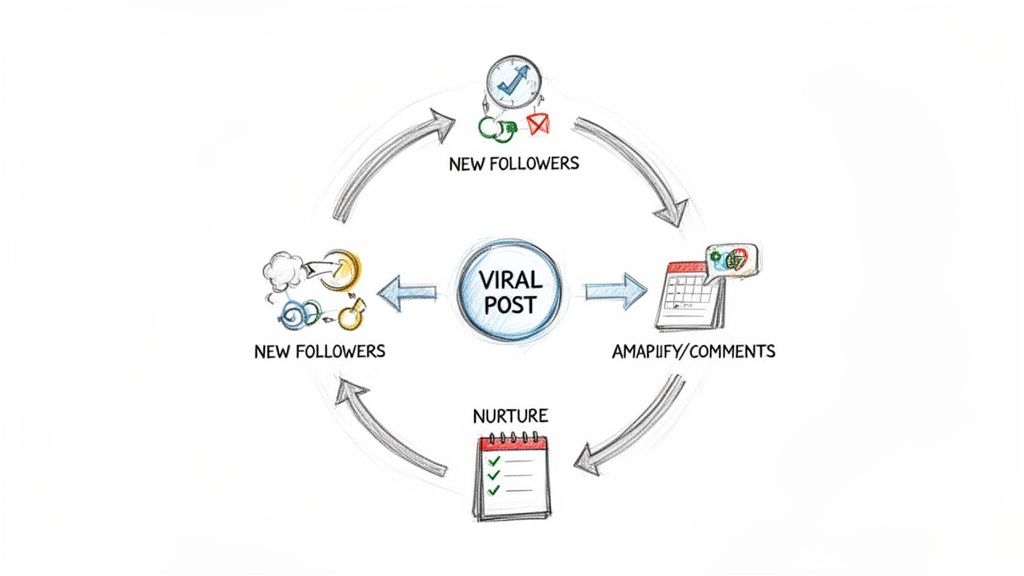
The end goal is to create a self-sustaining growth loop, often called a flywheel. It’s a simple but powerful idea that turns new viewers into loyal advocates who then help fuel your next viral moment.
Here’s how the flywheel works in practice:
- Viral Content Attracts: Your killer post brings a flood of new viewers and followers to your profile.
- Nurture with Value: You don't just let them go cold. You follow up with consistent, valuable content that reminds them why they followed you. This builds trust and a sense of community.
- New Followers Amplify: Now, when you drop your next piece of content, this larger, more engaged audience gives it a bigger initial push. They become the "first responders" who signal to the algorithm that this new post is also worth showing to more people, kickstarting its journey toward virality.
This loop means each success builds directly on the last, creating compounding growth instead of a series of isolated spikes.
Systematize and Test Everything
To keep that flywheel spinning, you need a system. This is where a simple A/B testing workflow comes in, helping you refine your approach with data, not just guesses. You don't need fancy software; a basic spreadsheet is all it takes.
For your next piece of content, just test one variable at a time:
- Headlines: Post the same video to TikTok and Reels, but use a slightly different text hook on each. Which one gets more shares in the first 24 hours?
- Visuals: Create two versions of a carousel. One uses illustrations, the other uses real screenshots. Which one gets more saves?
- Calls to Action: End one video by asking a question and another by asking for a "share." Which one drives the action you want?
By tracking these small experiments, every single piece of content you create gets a little smarter than the last. You stop wondering how to go viral and start building an engine that makes it an intentional outcome.
Your Questions About Going Viral, Answered
Even with the best strategy, chasing virality brings up a ton of questions. It's totally normal to wonder if you should be posting more, if paid ads are a waste of money, or how long you should even wait for something to take off. Let's dig into the common questions that pop up on the path to making something go huge.
How Long Does It Take for Content to Go Viral?
There's no magic number here. Virality usually hits in waves. You might see a big spike in the first 24-48 hours as the algorithm and your initial audience share it around.
But sometimes, content is a "slow burn." It can simmer for days or even weeks until a big account or influencer stumbles on it, giving it a second, much bigger life. The key is to nail that first-hour promotion we talked about. Your initial push is what gives your content a fighting chance to catch that first wave.
Quality or Quantity? The Age-Old Debate
It's the classic social media dilemma, but the answer is a mix of both. Ultimately, consistency is way more important than sheer frequency. Three high-quality, genuinely useful posts a week will always beat seven mediocre ones.
People follow you for the value you deliver, not just the volume. If you burn them out with low-effort content, you’re just begging for an unfollow. Find a pace you can actually stick to without ever sacrificing quality.
A smart workflow I've seen work well is creating one big "pillar" piece of content—like a detailed guide or a video—and then slicing it up into smaller, snackable posts. This lets you stay consistent across platforms without killing yourself to create something new every single day.
Should I Pay to Promote My Content?
Paying to boost a post can be a massive accelerator, but only if the content is already showing signs of life. Think of it this way: paid promotion is fuel, not fire.
If a post is already getting solid organic engagement—people are sharing it, saving it, and leaving thoughtful comments—putting a little money behind it can push it out to a whole new audience and kickstart that next wave of sharing.
But throwing money at a dud post that no one is engaging with? That’s like trying to fuel a car that doesn't have an engine. It's not going anywhere.
- Test the waters first. Let a post run organically for at least 24 hours to see how it performs on its own.
- Look for the right signals. High share and save rates are your best friends here. They scream "viral potential."
- Amplify your winners. Only put your ad budget behind the posts that are already resonating with your audience.
What Metrics Actually Matter for Viral Content?
A massive view count feels great, but it’s a vanity metric. If you want to understand why something went viral so you can do it again, you have to look deeper. Focus on the numbers that show real engagement and connection.
The Top 3 Metrics to Obsess Over:
- Shares: This is the holy grail. It means your content was so valuable or hit such an emotional nerve that someone was willing to attach their own name to it and show it to their friends.
- Saves: This metric is pure gold. It tells you your content was so genuinely useful that someone wanted to pocket it for later. It's a huge signal of utility-driven virality.
- Comment Sentiment: Don't just count the comments; read them. What are people actually saying? Are they tagging their friends? Adding their own stories? This qualitative data gives you the why behind the numbers.
When you start focusing on these metrics, you stop just seeing that a post went viral and start understanding how to make it happen again.
Ready to build your own viral content engine without the guesswork? Postful gives you AI-powered brainstorming tools, templates, and automation to create high-impact content consistently. Start growing your reach today, completely free. Get started with Postful.