

Finding your niche is about identifying a specific group of people you can serve better than anyone else. It's that sweet spot where your unique passions and skills overlap with a genuine market need. Get that right, and you become the go-to expert for a very specific audience, making your content creation process incredibly productive.
Why a Niche Is Your Greatest Competitive Advantage

A lot of founders get this backward. They think choosing a niche limits their audience, but the opposite is true—it actually unlocks it. When you try to appeal to everyone, you end up connecting with no one. A niche lets you create hyper-relevant content that speaks directly to the problems and desires of a specific group, making your message impossible to ignore.
This shift from broad to specific is more critical than ever. Today’s social media algorithms prioritize relevance over everything else. Platforms like TikTok and Instagram are behaving more like search engines, driven by what people are interested in, not just who they follow.
This means your content can land in front of the perfect strangers in your target audience, even without a massive following. In fact, an analysis of 70 million posts showed TikTok's engagement rate hit 3.70%—a 49% jump year-over-year. It’s proof that specific, conversational content is what wins.
From Generalist to Specialist
Think about the difference between a general "marketing consultant" and a specialist who "helps SaaS founders create engaging demo videos." The specialist can charge premium rates because their expertise is concentrated and in-demand. They’ve become a big fish in a small, profitable pond.
By niching down, you get some major advantages:
- Less Competition: You stop fighting with everyone and start owning a specific category.
- Higher Conversion: Your audience feels understood, which builds trust and makes selling feel natural.
- Simpler Content Creation: The daily guesswork is gone. You know exactly what topics matter to your people. This boosts your productivity immensely.
- A Real Community: You attract true fans who are genuinely passionate about the same things you are.
Real-World Niche Success
Let's make this practical. Imagine a personal trainer struggling to get clients in a saturated gym market. They feel lost in the crowd. But by niching down to "postnatal fitness for new moms," they immediately stand out.
Suddenly, their marketing, their content, and their services are all laser-focused on solving a specific set of problems for a distinct audience. This is a core idea behind effective content marketing for startups.
A niche isn’t about thinking smaller; it’s about being smarter. It allows you to build a powerful brand with fewer resources by focusing your energy where it will have the greatest impact.
This focused approach makes creating consistent, valuable content totally manageable, even for a founder juggling a million other things. Tools designed for this exact problem, like Postful, can then help streamline your process, so you can show up for the audience that matters most without burning out.
Discovering Your Unique Niche Potential

Finding your niche isn't something you do with endless research. It's something you uncover through focused, practical exercises. We're going to move from theory to action right now.
Instead of getting stuck in analysis paralysis, we'll use a few simple frameworks to pull your best ideas to the surface. For maximum productivity, time-box this exercise: set a timer for 25 minutes (a Pomodoro session) for each of the following sections to maintain focus and avoid overthinking.
The goal isn't perfection on the first try. It’s to generate 3-5 powerful, well-defined concepts that feel authentic and have real market potential. Think of these as candidates you’ll test out in the real world.
Find Your Business Ikigai
The Japanese concept of Ikigai is your "reason for being." We can adapt it into a business framework to find that sweet spot where what you love doing meets what the market actually wants. This is the core of finding a niche that will last.
Grab a notebook or open a tool like Notion or Miro. Create four columns. Brainstorm answers for each prompt below, and don't filter yourself—just write down everything that comes to mind.
- What I Love (Passion): What topics could you talk about for hours? Example: Sustainable fashion, vintage synthesizers, productivity apps for remote teams.
- What I'm Good At (Skills): What have you learned from your job, hobbies, or life? Example: Hard skills like coding in Python, soft skills like simplifying complex data into visual charts.
- What the World Needs (Problems): What are people complaining about online? Example: “I can’t figure out how to meal prep for a whole week,” “My team wastes hours in pointless meetings.”
- What I Can Be Paid For (Market Demand): Where are people already spending money? Example: They buy templates on Gumroad, subscribe to newsletters, or hire coaches on Upwork related to your skills. Competition is a good sign.
The intersection of these four areas is where your best niche ideas live. For example, a passion for home organization, a skill for creating systems, and the market for decluttering services could point you toward a niche in "helping busy professionals organize their digital files using Notion."
Map Problems to Your Solutions
Once the Ikigai exercise gives you some direction, it's time to get specific. The best niches are built on solving painful, recurring problems for a very specific group of people.
Start by listing 5-10 specific problems you see your potential audience facing. Get detailed. Instead of "struggles with marketing," write "can't figure out how to write Instagram captions that get comments."
Next to each problem, brainstorm a specific, practical solution you could offer. Use this simple table format in a spreadsheet to keep your ideas organized.
| Problem Example | Your Potential Solution |
|---|---|
| First-time homebuyers feel overwhelmed by paperwork. | A checklist and guide to navigating closing documents. |
| Remote workers feel isolated and disconnected. | A weekly newsletter with virtual team-building activities. |
| Home bakers can’t get their sourdough starter right. | A short video course on troubleshooting common starter issues. |
This process forces you to think like a problem-solver. It shifts your focus from "what can I sell?" to "how can I genuinely help?"
The most profitable niches aren't just about what you want to talk about; they are about solving a specific, urgent problem for a defined group of people who are actively looking for a solution.
Create Your Ideal Audience Avatar
You can't serve an audience you don't understand. Creating an "audience avatar" makes your target customer feel real, which is key to crafting a message that actually connects. Go beyond demographics and get into their mindset. A practical tool for this is a free template from HubSpot or Xtensio, where you can build out a visual profile.
Give your avatar a name. Let's call ours "Startup Sarah." Now, answer these questions about her:
- Role: What’s her job? (e.g., Founder of an early-stage B2B SaaS company)
- Goals: What is she trying to achieve? (e.g., Get her first 100 paying customers)
- Challenges: What’s stopping her? (e.g., Limited budget, no marketing team, overwhelmed by social media)
- Where She Hangs Out: What platforms does she use? (e.g., LinkedIn, specific subreddits like r/SaaS, listens to the My First Million podcast)
- Her Language: What words does she use to describe her problems? (e.g., "lead generation," "churn," "customer acquisition cost")
Knowing "Startup Sarah" this well changes everything. You stop creating generic business advice and start creating content that speaks directly to her biggest pain points.
Now, look back at your list of 3-5 niche ideas and ask a simple question: which of these would help Sarah the most? That's your starting point.
Using Smart Research to Validate Your Niche Ideas

Having a few solid niche ideas is a great start, but let's be honest—an idea is just a hypothesis. Now it’s time to see if those hypotheses hold up in the real world, without spending a dime. We're going to turn the platforms you already use every day into powerful, free market research tools.
This whole process is about gathering evidence. You're looking for proof that a community for your niche not only exists but that it's active, engaged, and genuinely looking for solutions. You want to see people already talking about the exact problems you plan to solve.
The good news? Social media platforms are the new search engines. People are searching, asking questions, and making decisions inside apps like TikTok and YouTube, often skipping Google entirely. This is a huge advantage for creators trying to find their footing, as it favors trusted opinions from people with highly engaged, specific audiences.
Turn Social Platforms into Search Engines
Forget mindlessly scrolling. It's time to start searching with intent. Your goal here is to get a feel for demand, spot the gaps in existing content, and see what potential competitors are already up to. This is where you'll find the real opportunities.
Treat the search bar on TikTok, Instagram, and LinkedIn as your primary tool. Start broad with keywords related to your niche, then drill down into more specific terms.
Here’s a practical workflow:
Let's imagine your niche idea is "helping freelance illustrators use Procreate more efficiently."
- Broad Search: Start by searching
#ProcreateTipson Instagram or "Procreate tutorials" on YouTube. How many results pop up? Is the content recent? Use a spreadsheet to log the top 5 creators you find. - Specific Search: Now get granular. Try "Procreate animation for beginners" or "custom Procreate brushes for comics." This is how you find juicy sub-niches. Note which specific topics get the most engagement (likes, comments, shares).
- Problem-Based Search: Search for the questions people are asking, like "how to organize Procreate layers" or "best way to export Procreate files." These are content goldmines. Save links to these posts in your spreadsheet—they are your first content ideas.
As you search, pay close attention to the engagement. Are people saving posts, asking follow-up questions in the comments, and sharing the content? High engagement is a neon sign pointing to a passionate, active audience.
Eavesdrop in Online Communities
The most honest conversations happen where people feel safe enough to ask "dumb" questions and vent their frustrations. Places like Reddit, Facebook Groups, and Discord servers are where you'll find the unfiltered voice of your potential audience.
Your job is to be a professional listener. Join groups related to your niche ideas and just observe. Don't jump in and start selling yourself; just read, listen, and take notes.
- Reddit: Look for subreddits like
r/freelance,r/DigitalArt, orr/Procreate. Use the search bar within the subreddit to find keywords related to your niche ideas. - Facebook Groups: Search for groups like "Illustrator's Lounge" or "Digital Art Community." Look for recurring questions and check out any member polls.
- Discord: Many creators have their own dedicated servers. These can be a fantastic source of direct feedback and community pain points. For a productivity boost, use the search function in these communities to find conversations around keywords like "help," "question," or "struggle."
The real goal here is to learn the language your audience uses. What specific words do they use to describe their problems? What have they already tried that didn't work? This is the raw material for all your future content.
To add a bit more structure to your research and get some data-driven feedback, you could also try a dedicated niche validator tool to help organize your findings.
A Quick Niche Validation Checklist
As you do this research, you need a way to organize what you're finding. This isn't just casual browsing; you're collecting data to make a smart decision. Use a simple scoring system to compare your top ideas.
Below is a simple table you can replicate in Google Sheets or Notion. Score each of your niche ideas from 1 (weak) to 5 (strong) based on the evidence you find for each criterion.
Niche Validation Checklist
| Validation Criteria | Niche Idea 1 Score (1-5) | Niche Idea 2 Score (1-5) | Evidence/Notes |
|---|---|---|---|
| Audience Activity | 4 | 2 | e.g., "r/Procreate has 10+ posts/day" |
| Recurring Questions | 5 | 3 | e.g., "Many ask about file export settings" |
| Monetization Proof | 4 | 1 | e.g., "Found 3 creators selling brush packs" |
| Content Gap | 3 | 5 | e.g., "Lots of beginner content, not much for advanced users" |
| Personal Passion | 5 | 3 | e.g., "I love teaching animation workflows" |
| Total Score | 21 | 14 |
By the end, the scores should give you a pretty clear picture of which idea has the most potential.
Here are the key questions you should be asking yourself:
- Is there an active and engaged audience? Look for signs of life. Are there daily posts in the Reddit community? Does an Instagram hashtag have recent, popular content? A quiet community is a huge red flag.
- Are people constantly asking questions? An endless stream of questions is one of the best signs of a healthy niche. It means people are actively looking for help and haven't found the perfect solution yet. To get better at spotting these opportunities, check out our guide on how asking better questions leads to better insights.
- Is anyone already making money here? Don't be afraid of competition—it's proof of concept. Look for people selling courses, ebooks, coaching, or products. If no one is making a dime, it might mean the audience isn't willing to pay.
- Can you spot a content gap? Analyze what others are doing. Are they only focused on beginners? Is their advice too technical? Your opportunity lies in the gaps they’ve left. You could be the one who offers a unique angle, a different format, or serves a part of the audience everyone else is ignoring.
By the end of this process, you should have a clear winner. One of your ideas will stand out with strong evidence of an engaged community, real problems, and a clear path for you to become the go-to expert.
Defining Your Niche Statement and Content Pillars
Once you've got a validated idea, it's time to sharpen that concept into a crystal-clear strategy. This is where you graduate from a loose idea to a focused plan that will steer every single piece of content you create from here on out. The mission? To spell out your value so clearly that your perfect audience instantly gets that you are the one to help them.
This all starts by hammering out a simple but powerful niche statement. Don't think of this as just a tagline—it's your North Star. It makes sure every post, video, and comment you publish reinforces your expertise and leaves no doubt about what you do.
A solid grasp of the Definition of Target Markets is a huge help here. Knowing exactly who you're talking to is what makes your niche statement and content pillars actually work.
Crafting Your Niche Statement
Your niche statement needs to be short enough to pop into a social media bio, yet descriptive enough to tell someone exactly how you can solve their problem. Think of it as the ultimate elevator pitch for your brand.
We'll use a straightforward template that just works.
I help [Specific Audience] achieve [Specific Outcome] by providing [Unique Method].
This little formula forces you to get specific. Who do you serve? What result do you deliver? And what makes your way of doing it special? Vague statements like "I help people with marketing" are invisible. Specific ones grab attention.
Let's see it in action with practical examples:
Vague Idea: "I'm a financial advisor."
Niche Statement: "I help freelance creatives in their 30s build a six-month emergency fund by providing a simple, automated savings system."
Vague Idea: "I teach people how to cook."
Niche Statement: "I help busy parents cook healthy, 30-minute vegan meals by providing weekly plant-based meal plans and shopping lists."
See the difference? The second version in both examples immediately pinpoints a specific pain for a specific group and offers a tangible fix. That kind of clarity is a magnet for the right followers and, just as importantly, a filter for the wrong ones. That's exactly what you want.
From Statement to Content Pillars
With your niche statement locked in, you’ve laid the foundation for all your content. The next move is to break that statement down into 3-5 core content pillars. These are the main themes you’ll talk about again and again to build your authority.
Content pillars are the perfect antidote to creator burnout. No more staring at a blank screen wondering what to post. You'll have a reliable framework of topics that you already know resonate with your audience. This system makes sure every post is on-brand and on-purpose. To really dig into building this framework out, check out this guide on content pillars.
Let's use a practical example:
- Niche Statement: "I help first-time Shopify owners boost conversions by providing easy-to-implement CRO templates."
We can pull a few logical content pillars straight from this statement that speak directly to the audience's goals. Use a mind-mapping tool like MindMeister or a simple document to flesh this out.
Example Content Pillars:
- Pillar 1: Product Page Optimization: This is where you’d cover everything from killer product descriptions and better photos to adding customer reviews and trust badges. Example Post: "3 A/B Tests to Run on Your Product Photos This Week."
- Pillar 2: Checkout Flow Improvements: Here, you'd tackle topics like cutting down on cart abandonment, simplifying the checkout process, and offering the right payment options. Example Post: "A 5-Step Checklist to Reduce Cart Abandonment."
- Pillar 3: A/B Testing Basics: This pillar would demystify A/B testing, showing your audience how to test headlines, button colors, and calls to action without needing a data science degree. Example Post: "How to Use Google Optimize for Your First A/B Test (for free)."
This structure gives your audience a predictable, valuable experience. They know what they're getting from you, and you have a clear roadmap for what to create. It makes staying consistent and becoming the go-to expert in your space a whole lot easier.
Building a Productive Niche Content Workflow
A brilliant niche strategy is nothing more than a good idea until you put it into consistent action. Without execution, even the sharpest niche will fail to gain traction. This is where so many founders get stuck—not on the idea itself, but on the day-to-day grind of actually creating the content.
The secret isn't working harder. It’s building a smarter, more productive workflow that turns your strategy into reality. It’s about creating systems that let you show up for your audience consistently without sacrificing the time you need to, you know, run your business. This is especially true for founders and all-in-one doers who are already stretched thin.
Your niche statement and content pillars give you the map. A solid workflow is the vehicle that gets you there.
Systemizing Your Content Creation
To avoid the burnout that comes from the daily "what do I post today?" scramble, you have to systemize your efforts. This means shifting from a reactive mindset to a proactive, batch-oriented approach. This is where tools designed for efficiency, like Postful, Trello for content planning, or Canva for design templates, become a core part of your productivity stack.
Instead of staring at a blank page, you can use AI-powered tools to generate ideas that are already locked into your core content pillars. It jumpstarts the creative process and kills that initial friction.
A practical, productive workflow could look something like this:
- Ideation (1 Hour/Month): Open a Trello board with lists for each content pillar. Spend one hour brainstorming post ideas for the entire month and add them as cards to the appropriate lists.
- Batch Writing (2 Hours/Week): Every Monday, pull 3-5 ideas from your Trello board and write the full copy for them in a Google Doc. Don't worry about perfection, just get the drafts done.
- Batch Design (1 Hour/Week): Every Tuesday, use pre-made Canva templates to create all the visuals for the week's posts.
- Scheduling (30 Mins/Week): Upload all your copy and visuals into a scheduling tool and set them to publish automatically throughout the week.
This simple workflow transforms content creation from a daily chore into a predictable, manageable task. You can knock out a full week’s worth of high-quality, niche-specific content in just a few focused hours.
A productive workflow is less about waiting for inspiration and more about repeatable systems. When you systematize your content creation, you guarantee consistency—and consistency is the single most important factor in building authority within your niche.
This diagram breaks down the core elements of a focused niche strategy that fuels your entire workflow.
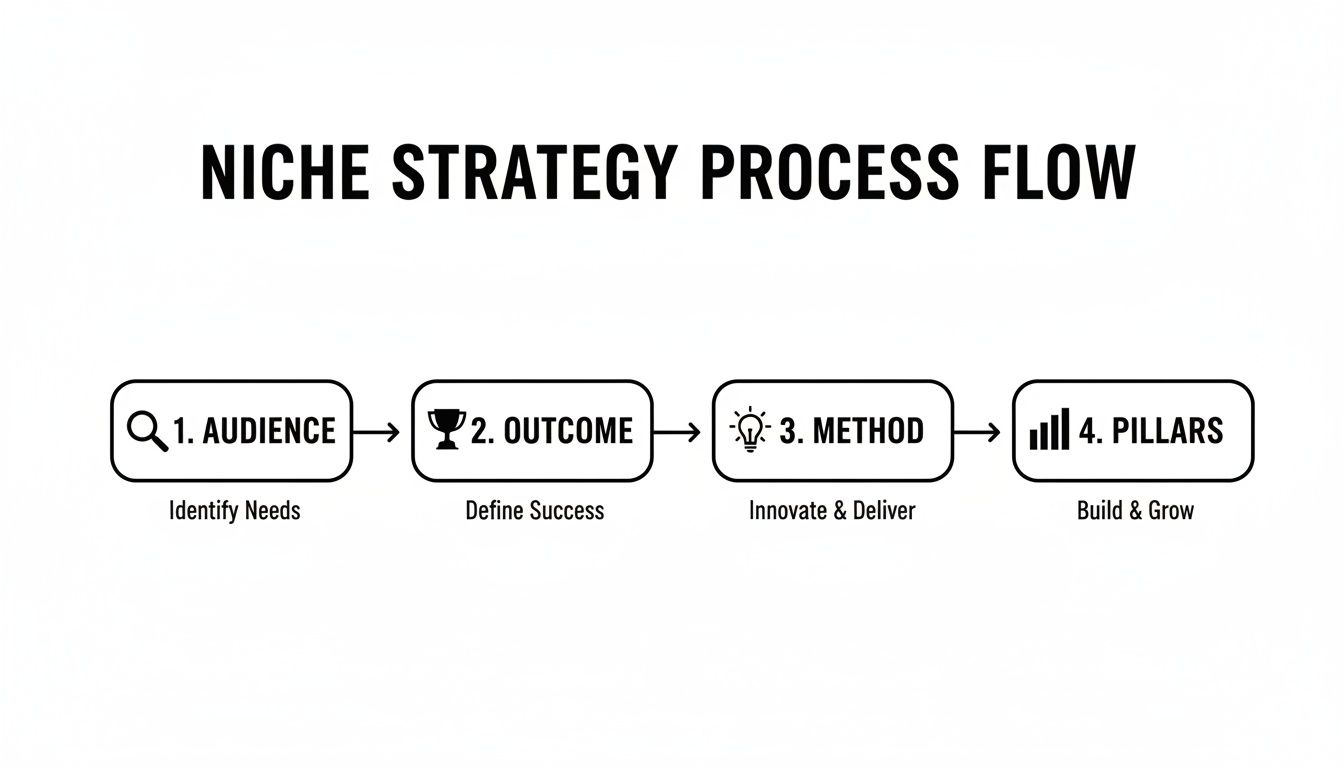
The flow from a specific Audience to a desired Outcome, delivered by your unique Method and broken down into Pillars, provides a clear roadmap for every single piece of content you create.
Focusing on Niche Communities
Your workflow shouldn't just be about broadcasting to the masses. The real growth often happens in smaller, more intimate spaces. Today's audiences are increasingly moving into what some experts call "social dark forests"—private or semi-private communities where they can have more authentic conversations, far from the noise of public feeds.
These niche communities are where true connection happens, making them perfect for founders building loyal audiences. An analysis from Fleishman Hillard highlights this shift, showing how users are flocking to places like Discord servers and Substack newsletters to escape performative content. Smart brands are already there, co-creating products with subscribers and launching exclusive drops in WhatsApp groups.
This isn't about chasing follower counts; it's about stewarding a community. You can dig into more insights on this trend by reading the full report on social media predictions.
A Practical Example of a Niche Workflow
Let’s bring this all together with our earlier example: "I help freelance creatives in their 30s build a six-month emergency fund by providing a simple, automated savings system."
- Pillar: Automated Savings Systems
- Target Community: A private Facebook group for freelance illustrators.
- Weekly Content Workflow:
- Monday: Schedule a post sharing a quick tip on "The 'Pay Yourself First' rule for freelancers," created and scheduled during your weekly batching session.
- Wednesday: Post a short, engaging video template (created using a tool like CapCut) showing how to set up an automatic transfer from a business account to a savings account.
- Friday: Start a conversation in the Facebook group by asking, "What's the biggest thing stopping you from automating your savings?" and calendar a 15-minute block to actively reply to comments.
This simple, repeatable process ensures you're consistently providing value that directly maps back to your niche statement. It's focused, efficient, and built for the long haul. With the right systems in place, you can confidently execute your strategy and become the go-to expert your audience trusts.
Common Questions About Finding Your Niche
Even with a solid plan, it's completely normal for a little self-doubt to creep in right before you commit. It happens to everyone.
Knowing how to find your niche is one thing; feeling truly confident in your choice is another. Let's tackle the questions that keep most founders stuck.
What If My Chosen Niche Is Too Small?
A niche that feels "small" is often your biggest advantage.
Think of it this way: a highly engaged community of 1,000 true fans is infinitely more valuable than 100,000 indifferent followers. What seems like a small pond can easily represent thousands of potential customers actively looking for exactly what you offer.
The key isn't size; it's profitability. You need to validate that people are already spending money to solve the problem you've picked. Look for existing courses, tools, or coaching services. A passionate, well-defined audience leads to sky-high conversion rates and the kind of word-of-mouth marketing you just can't buy.
Can I Have More Than One Niche?
When you're just starting out, the answer is a firm no. You have to focus on one niche and one niche only.
Trying to serve multiple audiences at once is a surefire way to dilute your message, confuse the algorithms, and guarantee you never become a recognized authority in any single area. It's also a productivity nightmare, forcing you to create double the content for half the impact.
Your first goal is to become the absolute go-to expert for one specific group with one specific problem. Once you've built a sustainable business and established that authority, you've earned the right to branch out. You could expand into an adjacent market or solve a new problem for the audience that already knows and trusts you. Master one before you chase another.
What If My Niche Is Already Crowded?
Competition is a great sign. Seriously. It proves a market exists and that people are willing to pay for solutions. Don't let it scare you off—let it turn you into a detective.
Analyze what the existing players are doing well, but more importantly, look for the gaps where they're falling short.
Your unique personality, your specific experiences, and your individual perspective are the most powerful differentiators you have. A crowded market doesn't mean there's no room for you; it means you have an opportunity to be a fresh voice.
You can stand out by:
- Offering a unique teaching style: Maybe you're funnier, more data-driven, or more empathetic.
- Focusing on a specific sub-audience: Don't just target "SaaS founders," but "bootstrapped SaaS founders in their first two years."
- Providing a more hands-on, community-focused approach: People crave connection.
The goal isn't to be the only voice in the space. It’s to be the right voice for your specific people.
How Long Should I Test a Niche Before Pivoting?
You need to give it a fair shot. I recommend consistently creating content and engaging with your audience for at least 3 to 6 months. This gives you enough time to gather real data and make an informed decision, not an emotional one.
Keep an eye on key metrics like audience growth, post engagement, and clicks to your website. A simple spreadsheet tracking weekly follower growth, average likes/comments, and link clicks will give you the data you need. Are you attracting the right kind of followers? Are their questions and comments actually aligned with your niche?
If you see minimal traction and creating content feels like a constant uphill battle after this period, it might be time to reassess. A pivot isn't a failure; it’s a strategic adjustment based on real-world feedback.
Finding and dominating your niche starts with a great strategy but depends on consistent execution. Postful gives you the AI-powered tools and templates to show up for your audience every day, without the grind. Brainstorm ideas, refine your message, and schedule a week of content in one sitting. Start creating for free on Postful.