

Forget expensive ads and complicated sales funnels. For a startup, content is the most reliable and scalable engine for growth. It’s how you build brand authority, bring in qualified leads, and outflank bigger competitors, even when you're on a shoestring budget.
This isn't just another marketing tactic; it's your unfair advantage.
Why Content Is Your Startup's Secret Weapon
Every dollar and hour is precious when you're building something new. Unlike paid ads, which die the moment you stop paying, strategic content delivers compounding returns. A single, well-researched article can pull in organic traffic, educate potential customers, and build trust for years to come.
You’re playing the long game, building a sustainable marketing channel that you actually own and control.

Building Trust Before the Sale
Startups always have a credibility gap. Why should someone trust your new solution over a company that’s been around for a decade? Content is the bridge. By consistently sharing valuable insights that solve real problems for your audience, you build authority and rapport.
Your marketing shifts from being an interruption to a welcome resource. Think about the core benefits:
- It educates your audience. It helps people understand the problem you solve, which makes them far more likely to see the value in what you're offering.
- It generates qualified leads. Content naturally pulls in people who are actively searching for solutions like yours—these are much higher-quality leads than you'll ever get from cold outreach.
- It establishes brand authority. When you become the go-to source for information in your niche, your brand becomes synonymous with expertise.
For startups, great content is key to turning leads into paying customers. Skip the broad overviews and instead focus on pieces that hit specific pain points and show off your product’s unique value.
The data backs this up—a solid 78% of small businesses now lean on content marketing as a core part of their strategy. If you want a deeper look at how content works as a growth engine for new ventures, this guide on content marketing for small businesses is a fantastic resource.
Ultimately, content isn't just one thing. It's an entire ecosystem of assets—from blog posts to social media to case studies—all working together to attract and keep your ideal customers.
Laying Your Content Foundation Without Wasting Time
A solid content strategy for a startup isn't some massive document you spend a month writing. It’s about focused action. Your foundation needs to be lean, clear, and tied directly to growth from day one.
Forget abstract goals. We need to set targets that actually move the needle.
That means shifting your thinking from "we should probably start a blog" to "our blog will generate 20 marketing qualified leads (MQLs) this quarter." That level of specificity is what transforms content from a side project into a core part of the business. It gives you a real benchmark for success.

Know Your Audience Intimately
Before you write a single word, you need a razor-sharp profile of your ideal customer. Generic personas are useless here. You need to get into the trenches.
Talk to your first five customers. Listen in on sales calls. Read through support tickets. What language do they use when they describe their problems? What are their biggest frustrations?
A powerful Ideal Customer Profile (ICP) goes way beyond demographics:
- Primary Pain Points: What specific problems are keeping them up at night? The ones your product actually solves.
- "Aha!" Moment Triggers: What information or realization makes them finally decide they need a solution like yours?
- Watering Holes: Where do they actually hang out online? Get specific. Is it a certain subreddit, a niche LinkedIn group, or a private forum?
Productivity Tip: Create a simple shared document (like a Notion page or Google Doc) titled "Voice of the Customer." Every time you get a verbatim quote from a customer interview, support ticket, or sales call that perfectly describes a pain point, add it to the list. This becomes an invaluable resource for writing copy that resonates.
This deep understanding is your secret weapon. It ensures every piece of content speaks directly to the right person, making your marketing a whole lot more efficient.
Define Your Core Content Pillars
Once you know your ICP's biggest problems, you have your content pillars. These are the three or four core topics your startup is going to own. Think of them as the main categories for everything you create—each one a deep well of potential articles, videos, and social posts.
For example, a fintech startup targeting millennials might land on these pillars:
- Investing for Beginners
- Personal Budgeting Hacks
- Navigating Market Volatility
Each pillar hits a major pain point for their ideal customer. This tight focus keeps you from chasing random keywords and helps you build topical authority, which search engines love. It’s how you make sure your content marketing is cohesive and actually has an impact.
Key Takeaway: A strong foundation isn't about having all the answers right away. It's about asking the right questions: Who are we really helping? What are their biggest problems? And how can our expertise be the solution?
This strategic focus is what allows you to create assets that truly resonate. If you want to go deeper on this, check out our guide on how to build powerful content pillars for your brand. It’s the most productive way I know to build a content engine that delivers results without burning through your precious time and cash.
Creating High-Impact Content on a Lean Budget
The single biggest mistake I see startups make is trying to be everywhere at once. Spreading yourself thin across a blog, YouTube, TikTok, and LinkedIn is a one-way ticket to burnout, not growth.
The smarter play, especially when you're running lean, is to pick one or two channels where your audience actually lives and completely own them.
This just takes an honest assessment. If your ideal customers are VCs and B2B decision-makers, a polished LinkedIn presence is non-negotiable. If you're targeting developers, a technical blog packed with code snippets is your best bet. The goal here is focus, not sheer volume.
Choosing Your Startup's Primary Content Channel
Deciding where to plant your flag can feel overwhelming. To make it a little easier, I've broken down the most common channels for startups. Think of this as your cheat sheet for choosing where to invest your time and energy.
| Channel | Best For | Core Skill Required | Example Use Case |
|---|---|---|---|
| Blog / SEO | Building long-term organic traffic, establishing authority on technical or complex topics, and capturing high-intent search traffic. | In-depth writing, keyword research, patience. | A B2B SaaS company writing the definitive guide to a niche industry problem. |
| B2B sales, networking with decision-makers, building a personal brand, and sharing company news. | Professional storytelling, networking, consistent engagement. | A founder sharing lessons learned while building their company. | |
| X (Twitter) | Real-time engagement, joining industry conversations, building in public, and connecting with tech/media. | Witty, concise communication; rapid response. | A developer sharing quick tips and engaging with other builders in their space. |
| YouTube | Visual storytelling, product demos, tutorials, and building a strong community connection. | Video production & editing, on-camera presence. | An ed-tech startup creating a series of "how-to" videos for its software. |
| Newsletter | Nurturing a dedicated audience, direct communication, and building a loyal community away from noisy algorithms. | Strong writing voice, value-driven curation. | A solo consultant sharing weekly insights with their subscribed clients. |
Picking the right channel isn't about what's trendy; it's about aligning your strengths with where your ideal customer spends their time. Once you've made your choice, you can move on to creating your cornerstone asset.
Crafting a Foundational Pillar Post
Instead of cranking out dozens of forgettable articles, pour your limited resources into creating one monster piece of "pillar" content. This is your definitive, go-to resource—a comprehensive guide, original research, or an ultimate checklist that is genuinely the best thing on the internet for that topic. It’s the kind of asset that becomes the bedrock of your entire content strategy.
Practical Example: A B2B SaaS startup targeting HR managers could create an exhaustive guide titled "The Ultimate Guide to Employee Onboarding Workflows for Remote Teams." This single asset establishes immediate authority and can be repurposed for months. We've actually broken down some powerful thought leadership content examples that show this strategy in action.
Key Takeaway: A single, exceptional piece of pillar content will generate more long-term traffic and authority than 50 mediocre blog posts. It’s about impact, not activity.
And the data backs this up. Recent 2025 findings show that long-form content over 2,500 words pulls in 77.2% more backlinks and generates three times more traffic than shorter posts. With 80% of marketers doing keyword research, it's obvious that deep, strategic content is what wins.
Baking In SEO from Day One
Your pillar content needs to be built on a solid SEO foundation from the very beginning. This isn't just about getting read today; it's about attracting a steady stream of organic traffic for years to come. The good news? You don't need expensive subscriptions to get started.
A few free tools can give you incredible insights:
- AnswerThePublic: Use this to find the exact questions your customers are typing into Google. Frame your headings and subheadings around these questions to nail user search intent.
- Google Keyword Planner: Find relevant keywords with decent search volume but lower competition. As a startup, you want to target these "quick win" terms to start building momentum.
- Google Trends: Check a topic's popularity over time. You want to make sure you're investing in a subject with sustained interest, not just a fleeting fad.
To really maximize your efficiency, especially on a tight budget, look into the top AI tools for content marketing. They can help with everything from brainstorming outlines based on your keyword research to polishing your copy, letting a tiny team produce seriously high-quality content.
Your Smart Guide to Content Distribution and Repurposing
Hitting "publish" on a huge piece of content is only half the job. So many founders I know make the same mistake: they spend weeks on an amazing article, publish it, and then immediately jump to the next thing on their list.
If you want to get real, meaningful value from all that work, you need a system. One that helps you multiply your content's reach without multiplying your workload.
This is where the Pillar and Spoke model completely changes the game. Think of that big, foundational blog post—the 2,500-word guide you poured everything into—as the pillar. All the smaller, related pieces you create from it are the spokes. This "create once, distribute forever" mindset is a lifesaver for lean teams.
This simple workflow shows how to move from a single idea to widespread impact.
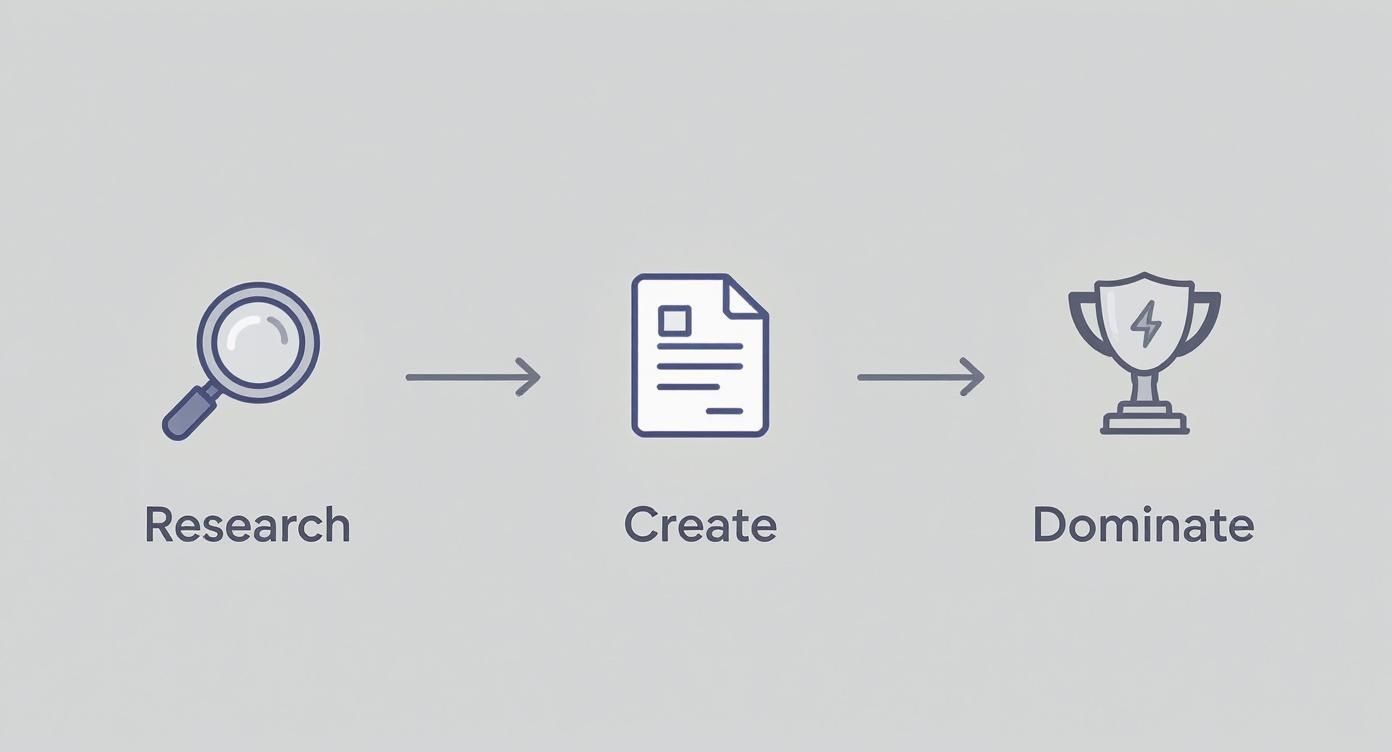
As you can see, creation is just one piece of the puzzle. Real domination comes from smart, relentless distribution.
A Practical Repurposing Workflow
Let's get practical. How does one pillar asset actually fuel your marketing for weeks?
Imagine your pillar content is that epic "Ultimate Guide to Employee Onboarding for Remote Teams" you just finished.
Here’s how you can slice it up into multiple spokes:
- Twitter (X) Thread: Grab the 5-7 most powerful stats or tips from the guide. Each one becomes a tweet in a thread, with the final tweet linking back to the full article for anyone who wants to go deeper.
- LinkedIn Carousel: Turn the key sections into a 10-slide PDF carousel. You can use a tool like Canva to quickly design clean, visually appealing slides with bold headlines and one key idea per slide. It’s super effective for grabbing attention in the feed.
- Short-Form Video Scripts: Look at your subheadings. Each one is a potential script for a 60-second TikTok or YouTube Short. A section like "Common Onboarding Mistakes" is perfect for a quick, punchy video.
- Newsletter Series: Don’t just email a link to the article. Break your guide into a three-part email series. Each week, dive deep into one core concept from the post. This delivers massive value directly to your most engaged audience—their inbox.
The goal is to make your content work smarter, not harder. One pillar post shouldn't just be one asset; it should be the raw material for at least ten other pieces of content.
This systematic approach to repurposing ensures you get the absolute maximum ROI on every minute you invest. For a more detailed breakdown, our guide on effective content repurposing strategies offers a repeatable framework you can steal.
Scrappy Distribution Tactics That Work
Once you have your repurposed assets ready, you need to get them in front of the right eyeballs. Forget about expensive ad campaigns for now. The focus should be on targeted, low-cost distribution in the communities where your ideal customers already hang out.
- Niche Reddit Communities: Find relevant subreddits like
r/SaaSorr/startups. The key here is not to just drop links and run. Share a genuinely valuable insight from your content to start a real conversation. - Industry Slack Groups: Many professional communities have channels like
#shameless-plugsor#content-shares. But don't just post there. Contribute to other discussions first, build some goodwill, and then share your work when it’s genuinely helpful to the conversation. - Strategic Guest Posting: Identify non-competing blogs that your audience reads. Pitch them a unique article that solves a specific problem and naturally links back to your pillar content. This drives high-quality referral traffic and builds valuable backlinks that help with SEO over time.
Measuring Content ROI and Scaling Your Engine
You’ve done the hard work of creating and sharing your pillar content. Now for the big question: Is any of it actually working?
The good news is you don’t need a complicated, expensive analytics suite to figure this out. A couple of free tools are all you need to cut through the noise and see what’s really moving the needle for your startup.
It's easy to get distracted by vanity metrics like page views and social media likes. They feel good, but they don't pay the bills. Instead, your focus should be squarely on the numbers that signal real business growth. These are the metrics that prove your content is doing its job.
Tracking What Truly Matters
To get started, you only need two free, essential tools from Google: Google Analytics (GA4) and Google Search Console. They’ll give you all the foundational data you need to make smart decisions about your content engine.
Here are the key metrics to obsess over:
-
Organic Traffic: This is simply the number of people finding your website through search engines like Google. A steady, upward trend here is a fantastic sign your SEO efforts are starting to pay off.
-
Keyword Rankings (via Search Console): Keep an eye on your position for the keywords you’re targeting. Seeing your article climb from the depths of page five to page one for a high-intent term is a massive win.
-
Conversions: This is the ultimate measure of success. Did a reader sign up for your newsletter, book a demo, or join your waitlist after consuming a piece of content? Set up simple event tracking in GA4 to monitor these actions.
Measuring content ROI isn’t about tracking every single click and impression. It’s about drawing a clear line from your content efforts to tangible business outcomes, like qualified leads and better organic visibility.
This focused approach helps you quickly identify which blog posts and guides are your heavy hitters. From there, you can double down on what’s working and either update or ditch what isn’t.
Scaling Your Content Engine with AI
Once you have data showing what resonates with your audience, it’s time to ramp up production without burning yourself out. This is where artificial intelligence becomes a founder's secret weapon.
Used responsibly, AI tools can dramatically increase your content output and efficiency. Here is a practical workflow:
- Brainstorm Titles and Angles: Feed an AI your target keyword (e.g., "startup productivity tools") and ask for 10 click-worthy headlines. This beats staring at a blank page.
- Generate Detailed Outlines: Turn a simple topic into a well-structured outline, complete with logical subheadings, saving you hours of research. Prompt idea: "Create a detailed blog post outline for the title '[Your Chosen Title]' for an audience of early-stage startup founders."
- Proofread and Refine Drafts: Use AI as your on-demand editor to catch typos, fix grammatical errors, and improve the clarity of your writing. Copy and paste your draft and ask it to "act as a professional editor and improve this text for clarity and flow."
The payoff for startups that embrace this is huge. The average ROI for content marketing is $7.65 for every $1 spent, and 68% of companies report a higher ROI after adopting AI. You can discover more insights on content marketing statistics to see just how powerful this combination is.
By pairing data-driven insights with the efficiency of AI, you create a repeatable system for growth. You can finally invest your time and resources with confidence, knowing you’re creating more of the content that you know will move the needle for your startup.
Common Questions About Startup Content
Even with the best playbook, you're going to hit roadblocks. It's just part of the process. When you’re in the trenches trying to make content work for your startup, the same questions tend to pop up again and again.
Don't worry, you're not alone. Here are the most common ones I hear from founders, along with some straight-up answers to help you get unstuck and back to building.
How Much Should a Startup Even Budget for This?
There’s no magic number here, but you can think about it in stages.
When you’re just starting out—pre-seed or seed stage—your budget is probably close to zero. That's totally fine. Your primary investment is your own time, or "sweat equity." The founder’s voice is powerful, so lean into writing, recording, or just sharing what you know.
Once you’ve got some traction and funding (think Series A), it’s time to dedicate real dollars. A good rule of thumb is to allocate 10-25% of your total marketing budget to content. That could mean hiring a great freelance writer, paying for some simple design tools, or running a few small-scale promotional experiments.
When Am I Actually Going to See Results?
This is the hard part: patience. Content isn't like paid ads where you see an immediate (but fleeting) spike in traffic. It's a long game that builds on itself over time.
For a brand-new startup with a fresh domain, you’re looking at six to eight months before you can expect to see consistent, meaningful organic traffic. It’s a marathon, not a sprint.
But that doesn't mean you're flying blind until then. Look for these early signs that things are working:
- You're showing up on Google. Seeing your articles pop up on pages 3-5 for your target keywords is a great first signal.
- People are engaging. You're getting real comments and shares when you repurpose your pillar posts for social media.
- You hear it directly. An early customer or an investor mentions they read—and liked—an article you wrote. That’s gold.
The goal in the first quarter isn't a massive traffic spike. It's consistency. Keep publishing high-quality, relevant stuff. The momentum will follow.
Should I Hire a Freelancer or Just Do It Myself?
This is the classic founder dilemma: time versus money. Here’s how I break it down.
-
Do it yourself if: You genuinely love the topic, you’re a decent writer or speaker, and you can realistically carve out a few hours every single week. There’s an authenticity to founder-led content that’s almost impossible to fake.
-
Hire a freelancer if: You’re slammed, or if writing (or video, or design) just isn’t your strong suit. A good freelancer can take your strategy and run with it, freeing you up for sales and product. Just make sure they truly get your industry and your customer.
How Do I Know If My Content Is Any Good?
"Good" content isn't about beautiful prose. It's about effectiveness. Did it do the job you created it for? Did it solve the reader's problem? Did it actually rank for the keyword you were aiming for?
Here are a few questions to ask yourself to gut-check your quality:
- Does it answer the whole question? Your reader shouldn't have to hit the back button and go to another Google result after reading your piece.
- Is it better than what's already out there? Seriously, Google your keyword and read the top three posts. Is yours more in-depth? Does it offer a unique angle? Is it just plain easier to understand?
- Does it make someone do something? Great content doesn't just sit there. It gets a comment, a share, or a newsletter sign-up.
Ready to build a consistent, powerful social media presence without the grind? Postful is an AI-powered tool built for busy founders and doers. It helps you generate high-quality post ideas, refine your message, and automate your workflow, so you can show up confidently and grow your reach.