
A content marketing strategy is the documented plan that answers why you create content, who it's for, and how it will actually help you hit your business goals. It's not just about cranking out blog posts or tweets; it's the high-level blueprint that gives every single piece of content a specific, measurable job to do.
Your Navigational Chart for Business Growth
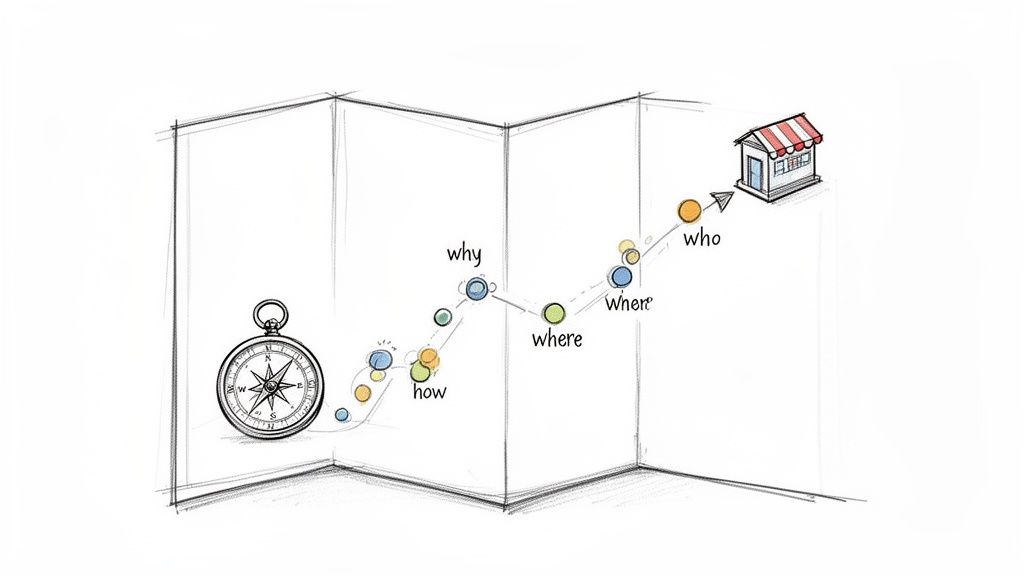
Imagine trying to sail across an ocean with no map, no compass, and no destination in mind. You’d be busy adjusting the sails and steering the ship, but you'd be adrift—burning through time and resources without getting anywhere. That’s exactly what creating content without a strategy feels like.
A lot of founders fall into the "random acts of content" trap. They post a blog here, a tweet there, and just hope for the best. A content marketing strategy is what replaces that hope with a clear, documented plan. It's the difference between being busy and being productive.
A content marketing strategy is your answer to the question, "Why are we even doing this?" It forces you to connect every piece of content back to a real business outcome, turning your marketing from a shot in the dark into a predictable growth engine.
This plan doesn't need to be some complicated, hundred-page document. For a lean startup, it can live on a single page. Its only purpose is to bring clarity and direction, making sure every marketing action you take moves you closer to your ultimate goal—whether that's more sales, better brand visibility, or a loyal community.
To get started, we can break down a solid strategy into four core components. Think of them as the essential pillars holding everything up.
The Four Pillars of a Content Marketing Strategy
This table gives you a high-level look at the key questions your strategy needs to answer. We'll dive deep into each one throughout this guide.
| Pillar | What It Answers | Practical Example |
|---|---|---|
| Audience & Goals | Who are we trying to reach, and what do we want them to do? | Reaching freelance graphic designers to generate 20 demo requests per month. |
| Content Creation | What kind of content will resonate with them and achieve our goals? | Creating blog posts about "How to Price Design Projects" to solve their problems. |
| Content Distribution | Where and how will we get this content in front of them? | Promoting the posts on LinkedIn and in design-focused online communities. |
| Measurement & KPIs | How will we know if any of this is actually working? | Tracking demo sign-ups from blog traffic using Google Analytics goals. |
With these pillars in place, every marketing decision becomes simpler and more effective. You're no longer just guessing; you're executing a plan.
Moving From Tactics to Strategy
It’s incredibly easy to confuse content tactics with content strategy. Tactics are the individual actions you take, while the strategy is the overarching vision that guides every single one of those actions.
- Tactic: Publishing three blog posts per week.
- Strategy: Becoming the go-to educational resource for early-stage B2B SaaS founders to increase organic search traffic by 40% in six months and generate qualified leads.
See the difference? The tactic is just an activity. The strategy connects that activity to a specific audience, a clear goal, and a measurable outcome. For startups with tight budgets and even tighter schedules, this distinction is everything. You just don't have time to waste on tactics that don't serve the bigger picture.
For instance, the founder of a new project management tool could build a strategy around helping freelance graphic designers improve their client management skills. Their content would then zero in on designer pain points with articles like "5 Ways to Automate Client Onboarding" or "How to Create Project Timelines Clients Actually Understand."
Every single piece of content reinforces their position as a helpful expert for that specific niche. As you build out your own plan, our guide to content marketing for startups offers a focused look at executing this for new ventures. This strategic approach ensures you aren't just creating more noise—you're building a valuable resource that naturally pulls in your ideal customers.
Why Founders Need a Strategy Before Creating Any Content
Jumping into content creation without a strategy is like trying to build a house without a blueprint. Sure, you can buy the best materials and hire a skilled crew, but you’ll end up with a chaotic, expensive mess that doesn't actually work.
For founders, every hour and every dollar is precious. This kind of wasted effort isn't just a mistake—it's a potential death sentence for a growing business.
A content marketing strategy isn’t some "nice-to-have" document you create once and forget about. It's the critical first step that turns your marketing from a cost center into a predictable way to bring in revenue. It ensures every single blog post, video, or social update has a specific job to do, tying your efforts directly to what matters most: your business goals.
Stop Wasting Time and Start Building Assets
Without a clear plan, founders almost always fall into the trap of "random acts of content." You write a blog post because you feel you should. You post on social media because someone said it was important. This burns through your most limited resources—time and focus—with very little to show for it.
A strategy forces you to be intentional. Instead of asking, "What should I post today?" you start with much bigger questions that lead to work that actually moves the needle:
- Who is my absolute ideal customer? Not a vague demographic, but a real person with a specific problem you are uniquely positioned to solve.
- What business goal will this piece of content help me achieve? Is it about attracting investors, getting qualified leads, or maybe even reducing customer churn?
- How will I know if this worked? What specific metric will I track to measure success?
Productivity Tip: Create a simple content brief template in Notion or a Google Doc that forces you to answer these three questions before you write a single word. This five-minute workflow prevents hours of wasted effort on content that misses the mark.
Answering these questions upfront stops you from creating content that serves no real purpose. Every article, every post becomes a valuable asset that works for your business 24/7, long after you hit "publish."
A content strategy provides the focus needed to turn marketing activities into business outcomes. It’s the framework that separates founders who are just busy from founders who are building a sustainable growth engine.
Tangible Business Outcomes of a Solid Strategy
Investing time in a strategy isn't just about avoiding mistakes; it's about unlocking massive opportunities. The global content marketing market was valued at $413.2 billion in 2022 and is projected to skyrocket to a staggering $2 trillion by 2032. You can dig into the numbers in this in-depth analysis of content marketing trends.
This explosive growth is proof: when done right, content delivers a powerful ROI. For a founder, a smart strategy can produce concrete, game-changing results.
- Builds Unshakeable Brand Authority: Consistently publishing valuable content positions you as the go-to expert in your niche. This authority not only attracts customers but also makes your startup far more appealing to potential investors and partners.
- Generates a Consistent Flow of Qualified Leads: When you create content that directly addresses your ideal customer's pain points, you attract people who are actively looking for your solution. This is the difference between chasing cold leads and having warm prospects come directly to you.
- Dominates Niche Search Rankings: A strategic approach to content is the backbone of modern SEO. It helps you rank for the keywords your customers are actually searching for, creating a reliable, long-term source of free organic traffic.
- Cultivates a Loyal Community: Great content builds a real relationship with your audience. It fosters trust and turns one-time customers into loyal advocates who champion your brand and fuel its growth for the long haul.
The Six Building Blocks of a Winning Content Strategy
A powerful content strategy isn't some abstract document you create once and forget. It's a practical blueprint made of distinct, interconnected pieces. Think of it like assembling a high-performance engine: each part has a specific job, and they all have to work together perfectly to get you where you want to go.
For a founder or a small team, breaking it down into these six building blocks makes the whole process feel manageable, actionable, and a lot less intimidating. This framework turns your content from a bunch of random tasks into a cohesive system built for growth.
Let's walk through each component, one by one.
1. Pinpoint Your Ideal Audience
Before you write a single word, you have to know exactly who you're talking to. Creating content without a clear audience is like shouting into a crowded room and just hoping the right person hears you. It’s a massive waste of time and energy.
Your goal is to get past vague descriptions and build a simple, functional customer persona. This isn't some complex academic project; it's a practical tool to keep you laser-focused.
Actionable Prompts for Your Persona:
- Role & Industry: What's their job title? Where do they work? (e.g., "Founder at a marketing agency," "Freelance graphic designer").
- Primary Goal: What’s the one big thing they're trying to accomplish in their job? (e.g., "Land more high-ticket clients," "Streamline project delivery").
- Biggest Pain Point: What's the single biggest roadblock stopping them from hitting that goal? (e.g., "Struggles with inconsistent lead flow," "Wastes too much time on admin tasks").
- Where They Learn: Where do they actually go for information? (e.g., LinkedIn, specific industry blogs, YouTube tutorials, podcasts).
Productivity Tip: Don't get stuck here. Spend 30 minutes creating a "good enough" persona. You can refine it later based on real data and customer conversations. A simple bulleted list is more useful than a fancy document you never look at.
This simple persona—let's call her "Melanie, the marketing agency founder"—instantly gives your content direction. Now you know her problems, and you know where to find her.
2. Set Measurable SMART Goals
Your content needs a job. Vague goals like "increase brand awareness" are impossible to track and usually lead nowhere. Instead, use the SMART framework to set clear, motivating targets that actually connect to your business.
- Specific: What, exactly, do you want to achieve?
- Measurable: How will you track progress?
- Achievable: Is this realistic with the resources you have right now?
- Relevant: Does this actually support a bigger business objective?
- Time-bound: When will you get this done?
Bad Goal: "Get more traffic to our website."
SMART Goal: "Increase organic blog traffic by 25% over the next quarter by publishing eight SEO-optimized articles targeting long-tail keywords relevant to our ideal customer."
That level of clarity is a game-changer. It tells you exactly what to work on and gives you a clear finish line to aim for.
3. Choose Your Core Content Channels
As a founder, you can't be everywhere at once. Trying to post on every social media platform is a fast track to burnout and mediocre results. The secret is to choose one or two core channels where your ideal audience hangs out and go all-in on them.
Go back to your persona. If "Melanie" spends her time on LinkedIn and reads industry newsletters, then that’s where you need to be. Forget about TikTok or Pinterest if your audience isn't there.
Practical Example: A B2B SaaS company targeting sales leaders might choose LinkedIn as their primary channel and an SEO-focused blog as their secondary. They can completely ignore platforms like Instagram and Facebook to conserve their resources and maximize impact where it counts.
For many founders, especially those building a professional network, understanding how a platform really works—like with a comprehensive LinkedIn content strategy for 2025—is the key to growth. Mastering one channel is way more powerful than being just okay on five.
4. Plan Your Content Formats and Pillars
Okay, you know who you’re talking to and where you’ll find them. Now, what are you actually going to create? The formats you choose should match your audience's habits and your channels' strengths. LinkedIn, for instance, loves text posts and short videos, while a blog is the perfect home for deep-dive articles.
To keep your content consistent and build real authority, organize everything around content pillars. These are just 3-5 broad topics that your brand will own. For a project management tool targeting freelancers, your pillars might be:
- Client Management
- Project Scoping & Pricing
- Productivity Workflows
- Financial Management for Freelancers
These pillars become the foundation for all your ideas. If you want to go deeper, you can learn how to develop strong content pillars to guide your entire process. This approach ensures every single piece of content reinforces your expertise.
5. Build a Realistic Content Calendar
A content calendar is the tool that turns your strategy into reality. It’s a simple schedule that maps out what you’re publishing, where you're publishing it, and when. This isn't about creating some rigid, unbreakable plan; it's about building a system for consistency.
Consistency is probably the single most important factor in content marketing. A calendar kills the daily stress of "What should I post today?" and opens the door for productive workflows like content batching—where you create a week's worth of posts in a single sitting.
Here’s an example of what a simple calendar in a tool like Postful might look like.
Productivity Workflow: Use a tool like Trello, Asana, or a dedicated content scheduler like Postful. Create columns for "Ideas," "In Progress," "Ready for Review," and "Scheduled." This visual workflow makes it easy to see your content pipeline at a glance and stay ahead of your publishing schedule.
This kind of visual planner helps you see your entire schedule at a glance, making sure you have a good mix of topics and formats lined up.
6. Define Your Key Metrics for ROI
Finally, you need to know if any of this is actually working. Your key performance indicators (KPIs) should tie directly back to the SMART goals you set earlier. Don't get distracted by vanity metrics like "likes" unless they are a direct path to a real business outcome.
Focus on the numbers that prove your return on investment (ROI):
- For Traffic Goals: Track Organic Traffic, Unique Visitors, and Time on Page.
- For Lead Generation Goals: Measure Email Signups, Gated Content Downloads, and Demo Requests.
- For Authority Goals: Monitor Keyword Rankings, Backlinks Earned, and Social Media Shares.
Productivity Tip: Create a simple monthly performance dashboard in a Google Sheet. Spend 30 minutes at the start of each month pulling in your key metrics from Google Analytics and your social platforms. This quick routine keeps you focused on what's working and prevents you from getting lost in data.
This data is your feedback loop. It tells you what’s hitting the mark with your audience so you can do more of what works and cut what doesn't.
Putting Your Content Strategy into Action
A well-documented strategy is a powerful asset, but it’s worthless if it just collects dust. The real test is turning those ideas and plans into consistent, high-impact content.
This is where many founders get stuck—the leap from planning to doing feels overwhelming. The secret is to think of your strategy as a recipe, and your execution as the actual cooking.
To make this tangible, let’s see how different businesses would apply the building blocks we’ve discussed. A strategy isn't a one-size-fits-all template; it has to be shaped around your specific audience, goals, and resources.
Examples of Content Strategies in Practice
Here’s how three distinct businesses might define their content strategy, showing how the core components change based on context.
1. The B2B SaaS Startup (Project Management Tool)
- Audience: Overwhelmed freelance project managers struggling to scale their client work.
- Goal: Generate 50 qualified demo requests per month through organic search within six months.
- Channels: A highly focused SEO-driven blog and a strong presence on LinkedIn.
- Content: In-depth, practical blog posts like "How to Create a Project Scope That Prevents Scope Creep" and "5 Client Onboarding Templates for Freelancers." On LinkedIn, they’d share bite-sized tips from these articles and engage in conversations within freelancer communities.
2. The Freelance Consultant (Brand Strategist)
- Audience: Early-stage DTC founders who need branding help but have a limited budget.
- Goal: Build a waitlist of 10 potential clients for a new group coaching program over the next quarter.
- Channels: A weekly email newsletter and short-form video on Instagram Reels.
- Content: The newsletter would offer exclusive branding tips and case studies. Instagram Reels would feature quick, engaging videos like "3 Common Branding Mistakes New Founders Make" to drive newsletter sign-ups.
3. The Direct-to-Consumer Brand (Sustainable Home Goods)
- Audience: Eco-conscious millennials who value aesthetics and transparency in the products they buy.
- Goal: Increase social media engagement by 30% and drive $10,000 in attributed sales from social channels.
- Channels: Instagram and Pinterest.
- Content: Visually stunning user-generated content, behind-the-scenes looks at their sustainable production process, and "how-to" guides for creating an eco-friendly home.
Each of these examples connects a specific audience to a measurable goal using focused channels and relevant content formats. This targeted approach prevents wasted effort and ensures every piece of content has a clear purpose.
A Simple Workflow for Consistent Execution
Now that you see how a strategy looks in the real world, how do you execute it without getting bogged down? A simple, repeatable workflow is your best friend.
This five-step cycle turns your strategy into a productive, ongoing process.
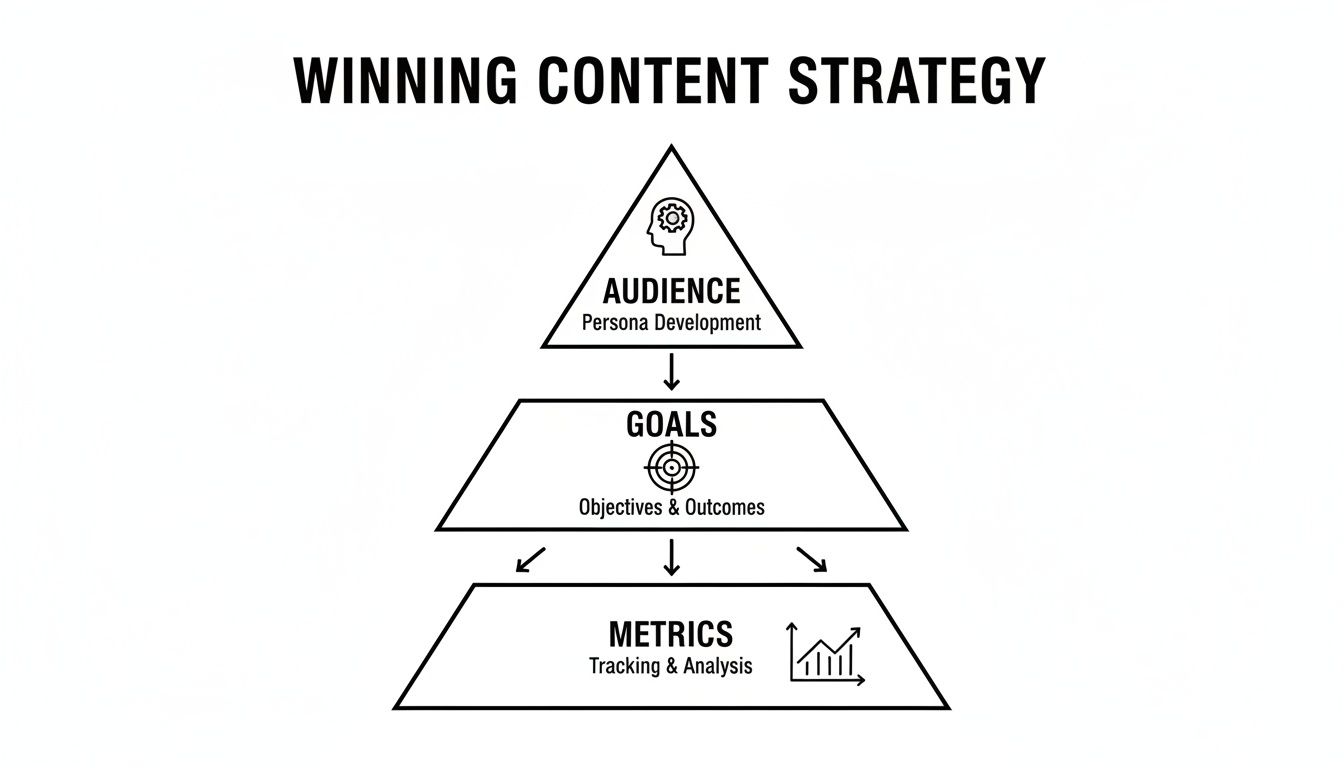
This visual just reinforces that everything flows from knowing exactly who you're serving. Without that foundation, your goals and metrics become meaningless.
Here’s the workflow:
- Ideate: Brainstorm content ideas based on your content pillars and audience persona. What problems can you solve for them this week?
- Create: Develop the content. This could be writing a blog post, recording a video, or designing an infographic.
- Distribute: Publish your content on your chosen channels. This step also includes promotion—sharing it in your newsletter or with partners.
- Measure: Track your key metrics. Did the content help you move closer to your SMART goal?
- Iterate: Use the data you gathered to make your next piece of content even better. Double down on what works and cut what doesn’t.
This isn’t a one-time process; it’s a continuous loop of learning and improvement.
Boosting Productivity with Modern Tools
For a founder or small team, executing this workflow consistently is the biggest challenge. This is where modern tools can be a massive productivity multiplier, automating the tedious stuff and freeing you up to focus on high-value work.
A great strategy combined with the right tools creates leverage. You can achieve the impact of a much larger team by automating the manual work that causes burnout and inconsistency.
Tools like Postful are designed to remove friction from this process. Instead of staring at a blank page, you can get curated content ideas tailored to your audience. When it’s time to create, you can use AI-powered brainstorming features to refine your message.
Most importantly, you can schedule everything in advance, which is the key to maintaining a consistent presence without the daily grind. Efficient scheduling is made even simpler when you understand what is a content calendar and how to use one effectively.
To really put your strategy into action, consider exploring the top AI tools for content marketing. By building a system around a clear workflow and the right tools, you can finally bridge the gap between having a strategy and seeing it deliver real, measurable results for your business.
Common Mistakes That Wreck Content Strategies
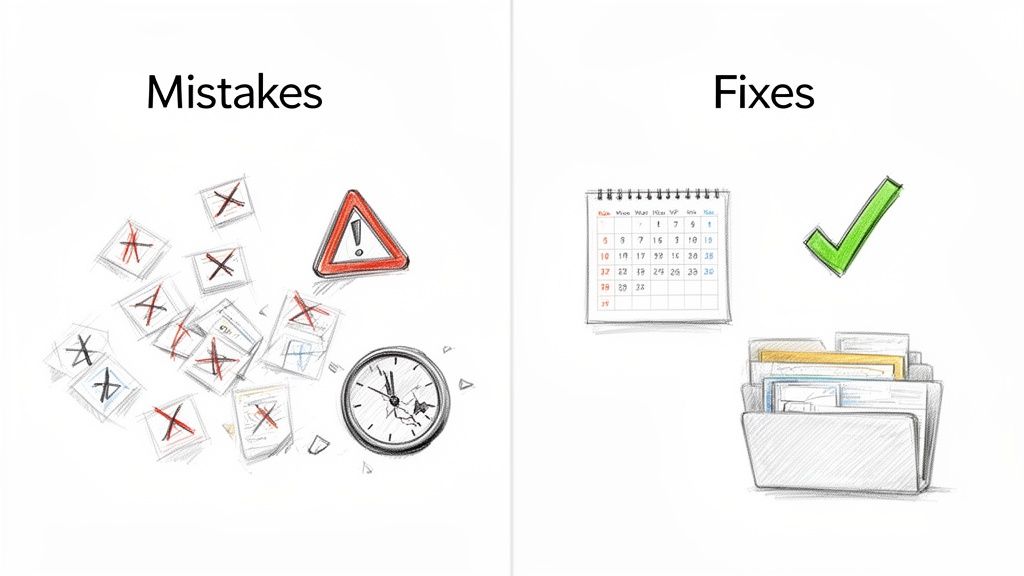
Even the smartest strategy can fall apart when it runs into a few common, totally avoidable roadblocks. For founders already juggling a dozen other jobs, these pitfalls are especially painful because they burn up your two most valuable resources: time and focus.
The good news? You don't have to learn these lessons the hard way. This section is your troubleshooting guide. We’ll break down the traps that derail most content plans and give you straightforward fixes to keep you moving forward.
Mistake 1 Inconsistent Publishing
The fastest way to lose momentum is to be inconsistent. Firing off three blog posts one week and then going completely silent for a month just confuses your audience and the search algorithms. People build trust through reliability, and algorithms reward a steady rhythm.
This "feast or famine" posting schedule is almost always a symptom of a broken workflow. Without a system in place, creating content feels like a constant, last-minute scramble.
The Fix Content Batching and Scheduling
Stop trying to create content on the fly. Instead, block out a dedicated chunk of time each week or month to "batch" your work. For example, you could spend one afternoon writing four weekly blog posts or recording a handful of short-form videos.
- Productivity Workflow: A tool like Postful is perfect for this. You can schedule your entire batch of content in a single session. This frees up your brain for the rest of the month, knowing your marketing is running on autopilot.
- Practical Example: A SaaS founder could dedicate the first Monday of every month to writing and scheduling all of their LinkedIn posts for the next 30 days. It guarantees a consistent presence without the daily pressure.
Mistake 2 Creating for the Wrong Audience
This one is subtle, but it's a killer. You might be creating beautifully written, well-researched content, but if it doesn't solve a real problem for your ideal customer, it will land with a thud. This usually happens when founders write about what they think is interesting, not what their audience is actually searching for.
Every single piece of content you produce has to answer your audience's unspoken question: "What's in it for me?"
The Fix Revisit Your Persona Constantly
Your customer persona isn't a "set it and forget it" document. It's a living guide. Before you start creating anything new, ask yourself these simple questions:
- Does this solve a problem my ideal customer actually has right now?
- Is this a topic they are actively looking for answers to?
- Will this get them one step closer to one of their goals?
This simple check gives every piece of content a clear purpose. It shifts your mindset from "I need to create content" to "I need to create a valuable resource that helps a specific person solve a specific problem."
Mistake 3 Neglecting Content Distribution
Hitting "publish" isn't the finish line—it's the starting gun. So many founders spend 90% of their energy creating content and only 10% promoting it. That ratio needs to be flipped. The "if you build it, they will come" fantasy just doesn't work anymore. A brilliant article that nobody ever sees is a wasted effort.
Your distribution plan is just as critical as your creation plan. Ignoring it is one of the most common reasons an otherwise solid content strategy completely fails to get results.
The Fix The 80/20 Rule of Promotion
Adopt the 80/20 rule: spend 20% of your time on creation and 80% on distribution. This simple shift forces you to squeeze more value out of every single asset you produce.
- Actionable Workflow: For every blog post you write, create a simple promotion checklist.
- Share it on your main social channels.
- Send it out to your email list.
- Chop up key insights into a LinkedIn carousel or an Instagram Reel.
- Drop a link in relevant online communities or forums where your audience hangs out.
This systematic approach makes sure all your hard work actually reaches the people you created it for.
Your Content Strategy Questions, Answered
Even with the best blueprint, questions pop up. I get it. This last section is a quick-fire round to tackle the most common things I hear from founders and small teams as they start putting their content strategy into action.
Let's clear up any lingering doubts so you can move forward.
How Long Does This Actually Take?
Let's be real: content marketing is a marathon, not a sprint. While you might get a few small wins early on, seeing real, meaningful results—like a steady flow of organic leads or top search rankings—usually takes 6 to 12 months of consistent work. You're building an asset, and that takes time.
In those first few months, the key is to watch the leading indicators. These are the small signals telling you you're on the right track:
- Is website traffic growing? Are more people finding your blog?
- Is social engagement up? Are people commenting, sharing, and clicking?
- Are you getting new email subscribers? Is your content valuable enough for them to sign up?
Tracking these early metrics will keep you motivated while the big wins, like new customers, are building in the background. Remember, consistent effort over a long time beats short, intense bursts of activity every single time.
How Much Should a Startup Budget for Content?
There’s no magic number here. A common rule of thumb for small businesses is to put 10% to 30% of their total marketing budget toward content. But for a founder, the "budget" is usually more about time than money, especially when you're just starting out.
The most important thing is to be realistic. It’s far better to pick one or two channels and be incredibly consistent there than to spread yourself thin across five.
Focus your limited resources—whether that's your time or your cash—on creating genuinely valuable content for that single channel. Once you've mastered that, you can think about expanding. You can stretch your time budget a lot further by using tools that help you create and publish more efficiently.
Content Strategy vs. Content Plan—What's the Difference?
This is a classic point of confusion, but the distinction is simple and super important for staying organized. Think of it like building a house: the strategy is the architect's blueprint, while the plan is the construction crew's daily schedule.
- A Content Strategy is your high-level vision. It’s the why, the who, and the what. It defines your goals, your audience, your core topics, and the unique value you're bringing to the table. This is your foundation—it shouldn't change much.
- A Content Plan is the tactical execution. It's the how and the when. This is your content calendar, with specific topics, formats, keywords, and publish dates mapped out. Your plan is flexible and will evolve from week to week.
Your strategy guides every decision you make in your plan. You absolutely need both. The strategy gives you direction, and the plan makes sure you actually get there.
Ready to turn your strategy into consistent action? Postful is the AI-powered social media tool built for founders and doers. Stop staring at a blank page and start growing your reach with curated ideas and automated workflows. Join the waitlist at https://postful.ai to secure your early access.