
Think of your brand's voice as its personality. It’s not about what you say, but how you say it. It’s the distinct style, the specific words you choose, and the overall feeling you leave with your audience. Is your brand the witty, sharp-tongued friend or the wise, reassuring mentor? That's brand voice in a nutshell.
What Is Brand Voice and Why It Matters
If your favorite brand were a person, who would they be? Are they rebellious and clever like Oatly? Or are they all about inspiration and drive, like Nike? That unique character is their brand voice. It’s the human touch that turns a faceless company into something relatable, something your audience can actually connect with.
This isn't just about sounding good—it's a core part of your business strategy. A clear, consistent voice makes your brand instantly recognizable, sometimes even without your logo. That consistency builds trust, which is the foundation of any loyal community. In a market where everyone is shouting for attention, a memorable voice helps you cut through the noise and attract the right people.
This diagram shows how your brand voice fits into your bigger communication picture, starting with your core identity.
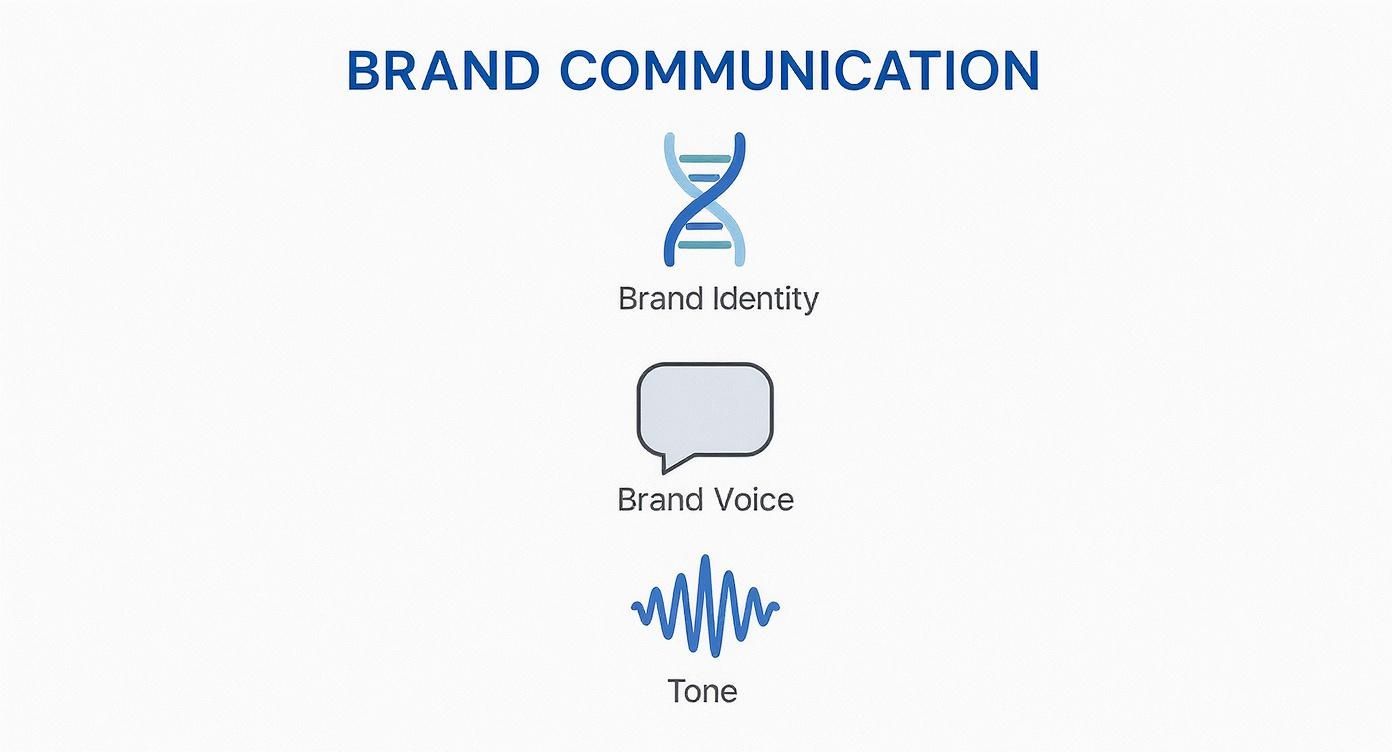
As you can see, your fundamental Brand Identity (the who) informs your consistent Brand Voice (the how), which then adapts its Tone for different situations.
The Real Impact of a Consistent Voice
People often talk about consistency, but what does it actually do? When your social media posts, emails, and website all sound like they came from the same person, you create a seamless experience for your customers. It feels reliable and trustworthy.
The numbers back this up. Businesses that maintain a consistent brand presentation can see their revenue jump by up to 33%. This happens because a clear, authentic voice makes customers feel more connected and confident in their choices.
To help clear things up, here’s a quick breakdown of how brand voice, tone, and brand identity all work together. They're often mixed up, but each has a distinct role.
Brand Voice vs Tone vs Brand Identity
| Concept | What It Is | Example |
|---|---|---|
| Brand Identity | The visual and foundational elements of your brand. | Your logo, color palette, and core mission statement. |
| Brand Voice | Your brand’s consistent personality across all communication. | A witty, clever, and informal personality (like Wendy's). |
| Tone | The emotional inflection of your voice, adapted for specific situations. | Using an apologetic and serious tone to address a customer complaint. |
Think of it this way: Your identity is what you look like. Your voice is how you talk all the time. Your tone is how you adjust your voice when you're happy, serious, or excited.
Ultimately, a strong brand voice is a must-have for your marketing. It's how you build real relationships, make your content hit harder, and is a key driver in how you can increase brand awareness over the long haul. Without it, your messages can feel disconnected and flat, making it nearly impossible to build a loyal following.
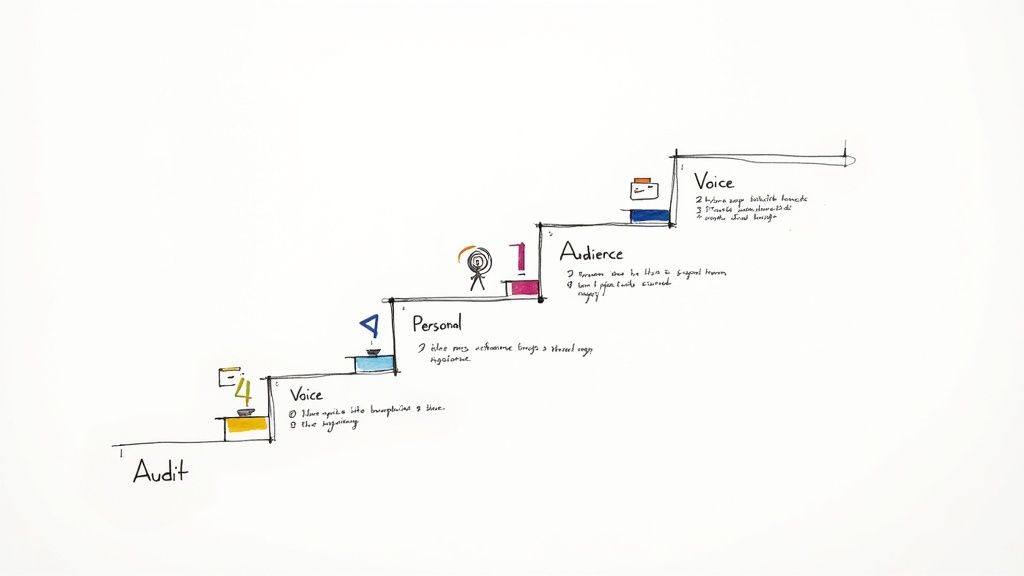
How to Define Your Brand Voice in Four Steps
Alright, let's get practical. It's one thing to talk about brand voice in theory, but it's another thing entirely to actually build one. A voice that lives only in a slide deck is a voice that nobody will ever use.
So, here’s a straightforward, four-step process to help you workshop a brand voice that’s authentic, memorable, and dead simple for your team to use every single day.
Just remember, your brand's voice doesn't come out of thin air. It’s a direct extension of your core strategy. A great perspective on how strategy translates into brand language points out that your voice should feel like a natural part of who you are as a business.

Step 1: Start with Your Mission and Values
Your brand voice has to be anchored to your “why.” If it isn’t, it will ring hollow and feel completely disconnected from everything else you do. So, the first move is to revisit your core mission and values—those guiding principles behind every decision you make.
Get your team together and ask some big questions:
- Beyond making money, why do we exist?
- What promises are we making to the people we serve?
- What are the core beliefs we’ll never, ever compromise on?
Productivity Tip: Create a shared document (like a Google Doc or Notion page) with these questions and ask team members to add their thoughts before the meeting. This saves time and ensures you get more authentic, unfiltered ideas to kickstart the discussion.
Step 2: Pinpoint Your Audience
You can’t have a good conversation if you don’t know who you’re talking to. To craft a voice that truly connects, you have to get inside your audience's head. And I don’t just mean demographics like age or location. You need to go deeper.
What do they care about? What keeps them up at night? How do they talk to their friends? Are they looking for a serious expert or a friendly guide who’s been in their shoes? Mapping this out gives you a clear picture of the person on the other side of the screen.
Practical Example: A B2B software company might discover their audience (busy project managers) avoids corporate jargon and appreciates direct, benefit-driven language. They don't want to hear about "synergistic paradigms"; they want to know how the tool will save them 10 hours a week.
If you want to get more structured with this, our guide on what is a user persona can help you build out a detailed profile.
Step 3: Describe Your Brand as a Person
This is the fun part, where your voice starts to feel real. If your brand walked into a room, who would it be? Use descriptive adjectives to bring its personality to life. Is it playful? Authoritative? A little quirky? Or maybe more serene?
Pro Tip: Try a "This, Not That" exercise with your team. Is your brand more like a helpful librarian or a brilliant professor? A funny best friend or a cool older sibling? This comparative approach quickly helps you zero in on the right personality traits.
Pick three or four core traits that really nail the essence of your brand. A fintech startup might go with: Empowering, Clear, and Trustworthy. A local coffee shop, on the other hand, might choose: Warm, Creative, and Community-Focused.
Step 4: Create a Brand Voice Chart
Now it’s time to turn those adjectives into a practical, everyday tool. A brand voice chart is your secret weapon for consistency. It’s a simple but incredibly powerful guide that gives your team clear do's and don'ts, taking all the guesswork out of content creation.
This chart makes sure everyone—from the person running your social media to the one answering customer emails—is speaking the same language.
Here’s a quick example for a brand whose voice is "Playful & Encouraging":
| We Are… | We Are Not… |
|---|---|
| Playful | Silly |
| ✓ Use witty wordplay and smart pop culture references. | ✗ Use childish jokes or unprofessional slang. |
| Encouraging | Patronizing |
| ✓ Celebrate small wins and cheer on progress. | ✗ Talk down to users or oversimplify concepts. |
| Enthusiastic | Hyperbolic |
| ✓ Use exclamation points and positive language. | ✗ Make unrealistic promises or use excessive hype. |
This simple chart becomes your single source of truth. It transforms your brand voice from an abstract idea into a practical tool that makes your team more efficient and keeps your communication sharp and consistent across the board.
Inspiring Brand Voice Examples from Top Companies
Theory is one thing, but seeing a great brand voice in the wild is where it all clicks. When you see how successful companies craft their personalities, you get a real-world blueprint for building your own.
Let's break down how three very different brands—Duolingo, Nike, and Oatly—use a unique voice to build massive, loyal followings.
A powerful voice makes you instantly recognizable. Think about it: brands with a strong, consistent voice are 2.5 times more likely to be recognized by people without even seeing a logo. One survey found that a whopping 74% of people could identify a brand just from its content when the voice was clear. That’s how much personality matters. If you want to dive deeper, you can explore the research on brand voice recognition.
Duolingo: The Playful and Persistent Motivator
Duolingo’s brand voice is a masterclass in making a tough task—learning a new language—feel fun and slightly unhinged. Their mascot, Duo the owl, is the perfect embodiment of this.
- Personality Traits: Playful, witty, persistent, and a little bit chaotic.
- How It's Applied: On social media, especially TikTok, Duo is a sassy, meme-loving character who playfully badgers users to do their lessons. This "passive-aggressive" pushiness is a running joke the community loves, creating a unique and super-engaging relationship. Even their app notifications are famously persistent but framed with encouragement, turning a simple reminder into a brand moment.
- Why It Works: It transforms a simple learning tool into a relatable, entertaining personality. This voice connects deeply with a younger audience on social media, turning users into evangelists who share the memes and inside jokes, which drives huge organic growth.
Nike: The Empowering and Authoritative Coach
Nike’s voice is legendary. It’s not just about selling shoes; it’s about selling the very idea of personal greatness. Their voice consistently empowers you, speaking to the athlete inside everyone.
- Personality Traits: Authoritative, inspiring, determined, and confident.
- How It's Applied: From their iconic "Just Do It." slogan to ads featuring world-class athletes, the language is always direct and motivational. Website copy and social posts use strong, active verbs and focus on overcoming challenges to reach your potential. They don’t just describe a product; they frame it as a tool to help you win.
- Why It Works: This voice taps into our universal desire for self-improvement and achievement. It positions Nike not as a retailer, but as a trusted partner on your athletic journey. That authoritative yet inspiring tone builds incredible brand loyalty and cements them as the undisputed leader in the sports world.
Oatly: The Witty and Rebellious Challenger
Oatly crashed the party by taking on the dairy industry with a voice that is anything but corporate. They are the textbook example of a challenger brand using wit and self-awareness to win people over.
- Personality Traits: Witty, rebellious, conversational, and transparently self-aware.
- How It's Applied: You see it everywhere, from their quirky packaging that reads like a stream-of-consciousness monologue to ads that openly poke fun at traditional marketing. Their social media is full of clever comebacks and posts that break the fourth wall, speaking to their audience like a smart, funny friend.
- Why It Works: In a category dominated by stale health messaging, Oatly’s irreverent and honest voice feels like a breath of fresh air. It resonates with people who are tired of slick corporate-speak and crave authenticity, helping them build a true cult-like following.
Building Your Brand Voice Style Guide
So, you’ve defined your brand voice. That’s a huge win, but it’s only half the battle. A brilliant voice is useless if it’s not applied consistently by everyone who creates content for your brand—from your social media manager to a new freelance writer.
This is where a brand voice style guide becomes your most valuable tool. Think of it as the official playbook for your brand’s personality. It’s a simple, shareable document that removes all the guesswork, ensuring every tweet, email, and blog post sounds like it came from the same person. As your team grows, this guide is what keeps your brand from developing a split personality.
For a deep dive into formalizing your brand's verbal identity, the steps for creating robust brand voice guidelines offer a fantastic framework. This resource can help you build a document that truly scales with your business.
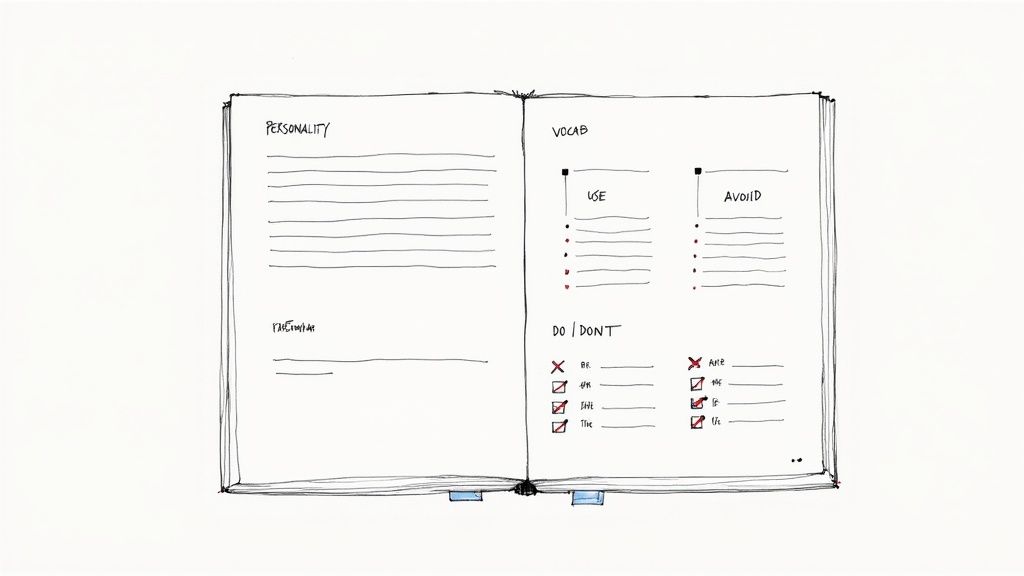
Key Elements of a Brand Voice Style Guide
A great style guide is practical, not poetic. It should be a quick-reference tool that anyone can pick up and use immediately. Your goal is to provide clarity and actionable direction, not a 50-page philosophical treatise on your brand’s essence.
Here are the essential components to include:
-
Brand Personality Summary: A brief, one-paragraph description of your brand as if it were a person. Revisit the three or four core adjectives you chose earlier (e.g., "Empowering, Clear, and Trustworthy") and explain what they mean in practice.
-
Your Brand Voice Chart: This is the heart of your guide. Include the "We Are / We Are Not" chart from the previous section to give clear, side-by-side comparisons. This is often the most-used part of the document.
-
Vocabulary Lists: Create two simple lists: "Words We Use" and "Words to Avoid." This helps maintain consistency in how you talk about your product, your customers, and your industry. For example, you might choose to always say "team members" instead of "employees."
-
Grammar and Formatting Rules: Get specific on the small details that shape your voice. Do you use the Oxford comma? Are emojis okay? What about contractions like "you're" and "it's"? Answering these questions prevents inconsistencies from creeping in.
Productivity Tip: Don't build your style guide in a silo. Use a collaborative platform like Google Docs, Notion, or even a simple Trello board to build it with your team. This creates buy-in from the start and makes the guide a living document that people actually use and update.
| Component | Purpose | What to Include |
|---|---|---|
| Personality Summary | To provide a high-level, humanized overview of the brand's character. | A short paragraph describing the brand as a person, using your core voice adjectives. |
| Voice Chart | To give concrete, side-by-side examples of what the voice is and isn't. | The "We Are / We Are Not" chart with clear, contrasting examples. |
| Vocabulary Lists | To enforce consistency in key terminology related to your product and industry. | Simple "Words We Use" and "Words to Avoid" lists. |
| Grammar & Formatting | To standardize the small but impactful details of writing style. | Rules on punctuation (like the Oxford comma), emoji usage, and contractions. |
Key Elements of a Brand Voice Style Guide
By focusing on these four pillars, you create a guide that's easy to digest and immediately useful for anyone writing on behalf of your brand.
Making Your Guide Actionable for Everyone
Once you've built your guide, the final step is to make it accessible. Don't bury it in a forgotten folder. Share it with your entire team, your freelancers, and even use it to train AI content tools.
An effective style guide doesn’t restrict creativity; it provides the guardrails so creativity can flourish in the right direction. It empowers your team to be more productive and confident in their work, knowing they are perfectly representing the brand.
Practical Workflow: To embed the style guide into your process, add a "Brand Voice Check" as the final step in your content approval checklist. This simple reminder ensures every piece of content gets a quick review for consistency before it goes live, saving you from off-brand mistakes.
By documenting what your brand voice is (and isn't), you create a single source of truth that keeps everyone aligned, efficient, and consistently on-brand.
Putting Your Brand Voice to Work
Defining your brand voice is one thing. Actually bringing it to life in your day-to-day content is where the magic really happens. A good style guide isn't a document that collects dust; it’s a living, breathing part of your workflow that shapes everything from a quick tweet to an in-depth blog post.
The real key to consistency isn’t sounding like a robot. It’s about letting your core personality shine through while adapting to the context of each platform. Your brand voice stays the same, but your tone will naturally shift.
Think about it like this: you're the same person at a professional conference as you are at a casual coffee meeting, but you adjust your language and energy for each setting. You're not being fake; you're just being appropriate.
This means the witty, conversational voice you use on Instagram can become more professional and insightful on LinkedIn without feeling disjointed. The personality underneath it all is the same, creating a cohesive experience for your audience no matter where they find you.
A Simple Workflow for Different Platforms
To keep things consistent (and save your sanity), it helps to have a simple workflow that puts your style guide into action. Instead of starting from scratch every time, you can use your guide as a final check before hitting publish.
Here’s a practical approach that works well:
- Start with the Core Message: What’s the one thing you’re trying to say? It could be a new feature, a customer story, or just a helpful tip. Get that idea down first.
- Write the "Default" Post: Draft your initial post using the core personality from your style guide. Don’t worry about platform specifics just yet. Just get the words out.
- Adapt for Each Channel: Now, take that default version and tweak it for each platform. Ask yourself a few simple questions for each one.
- For Instagram: How can I make this more visual and conversational? Can I throw in a relevant emoji or ask a question to get people talking?
- For LinkedIn: How can I frame this to offer real professional value? Should I adopt a more authoritative, structured tone?
- For Your Blog: How can I expand on this idea with more detail, data, and storytelling?
This process keeps you from just winging it and helps you build a strong, recognizable presence everywhere you post. It’s an efficient way to make sure your audience always knows it’s you.
Using Modern Tools to Stay Consistent
Let's be honest, manually checking every single post against your style guide can be a drag. This is where the right tools can make a huge difference, especially as you scale. AI content generators have become powerful allies in keeping that brand voice on point.
By feeding your brand voice style guide—your personality summary, vocabulary lists, and do's and don'ts—directly into an AI tool, you essentially create a personalized content assistant. It learns your unique voice and can generate on-brand drafts in seconds.
For example, a tool like Postful can take your style guide and help you brainstorm and draft social media captions that sound exactly like you. This completely changes the game. Instead of staring at a blank page, you’re just reviewing and editing, which saves hours while making sure every post is perfectly aligned.
This approach is also fantastic for defining your core messaging themes, which you can learn more about in our guide to creating content pillars for your brand.
Common Brand Voice Questions Answered
As you start putting your brand voice into practice, a few common questions are bound to pop up. Let's tackle them head-on so you can move forward with confidence.
How Is Brand Voice Different from Tone of Voice?
This is probably the most common point of confusion, but the distinction is pretty simple.
Think of it like this: your brand voice is your core personality—it's who you are, day in and day out. Your tone of voice is the specific mood you adopt in a given situation. Your personality doesn't change, but your emotional expression does.
Practical Example: Mailchimp's voice is consistently friendly and empowering. When writing a celebratory blog post about a customer's success, their tone is enthusiastic and cheerful. But when writing an apology for a service outage, their tone becomes sincere and serious, even though the underlying friendly personality remains.
Your brand voice is your personality. Your tone is your mood. The first is permanent; the second is temporary and adaptive.
Getting this right allows you to be human and responsive without losing the core character that makes your brand recognizable.
Can My Brand Voice Change Over Time?
Yes, absolutely. Just like people, brands evolve. A voice that worked perfectly for your scrappy startup might not feel right once you've become an established industry leader. Your core values might stay the same, but your voice can mature as your business grows, your audience shifts, or the market changes.
The key is to make any change intentional and gradual. You don't want to give your audience whiplash with a sudden personality switch.
We recommend doing a quick brand voice audit every year or so. Does it still feel right? Does it align with where your business is headed? This keeps your communication fresh and relevant without confusing the people who already know and love you.
How Do I Ensure My Team Uses the Brand Voice Consistently?
Consistency is everything, but it doesn't happen by accident. Your best friend here is a clear, easy-to-use Brand Voice Style Guide. This document becomes the single source of truth for everyone, from your marketing intern to your customer support lead.
To make it truly effective, you have to build it into your team's workflow.
- Tool Suggestion: Use a text expansion tool like TextExpander or a shared library in your writing app (like Grammarly Business). You can create snippets for on-brand phrases, greetings, or even full email templates. This makes it effortless for your team to stay consistent without memorizing rules.
- Training Workflow: Hold a brief, 30-minute monthly "voice workshop." Grab a few recent examples of on-brand content (and maybe one or two that missed the mark) and discuss them as a team. This provides real-world learning and keeps the voice top-of-mind.
- Onboarding: Make the style guide a non-negotiable part of training for any new hire who will be writing or speaking on behalf of the company.
A few informal content reviews now and then can also work wonders. It's a low-pressure way to offer feedback and keep everyone aligned, ensuring your brand presents a unified front everywhere it shows up.
Ready to create consistently on-brand social media content without the guesswork? Postful is an AI-powered tool that learns your unique brand voice, helping you brainstorm and draft posts that connect with your audience every time. Join the waitlist to get early access at https://postful.ai.