
Brand messaging is the story your business tells, over and over, across every single platform. It’s a deliberate mix of what you say, how you say it, and why anyone should care, all working together to build a specific feeling in your audience’s mind.
It’s Not Fluff—It’s the Foundation
Think of your brand messaging as your business's personality. Just like a person, your brand needs a unique way of communicating its values, its promises, and its whole reason for being. It’s not just a clever tagline or a one-off ad campaign; it’s the DNA of your communication.
This messaging is woven into every tweet, every email, and every webpage, all answering one simple question for your customers: "Why should I choose you over everyone else?"
Without a clear message, you’re just noise. You risk sounding generic, inconsistent, or worse, just plain confusing. A solid messaging framework is your north star, guiding every piece of content you create. That consistency is what builds recognition and, eventually, a real connection with your people.
For Founders, Messaging Is a Productivity Hack
If you're a busy founder or juggling a side-hustle, brand messaging isn't some fuzzy marketing concept—it’s a straight-up productivity tool. When your message is crystal clear, creating content gets so much faster. You're no longer staring at a blank screen wondering what to say. You have a playbook.
This clarity pays off immediately:
- You Build Trust, Faster: Consistency signals professionalism and reliability. New customers feel more confident hitting that "buy" or "follow" button.
- You Stand Out from the Crowd: A unique message carves out your space in a noisy market. It turns what makes you different into your biggest advantage.
- You Create Content in Record Time: It kills the guesswork. You can pump out high-quality, on-brand content for social media, emails, and your website without wasting precious hours. Productivity Suggestion: Create a "Messaging Swipe File" in Notion or a Google Doc. Every time you write a headline, social post, or email subject line that perfectly captures your brand message, save it. This becomes a goldmine for future content creation, saving you from starting from scratch.
Your Voice, Unified and Amplified
Let’s say you’re a startup founder using a tool like Postful to get your ideas out there while you build your business. Your brand messaging is the consistent thread you use to connect with people on social media. And make no mistake, it works.
The global digital advertising market didn't just grow—it exploded from $350 billion in 2020 to a projected $786.2 billion by 2026. That's a 9% compound annual growth rate. A huge chunk of that growth is fueled by brands—even tiny ones—mastering their message on platforms like Instagram and LinkedIn. It’s proof that a clear story helps the little guys compete with the giants. You can dig deeper into the impact of digital marketing at Boomcycle.
To get started, it helps to break brand messaging down into its core parts. These are the building blocks you’ll use to construct your entire communication strategy.
Here’s a quick look at the essential pillars we're about to unpack.
The Core Pillars of Brand Messaging at a Glance
| Pillar | What It Is | Practical Example for a Founder |
|---|---|---|
| Value Proposition | The single, clear promise of value you deliver. | "We help busy founders create a month of social media content in one hour." |
| Voice & Tone | Your brand's personality and the specific mood you use. | "Our brand is helpful, witty, and a little rebellious. No boring corporate-speak." |
| Messaging Pillars | The 3-5 core themes or topics you always talk about. | A productivity app's pillars: 1) Beating Procrastination, 2) Deep Work, 3) Work-Life Balance. |
| Taglines & Slogans | Short, memorable phrases that capture your brand's essence. | "The smarter way to manage your inbox." |
| Proof Points | The evidence that backs up your claims (data, testimonials, etc.). | "Trusted by over 10,000 remote teams worldwide." |
Think of these five elements as your messaging toolkit. Get them right, and you’ll have everything you need to communicate with clarity and confidence.
The 5 Core Components of Unforgettable Messaging
Okay, let's turn the abstract idea of "brand messaging" into something you can actually build. The best way to do that is to break it down into five core components. Think of these like the essential ingredients in a recipe. Get them right, and you’ll create something memorable that truly connects with people.
Let’s dig into each one.
1. Value Proposition: Your Core Promise
This is, hands down, the most important piece of the puzzle. Your value proposition is a clear, simple promise of the value you deliver. It answers the one question every potential customer has: "Why should I choose you over everyone else?"
This isn’t a fluffy slogan. It’s the foundational reason your business even exists. A great value prop is the bedrock of all your messaging. If you're looking for a deep dive, this guide on how to create a value proposition that actually wins customers is a fantastic resource.
- Practical Workflow: Use a simple template: "We help [your specific audience] achieve [the outcome they want] by [what you do differently]." Spend 15 minutes writing 5-10 versions. Don't overthink it, just get ideas down.
- Practical Example: A meal-kit service: "We help busy professionals eat healthy, home-cooked meals by delivering pre-portioned, 15-minute recipes right to their door."
2. Tone of Voice: Your Brand’s Personality
If your value proposition is what you say, your tone of voice is how you say it. It’s the personality that comes through in your words. Are you witty and informal? Or are you more authoritative and buttoned-up?
Nailing this down is what keeps you from sounding like a robot or, even worse, inconsistent. It’s what makes your brand feel human. For a deeper look at this, check out our guide on what is brand voice and how to find yours.
- Practical Workflow: Use a "This, Not That" chart. For example: Funny, not silly. Confident, not arrogant. Helpful, not patronizing. This gives you clear boundaries.
- Practical Example: Mailchimp's voice is known for being informal and encouraging ("You got this!"), which feels supportive for small business owners who are often overwhelmed by marketing.
3. Messaging Pillars: Your Key Themes
You can't talk about everything all at once. It just becomes noise. Messaging pillars are the 3-5 core themes your brand will own, talk about, and become known for. These pillars act as a filter for your content, making sure everything you create reinforces your main story.
When you stick to your pillars, you start building a clear path toward trust, speed, and growth.
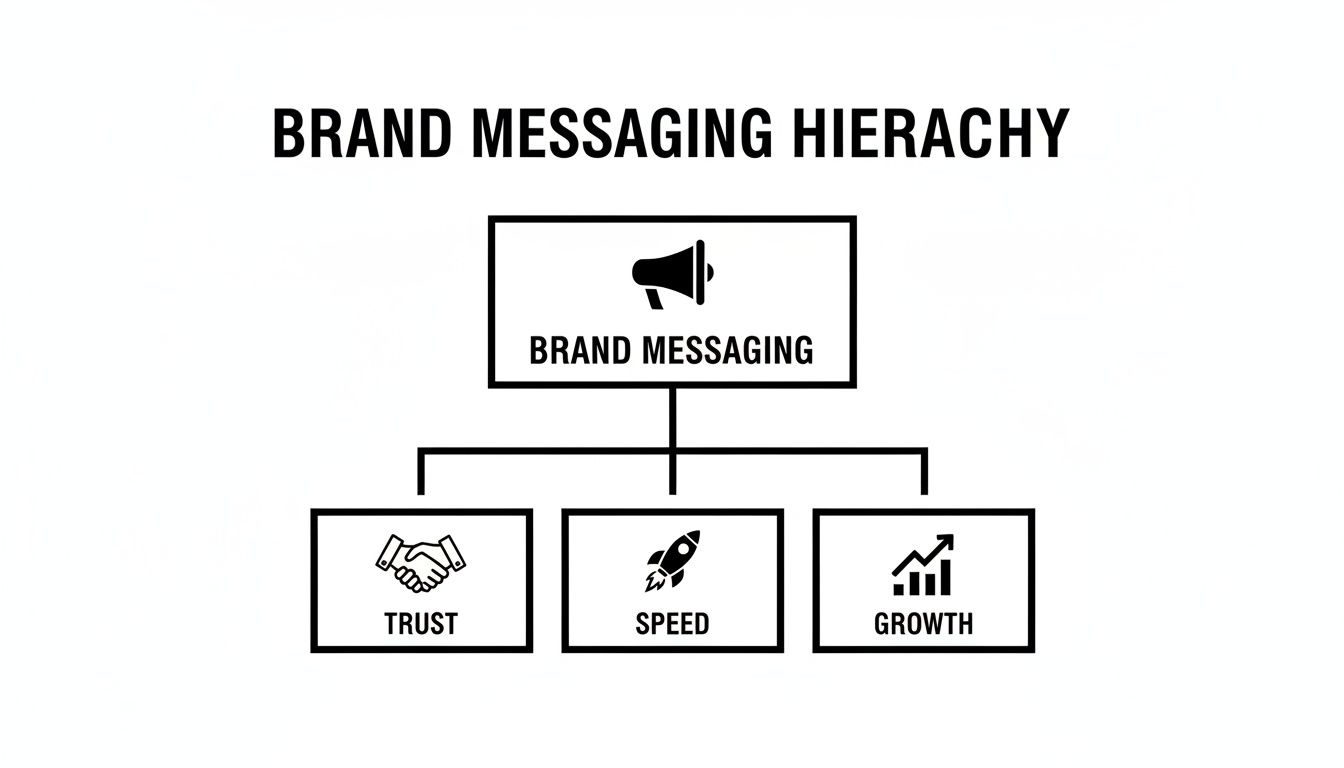
This really just shows how a focused strategy leads to real results that every founder is chasing.
- Practical Workflow: Open a spreadsheet. In column A, list your pillars. In columns B, C, and D, brainstorm 10-15 specific content ideas (blog posts, tweets, videos) for each pillar. You've just created a content calendar foundation.
- Practical Example: For a financial advisor targeting millennials, pillars could be: 1) Smart Investing Basics, 2) Paying Off Debt, and 3) Building Generational Wealth. Every piece of content would fit into one of those buckets.
4. Tagline: Your Memorable Hook
Your tagline is a short, catchy phrase that captures the essence of your brand. It’s the hook that gets stuck in people’s heads. A classic example is Dollar Shave Club’s "Shave Time. Shave Money." It’s clever, short, and tells you their entire value prop in four words.
A tagline is not your brand message, but the memorable output of it. It’s the tip of the iceberg, hinting at the massive value that lies beneath the surface.
5. Proof Points: Your Believability
Finally, you need proof points. This is the evidence that backs up everything you're saying. Without proof, your messaging is just a bunch of empty promises. Proof points are what build trust and turn a skeptic into a believer.
- Practical Workflow: Create a dedicated folder in your Google Drive or Dropbox called "Proof Points." Every time you get a positive customer email, a great review, or a new data point, save a screenshot or note in that folder. It becomes your go-to resource.
- Practical Example: Instead of "Customers love our software," use "Rated 4.9/5 stars by over 500 users on G2."
Craft Your Messaging Framework in One Afternoon
Let's turn all this theory into something you can actually use. Building a brand messaging framework isn't some month-long slog reserved for big corporations. You can nail down a powerful one-page guide in a single afternoon. Seriously.
Think of it as your secret weapon for content creation. It's the cheat sheet that will save you from staring at a blank screen, wondering what to say next. We'll build it together, step-by-step.
Step 1: Pinpoint Your Why
Before you write a single word about what you do, you need to be crystal clear on why you do it. This is your mission, the soul of your brand. It’s the real reason you get out of bed in the morning to work on this thing, beyond just making money. A strong "why" is magnetic; it pulls the right people in.
- Productivity Suggestion: Set a 25-minute timer (the Pomodoro Technique) and free-write your answer to this question: Why does my business exist, and what problem am I truly passionate about solving for my customers? Don't edit, just write. The best stuff often comes out when you're not overthinking it.
- Practical Example: A founder of a sustainable packaging company: "To help e-commerce brands ditch plastic without sacrificing that awesome unboxing experience for their customers."
Getting this right ensures everything you create feels authentic and purposeful.
This simple sketch shows how the pieces fit together.
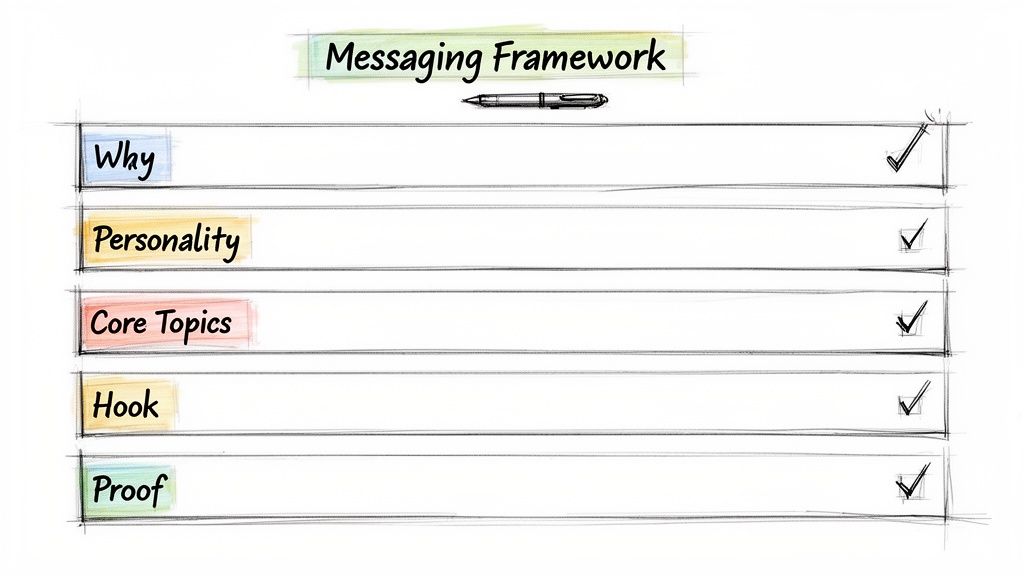
Each of these is a building block for a message that truly connects.
Step 2: Define Your Brand Personality
Next up, how does your brand sound? If it walked into a room, what vibe would it give off? Are you the witty expert, the friendly and approachable guide, or the inspiring mentor?
Defining your brand's personality is what makes your communication feel like it's coming from a real person, not a robot.
- Productivity Suggestion: Go to your three favorite brands' social media accounts. Write down three adjectives that describe their personality. This exercise helps you see how personality is conveyed and clarifies what you want (or don't want) for your own brand.
- Practical Example: A graphic designer selling digital templates: Creative, Empowering, and Approachable.
Step 3: Choose Your Core Topics
You can't talk about everything to everyone. Your messaging pillars are the 3-5 core topics you’ll own. These are the subjects you'll return to again and again, establishing your expertise and keeping your content focused.
They should sit at the intersection of what your audience cares about and what your brand stands for. And of course, knowing your audience is key. If you need a refresher, our guide on what is audience segmentation will help you get specific about who you're talking to.
Productivity Suggestion: Use a free mind-mapping tool like Miro or MindMeister. Put your brand name in the center. Brainstorm every possible topic you could talk about. Then, drag and drop related ideas into 3-5 distinct clusters. These clusters are your pillars.
Step 4: Craft Your Hook
Your hook is your tagline or a killer value proposition. It’s that short, memorable phrase that stops the scroll and makes people lean in. It needs to be punchy, clear, and scream "this is for you."
- Productivity Suggestion: Use a headline analyzer tool (like CoSchedule's) to test different versions of your hook. It will score them based on clarity, emotion, and power words, helping you choose the strongest option scientifically.
- Practical Example: A SaaS tool for remote teams: "Bring your team together, no matter where they are."
Step 5: Gather Your Proof
Okay, you’ve made some bold claims. Now it’s time to back them up. Proof points are the evidence that makes your brand believable. We're talking testimonials, case studies, impressive data, or even user-generated content.
- Productivity Suggestion: Automate this! Set up a system using a tool like Zapier to automatically save positive mentions of your brand on Twitter or new 5-star reviews from a platform like G2 into a spreadsheet. This builds your proof library on autopilot.
- Practical Example: "Trusted by over 15,000 small business owners" or "Helped our clients increase sales by an average of 30%."
Want to see how this looks in the wild? Check out these B2B messaging framework examples. They’re great for getting a feel for how other brands put these pieces together.
Your One-Page Brand Messaging Template
To make this even easier, I've put all these steps into a simple, fill-in-the-blank template. Spend an hour with a coffee and fill this out. It’ll become the single most valuable document for your marketing.
| Component | Guiding Question | Your Answer (Example: A Time-Tracking App) |
|---|---|---|
| Why (Mission) | Why does my business exist, beyond making money? | To help freelancers reclaim their time and get paid what they're worth. |
| Personality | If my brand were a person, what three words would describe them? | Empowering, Direct, and Insightful. |
| Core Topics | What are the 3-5 key themes I will consistently talk about? | 1. Profitable Freelancing, 2. Client Management, 3. Work-Life Balance. |
| Hook (Tagline) | What is the single most important promise I make in ten words or less? | Stop guessing. Know exactly where your time goes. |
| Proof Points | What evidence (testimonials, data, etc.) proves I can deliver on my promise? | "Helped users uncover an average of 10 billable hours per month." |
Once this table is filled out, print it, save it to your desktop, or pin it in your project management tool—whatever it takes to keep it front and center. This little page is your new north star for every piece of content you create.
Common Messaging Mistakes and How to Fix Them
You’ve put in the work to craft your brand messaging—that's a huge step forward. But even the best frameworks can get derailed by a few common slip-ups. Honestly, knowing what not to do is just as important as knowing what to do.
I see it all the time with startups and side-hustles. They try so hard to sound "professional" or appeal to the widest possible audience that they accidentally dilute their message. Instead of standing out, they just blend in. The good news is these mistakes are easy to spot and even easier to fix.
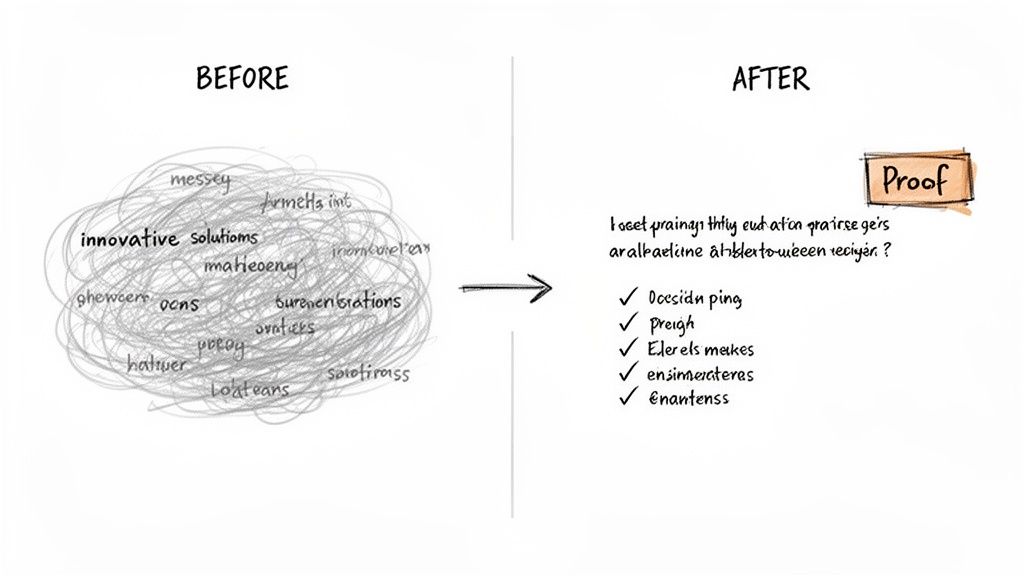
Let's walk through the most common traps and how you can sidestep them with a few simple shifts.
Mistake 1: Using Vague Corporate Jargon
One of the fastest ways to make a customer's eyes glaze over is hiding behind fluffy, overused buzzwords. Think "innovative solutions," "synergistic frameworks," or "world-class service." These phrases sound important, but they mean absolutely nothing to your audience. They lack specifics. They lack humanity.
- Before: "We provide innovative, streamlined solutions to maximize your workflow efficiency."
- After: "We help freelance writers save 10 hours a week with project templates that organize their work automatically."
The Fix (Productivity Tip): Use a free tool like the Hemingway App. Paste your copy into it. It will highlight complex sentences, jargon, and passive voice. Your goal is to write at a 7th or 8th-grade reading level for maximum clarity.
Mistake 2: Making Claims Without Proof
You can shout from the rooftops that your product is the "best" or "most effective," but without evidence, they're just empty words. Today's customers are smart and skeptical; in fact, 81% need to trust a brand before they even think about buying. Bold claims without anything to back them up don't build trust—they break it.
- Before: "Our app is the number one choice for boosting productivity."
- After: "Join 50,000+ founders who use our app to complete their daily tasks 40% faster."
The Fix (Productivity Tip): When writing copy, use the "Prove it" challenge. After every claim you make, ask yourself "How can I prove this?" This forces you to immediately search for a specific number, testimonial, or case study to include.
Mistake 3: Trying to Be Everything to Everyone
When you try to talk to everyone, you end up connecting with no one. It’s a classic trap. You get scared of excluding a potential customer, so your messaging becomes watered-down and generic. But a sharp, focused message is what actually attracts a loyal tribe.
A brand that tries to be for everybody is a brand for nobody. The goal is to make a specific group of people feel like you created your product just for them.
The Fix (Productivity Tip): Create a simple "Ideal Customer Persona" document. Give them a name, a job, and a core problem. Before you write anything, ask: "Would [Persona's Name] find this useful? Does it speak their language?" This keeps your messaging laser-focused.
Putting Your Messaging to Work on Social Media
Okay, you've got a killer brand messaging guide. Now what? A guide is only useful if you actually use it. This is where your strategy hits the real world, turning that framework into a daily content workflow that actually connects with your audience and, just as importantly, saves you a ton of time.
The whole point is to bridge the gap between that one-page guide and the posts you publish every single day. Without a system, it’s far too easy to slip back into old habits, creating random content that feels completely disconnected from the core message you worked so hard to build.
Your Pre-Publish Social Media Checklist
To keep your content consistently on-brand, run every single post through this simple checklist before it goes live. Think of it as a final quality check. It ensures every tweet, reel, and update reinforces who you are.
- Does this sound like us? Is the language and personality in line with your defined brand voice? (Compare it against your "This, Not That" chart).
- Does this connect to a pillar? Can you trace the post back to one of your 3-5 core messaging themes? (Tag it with the pillar name in your content calendar).
- Does this serve our audience? Is this genuinely valuable to your ideal customer, or is it just noise? (Refer to your persona doc).
- Does this include a proof point? If you're making a claim, back it up. Add data, a testimonial, or some social proof to build credibility. (Pull from your "Proof Points" folder).
This simple workflow turns your abstract messaging into a concrete, repeatable process. Need more ideas to get started? Our guide on how to create engaging social media content has some great, actionable tips.
A messaging framework isn't a "set it and forget it" document. It's a living tool that should actively shape every piece of communication you put out into the world, especially on social media where consistency is everything.
Streamline Your Workflow with the Right Tools
Manually checking every post can feel like a chore, and let's be honest, you'll probably skip it when you're busy. This is where an AI-powered platform like Postful becomes a massive productivity booster for founders and side-hustlers.
Postful is built to help you put your brand messaging into action with way less effort. Its AI can help refine your drafts to match your unique brand voice, while its templates are already built around common messaging goals. By taking care of the repetitive stuff, it helps you deliver a powerful, consistent message on a regular basis—letting you build trust and engagement without the constant grind.
Got Brand Messaging Questions? We’ve Got Answers.
Even with a solid plan, you're bound to have questions once you start putting your brand messaging into practice. It happens to everyone. Let’s tackle a few of the most common ones that come up for founders.
How Often Should I Review My Brand Messaging?
Think of your brand messaging less like a stone tablet and more like a living document. While day-to-day consistency is key, giving it a good look-over every 6-12 months is a smart habit.
You’ll definitely want to revisit it sooner if you make a major pivot, launch a totally new product, or just get a sense that your audience's needs are shifting.
Productivity Suggestion: Schedule a recurring calendar event every six months titled "Brand Messaging Review." In the invite, link to your messaging framework document. This ensures it doesn't get forgotten in the daily grind.
What’s the Real Difference Between Brand Voice and Tone?
This is a classic—and it’s a source of confusion for a lot of people. But the difference is actually pretty simple, and getting it right is a game-changer.
- Brand Voice: This is your brand’s personality. It’s the core of who you are, and it doesn't change. If your voice is witty and confident, it’s always witty and confident.
- Tone: This is the emotional flavor you add to your voice for different situations. You’d use your witty, confident voice in a supportive tone when helping a customer, but switch to an energetic tone when you’re hyping a new feature.
Your voice is what your personality is; your tone is how you adapt that personality to a specific conversation.
How Do I Know If My Messaging Is Actually Working?
Good news: you don't have to guess. The best way to test your messaging is to just watch and measure how your audience responds.
Look for these clues:
- Engagement: Are people in your comments using the same kind of language you do? Are they sharing the posts that really nail your core messaging pillars? When they do, it’s a great sign that they "get it."
- Direct Feedback: Don't be afraid to ask. Run a simple poll on social media asking your followers what three words come to mind when they think of your brand. You'll know right away if what you're putting out there is what they're picking up.
- Conversions: At the end of the day, a clear value proposition should drive action. Productivity Suggestion: Use a free tool like Google Optimize to run a simple A/B test on your website's main headline. Test your core value proposition against an alternative. It's a low-effort way to get hard data on what resonates most.
Ready to turn your sharp new messaging into great content without all the effort? Postful gives you AI-powered tools and templates to create on-brand social media posts, consistently. It's the fastest way to connect with your audience and grow your business. Join the waitlist today!