Tag: lead generation

  • How to Build an Email List: A Practical Guide for Real Growth

    How to Build an Email List: A Practical Guide for Real Growth

    Building an email list isn't just about collecting contacts. It's about forging a direct, valuable connection with your audience—a powerful communication channel you fully own and control. You do this by offering something genuinely useful in exchange for an email address, and in return, you get one of the highest-performing assets in all of marketing.

    Why an Email List Is Your Most Powerful Growth Engine
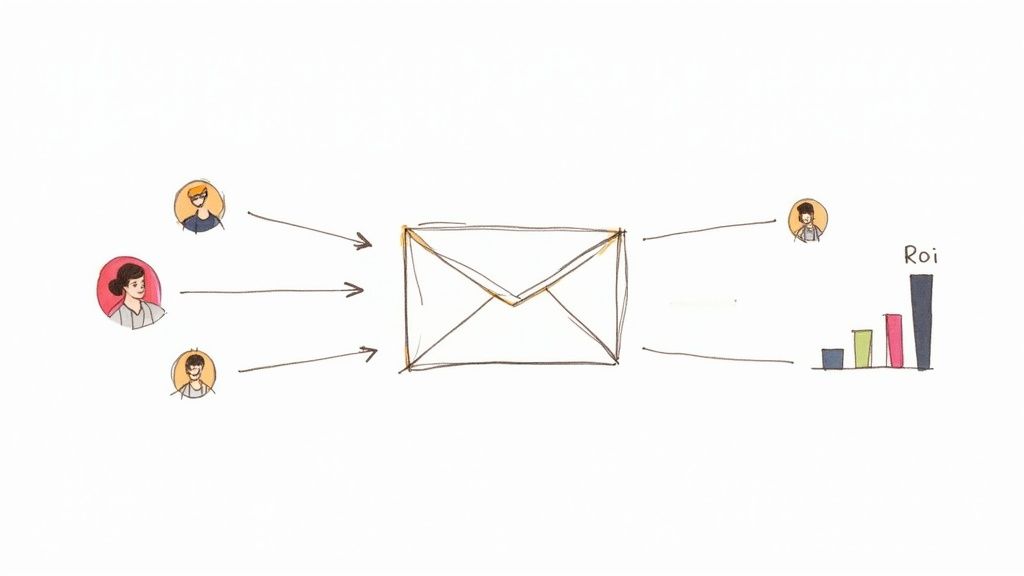
    A visual diagram showing users sending emails, processed by an envelope, leading to positive ROI.

    Before we jump into the how, let’s get grounded in the why. For any founder or side-hustler, understanding this is critical. Your social media following feels important, but you’re essentially renting space on someone else's platform. An algorithm change can vaporize your reach overnight, turning a hard-won audience into strangers.

    An email list is different. It’s an asset you own, period. This direct line to your people is immune to the whims of algorithms, giving you a stable, reliable way to connect with your most engaged followers, nurture leads, and drive sales.

    The Unbeatable Economics of Email Marketing

    The numbers don't lie. While social media and paid ads have their place, email marketing consistently delivers a staggering return on investment. Marketers report an average return of $36–$42 for every $1 spent. That's not a typo.

    This incredible ROI is fueled by the simple fact that email is everywhere. Projections show there will be nearly 4.6 billion users by 2025. You can find more email marketing statistics on omnisend.com.

    For a founder or small business owner, this means every subscriber is a potential long-term customer. You're not just collecting contacts; you're building a resilient revenue engine that can weather market shifts and platform changes.

    This direct connection lets you build real relationships at scale. You can segment your list and send personalized messages that resonate far more deeply than a generic social media post. It's like having a one-on-one conversation with thousands of potential customers at the same time.

    Before we dive into the step-by-step tactics, let's quickly map out the core components you'll need. Think of this as your high-level checklist for getting started.

    Your Core Email List Building Toolkit

    Component What It Does Why It’s Essential
    Email Service Provider (ESP) Manages your subscriber list, sends emails, and tracks performance. The technical backbone of your entire email operation.
    Lead Magnet An incentive (e.g., checklist, ebook) offered for an email address. Gives people a compelling reason to sign up right now.
    Landing Page / Signup Form A dedicated page or form where people can subscribe. The "front door" for new subscribers to join your list.
    Onboarding Sequence An automated series of emails sent to new subscribers. Welcomes new members and builds an immediate connection.

    With these four pieces in place, you have a complete system for turning casual visitors into engaged subscribers. Now, let's explore how to bring them to life.

    The Core Benefits of an Owned Audience

    Owning your audience gives you a strategic edge that goes way beyond immediate sales.

    • Direct, Unfiltered Communication: Your message lands right in their inbox. No algorithms, no fighting for visibility in a crowded feed.
    • Sky-High Engagement: These people asked to hear from you. That makes them far more receptive to your offers. A well-crafted email to a warm list will always crush a cold ad.
    • Building Real Customer Value: Email is the perfect place to nurture relationships over the long haul. A solid welcome sequence, regular value-packed newsletters, and personalized offers dramatically increase customer lifetime value.
    • Predictable Traffic and Sales: Got a new product launching? An important announcement? You can drive a predictable wave of traffic and sales just by hitting "send." That level of control is a game-changer for planning and forecasting.

    Here’s a practical example: A freelance graphic designer uses Instagram for visual discovery but drives all their high-ticket sales through their email list. When they open up three new client spots, they announce it to their email subscribers first with an early-bird discount. The spots often fill up within 24 hours before they even mention it on Instagram. This creates exclusivity, rewards their loyal community, and generates predictable income.

    Ultimately, your email list isn't just another marketing channel. It's the foundation of a durable, profitable business.

    Creating Lead Magnets People Genuinely Want

    A hand holding a magnet attracting digital content like checklists, quizzes, templates, and a resource library.

    Handing over an email address is a transaction. It's built on trust and value. If you want someone to join your list, you can't just toss a generic, low-effort PDF their way and expect them to bite. The best lead magnets solve a specific, nagging problem for your ideal subscriber, delivering an immediate win that makes them feel smart for signing up.

    This is the whole game when it comes to building an email list that's actually engaged from day one. Forget about writing a massive, 50-page ebook that nobody has time to read. Instead, focus on a quick, high-impact solution your audience can use right now. A great lead magnet should feel like a shortcut or a secret weapon.

    Pinpointing Your Audience's Real Needs

    The secret to a killer lead magnet isn't slick design or clever copy; it's deep empathy for your audience. You need to get inside their heads and understand their challenges so well that your offer feels like you're reading their mind. Before you even think about formats, you have to nail the core pain points of your target subscriber.

    To get there, you need a crystal-clear picture of who you're trying to attract. For a deeper dive, our guide on what a user persona is is a great place to start. It'll help you map out the real motivations and goals of your ideal audience.

    Once you’re clear on who you're talking to, ask yourself these questions to uncover lead magnet gold:

    • Practical Example (Template): A financial consultant notices her clients waste hours formatting spreadsheets. She creates a "Monthly Budgeting Template" in Google Sheets. This saves them time and positions her as a practical expert.
    • Practical Example (Checklist): A real estate agent sees first-time buyers are overwhelmed. He creates a "First-Time Homebuyer's Checklist" covering everything from mortgage pre-approval to closing day. It simplifies a complex process.
    • Practical Example (Guide): A content marketer knows startups struggle with SEO. She writes a one-page guide titled "5 SEO Mistakes to Avoid on Your New Website." It's a quick, actionable diagnostic tool.

    By zeroing in on a single, well-defined problem, your lead magnet becomes an irresistible solution.

    A Playbook of High-Value Lead Magnet Ideas

    The format of your lead magnet should be a direct answer to the problem it solves. A freelance writer's audience might be desperate for a pitch template, while a fitness coach's followers would jump at a 7-day workout plan. The key is to match the format to the desired outcome.

    Here are some powerful ideas, tailored to different business models, that go way beyond the standard ebook:

    For Consultants & Service Providers

    • Interactive Quiz or Assessment: A marketing consultant could offer a "What's Your Brand's Marketing Score?" quiz that emails personalized feedback and tips.
    • Case Study Breakdown: A web developer could share a PDF showing how they increased a client's site speed by 200%, detailing the exact steps they took.
    • ROI Calculator: A Facebook Ads specialist could create a simple spreadsheet where potential clients plug in their numbers to see the potential return on ad spend.

    For SaaS Companies & Tech Founders

    • Exclusive Template Library: A project management tool could offer a free library of Notion or Trello templates for different project types (e.g., "Content Calendar Template").
    • Free Mini-Course: A video editing software company could create a three-day email course on "Editing Your First Viral Video."
    • Industry Benchmark Report: An email marketing platform could release an annual report on "The State of Email Marketing," packed with data and insights.

    For Creators & Side-Hustlers

    • Resource Library: A YouTuber could create a password-protected page with a curated list of all the camera gear, software, and music they use.
    • Printable Checklist: A professional organizer could offer "The 30-Day Declutter Challenge," a simple PDF checklist to print out.
    • Video Workshop Replay: A career coach could offer gated access to the recording of a popular "How to Nail Your Next Job Interview" live workshop.

    To really stand out, explore a variety of proven lead magnet ideas that convert and offer genuine value. It’s the only way to cut through the noise.

    Key Takeaway: The best lead magnets aren't about length; they're about utility. A one-page checklist that solves an immediate problem is infinitely more valuable than a 100-page ebook that doesn't.

    Tools to Create Professional Lead Magnets Fast

    You don't need a pro designer or a big budget to create something that looks polished and credible. The goal is to make something that’s easy to consume and gets the job done. A few user-friendly tools are perfect for founders and side-hustlers who need to move quickly.

    • Canva: An incredibly versatile design tool with thousands of templates for checklists, workbooks, and presentations. Productivity Tip: Create a brand kit in Canva with your colors and fonts. Now, any template you choose will instantly match your branding, saving you hours of design time.
    • Beacon.by: This platform is built specifically for creating lead magnets. It helps you repurpose existing blog content into ebooks and guides with just a few clicks. Productivity Tip: Use Beacon.by to turn your top 3 blog posts into three different lead magnets in under an hour to test which topic resonates most with your audience.
    • Google Docs or Notion: Never underestimate the power of a well-formatted document. For simple templates and checklists, just export as a PDF, and you're good to go. Productivity Tip: Use Notion's built-in templates as a starting point for your resource library or checklist to avoid starting from a blank page.

    The name of the game is productivity. Pick a tool that lets you test ideas fast without getting stuck in complicated software. Your time is better spent getting to know your audience than fighting with design programs.

    Designing Signup Forms That Actually Convert

    A killer lead magnet is only half the job. If your signup form is confusing, hard to find, or just plain boring, even the most amazing offer will collect dust. This is where the real work of list-building begins: designing and placing your forms to turn casual visitors into loyal subscribers.

    The goal isn't to be annoying. It's to show up with a valuable offer at the exact moment someone is most likely to need it. This takes a bit of strategy around form types, where you put them, and the words you use to get that click.

    Choosing the Right Type of Signup Form

    Different forms have different jobs. By mixing and matching them based on where they appear, you create multiple chances for people to sign up without feeling spammed. Pop-ups can work wonders, but they can also be disruptive, so it's smart to use a variety of options.

    • Embedded Forms: These sit right inside your content, like at the end of a blog post. They feel natural and non-intrusive, making them perfect for catching readers who are already hooked on your topic.
    • Pop-up Forms: These are your attention-grabbers. You can set them to trigger based on time spent on a page, how far someone scrolls, or exit-intent (when a user moves their mouse to leave). They can get conversion rates as high as 9.3%, but use them wisely to avoid wrecking the user experience.
    • Slide-in Forms: A much friendlier alternative to a full-screen pop-up. These usually slide in from a corner, catching the eye without blocking the whole page. It's a great balance between being visible and being polite.
    • Dedicated Landing Pages: This is a standalone page with one single mission: get the signup. It has no other navigation or distractions, which makes it the go-to choice for paid ad campaigns or social media promos where you need total focus on the call to action.

    Strategic Placement for Maximum Visibility

    Where you put your forms is just as important as what they look like. Think about how people move through your site and find the sweet spots for a subscription offer.

    • Practical Example (Blog Post): A food blogger shares a recipe for sourdough bread. At the bottom of the post, she embeds a form offering a "Free Sourdough Starter Feeding Schedule." It's a perfectly timed, relevant offer.
    • Practical Example (Hello Bar): A SaaS company uses a "hello bar" at the top of their site to announce a new feature and offer early access to their newsletter subscribers. It's visible on every page without being intrusive.
    • Practical Example (About Page): A business coach shares their personal journey on their "About" page. At the end, they invite readers to join their weekly newsletter for more stories and insights, capitalizing on the personal connection they just built.

    Here’s a great example from ConvertKit's website. Notice how they offer a couple of clear, non-pushy ways for visitors to take the next step.

    The language is all about the benefit to the user. It’s designed to guide interested people forward, not force them.

    Writing Copy That Persuades and Converts

    The words on your form are your final pitch. They have to be clear, quick, and compelling. Every word needs to squash hesitation and remind the visitor why they should sign up. Vague headlines and generic buttons like "Submit" will absolutely tank your conversion rates.

    Headline Formulas:

    • The "How To" Headline: "How to Write a Novel in 90 Days"
    • The "Free Resource" Headline: "Download My Free Client Onboarding Checklist"
    • The "Benefit-Driven" Headline: "Get 5 High-Protein Recipes Delivered to Your Inbox Weekly"

    The button text—your call to action (CTA)—is just as critical. Ditch "Subscribe" for something that reflects what the person is actually getting. For a deeper look, check out our guide on what a call to action is and how to write effective ones.

    CTA Examples:

    • "Send Me the Template!"
    • "Unlock the Free Course"
    • "Get Your Checklist"

    Your form's copy needs to answer the visitor's unspoken question: "What's in it for me?" Make the benefit so obvious and exciting that clicking the button feels like the only logical thing to do.

    A Simple Workflow for A/B Testing Your Forms

    The only way to know what really resonates with your audience is to test it. Don't just guess. Tools like ConvertKit, Mailchimp, and MailerLite have A/B testing features built right in, making this easy.

    Here’s a quick productivity workflow to get started:

    1. Formulate a Hypothesis: Start with a simple question. Example: "I believe a more urgent CTA like 'Get Instant Access' will convert better than a passive one like 'Download Now'."
    2. Change One Variable: This is key. Test only one thing at a time—the headline, the button color, the image, etc. If you change multiple things, you'll never know which one made the difference.
    3. Run the Test: Let your email tool show the two versions (A and B) to different people for a set period (e.g., two weeks) or until you have enough data for a clear winner. Most platforms will tell you when the results are statistically significant.
    4. Analyze and Implement: Check the results. If 'Get Instant Access' got a 15% lift in conversions, make that your new default. Then, come up with a new hypothesis for your next test (e.g., "Will changing the headline to a question increase signups?").

    By constantly testing, you're replacing guesswork with data. It’s this steady process of small, smart improvements that builds a powerful system for growing your email list over the long haul.

    Smart Promotion Tactics to Grow Your List Faster

    So you’ve created a killer lead magnet and your signup forms look sharp. That’s a fantastic start, but it's not enough. Your list isn't going to build itself.

    You have to get out there and actively promote your offer where your ideal subscribers are already hanging out. Sitting back and waiting for signups isn't a strategy. Proactive promotion is how you kickstart real, sustainable growth and create multiple pathways for people to discover your value and join your community.

    Turn Your Best Content Into Subscriber Magnets

    Your existing content is a goldmine for list growth. Seriously. Start by looking at your top-performing blog posts—the ones that already pull in consistent traffic from Google or social media. These articles have proven their worth, making them the perfect spot to offer a "content upgrade."

    A content upgrade isn't just another generic newsletter signup. It’s a super-specific bonus resource that directly complements the article someone is already reading and enjoying.

    • Practical Example: A marketing blog has a popular post on "How to Write Great Headlines." The content upgrade is a PDF of "101 Proven Headline Formulas You Can Steal."
    • Practical Example: A personal finance blog has an article on "The Best Budgeting Apps." The content upgrade is an interactive "Budget Calculator Spreadsheet" that readers can download.
    • Practical Example: A SaaS company's blog has a guide to "Mastering Customer Onboarding." The upgrade is a Trello board template of their "Perfect Customer Onboarding Workflow."

    The key here is hyper-relevance. Because the offer is so tightly connected to the content, conversion rates for content upgrades can absolutely crush those of a generic, site-wide lead magnet. You're solving a problem for them at the exact moment it pops into their head.

    Leverage Social Proof and Expertise

    Social media is way more than just a broadcast channel. It's a powerful tool for driving targeted signups when you use it right. Instead of just shouting "sign up for my newsletter," use these platforms to showcase your expertise and make your lead magnet the next logical step for your followers.

    Here’s a simple productivity workflow for Twitter:

    1. Create a High-Value Thread: Write a 5-7 tweet thread breaking down a complex topic related to your lead magnet. Example: If your lead magnet is a "Cold Email Template," write a thread on "The 5 Biggest Mistakes People Make in Cold Emails."
    2. Add the CTA Tweet: As the last tweet in the thread, add your call to action. Example: "If you want to avoid these mistakes, I created a free template with 3 cold emails that have a 60%+ open rate. Grab it here: [Link to landing page]."
    3. Retweet with Comments: Periodically, use the "Retweet with comment" feature on your own thread to add new insights or results, bringing it back to the top of your followers' timelines.

    This approach works because you’re building credibility first. You provide value upfront, so asking for an email feels like a natural exchange. For a deeper dive, our guide on how to generate leads on social media breaks down this process for different platforms.

    Run Lean and Effective Paid Campaigns

    Organic promotion is great, but it can be a slow burn. Paid ads on platforms like Facebook or Instagram let you put your offer directly in front of a highly targeted audience, fast. And you don't need a massive budget to get results.

    The secret to a profitable ad campaign is precision. Don't target everyone. Instead, focus on a small, specific audience whose problems your lead magnet directly solves.

    Let’s imagine a real-world scenario:

    • Business: A fitness coach specializing in workouts for busy professionals.
    • Lead Magnet: "The 15-Minute Bodyweight Workout PDF."
    • Ad Creative: A short video of them performing one of the exercises, with text overlay: "No time for the gym? Grab my free 15-minute workout guide."
    • Targeting: People aged 30-50, who live in major cities, have job titles like "Manager" or "Consultant," and have shown interest in pages related to fitness and productivity.

    By sending this highly-targeted traffic to a dedicated landing page with zero distractions, you can start acquiring quality subscribers for just a few dollars each. This turns a small, controlled ad spend into a predictable system for growing your list.

    Forge Strategic Partnerships

    You don't have to build your audience entirely from scratch. Partnering with other creators or businesses in your niche can introduce your lead magnet to a brand-new, perfectly relevant audience. This could be as simple as a newsletter swap or as involved as co-hosting a webinar.

    Practical Workflow:

    1. Identify 5-10 Potential Partners: Find creators or businesses who serve your audience but aren't direct competitors. Example: A nutritionist could partner with a yoga instructor.
    2. Craft a Personalized Pitch: Send a short email explaining who you are, what you admire about their work, and propose a simple collaboration. Example: "I love your weekly yoga tips! I have a '7-Day Healthy Meal Plan' that your audience might find valuable. Would you be open to a newsletter swap where we each feature the other's lead magnet?"
    3. Make It Easy for Them: If they agree, provide them with all the copy, links, and images they need. The less work they have to do, the more likely they are to follow through.

    This creates a partnership that accelerates growth for everyone involved.

    Turn Subscribers Into Fans With a Welcome Email Sequence

    That first email you send is your single best chance to make a brilliant impression. When someone trusts you with their email address, they’re giving you a brief window of their attention. Don't waste it.

    A well-crafted welcome sequence turns that fleeting moment into a genuine, long-term relationship. This isn't just about delivering your lead magnet; it's about transforming a new subscriber into an engaged fan who actually looks forward to your emails.

    An automated welcome series is your secret weapon for building a real community. It works 24/7 to introduce your brand, set expectations, and prove you’re worth listening to. The goal is to make every new subscriber feel seen, understood, and genuinely excited about what’s to come.

    The Anatomy of a High-Converting Welcome Sequence

    A great welcome sequence is usually three to five emails sent over the first week or so. Each email has a specific job, guiding the new subscriber on a journey from "who are you?" to "I can't wait for your next email."

    It's the automated follow-up to all your hard work getting them to sign up in the first place.
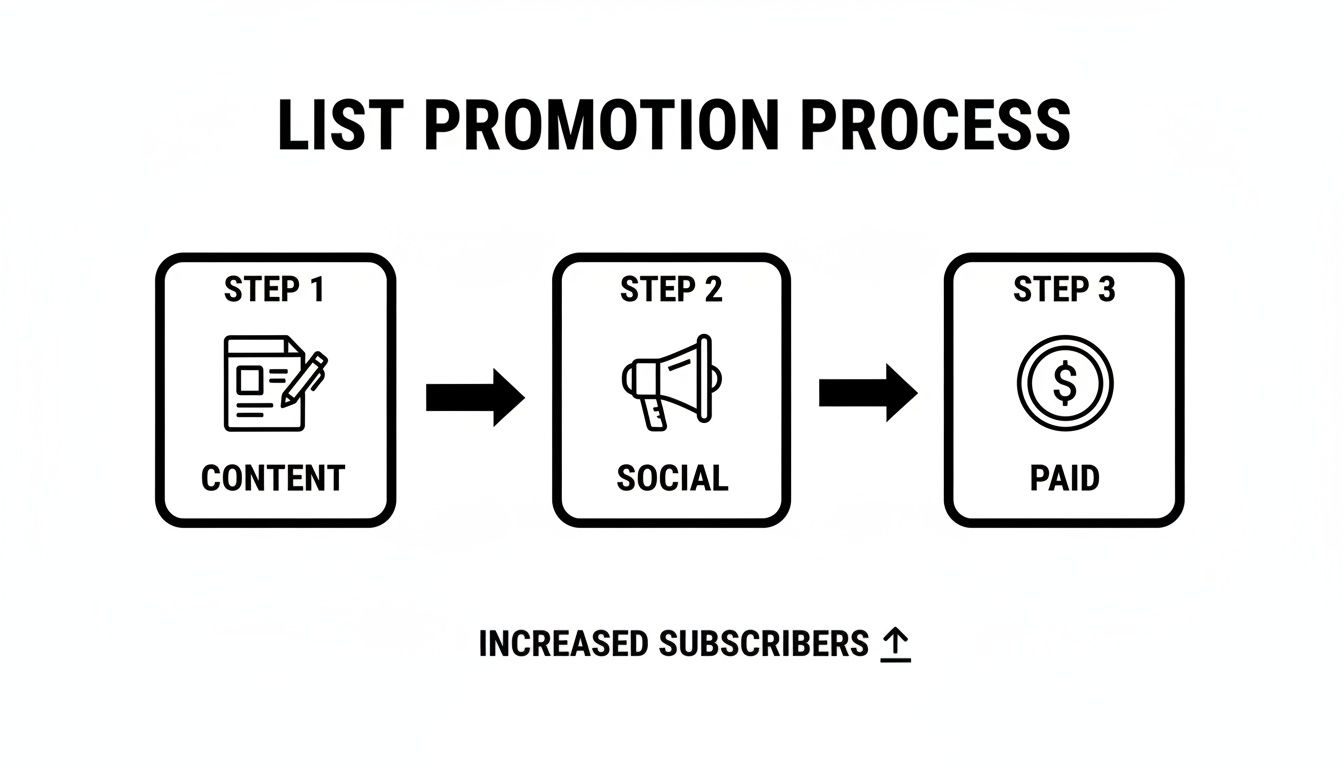
    A diagram illustrating the list promotion process with steps: Content, Social, and Paid, leading to increased subscribers.

    Let’s break down the structure of a sequence that just works.

    • Email 1: The Instant Delivery & Warm Welcome. This one needs to go out immediately. Its main job is to deliver the promised lead magnet, but its second job is just as critical: to say thank you and set the stage. Practical Example: Subject: "Here's your productivity planner!" The body is short: "Hey [Name], thanks for signing up. You can download your planner here. I'll be back in a day or two with the story of how it saved my own business."

    • Email 2: The Personal Story & Connection. A day or two later, open up and share your origin story. Why did you start your business or side-hustle? What problem are you obsessed with solving? This humanizes your brand and builds a real connection that goes way beyond transactions.

    • Email 3: The Unexpected Value. Now it’s time to surprise them with something extra. This could be a link to your most popular blog post, a short video tip, or a curated list of amazing resources. Practical Example: "I thought you might also like this article I wrote on the top 5 apps I use to stay organized. Hope it helps!" This proves you’re generous and committed to their success, which builds massive trust.

    • Email 4: The Gentle Nudge. By now, you've built rapport. This is the moment to gently introduce your core offer. This shouldn't be a hard sell. Instead, frame it as the next logical step to solving their problem, connecting it back to the value you’ve already provided.

    Pro Tip: End each email with a question to encourage replies. Asking something simple like, "What's the biggest challenge you're facing with [your topic] right now?" can turn a one-way broadcast into a two-way conversation, giving you invaluable insights.

    Segmentation Is Your Superpower

    As you grow your list, you'll quickly realize that not all subscribers are the same. This is where segmentation—dividing your list into smaller groups based on interests or behavior—becomes a total game-changer.

    Seriously, the numbers don't lie. Reports for 2024–2025 show that segmented campaigns can generate 30% higher open rates and up to 50% higher click-through rates. Some marketers even see as much as a 760% increase in revenue from segmented campaigns. You can discover more insights about email segmentation statistics on amraandelma.com.

    Practical Example: In your welcome sequence, you could ask, "Are you a beginner, intermediate, or advanced [your topic] user? Click the link that best describes you." When they click, your email tool automatically tags them. Now you can send beginner-friendly content to the beginners and advanced strategies to the experts, making your emails far more relevant.

    Keeping Your Email List Healthy and Engaged

    Building an email list is a bit like gardening. You can’t just plant the seeds and walk away. A bigger list isn't always better, especially if half of it never opens your emails. Real, long-term success comes down to list quality, which means embracing the often-overlooked practice of list hygiene.

    Every email list naturally decays over time. It’s just a fact of life. People change jobs, ditch old email accounts, or simply lose interest in what you have to say. This isn't a sign of failure; it's a predictable headwind you have to manage.

    In fact, validation data shows that an average of 28% of email addresses on a typical list become unusable within a year. That’s a huge number. It means you have to keep acquiring new subscribers just to stay where you are. You can dig into the details of list decay on ZeroBounce.net.

    This decay directly hammers your deliverability—the all-important metric that determines if your emails land in the inbox or get lost in the spam folder. Email providers like Gmail and Outlook are always watching. They track how people engage with your emails. If you’re sending to a list full of dead or dormant addresses, your sender reputation takes a hit, making it harder to reach even your most loyal fans.

    Pruning Your List for Better Performance

    This is going to sound counterintuitive, but you need to regularly remove inactive subscribers from your list. It’s called “pruning,” and it’s one of the best things you can do for your email marketing. It ensures you're only talking to people who actually want to hear from you, which in turn boosts your open rates and strengthens that sender score.

    Here’s a simple productivity workflow for list pruning:

    1. Define "Inactive": First, decide what “inactive” means for you. A solid starting point is anyone who hasn't opened or clicked an email in the last 90 days.
    2. Create a Segment: In your ESP (like MailerLite or ConvertKit), create a segment of these inactive subscribers. This usually takes less than a minute.
    3. Launch a Re-Engagement Campaign: Before you delete them, send a short, 2-email campaign. Example Email 1 Subject: "Is this goodbye?" Email 2 Subject: "Final chance to stay on the list." The email can simply ask them to click one link if they want to stay.
    4. Prune the Unresponsive: After a week, anyone in that segment who still hasn't opened or clicked is safe to remove. Delete them from your list. Your deliverability will thank you.

    Pruning your list isn't about losing subscribers; it's about gaining deliverability. A smaller, highly engaged list is far more valuable than a large, silent one.

    Burning Questions About Building an Email List

    Even with the best playbook, you’re bound to have questions once you start getting your hands dirty. Let's tackle some of the most common ones that pop up.

    How Often Should I Actually Email My List?

    There’s no magic number, but a solid starting point for most people is once a week. This keeps you on their radar without clogging up their inbox.

    But the real answer? It depends entirely on your audience and what you're sending. Practical Example: A financial news newsletter might send daily updates on the market, while a marketing consultant might send a deep-dive tactical email once every two weeks. The most important thing is consistency. Pick a schedule you can realistically stick with and let your subscribers know what to expect.

    Should I Just Buy an Email List?

    Let me make this simple: absolutely not. Buying a list is the fastest way to wreck your sender reputation and tank your engagement. These people never asked to hear from you, which means your emails are prime candidates for the spam folder.

    Building your list organically is the only way to go. It guarantees every single subscriber has given you explicit permission to be there. The result? Higher open rates, better deliverability, and a real community that actually wants to hear what you have to say.

    What’s a Good Open Rate, Anyway?

    While it varies by industry, a healthy open rate usually hovers between 20% and 30%. But honestly, what matters more is your trend over time. Are your numbers going up?

    Instead of obsessing over benchmarks, focus on improving your own stats by:

    • A/B testing your subject lines. Productivity Tip: Spend 5 minutes brainstorming 10 different subject lines for every email. Pick the best two and test them.
    • Pruning inactive subscribers. A clean list is a happy list.
    • Segmenting your audience. Sending more relevant content is always a win.

    For a much deeper dive that goes beyond these common questions, check out this comprehensive guide on building an email list that actually grows your business.


    Once you have a clear strategy, your social media can become a powerful engine for driving traffic to your signup forms. Postful gives you the templates and AI-powered brainstorming you need to create consistent, high-value content that turns followers into subscribers. Join the Postful waitlist to get started.


  • How to Repurpose Reviews, Messages, and Photos Into Weekly Social Content

    How to Repurpose Reviews, Messages, and Photos Into Weekly Social Content

    This article was assisted with AI. We may include links to partners.

    Every day, service professionals collect a wealth of content-from glowing customer reviews and heartfelt messages to before-and-after photos of their work. Yet, many struggle to turn these valuable assets into consistent social media content that builds their brand and attracts new clients. If you’re using platforms like Thumbtack or Angi for leads but want to grow your presence beyond them, repurposing what you already have is a smart, low-effort strategy.

    Social proof plays a huge role in purchasing decisions. In fact, 90% of buyers say social proof influences their research. Leveraging your existing reviews, messages, and photos not only saves time but also builds trust with your audience. Here’s how to turn your everyday work into engaging weekly social content that feels authentic and drives results.

    Why Repurposing Content Matters for Service Pros

    Marketing often feels like a full-time job, especially for independent contractors and small service providers who are experts in their trade but not necessarily in social media. The good news is you don’t need to create content from scratch every time. Your client interactions and project documentation are a goldmine waiting to be shared.

    Consumers trust user-generated content more than polished brand materials. According to 85% of consumers who see user-generated content find it more trustworthy than brand-created photos or videos. This means that your real customer reviews and genuine job photos hold more weight than staged marketing shots.

    Plus, positive social media experiences lead to recommendations. Over 70% of people who have a good experience with a business on social media will recommend it to their networks. Repurposing content consistently keeps your business top of mind and encourages word-of-mouth referrals.

    Additionally, repurposing content allows service professionals to showcase their expertise in a variety of formats, catering to different audience preferences. For instance, a detailed blog post about a recent project can be distilled into a series of engaging social media posts, infographics, or even short video clips. This not only maximizes the reach of your original content but also provides opportunities for engagement across multiple platforms, enhancing your visibility and authority in your field.

    Moreover, by sharing insights and experiences from past projects, you can create a narrative that resonates with potential clients. Storytelling is a powerful tool in marketing; when you share the challenges you faced and how you overcame them, it humanizes your brand and builds a connection with your audience. This approach not only fosters trust but also positions you as a knowledgeable resource, encouraging potential clients to turn to you for their service needs.

    Step 1: Collect and Organize Your Content

    Start by gathering all the reviews, messages, and photos you’ve received from clients. This includes:

    Section Image

    • Online reviews from platforms like Thumbtack, Angi, or Houzz
    • Direct messages or emails praising your work
    • Before-and-after photos or snapshots taken during jobs

    Organize these assets in a simple folder or spreadsheet system. Label photos by project type and date, and categorize reviews by service or client type. This makes it easier to find relevant content when planning your posts. Consider creating subfolders for different types of projects, such as renovations, landscaping, or installations, to streamline your search process even further. This level of organization not only saves time but also allows you to quickly showcase your expertise in specific areas when potential clients inquire about your services.

    Using a tool that connects your job documentation to your social media can save hours. For example, platforms that let you turn job photos directly into scheduled posts automate much of the process. This approach fits perfectly with the busy schedules of service pros who want practical solutions without hiring a marketing team. Additionally, some tools offer analytics features that can help you track engagement, allowing you to refine your content strategy based on what resonates most with your audience.

    Why Documentation Is Your Best Marketing Asset

    Documenting your work isn’t just for client proof-it’s the foundation for your content strategy. Each photo or message tells a story that can resonate with potential customers. Sharing these stories regularly builds credibility and shows the quality of your work in a way that generic ads can’t. Furthermore, incorporating client testimonials alongside your visuals can create a powerful narrative that highlights the impact of your services. When prospective clients see real-life examples of your work paired with enthusiastic endorsements, they are more likely to trust your brand and envision themselves as satisfied customers.

    Moreover, consider the power of storytelling in your documentation. Instead of merely posting a picture of a completed project, share the journey behind it. Discuss the challenges faced, the solutions implemented, and the satisfaction of the client upon completion. This not only humanizes your brand but also engages your audience on a deeper level, making them more likely to interact with your content and share it within their networks. By weaving these narratives into your marketing strategy, you can create a compelling portfolio that speaks volumes about your expertise and dedication to quality service.

    Step 2: Craft Engaging Social Posts from Reviews and Messages

    Customer reviews and messages are powerful social proof. But simply reposting them verbatim can feel flat. Instead, turn these into engaging posts by:

    • Highlighting key phrases: Pull out the most impactful parts of a review and create a quote graphic or caption.
    • Adding context: Briefly explain the project or challenge you solved to give the review more meaning.
    • Using visuals: Pair reviews with photos from the job or a friendly image of your team.

    This approach not only showcases your happy customers but also tells a story that potential clients can relate to. Remember, 91% of 18–34-year-olds trust online reviews as much as personal recommendations, making this content especially valuable for reaching younger audiences.

    Turn Messages Into Testimonials

    Sometimes, clients send you heartfelt thank-you messages or quick compliments. Don’t let these go unused. With permission, transform these messages into short testimonials or social media shout-outs. A simple “Thank you, [Client Name], for your kind words!” post paired with a project photo humanizes your brand and encourages more positive feedback.

    Step 3: Use Before-and-After Photos to Tell Visual Stories

    Visual content grabs attention and drives engagement. Before-and-after photos are especially effective because they demonstrate your skills in a clear, compelling way. Here’s how to maximize their impact:

    Section Image

    • Show the transformation: Use side-by-side images or swipe posts to highlight the difference your work made.
    • Add captions that explain: Describe the problem, your solution, and the client’s reaction.
    • Incorporate client quotes: Combine photos with snippets from reviews or messages for a richer story.

    Since 85% of consumers rely on user-generated videos before trusting a product or brand, consider turning your photos into short video slideshows or reels. This dynamic content performs well on platforms like Instagram and TikTok.

    Scheduling and Consistency Are Key

    Posting once in a while won’t build momentum. Aim to share at least one piece of repurposed content weekly. Scheduling tools can help you maintain this consistency without extra daily effort. For example, automate posting from your job documentation system to social media to keep your audience engaged regularly.

    Step 4: Mix Content Types for a Balanced Feed

    Variety keeps your audience interested. Rotate between:

    • Review highlights
    • Client messages/testimonials
    • Before-and-after photos or videos
    • Tips or behind-the-scenes glimpses of your work process

    Curated content like this is preferred by most consumers. In fact, 78% of consumers prefer curated content over brand-produced content. By sharing authentic, client-centered posts, you build trust and show the real value of your services.

    Engage Your Audience

    Don’t just post and ghost. Respond to comments, thank clients publicly, and encourage followers to share their own experiences. Engagement boosts your visibility and turns followers into advocates.

    Step 5: Use AI Tools to Streamline Content Creation

    AI-powered platforms can help turn your raw content into polished social posts quickly. For example, AI can generate captions for before-and-after photos or rephrase client messages into attention-grabbing testimonials. This saves time and ensures your posts stay professional and consistent.

    For service pros juggling multiple projects, this kind of automation is a game-changer. It bridges the gap between your day-to-day work and your marketing efforts, making it easier to build an audience organically without extra stress.

    Final Thoughts: Turn Your Work Into Your Best Marketing

    Repurposing reviews, messages, and photos into weekly social content isn’t just about filling a calendar. It’s about telling authentic stories that build trust and attract new clients. With 90% of buyers influenced by social proof and 85% trusting user-generated content more than brand-created materials, your existing assets are more powerful than you think.

    Section Image

    By organizing your content, crafting engaging posts, showcasing transformations visually, mixing content types, and using AI tools to streamline the process, you can create a sustainable social media presence that works for your business. This approach gives you control over your marketing, saves time, and helps you grow beyond lead platforms like Thumbtack and Angi.

    Ready to start turning your everyday work into social content? Tools like Postful can help you capture your next job and share it effortlessly, making social media marketing one less thing to worry about.

    Start Sharing Your Story with Postful

    Transform your customer reviews, messages, and project photos into compelling social media narratives with ease using Postful. As an AI-powered tool designed for busy individuals and small businesses, Postful streamlines your social media efforts by generating ideas, refining content, and ensuring consistency in your posts. Say goodbye to the confusion and time drain of social media management. Sign up for Postful today and start growing your audience with authentic, engaging content that resonates.

  • Why Every Contractor Needs an Online Portfolio — and How to Share It

    Why Every Contractor Needs an Online Portfolio — and How to Share It

    This article was assisted with AI. We may include links to partners.

    Imagine a potential client searching online for a contractor to renovate their kitchen or build an addition. What will they find? If your work isn’t showcased clearly and professionally online, you might not even make the shortlist. With 65% of homeowners finding new contractors through online searches, having an online portfolio isn’t just a nice-to-have – it’s essential for growing your business and standing out in a crowded market. Research shows that 78% of home improvement customers start their projects with online research, making your digital presence the first impression you make.

    But an online portfolio is more than just a gallery of photos. It’s a dynamic tool that can build trust, demonstrate your skills, and keep clients engaged throughout the project lifecycle. This article breaks down why every contractor needs one and offers practical tips for sharing it effectively to attract and retain clients.

    The Power of an Online Portfolio for Contractors

    Contracting is a highly visual and trust-driven business. Potential clients want to see proof that you can deliver quality work before they commit. An online portfolio does exactly that by showcasing your past projects, highlighting your expertise, and providing social proof through client reviews and testimonials.

    Section Image

    Nearly half of clients find construction companies through online review platforms like Google or Yelp, which means your portfolio should integrate or link to these reviews to reinforce credibility. A strong online presence, including a well-maintained portfolio, can significantly impact lead generation. In fact, 68% of construction firms report that a strong brand presence positively affects their ability to attract new clients according to industry reports.

    Additionally, an online portfolio allows you to control your narrative. Instead of relying solely on word-of-mouth or third-party platforms, you can present your work the way you want, emphasizing your unique strengths and specialties. This autonomy is especially important for independent professionals and small service providers who often depend on lead platforms but want more control over their marketing efforts.

    Building Trust Through Visual Proof

    Photos and videos of completed projects give potential clients a tangible sense of your capabilities. Including before-and-after photos, 3D walkthroughs, or virtual tours can make your portfolio even more compelling. Nearly half of construction contractors now include virtual tours and 3D walkthroughs on their websites to engage visitors more deeply.

    These visual elements not only showcase your craftsmanship but also help clients visualize the possibilities for their own projects. When paired with positive client reviews, your portfolio becomes a powerful trust-building tool that can convert curious visitors into paying customers.

    Moreover, the use of high-quality images and engaging video content can significantly enhance the user experience. Clients are more likely to spend time on a website that offers rich media, which can lead to higher engagement rates. By incorporating detailed project descriptions alongside your visuals, you can provide context and insight into your work process, materials used, and the challenges overcome during each project. This not only informs potential clients but also demonstrates your professionalism and attention to detail, further solidifying their trust in your abilities.

    In addition to showcasing your work, an online portfolio can serve as a platform for sharing valuable content related to your industry. Consider adding a blog section where you discuss trends in construction, tips for homeowners, or insights into sustainable building practices. This not only positions you as an expert in your field but also helps to create a connection with your audience, fostering a community around your brand. Engaging content can encourage visitors to return to your site, increasing the likelihood of them choosing your services when they are ready to start their projects.

    How to Create an Effective Online Portfolio

    Creating an online portfolio doesn’t have to be complicated or expensive. The key is to focus on clarity, professionalism, and relevance to your target audience.

    Section Image

    Choose the Right Platform

    Many contractors start with simple website builders that offer portfolio templates tailored for construction and home improvement businesses. Platforms like Houzz, Thumbtack, and Angi are popular for lead generation, but having your own website where you control the content is crucial for long-term growth. A personal website not only showcases your work but also allows you to establish your brand identity, making it easier for clients to remember you and your services. Website builders like Solo, Wix, and Squarespace provide easy to use templates to get you started.

    Consider integrating your portfolio with social media channels where 82% of construction companies actively promote their projects and services. Sharing your portfolio content on platforms like Instagram, LinkedIn, and Facebook can expand your reach and attract new clients organically. Engaging with your audience through comments and direct messages can also foster relationships and build trust, which is essential in the construction industry where word-of-mouth referrals are invaluable.

    Showcase Your Best Work

    Select projects that highlight a range of skills and services you offer. Quality trumps quantity – it’s better to have a few outstanding projects with detailed descriptions, photos, and client testimonials than many mediocre ones. Explain the challenges you faced and how you solved them. This storytelling approach helps potential clients connect with your work on a deeper level. Including before-and-after photos can be particularly impactful, as they visually demonstrate your capabilities and the transformation you can achieve.

    Additionally, consider including a section for case studies that delve deeper into specific projects. This could involve outlining your project management process, the materials used, and any innovative techniques you employed. Such detailed insights not only showcase your expertise but also position you as a knowledgeable professional in your field, making clients more likely to trust you with their projects.

    Keep Content Fresh and Engaging

    Regularly update your portfolio with new projects and client feedback. Content marketing is a proven strategy in the construction industry, with 65% of firms using it to attract new clients. Adding blog posts about recent projects, tips for homeowners, or industry trends can also boost your website’s SEO and drive more traffic. Consider creating video content as well; a short video tour of a completed project can provide a dynamic view that static images cannot, allowing potential clients to experience your work in a more engaging way.

    Repurposing your project photos and reviews into social media posts can save time and increase engagement. Tools that automate social media posting from your job documentation can make this process seamless, helping you maintain a consistent online presence without extra effort. Furthermore, engaging with local community groups or forums can enhance your visibility and position you as a go-to expert in your area. By sharing insights and participating in discussions, you can build a network that may lead to future projects and collaborations.

    Sharing Your Online Portfolio to Maximize Impact

    Having an online portfolio is only half the battle. You need to actively share it where your potential clients are looking.

    Section Image

    Leverage Digital Channels

    Digital channels generate 40% of construction leads, outperforming referrals and other sources combined. Email marketing, for example, has a 25% higher open rate in the construction sector compared to other industries, making it a valuable tool to share portfolio updates and keep your audience engaged.

    Regular newsletters featuring recent projects, client testimonials, and helpful tips can nurture leads and encourage repeat business. Including clear calls to action, like inviting recipients to view your portfolio or schedule a consultation, boosts conversion rates.

    Utilize Online Review Platforms

    Since 48% of clients find contractors through review platforms, make sure your portfolio links to your profiles on Google, Yelp, or Angi. Encourage satisfied clients to leave reviews and showcase these testimonials prominently within your portfolio. Positive reviews build trust and improve your search rankings, making it easier for new clients to discover you.

    Engage on Social Media

    Social media is a powerful way to share your portfolio and interact with potential clients. Posting before-and-after photos, project walk-throughs, and client shout-outs can attract followers and generate leads. With 60% of clients preferring digital updates, social media also serves as an effective channel to keep existing clients informed and engaged throughout their projects.

    Attending industry conferences and trade shows, where 60% of construction marketers participate annually, can also help you network and promote your portfolio offline, driving traffic to your online presence.

    Measuring Success and Growing Your Portfolio

    Tracking how your portfolio performs helps you understand what resonates with your audience and where to improve.

    Use website analytics to monitor traffic, engagement, and conversion rates from your portfolio pages. Aim to increase organic traffic by 40% month-over-month through SEO-driven content and consistent updates. Pay attention to which projects get the most views and inquiries, and tailor future content accordingly.

    Strong branding combined with a well-maintained portfolio can generate a higher return on investment. The average ROI for digital marketing in the building industry is estimated at 4.5x, underscoring the value of investing in your online presence.

    Continuous Improvement

    Keep experimenting with different content formats like videos, virtual tours, and blog posts. Gather feedback from clients about what they found most helpful in your portfolio. This ongoing refinement will make your portfolio more effective over time and help you stay ahead of competitors.

    Remember, your portfolio is a living asset – it grows and evolves with your business. Use it to tell your story, celebrate your successes, and build lasting relationships with clients.

    Ready to turn your everyday work into a powerful marketing tool? Tools like Postful can help you document your projects and automate social media posting, making it easier than ever to build and share your online portfolio effectively.

    Take Your Portfolio Further with Postful

    Ready to elevate your online portfolio and harness the power of social media with ease? Discover how Postful can transform your digital marketing efforts. Our AI-powered tool is designed to streamline your social media strategy, allowing you to generate, refine, and syndicate content effortlessly. With Postful, you can stay authentic, engage your audience, and maintain a consistent online presence, all while saving time. Sign up for Postful today and start sharing your portfolio like a pro.

  • Thumbtack vs. Angi: Which Platform Gets You Better Local Leads in 2025?

    Thumbtack vs. Angi: Which Platform Gets You Better Local Leads in 2025?

    Choosing the right platform to find local leads can make or break a service professional’s business. With so many options available, Thumbtack and Angi remain two of the most talked-about platforms for contractors, handymen, and other home service providers. But which one truly delivers better local leads in 2025? This article dives into the latest data, user experiences, and industry insights to help you decide where to invest your time and effort.

    Understanding the Market Landscape for Home Service Leads

    The home services market in the U.S. has been growing steadily, with a total addressable market estimated at $657 billion as of 2025. This represents a healthy 10.9% increase from the previous year, signaling strong demand for tradespeople and service providers nationwide. However, the explosive growth seen during the pandemic has started to slow down, as noted by Angi’s Chief Economist, Mischa Fisher. Consumer spending is stabilizing, which means platforms must innovate to keep attracting both professionals and customers.

    Section Image

    Despite the market’s size, finding quality leads remains a challenge. Service pros often rely on platforms like Thumbtack and Angi to connect with homeowners, but the experience can be frustrating. Venkatesh Ragala, CEO of InstaService, highlights this pain point: traditional platforms often trap homeowners in a cycle of waiting for quotes, unclear pricing, and uncertainty about whether a provider will even show up. This frustration impacts the entire ecosystem, from lead generation to job completion.

    Given this context, it’s crucial to evaluate how Thumbtack and Angi stack up in 2025, especially as Angi recently introduced AI-driven tools to enhance the customer experience. These innovations aim to streamline the process, allowing homeowners to receive instant quotes and connect with service providers in real-time, thereby reducing the anxiety associated with home repairs. Furthermore, the integration of customer reviews and ratings into these platforms has become increasingly sophisticated, enabling users to make more informed decisions based on the experiences of others.

    Moreover, the competitive landscape is evolving as new players enter the market, each vying for a share of the lucrative home services pie. Startups are leveraging technology to create niche platforms that cater to specific trades, such as plumbing or electrical work, offering tailored solutions that traditional platforms may overlook. This diversification not only enhances the customer experience but also provides service professionals with targeted leads that are more likely to convert into jobs. As the market continues to mature, understanding these dynamics will be essential for both service providers and consumers navigating the complex world of home services.

    Thumbtack’s Reach and User Experience in 2025

    Thumbtack continues to be a popular choice among independent service professionals. It offers a straightforward interface where pros can find local leads by bidding on jobs posted by homeowners. This model gives providers some control over pricing and project scope, but it also means competition can be fierce, especially in saturated markets. The platform has introduced features aimed at enhancing user experience, such as improved filtering options that allow professionals to target specific job types or client demographics, making it easier to find the right leads.

    In terms of platform traffic, Thumbtack’s reach is significant but still trails behind some competitors. For example, in June 2023, Angi’s platform received 3.9 million hits, while HomeAdvisor’s combined platforms (part of the Angi family) garnered 10.1 million hits, indicating a broader audience reach. Thumbtack’s traffic, while robust, does not match this scale, which can impact the volume of leads available to service pros. However, Thumbtack has been actively working on partnerships and marketing campaigns to boost its visibility, aiming to attract more users and create a more vibrant marketplace for its professionals.

    That said, Thumbtack’s strength lies in its simplicity and the ability for pros to directly engage with potential clients. It also appeals to those who prefer a more hands-on approach to managing leads and pricing. However, many service providers find marketing themselves beyond the platform challenging, as social media and brand-building often require additional time and skills outside their trade expertise. To address this, Thumbtack has begun offering educational resources and webinars, helping users learn how to effectively market their services and leverage digital tools to enhance their visibility.

    Marketing Challenges for Thumbtack Users

    Many independent professionals using Thumbtack struggle with marketing beyond the platform. They often document their work with photos and reviews but don’t repurpose this content to build a broader brand presence. This limits their ability to attract repeat clients or referrals outside the platform’s ecosystem. Additionally, the lack of a cohesive marketing strategy can leave service providers feeling isolated and unsure of how to grow their businesses in a competitive landscape.

    For service pros looking to grow organically, tools that help turn daily work into social media content can be game-changers. Campaigns like “Service Pros + Lead Platforms” emphasize the importance of bridging lead platforms with long-term marketing strategies to build sustainable businesses. By integrating their Thumbtack profiles with social media accounts and utilizing customer testimonials effectively, service providers can create a more comprehensive online presence. Furthermore, Thumbtack has started to highlight success stories from its users, showcasing how effective marketing strategies can lead to increased bookings and client loyalty, inspiring others to follow suit and invest in their personal brands.

    Angi’s Innovations and Market Position in 2025

    Angi, formerly known as Angie’s List, has been a staple in the home services industry for decades. In its 30th year, Angi introduced an “AI Helper” in June 2025 designed to streamline the service request process. This AI-driven feature aims to reduce friction for homeowners by providing clearer pricing and faster responses, addressing some of the frustrations highlighted by industry experts.

    Despite reporting a 12% decline in revenue in Q2 2025 compared to the previous year, totaling $278.2 million, Angi remains a dominant player. This dip reflects the market’s normalization after pandemic-driven surges rather than a loss of relevance. The company’s focus on technological innovation and user experience improvements positions it well for future growth.

    Angi’s platform also benefits from a vast user base. The combined traffic of Angi and HomeAdvisor platforms outpaces competitors, giving service pros access to a larger pool of potential clients. This scale can translate into more consistent lead flow, especially for those who leverage the platform’s full suite of tools.

    Tradespeople Satisfaction and Career Outlook

    Angi’s “Skilled Trades in America Report” reveals that 90% of tradespeople are satisfied with their careers, up from 83% since the pandemic. This positive sentiment reflects a stable and growing workforce eager to meet homeowner demand. For service pros, this means a competitive but vibrant market where quality and reliability can set them apart.

    However, the challenge remains in converting leads into loyal customers. Angi’s AI enhancements and large market presence help streamline this process, but pros still need to actively manage their profiles and reviews to maximize visibility and trust.

    Comparing Lead Quality and Volume: Thumbtack vs. Angi

    When it comes to lead quality, both platforms have strengths and weaknesses. Thumbtack’s bidding system allows pros to vet jobs and clients before committing, which can lead to better matches but requires more effort. Angi’s AI-powered interface simplifies the process for homeowners, potentially increasing lead volume but sometimes at the cost of less personalized vetting.

    Section Image

    Volume-wise, Angi’s broader reach gives it an edge. More platform hits mean more leads, but also more competition. Service providers on Angi need to be proactive in managing their reputation and responsiveness to stand out. Thumbtack users, while facing fewer leads overall, might find higher engagement per lead due to the bidding and direct communication model.

    For many service pros, the choice comes down to their business style. Those who prefer a hands-off approach to marketing and want a steady stream of leads might lean toward Angi. Meanwhile, pros who want more control over pricing and client selection might prefer Thumbtack despite its smaller audience.

    How to Maximize Leads Regardless of Platform

    Regardless of whether you choose Thumbtack or Angi, success depends on more than just signing up. Effective marketing, timely communication, and reputation management are critical. Many service providers find themselves stuck relying solely on platform leads without building their own brand presence.

    Section Image

    Campaigns like “Service Pros + Lead Platforms” emphasize practical strategies to bridge this gap. For example, repurposing job photos and client reviews into social media posts can boost visibility and attract repeat business. AI-assisted content creation tools can save time and help pros maintain consistent engagement without needing marketing expertise.

    Building a brand beyond lead platforms also offers more predictability and control over your business pipeline. It reduces dependency on fluctuating platform algorithms and fees, giving you a stronger foundation for growth.

    Final Thoughts: Which Platform Gets You Better Local Leads in 2025?

    Both Thumbtack and Angi have their merits in 2025. Angi’s scale, AI innovations, and broad market presence offer a high volume of leads and a smoother customer experience. Thumbtack’s bidding system and user-friendly interface provide more control and potentially higher-quality engagements for those willing to invest time in managing their leads.

    Service professionals should consider their business goals, marketing skills, and preferred level of control when choosing between these platforms. For many, the best approach might be to leverage both while also investing in brand-building strategies outside these marketplaces.

    As the home services market continues to evolve, staying adaptable and proactive will be key. Platforms like Angi are innovating with AI to improve user experience, while Thumbtack offers a straightforward path to connect with local clients. Understanding these dynamics helps you make informed decisions that grow your business sustainably.

    Ready to turn your daily work into effective marketing content that attracts more clients? Tools like Postful can help you automate social media posting from your job documentation, making it easier to build your brand beyond lead platforms.

    Explore more about Angi’s recent developments and market insights here, and learn about the broader home services market growth here. For a deeper dive into the challenges homeowners face with traditional platforms, check out this expert perspective from InstaService’s CEO here.

    Boost Your Lead Generation with Postful

    As you navigate the competitive landscape of home services and consider platforms like Thumbtack and Angi for local leads, remember the power of a strong social media presence. With Postful, you can effortlessly grow your audience and maintain a consistent brand voice across all your channels. Our AI-powered tool simplifies content creation, tailors messages to your audience, and ensures your social media efforts resonate with potential clients. Ready to amplify your marketing with less effort and more impact? Sign up for Postful today and transform your daily work into compelling stories that attract and retain customers.

  • How to Get More Clients on Thumbtack and Similar Lead Platforms

    How to Get More Clients on Thumbtack and Similar Lead Platforms

    This article was assisted with AI. We may include links to partners.

    Every day, thousands of service professionals log into platforms like Thumbtack, Angi, and TaskRabbit hoping to land new clients. Thumbtack alone processes around 30,000 projects daily and has matched over 60 million projects to date, backed by more than 6 million 5-star customer reviews. This volume shows just how vibrant and competitive these marketplaces are for local service providers.

    But with so many professionals vying for attention, how do you stand out and consistently attract clients? It’s not just about being skilled at your trade; it’s about marketing yourself effectively within these platforms and beyond. This guide dives into actionable strategies to help you get more clients on Thumbtack and similar lead platforms, turning your daily work into a powerful marketing tool.

    Optimize Your Profile to Capture Attention

    Your profile is your storefront on these platforms. It’s often the first impression potential clients get, so it needs to be polished, professional, and persuasive. A comprehensive profile that clearly communicates your expertise, experience, and unique value can significantly increase your chances of winning projects.

    Section Image

    Start by uploading high-quality photos of your completed projects. Before-and-after images are particularly effective—they visually demonstrate your skills and the tangible results you deliver. Make sure your descriptions are clear and client-focused, highlighting benefits rather than just listing services. Consider using captions that tell a story about each project, detailing the challenges faced and how you overcame them, which can further engage potential clients and showcase your problem-solving abilities.

    Additionally, actively seek out and showcase customer reviews. According to Pocketsuite, maintaining a strong review profile enhances your visibility and builds trust with prospective clients. Encourage satisfied customers to leave detailed feedback, and respond professionally to all reviews to show you care about client satisfaction. Consider creating a dedicated section in your profile for testimonials, where you can highlight particularly glowing reviews or case studies that illustrate your success stories.

    Use Keywords Strategically

    Think about the terms your ideal clients might use when searching for services. Incorporate those keywords naturally into your profile description and service listings. This improves your chances of appearing in relevant searches within the platform. For example, if you’re a handyman specializing in kitchen remodeling, include phrases like “kitchen renovation,” “cabinet installation,” and “countertop repair.”

    Moreover, don’t overlook the power of local SEO. If you operate in a specific geographic area, include location-based keywords to attract clients in your vicinity. Phrases like “Los Angeles kitchen remodeling” or “New York City handyman services” can help you connect with local clients searching for services nearby. Additionally, consider writing blog posts or articles related to your field and sharing them on your profile. This not only showcases your expertise but also provides valuable content that can attract more visitors to your profile, further enhancing your credibility and visibility in the marketplace.

    Leverage Network Referrals and Build Relationships

    While lead platforms provide a steady stream of potential clients, the most reliable source of new business often comes from referrals. A study by Fractionus found that 92.8% of professionals acquire clients through network referrals. This highlights the importance of nurturing relationships both on and off these platforms.

    Section Image

    After completing a job, ask clients if they know anyone else who might benefit from your services. Word-of-mouth remains powerful, and happy clients are often eager to recommend trusted professionals. You can also build your network by connecting with other service providers in complementary fields—like landscapers partnering with painters or electricians collaborating with plumbers—to exchange referrals. These strategic partnerships can create a mutually beneficial ecosystem where each professional supports the growth of the others, ultimately leading to a more robust client base.

    Don’t underestimate the value of consistent communication. Follow up with past clients periodically with updates, helpful tips, or special offers. This keeps you top of mind when they or someone they know needs your services again. Additionally, consider hosting events or workshops that showcase your expertise while providing value to your network. These gatherings can serve as a platform for clients to bring along friends or colleagues who may be in need of your services, further expanding your reach and reinforcing your reputation as a knowledgeable and approachable professional.

    Moreover, leveraging social media can amplify your referral efforts. Share success stories, client testimonials, and behind-the-scenes glimpses of your work on platforms like Instagram or LinkedIn. Engaging content not only showcases your skills but also encourages your satisfied clients to share your posts within their networks, creating a ripple effect that can lead to new opportunities. Remember, the more visible you are in your community—both online and offline—the more likely you are to attract referrals that can propel your business forward.

    Turn Your Work Into Marketing Content

    Many service pros document their projects with photos or notes but stop there. Repurposing this content into marketing materials can dramatically boost your visibility without adding much extra work. Platforms like Thumbtack operate in over 700 categories across all 50 U.S. states, offering a vast audience for your content when used strategically. By tapping into this audience, you can not only showcase your skills but also connect with potential clients who may not have discovered you otherwise.

    For example, share before-and-after photos on social media channels like Instagram or LinkedIn, accompanied by brief stories about the project challenges and solutions. This not only showcases your expertise but also builds trust and credibility with potential clients who see your work in action. Engaging captions can invite followers to ask questions or share their own experiences, fostering a community around your brand. Additionally, consider using relevant hashtags to increase your reach and attract followers who are specifically interested in your services.

    Tools like Postful can automate this process by turning your job documentation into scheduled social media posts, saving time and ensuring a consistent online presence. This approach helps bridge the gap between lead platforms and your broader marketing efforts, making it easier to grow your brand organically. Furthermore, by analyzing the engagement metrics from these posts, you can refine your content strategy over time, focusing on what resonates most with your audience and adjusting your approach accordingly.

    Collect and Highlight Reviews Publicly

    Reviews aren’t just for the platform—they’re powerful social proof you can share elsewhere. Featuring glowing testimonials on your website or social media profiles reassures prospects that you deliver quality work. It also encourages more clients to leave feedback, creating a virtuous cycle of trust and visibility. Consider creating a dedicated section on your website for client testimonials, complete with photos and project details, to give potential clients a more comprehensive view of your capabilities.

    Additionally, you can leverage video testimonials, which can be particularly impactful. A short video clip of a satisfied client discussing their experience can convey authenticity and emotion that written reviews may lack. Sharing these videos on platforms like YouTube or embedding them in your website can enhance your marketing strategy, making your services more relatable and trustworthy. Engaging with clients who leave reviews by thanking them publicly can also foster loyalty and encourage others to share their positive experiences, further amplifying your reach and reputation in the industry.

    Understand Market Trends and Adapt

    Staying informed about industry trends can help you position your services more effectively. For instance, a recent Thumbtack survey found that 40% of Millennials plan to leave full-time jobs to freelance within five years. This shift means more clients seeking flexible, independent professionals-and more competition among service providers.

    Similarly, interest in skilled trades is rising among younger generations. Thumbtack’s report shows that 55% of Gen Zers are considering careers in trades, up 12% from the previous year, partly driven by social media influence. This growing workforce could mean more professionals joining lead platforms, increasing competition but also expanding the market overall.

    To stay ahead, focus on differentiating your services. Specialize in niche areas or offer exceptional customer service to create memorable experiences. Keep refining your marketing tactics based on what resonates with your target audience.

    Maximize Your Lead Generation with Smart Strategies

    Generating leads on platforms like Thumbtack isn’t just about waiting for clients to find you-it requires proactive effort. Setting up a detailed profile is just the start. Regularly updating your offerings, responding quickly to inquiries, and bidding competitively can improve your chances of landing jobs.

    Section Image

    According to TechCrunch, Thumbtack has over 200,000 professional contractors signed up, matching more than 5 million projects annually. This level of competition means you must be strategic to stand out.

    One effective tactic is to focus on building a strong reputation within your categories. Consistently deliver high-quality work to earn 5-star reviews, and use those reviews to boost your profile ranking. Platforms often prioritize professionals with better ratings and responsiveness.

    Another tip is to tailor your bids and messages to each client’s specific needs rather than sending generic responses. Personalized communication shows you understand their project and are ready to provide a custom solution.

    Use Data to Refine Your Approach

    Track which types of projects you win most often and which client interactions lead to bookings. Use this data to focus your efforts on the most profitable niches or client segments. Over time, this targeted approach will increase your conversion rate and reduce wasted time on less promising leads.

    Conclusion: Build Beyond the Platform

    Lead platforms like Thumbtack offer an incredible opportunity to connect with clients and grow your business. But relying solely on these platforms can limit your control and predictability. The most successful service professionals use them as a starting point, then expand their marketing efforts to build a sustainable brand.

    By optimizing your profile, leveraging referrals, repurposing your project content, and staying attuned to market trends, you can attract more clients consistently. Remember, marketing doesn’t have to be complicated or time-consuming-small, practical steps can make a big difference.

    Tools that automate social media posting from your daily work can save time and amplify your reach. As you grow your audience organically, you’ll create a steady flow of repeat clients and referrals, reducing dependence on lead platforms alone.

    Start turning your everyday jobs into marketing opportunities today, and watch your client base expand.

    Take Your Social Media to the Next Level with Postful

    Ready to transform your everyday work into a powerful marketing engine? With Postful, you can effortlessly grow your audience and keep your social media presence strong and consistent. Let our AI-powered tool generate, refine, and remix your content, saving you time and helping you stay authentic to your brand. Whether you’re starting with templates or repurposing your project content, Postful is your partner in building a sustainable brand beyond the lead platforms. Sign up for Postful today and start making social media work for you.

  • Generate Leads on Social Media That Actually Convert

    Generate Leads on Social Media That Actually Convert

    This article was assisted with AI. We may include links to partners.

    Before you even think about posting, the real work of lead generation begins. It’s about laying a solid foundation. Jumping straight into content creation without this groundwork is like building a house without a blueprint—it’s just not going to hold up.

    This isn’t just about broadcasting your message; it’s about turning your social media presence into a finely tuned lead magnet. And it works. A whopping 66% of marketers are already getting leads from these platforms. To join them, you need to start with a clear, deliberate strategy.

    Build Your Foundation for Lead Generation Success

    The first step is to get laser-focused on who you’re talking to. Move beyond a vague idea of your audience and define a crystal-clear Ideal Customer Profile (ICP). This goes way beyond basic demographics. You need to understand their biggest challenges, their goals, what drives them, and even the specific words they use to talk about their problems.

    Let’s get specific with a practical example:

    • For a B2B software company: Your ICP isn’t “small business owners.” It’s “CEOs of Series A tech startups with 10-50 employees who are struggling with project management efficiency and are active in LinkedIn industry groups.” See the difference?
    • For a B2C fitness coach: It’s not just “people who want to lose weight.” It’s “busy working mothers aged 30-45 who need 30-minute home workouts, follow wellness influencers on Instagram, and are part of supportive Facebook groups for moms.”

    A detailed ICP acts as your compass. Every piece of content, every platform choice, and every call-to-action should be designed to resonate directly with this specific person.

    Choose Your Platforms Wisely

    Once you know your ICP inside and out, picking your platforms becomes an evidence-based decision, not just a gut feeling. Don’t chase the latest shiny object. Instead, ask the most important question: “Where does my ideal customer actually spend their time and look for solutions?”

    This decision tree gives you a simple way to think about it, breaking it down by B2B vs. B2C.

    Infographic about generate leads on social media

    As you can see, your business model is the starting point. If you’re B2B, professional networks like LinkedIn are a no-brainer. If you’re B2C, you’ll likely find your audience on more consumer-focused platforms like Instagram and Facebook.

    To help you get started, here’s a quick framework for thinking through your options.

    Platform Selection Framework for Lead Generation

    This table breaks down the most popular platforms to help you pinpoint where your efforts will have the biggest impact based on your business and audience.

    PlatformBest For (B2B/B2C)Primary Audience DemoTop Content Formats for Leads
    LinkedInB2BProfessionals, C-suite, decision-makersThought leadership articles, case studies, webinar invites, industry reports
    InstagramB2C18-34, visually-driven consumersProduct demos (Reels), user-generated content, interactive Stories, influencer collabs
    FacebookB2C & B2B (Local)25-55+, community-focused usersLive Q&As, community group discussions, event promotion, customer testimonials
    X (Twitter)B2B & B2CTech-savvy, news-oriented usersQuick tips, industry news, polls, links to blog posts/lead magnets
    PinterestB2C25-49 (predominantly female), plannersVisual guides, infographics, product discovery Pins, DIY tutorials
    TikTokB2C16-24, trend-driven audienceBehind-the-scenes videos, educational shorts, user challenges, authentic content

    Choosing the right one or two platforms to focus on is far more effective than trying to be everywhere at once. Quality over quantity always wins in social media.

    Optimize Your Profile for Conversions

    Think of your social media profile as a mini-landing page. It’s often the very first place a potential lead interacts with your brand, and you have just a few seconds to make an impression. It needs to quickly tell people who you are, what you do for them, and exactly what you want them to do next.

    Your social media bio is prime real estate. Make it concise, focused on the benefits you offer, and include a clear call-to-action (CTA).

    A practical example for an agency:
    Before: “We are a full-service digital marketing agency.”
    After: “We help B2B SaaS startups scale with paid ads. 👇 Get our free ’50-Point Ad Creative Checklist’ here.”

    Use your pinned posts, link-in-bio tools, and featured sections to guide visitors toward your newsletter, a free download, or your contact form. The goal is to make the journey from discovering you to becoming a lead as smooth and simple as possible. For a more detailed walkthrough, this guide to social media for lead generation is a fantastic resource.

    Create Content That Captures and Converts

    Close-up of a person's hands typing on a laptop with a smartphone nearby, indicating content creation for social media.

    Your content is the bridge that turns a passive follower into an active lead. If you want to generate leads on social media, every post needs a purpose that goes way beyond just chasing likes.

    The best way I’ve found to do this is with a “Value-First” framework. The idea is simple: consistently solve your audience’s problems long before you ever ask for anything in return. Forget generic company updates; your content calendar should be packed with posts that educate, guide, and offer genuine insight. Think tangible solutions, not just noise.

    Offer High-Value Lead Magnets

    A lead magnet is that free, incredibly useful resource you offer in exchange for an email address. It’s the core of your conversion strategy, but it doesn’t need to be a 50-page ebook. In fact, I’ve seen quick, actionable resources outperform massive guides time and time again.

    Here are a few practical examples for high-converting lead magnets:

    • Actionable Checklists: A simple one-page PDF that helps someone complete a specific task. A marketing agency could offer a “10-Point Social Media Profile Audit Checklist.”
    • Plug-and-Play Templates: A ready-to-use resource that saves your audience a ton of time. A project management consultant might create a “Trello Board Template for Agile Sprints.”
    • Exclusive Mini-Guides: A short, focused guide that nails one specific problem. Think something like a “5-Step Mini-Guide to Choosing Your First Index Fund” from a financial advisor.

    The best lead magnets give your audience an immediate “win.” They should be so genuinely useful that someone is happy to trade their email for access. This simple value exchange is how you start building trust and bringing in quality leads.

    Once you have a few lead magnet ideas, it’s time to build them into your content plan. A simple productivity tool like Trello or Asana can be a lifesaver. Create columns for “Lead Magnet Ideas,” “Content in Progress,” and “Published & Promoting” to track your entire workflow from a rough concept to a live campaign.

    Craft Compelling Calls-to-Action

    Your posts can be packed with value, but without a clear next step, you won’t get any leads. This is where your Call-to-Action (CTA) comes in. The secret to a great CTA is making it feel like a natural extension of the value you just provided, not some jarring sales pitch.

    Instead of a boring “Click the link in bio,” frame your CTA around the benefit.

    • Weak CTA: “Download our guide.”
    • Strong CTA: “Tired of social media guesswork? Grab our free content planning template to save hours each week. Link in bio!”

    See the difference? The strong CTA connects the problem (guesswork) with the solution (the template) and highlights a real benefit (saving time). You can easily take a single lead magnet and create dozens of different posts around it. Our guide to content repurposing has a ton of workflows for getting the most out of every single piece you create.

    This focus on valuable content isn’t just a hunch; the data backs it up. Content marketing now drives over 51.5% of lead acquisition globally. Marketers are leaning into educational content because it flat-out works. And by 2025, an impressive 72.5% of marketers agree that blogging and similar value-driven content have become more effective for lead generation.

    Master B2B Lead Generation on LinkedIn

    An overhead shot of two professionals in a business meeting, using a laptop and discussing a graph, representing B2B lead generation on LinkedIn.

    When it comes to B2B, LinkedIn isn’t just another social network—it’s the main event. This is where your ideal customers hang out, share what they know, and, most importantly, make buying decisions. It’s the digital town square for professionals.

    The numbers back this up. A staggering 89% of B2B marketers lean on LinkedIn for lead generation, and 62% of them say it actually works. That makes it a non-negotiable part of any serious B2B marketing plan. You can see more LinkedIn stats over at SproutSocial.com.

    But success here isn’t about just having a profile. It’s about a smart, deliberate strategy focused on dialing in your profile, showing you know your stuff, and building real professional connections.

    Optimize Your Profile for Search and Authority

    Think of your personal and company profiles as valuable digital real estate. They need to be optimized for search just like a website. What keywords would your dream client type into the search bar to find someone like you? “SaaS sales consultant,” “logistics software expert,” “B2B content marketing”—sprinkle those terms throughout your headline, summary, and experience sections.

    A well-optimized profile works like a magnet for inbound leads. For a full breakdown, take a look at our guide on how to create a business profile on LinkedIn.

    Once your profile is solid, it’s time to get active in relevant industry groups. And I don’t mean just joining them. You have to contribute. Jump in to answer questions, share a useful insight from a recent project, and comment on other members’ posts.

    Here’s a simple, actionable workflow for productivity:

    1. Find 3-5 active groups where your target customers are talking.
    2. Set a recurring calendar reminder for 15 minutes each morning to scroll through the feeds.
    3. Your daily goal: leave one genuinely helpful comment or answer one question.

    This isn’t about pitching. It’s about consistently showing up and adding value, which positions you as an authority. When you do eventually reach out, people will already know who you are.

    A Practical Workflow for Sales Navigator

    If you’re serious about prospecting, LinkedIn Sales Navigator is an absolute game-changer. Forget endless manual searches. It lets you build incredibly specific lists of leads based on things like company size, job title, industry, or even if they’ve recently changed jobs.

    Here’s a workflow I’ve seen work time and again to turn Sales Navigator into a lead-generating machine:

    • Build Your Lead List: Use the advanced filters to create a saved list of at least 50 ideal prospects. For example, filter for “VP of Marketing” at “SaaS companies” in the “United States” with “51-200 employees.”
    • Engage Before Connecting: Before you hit that “Connect” button, go find a recent post they shared or commented on. A thoughtful reply shows you’ve actually paid attention.
    • Send a Personalized Connection Request: Please, ditch the generic template. Keep your message short, sweet, and to the point.

    A Connection Request That Actually Works:
    “Hi [Name], I saw your recent post about [Topic] and thought your point on [Specific Insight] was excellent. I’m also focused on helping [Their Industry] leaders with [Your Solution]. Would be great to connect and follow your work.”

    This simple approach turns a cold outreach into a warm introduction. You’re starting the relationship by giving, not asking, which dramatically increases the odds they’ll accept and be open to a real conversation.

    Turn Conversations into Customers with Direct Engagement

    A person's hands holding a smartphone, with social media icons and chat bubbles floating around it, representing direct engagement.

    Automated funnels are great, but some of the best leads I’ve ever seen came from old-fashioned human connection. It’s about stepping out from behind your scheduled posts and actually starting conversations. When you do this, your social media presence stops being a broadcast channel and starts becoming a community hub.

    The whole strategy pivots on one simple idea: show up where your ideal customers are already talking. Instead of waiting for them to find your page, you go to them. You offer helpful advice, build a little rapport, and turn a passive follower into a real relationship. This is how you generate leads on social media that actually stick—it’s all built on a foundation of authenticity and trust.

    Use Social Listening to Find Your Opening

    Think of social listening as your secret weapon for finding warm prospects. It’s really just the practice of keeping an ear out on social platforms for mentions of your brand, your competitors, or specific pain points your industry solves. Find one of these conversations, and you’ve got the perfect, non-intrusive opening to offer some real value.

    Ready to give it a shot? Here’s a simple workflow using tools like Brand24 or Sprout Social:

    • Set Up Keyword Alerts: Track the exact phrases a potential customer would use when they’re stuck. A financial advisor, for instance, might track things like “best way to start investing” or “confused about 401k options.” A software company could track “looking for CRM recommendations” or “[Competitor Name] alternative.”
    • Monitor Industry Hashtags: Keep an eye on both the big, popular hashtags and the smaller, niche ones in your field. This is where you’ll find people asking really specific questions.
    • Jump In and Be Genuinely Helpful: When you spot an opportunity, respond with a useful tip or a resource. And I mean actually useful—not a sales pitch. The goal is to help, not to sell.

    The point of social listening isn’t to interrupt conversations, but to become a valued participant in them. When you offer advice with no strings attached, you build instant goodwill and start positioning yourself as the expert they remember.

    Master the Art of the Non-Spammy DM

    Direct Messages can be an incredible tool for moving an interested person to the next step. But let’s be honest, a cold, generic pitch is the fastest way to get ignored, muted, or even blocked. You have to earn the right to slide into someone’s DMs.

    The best time to send a DM is right after a positive public interaction—maybe they left a great comment on your post or replied to one of your stories.

    Here’s a practical example of this workflow:

    • The Public Interaction: Someone leaves a thoughtful comment on your latest post about project management tips: “This tip about batching tasks is a game-changer!”
    • The DM That Follows: “Hey [Name]! Thanks so much for the great comment on my post. I’m glad you found the tip on task batching useful. I actually have a quick one-page checklist for weekly planning if you’d find it helpful?”

    See the difference? The message is personal and adds even more value. You’re offering another free resource based on an interest they’ve already expressed. It makes the jump from a public chat to a private one feel completely natural. It’s this simple, relationship-first approach that turns a casual follower into a genuinely warm lead.

    Amplify Your Results with Paid Social Ads

    Organic content is fantastic for building trust and a loyal community. But when you need to hit the accelerator, paid social ads are your best friend. They let you jump the line, bypassing the slow burn of organic reach to put your best offers right in front of a hand-picked audience.

    This isn’t about randomly “boosting” a post and hoping for the best. It’s about a more surgical approach. We’re going to use the powerful targeting tools inside platforms like Meta and LinkedIn to zero in on exactly who you want to talk to. The goal is to spend smarter, not just more, and make every dollar count.

    Setting Up a High-Impact Lead Gen Campaign

    The most direct path to getting leads is to use the native “Lead Gen” ad objectives. Both Meta (for Facebook and Instagram) and LinkedIn have this built right in.

    It works by showing users a simple, pre-filled form without ever making them leave the app. That seamless experience is a game-changer. It massively cuts down on the friction that makes people abandon a sign-up process, which means your conversion rates go way up.

    Here’s a practical workflow to launch your first campaign:

    • Define Your Audience with Precision: Don’t just stick to basic demographics. Get granular. Use interest targeting (e.g., people interested in “SaaS” and “Marketing Automation”), create lookalike audiences from your existing customer lists, and on LinkedIn, target specific job titles or industries.
    • Craft a Compelling Offer: Your ad has to promise immediate value. A great practical example is offering a “Free 15-minute SEO Audit” or a “Webinar on Improving Team Productivity.” Give people a good reason to hand over their contact info.
    • Keep Your Lead Form Simple: Ask only for what you absolutely need. For most, that’s just a name and an email. Every extra field you add is another chance for someone to drop off.

    The real magic of paid ads is in their specificity. You can target people who’ve visited your website, engaged with your posts, or look just like your best customers. That’s a level of precision you’ll never get with organic content alone.

    Testing and Tracking for Better ROI

    Launching your ad is just the starting line. The real work is in the constant cycle of testing and tweaking to get your costs down and your lead quality up. This is where A/B testing becomes your most valuable tool.

    You need to systematically test one thing at a time to see what your audience responds to. Is it the image? The headline? The call to action?

    Visuals are a huge part of this. To really make your ads pop and boost conversions, it pays to understand what goes into creating compelling video ads.

    Once your ads are running, you need to know what success actually looks like. I recommend creating a simple spreadsheet or using a tool’s native dashboard to track a few key metrics.

    Key Metrics for Social Media Lead Generation

    Here’s a quick rundown of the metrics I watch like a hawk. These numbers tell the real story of whether your campaigns are working or just burning cash.

    MetricWhat It MeasuresWhy It’s ImportantIndustry Benchmark (Example)
    Cost Per Lead (CPL)The average cost to acquire one new lead from a specific campaign.This is your North Star. It tells you if your ad spend is efficient and sustainable.$5 – $50 (Varies wildly by industry)
    Conversion RateThe percentage of people who click your ad and successfully submit the lead form.A high conversion rate means your ad, offer, and form are all working together perfectly.2% – 5% is a good starting point.
    Click-Through Rate (CTR)The percentage of people who see your ad and click on it.Indicates if your ad creative and copy are grabbing attention and are relevant to the audience.~1% on most platforms.
    Lead Quality ScoreA score you assign to leads based on how likely they are to become a customer.Not all leads are equal. This helps you focus on campaigns that bring in valuable prospects, not just names.Varies based on your internal scoring system.

    By keeping a close eye on these numbers, you can spot what’s working and what isn’t.

    If your CPL is too high, maybe your targeting is off or your offer isn’t strong enough. If your conversion rate is low, perhaps your lead form is too long. This data-driven approach is what turns your ad spend from a simple expense into a predictable, scalable investment in your business’s growth.

    A Few Common Questions About Social Media Leads

    When you’re first diving into social media lead generation, a handful of questions always seem to pop up. Getting straight answers is the best way to move forward with a solid plan and sidestep the common mistakes that trip people up.

    Let’s walk through a few of the most frequent ones I hear from marketers.

    How Long Does It Take to See Results?

    This is always the first question, and the honest answer is: it really depends. Your timeline for seeing real, tangible results comes down to your strategy and your industry.

    • Organic Methods: If you’re building a community and putting out value-first content, you’re playing the long game. Trust doesn’t happen overnight. You should expect to see consistent, quality leads coming in after 3-6 months of dedicated work.
    • Paid Advertising: On the flip side, a well-tuned paid campaign on Meta or LinkedIn can start pulling in leads within a few days. The trade-off? It requires a budget and constant tweaking to keep it effective.

    Honestly, a mix of both usually works best. Use paid ads to get some quick wins while your organic efforts are building a more sustainable, long-term engine for growth.

    The single biggest mistake is being too sales-focused too soon. Social media is a ‘social’ platform first. The most successful strategies follow the 80/20 rule: 80% of your content should be valuable and educational, with only 20% being promotional.

    What Is the Biggest Mistake to Avoid?

    Jumping straight into a sales pitch. It’s a classic mistake and a recipe for getting ignored. Too many businesses treat their social media profiles like a digital billboard, just shouting about their product over and over. This completely alienates the very people you’re trying to reach, who are there to connect and learn, not get a hard sell.

    The fix is simple: build a relationship first. Solve small problems for them, for free, with your content. This simple shift establishes a baseline of trust and makes your audience far more open to hearing you out when you do eventually present an offer.

    Do I Need Expensive Tools to Start?

    Absolutely not. You can get a ton done using just the native features on each platform. Things like direct outreach in LinkedIn DMs or building a community inside a Facebook Group don’t cost a dime—just your time.

    When you’re starting out, a simple spreadsheet is all you need to track your leads. As you start to get more traction, then you can think about investing in a few key tools to make your life easier. A CRM like HubSpot (which has a free tier), a social media scheduler like Buffer, or a landing page builder can help you automate things and manage more leads without going crazy. The key is to start simple and only add tools when you feel a real need for them.


    Ready to build a consistent, effective social media presence without the grind? Postful offers AI-powered templates and brainstorming tools to jumpstart your content creation. Join the waitlist today to secure early access.