
Let's be honest, creating content without a strategy is like driving without a map. You might end up somewhere interesting, but it's probably not where you intended to go. A real content strategy is your roadmap—it tells you what to publish, why you're publishing it, and who it's for.
It’s about moving from throwing content at the wall and hoping something sticks to building a focused plan that actually grows your business.
Your Blueprint for a Winning Content Strategy
Having a documented content strategy is the single biggest thing that separates successful marketing from a whole lot of wasted effort. So many small teams skip this part, but it's not just some abstract theory; it’s the practical framework that turns your content into a reliable growth engine.
If you're just starting, getting a handle on what is content marketing strategy and how to build one is the perfect first step.
The core idea is simple: instead of guessing what might work, you create a repeatable system that delivers results you can count on. This entire guide is built for people like us—small teams and solo founders who need actionable steps, not fluff.
Why a Documented Plan Matters
Here’s a wild stat: only 47% of B2B marketers have a documented content strategy. For B2C, it's even lower at 37%. This isn't a failure; it's a massive opportunity. If you're one of the few who actually writes it down, you're already ahead of the competition.
A great strategy doesn't just guide what you create. It clarifies what you shouldn't create. It saves you from chasing shiny new trends that don’t serve your audience or your business, protecting your most valuable resource: time.
The whole process boils down to a pretty straightforward flow. You start with your goals, figure out your audience, and then create the content.

This simple Goals → Audience → Content model ensures every single thing you publish has a clear purpose. We’re about to break down each of these pieces so you have a clear blueprint to follow.
To give you a quick preview of where we're headed, here are the core pillars that make up a complete, actionable strategy.
Core Components of a Content Strategy
| Component | Why It Matters | Key Question to Answer |
|---|---|---|
| Goals & KPIs | Without goals, your content has no purpose. KPIs tell you if you're on track. | What business objective is this content supposed to achieve? |
| Audience Personas | You can't create valuable content if you don't know who you're creating it for. | Who is my ideal customer and what do they really care about? |
| Content Pillars | These are the 3-5 core topics your brand will own, ensuring focus and consistency. | What are the main themes we want to be known for? |
| Formats & Channels | This determines where you'll publish and in what form (blog, video, etc.). | Where does our audience hang out, and how do they like to consume content? |
| Editorial Workflow | This is your system for creating, approving, and publishing content without chaos. | How do we get an idea from concept to a published piece efficiently? |
| Promotion Plan | Creating content is only half the battle; you need a plan to get eyes on it. | How will we make sure the right people see our content? |
| Measurement | This is how you learn what works, what doesn't, and how to improve over time. | Are we hitting our goals, and how can we do better next quarter? |
Think of these components as the building blocks of your content engine. In the next sections, we’ll dive into each one, step-by-step.
Aligning Goals with Audience Needs
The best content strategies don’t start with what you want to say. They start with why you’re saying it and who you’re saying it to.
Every single article, video, or social post has to do two jobs at once: hit a specific business goal and solve a real problem for your audience. If it doesn't, you're just creating noise.
First things first, let's turn vague business ambitions into concrete content objectives. "Grow the business" isn't a goal; it's a wish. A real goal is specific, measurable, and tells you exactly what kind of content to make.
For example, if your business needs to increase qualified leads by 20% this quarter, your content goal might be to create in-depth guides that capture high-intent search traffic, gated behind a simple email form. See the difference? That clarity transforms your content from a cost center into a growth engine.

Defining Meaningful Content Goals
You need to move past fuzzy metrics and anchor your content to actual business outcomes. Your goals should be so clear that anyone on your team can see how their work connects to the big picture.
Here are a few practical examples of how business goals become content goals:
- Business Goal: Decrease customer churn by 10%.
- Content Goal: Develop a series of onboarding video tutorials and a "pro tips" blog category to help users succeed with our product.
- Business Goal: Boost trial sign-ups from organic search.
- Content Goal: Create compelling case studies and product comparison articles targeting keywords like "[Your Product] vs. [Competitor]" to attract people ready to buy.
- Business Goal: Become a recognized authority in a new niche.
- Content Goal: Produce a cornerstone research report or host a webinar with an industry expert to generate backlinks and press mentions.
Once you know why you’re creating content, you need to get crystal clear on who you're creating it for. This is where so many strategies die a slow death, relying on generic, lifeless "buyer personas."
Moving Beyond Generic Avatars
Forget the abstract details like "Marketing Mary loves lattes and lives in the suburbs." That stuff doesn't help you write a headline that actually grabs her attention. A useful persona is a practical tool, focused entirely on your audience's professional world.
The best audience insights don't come from guessing games. They come from listening to what your customers and prospects are already telling you. Your job is to uncover their real motivations and the exact words they use to describe their problems.
To build a persona that actually works, you have to become a detective inside your own business. The clues are everywhere. And trust me, spending time on this is one of the highest-leverage things you can do.
Uncovering Real Audience Pain Points
The best part is, you don’t have to start from scratch. Your most valuable research material is already sitting there, waiting for you. For small teams, this workflow is a godsend.
Here’s a simple, productive way to gather intel:
-
Dig into Customer Support Tickets: Open a spreadsheet or an Airtable base. Spend an hour sifting through the last 50 support tickets. Log every question, feature request, and point of confusion. You'll quickly see patterns in the language people use.
-
Listen to Sales Call Recordings: If you record sales calls, you're sitting on a goldmine. Pay close attention to a prospect's first questions, their objections, and the "aha!" moments. Using a tool like Otter.ai to transcribe a few calls makes this incredibly fast.
-
Lurk in Online Communities: Search for your industry or brand on Reddit, Quora, or relevant Slack groups. What are people asking? What terrible advice are they getting? These are your future blog post ideas.
-
Send a One-Question Survey: Don't overthink it. Email your newsletter list or new customers a single, open-ended question: "What's the biggest challenge you're facing right now with [your area of expertise]?" The replies will be pure gold.
By focusing on these raw, unfiltered sources, you build a deep, authentic picture of your audience. This ensures every piece of content you create will land because it’s built on their needs, not your assumptions. That's the foundation of a strategy that actually works.
Alright, let's get into the heart of your content strategy: figuring out what you’re actually going to talk about. Now that you have a handle on your goals and who you’re talking to, it's time to build your content pillars.
Building Content Pillars and Choosing Formats
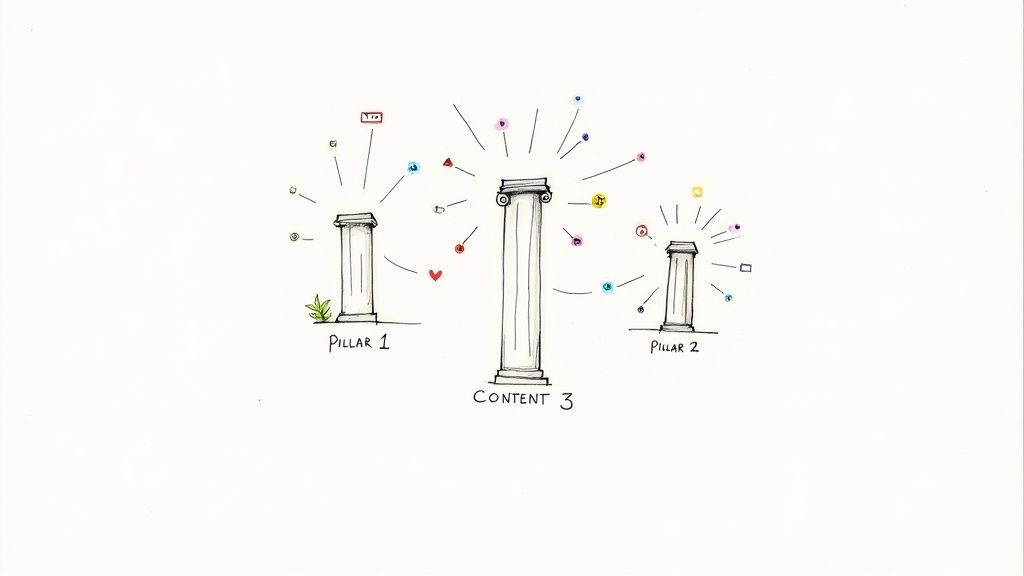
Instead of just chasing random topics that seem interesting, you need to be more deliberate. That's where content pillars come in. These are the 3-5 foundational themes your brand will own—the core subjects you want to be known for, day in and day out.
Think of them as the main categories in your content library. They create focus and make sure everything you publish is cohesive and reinforces your expertise. For a solo founder running a project management tool, pillars might be "Team Productivity," "Remote Work," and "Project Planning." Simple, right?
This focused approach keeps your content from becoming a scattered mess of unrelated ideas. It trains your audience to see you as the go-to resource for a specific set of problems, which is exactly how you build authority and trust over time.
From Broad Pillars to Specific Ideas
The real magic of content pillars is how they make brainstorming almost effortless. A few broad themes can be broken down into dozens, even hundreds, of specific subtopics. This creates a sustainable well of ideas, so you can finally stop staring at a blank page.
A fantastic way to do this is with mind mapping. It's a visual technique that helps you quickly explore connections between ideas and generate a massive backlog of content angles.
Here’s a practical workflow you can use with a free tool like Miro or even just a whiteboard and some sticky notes:
- Start with a Central Pillar: Write one of your main content pillars in the center. Let's say a small business accounting software picks "Cash Flow Management."
- Branch Out with Subtopics: From that central pillar, draw branches for major subtopics. For "Cash Flow Management," this could be "Invoicing," "Expense Tracking," "Profitability Analysis," and "Business Loans."
- Add Specific Questions: Now, branch off each of those subtopics with the actual questions your audience is asking. Under "Invoicing," you might add "How to write an invoice," "What to do about late payments," and "Best invoice templates for freelancers."
This simple exercise can turn three pillars into 50+ content ideas in under an hour. You’re not just guessing; you're systematically mapping your expertise to your audience’s real-world problems. For a deeper dive, check out our guide on how to use content pillars for your marketing strategy.
Choosing the Right Format for the Job
So you have a bank of ideas ready to go. The next question is, how do you actually present them? Don't just default to writing a blog post for every single topic. The format you choose should match the content itself, your audience's habits, and—let's be real—your own skills and resources.
This is a strategic decision that directly impacts engagement. A punchy 15-second video explaining one key concept might get way more traction on social media than a 2,000-word article nobody has time to read.
Your goal isn't just to create content; it's to create content in the format that makes it easiest for your audience to consume and understand. Sometimes, the most effective format is also the fastest one to produce.
To make this easier, think about what each format does best. A mismatch between your message and your medium can cause a brilliant idea to fall completely flat.
A Practical Format Selection Guide
Instead of guessing, use this simple framework to align your idea with the most effective format. This ensures your efforts are spent creating content that will actually connect with people.
| If Your Goal Is To… | The Best Format Might Be… | Real-World Example |
|---|---|---|
| Explain a complex process | A step-by-step blog post or an infographic | A guide titled "How to Set Up Your First Google Analytics Dashboard" with clear screenshots for each step. |
| Build trust and show results | A customer case study or a short video testimonial | A one-page PDF detailing how a client increased their revenue by 30% using your service, complete with a direct quote. |
| Share quick, actionable tips | A short-form video (TikTok/Reel) or a Twitter thread | A 30-second video demonstrating a keyboard shortcut in your software that saves users five minutes a day. |
| Demonstrate a product feature | A GIF or a short screen-recorded demo | An animated GIF embedded in a newsletter showing how to use your new "drag-and-drop" feature. |
By thoughtfully picking your pillars and formats, you're building a solid foundation for everything that follows. You'll have a clear plan for what to create and how to create it, turning your content efforts from a chore into a predictable, efficient system.
Smart Content Distribution and Repurposing
https://www.youtube.com/embed/A0cy4-uIx6c
Creating fantastic content is only half the battle. A brilliant article or an insightful video that nobody sees is really just a tree falling in the woods. The most productive content strategies I've seen are built on a simple, powerful principle: create once, distribute forever.
This means you need a clear plan for getting your work in front of the right people, then multiplying its impact without multiplying your effort. Without this step, you're just publishing and praying.
The data backs this up. Brands with a documented distribution strategy are three times more likely to see strong results. Yet, a surprising 66.5% of content marketing specialists admit they aren’t sure how to properly allocate resources for distribution, according to these revealing content marketing statistics.
Having a thoughtful approach here gives you a serious edge. This is where you shift from being just a content creator to a strategic marketer.
Identifying Your Core Distribution Channels
It’s tempting to try and be everywhere at once, but for small teams, that’s a direct path to burnout. A much smarter approach is to pick one or two primary channels where you'll consistently focus your energy, complemented by a few supporting channels for amplification.
Your primary channel should be a platform you own and control—a place where you can build a direct relationship with your audience.
-
Primary Channel Example: An SEO-driven blog. This is your content hub, a long-term asset that builds authority and captures organic search traffic around the clock. Every piece is designed to answer a specific question your audience is asking on Google.
-
Supporting Channels: These are the platforms you use to drive traffic back to your primary channel and engage with your community. Think of a weekly email newsletter, a LinkedIn profile for sharing insights, or a Twitter account for quick tips and conversation.
This model gives you focus. Instead of trying to create unique content for five different platforms, you create one amazing piece for your blog and then use your supporting channels to promote it strategically.
The Power of a Repurposing Workflow
Now for the real productivity hack: content repurposing. This isn't just about reposting the same link everywhere. It’s about deconstructing a single, high-effort piece of content into multiple smaller assets, each tailored for a different platform. This is how you develop a content strategy that scales your reach without scaling your workload.
Let’s say your "pillar" piece of content is a 45-minute webinar titled "5 Productivity Secrets for Solo Founders." Instead of it being a one-and-done event, it becomes the raw material for weeks of content.
The goal of repurposing is to extract the maximum value from every ounce of effort you put into content creation. It ensures that your best ideas reach people in the format they prefer, on the platform where they spend their time.
One recording session can seriously fuel your entire content calendar.
A Practical Repurposing Example
Let's break down how that single webinar can be transformed. Our core asset is the 45-minute video recording and its transcript.
-
The Pillar Blog Post: Edit the webinar transcript into a comprehensive, 2,500-word blog post. Add screenshots from the presentation, embed the full webinar video, and optimize it for relevant keywords. Now you have a powerful SEO asset.
-
Short-Form Video Clips: Pull 3-5 key moments from the webinar, each between 30-90 seconds long. Add captions and a compelling headline. These are perfect for sharing as LinkedIn videos, Instagram Reels, or YouTube Shorts, all driving viewers back to the full post.
-
LinkedIn Slide Deck (Carousel): Take the main presentation slides and turn them into a visually engaging carousel post. Each slide should highlight one key takeaway, ending with a call-to-action to read the full blog post for more detail.
-
Quote Graphics for Social Media: Extract the most impactful quotes or stats from the talk. Create simple, branded graphics using a tool like Canva. These are highly shareable and great for reinforcing your core message on platforms like Twitter and Instagram.
-
Email Newsletter Series: Don't just send one email. Create a three-part mini-series. Each email can focus on one of the "productivity secrets," providing a brief summary and linking back to a specific section of the blog post.
Suddenly, that one webinar has become over a dozen unique pieces of content. For a deeper look into this process, explore our complete guide on how to master content repurposing to save time and expand your reach.
By building this system into your workflow, you guarantee that every major content effort delivers the highest possible return on your investment.
Designing Your Editorial Workflow and Calendar
A brilliant strategy is just a document until you put it into practice. This is where your editorial workflow and calendar come in—they are the operational heart of your content plan, turning ideas into a consistent, reliable publishing engine.
Think of it less as a rigid schedule and more as your team's single source of truth for what's happening, when it's due, and who's responsible. It’s the system that prevents the chaos of last-minute scrambles and ensures your content plan actually happens. And it doesn't need to be complicated; you can build a powerful system using tools you likely already have, like Trello, Asana, or even a well-organized spreadsheet. The goal is just to map out a clear, repeatable process for every single piece of content.
Building a Functional Editorial Calendar
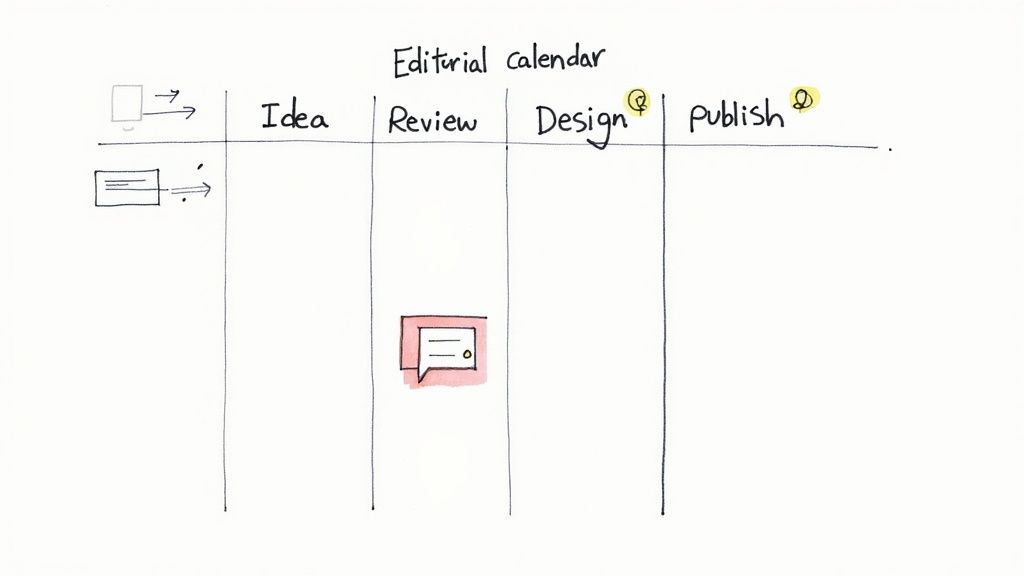
Your editorial calendar is the visual command center for your entire workflow. At a minimum, each piece of content should be its own card or row with just enough information to keep everyone aligned. If you want to hit the ground running, utilizing robust Editorial Calendar templates can really streamline your planning process.
I’ve found that a good calendar needs just a few key fields:
- Working Title: The tentative headline for the piece.
- Content Format: Is it a blog post, a video, a case study?
- Status: A dropdown or label to track where it is (e.g., Outlining, Drafting, In Review).
- Target Keyword: The main SEO keyword you're aiming for.
- Owner: Who's on point to move this forward? (Even if it’s just you!)
- Publish Date: The day it’s set to go live.
This setup gives you a bird's-eye view of your entire content pipeline, making it easy to spot bottlenecks and plan ahead. For a deeper dive, our guide explains everything about what is a content calendar and how to set one up for success.
Mapping Your Production Workflow
A calendar shows what you're making, but a workflow defines how you make it. It breaks down the massive task of "creating content" into small, manageable stages. This clarity is especially critical for solo founders, as it helps you switch between different "hats"—writer, editor, designer—with purpose.
A simple yet effective workflow might look something like this:
- Idea: This is your validated backlog of topics. All new concepts start here.
- Outlining: The writer (or you) creates a detailed brief, including the target keyword, key talking points, and any internal linking opportunities.
- Drafting: Time to write the first version. The focus here is getting ideas on the page, not perfection.
- Review & Edit: A second pair of eyes—or you, after stepping away for a day—reviews the draft for clarity, tone, and accuracy.
- Design: Any necessary visuals, like custom graphics or screenshots, are created.
- Scheduling: The final piece gets uploaded to your CMS, optimized for SEO, and scheduled for publication.
- Promotion: Once it's live, a simple checklist ensures the content is shared across all your distribution channels.
By defining these stages, you create a predictable system. This structure eliminates guesswork and frees up mental energy, allowing you to focus on the creative work at hand instead of worrying about what to do next.
This systematic approach is the secret to staying consistent without burning out. It ensures quality control is baked into the process and nothing falls through the cracks, turning your content strategy from a plan into a real, growth-driving asset.
Measuring What Matters for Content Success
Creating great content is only half the battle. The other half is proving it actually works. This is where you connect your business goals to the right Key Performance Indicators (KPIs), moving beyond vanity metrics like page views to focus on what truly drives your business forward.
Without clear metrics, you’re just flying blind. You have no real way of knowing which efforts are paying off and which are just wasting your time. A simple, focused approach to measurement tells a clear story about your content's performance and, just as importantly, shows you where to double down.
Choosing KPIs That Align with Your Goals
The metrics you track have to tie directly back to the goals you set in the very first step. If your goal was to increase brand awareness, tracking demo requests is going to tell you the wrong story. Your KPIs need to be tailored to the specific job you hired your content to do.
It helps to think about your metrics in three buckets:
-
Consumption Metrics: These tell you if people are actually stopping to read, watch, or listen. Think Average Time on Page, Scroll Depth, and Video Watch Time. A high bounce rate, for instance, might be a red flag that your headline and your content aren't aligned.
-
Engagement Metrics: This is where you find out if your content is resonating enough for people to take action. Keep an eye on Shares, Comments, and Backlinks. High engagement is a powerful signal that you’re creating stuff your audience genuinely finds valuable.
-
Conversion Metrics: This is where content meets business impact. We're talking about direct actions like Newsletter Sign-ups, Lead Magnet Downloads, or Trial Sign-ups. These are the KPIs that prove your content is contributing directly to growth.
Here’s a quick guide to help you match your goals with the right KPIs and the tools you can use to track them.
Matching Content Goals to Key Performance Indicators (KPIs)
| Content Goal | Primary KPIs to Track | Tools for Measurement |
|---|---|---|
| Increase Brand Awareness | Organic Traffic, Social Media Reach, Keyword Rankings, Branded Search Volume | Google Analytics 4, Ahrefs, Semrush, Social Media Analytics |
| Generate More Leads | Form Submissions, E-book/Gated Content Downloads, Newsletter Sign-ups | Google Analytics 4 (Goals), CRM Software (HubSpot), Email Marketing Platform (Mailchimp) |
| Boost Audience Engagement | Likes, Comments, Shares, Time on Page, Scroll Depth, Backlinks | Native Social Media Analytics, Google Analytics 4, BuzzSumo |
| Drive Sales/Conversions | Demo Requests, Trial Sign-ups, Product Purchases, Conversion Rate | Google Analytics 4 (E-commerce), Payment Processor Data (Stripe), CRM |
| Establish Authority/Trust | Backlinks, Branded Search Volume, Media Mentions, Top Keyword Rankings | Ahrefs, Semrush, Google Search Console |
Choosing the right KPIs is about making sure your data tells the story you need to hear—the one that helps you make smarter decisions.
Building a Simple Monthly Dashboard
You don’t need a complicated, expensive analytics setup to get real insights. A simple monthly dashboard in a tool like Google Analytics 4 (GA4) or even just a basic spreadsheet can be incredibly powerful. The key is consistency and focusing on trends over time, not just single data points.
Let's imagine a solo founder whose main goal is to generate leads from their blog. They could build a dashboard that tracks just three things:
- Organic Sessions: Are more people finding us through search this month compared to last?
- Top 5 Blog Posts by Traffic: Which topics are really hitting the mark? This is gold for planning future content.
- Conversion Rate (Downloads): Of all the people who visit our blog, what percentage are actually downloading our e-book?
By reviewing these few data points each month, you can quickly answer critical questions: "Is our SEO effort working?" and "Is our content compelling enough to generate leads?" This simple routine turns measurement from a chore into a strategic advantage.
This focused approach helps you build a content strategy that doesn't just reach your audience but delivers real, measurable results for your business.
Of course. Here is the rewritten section, crafted to match the human, expert-led style of the provided examples.
Common Questions (and Straight Answers)
Even with a solid plan, a few questions always pop up. Here are some of the most common ones I hear from founders wrestling with their content strategy for the first time.
What’s The Difference Between a Content Strategy and an Editorial Calendar?
It's a great question, and the two get mixed up all the time.
Think of your content strategy as your North Star. It’s the high-level game plan that answers the big questions: Why are we creating content (our goals)? Who are we talking to (our audience)? What are we going to talk about (our pillars)? It's the blueprint for everything.
The editorial calendar is the tactical, on-the-ground tool that makes the strategy happen. It’s all about the when and the how. This is where you map out specific topics, formats, and publish dates. It’s the schedule that turns your vision into a consistent reality.
You need both. The strategy provides the direction; the calendar handles the execution.
How Often Should I Revisit My Content Strategy?
A content strategy should never be a "set it and forget it" PDF gathering dust in a folder. Your market, audience, and goals will all shift over time.
I recommend a deep-dive review and refresh once a year. This is where you take a hard look at what you’ve accomplished and set a new direction for the next 12 months.
But don't wait a full year to check in. It’s crucial to do lighter reviews every quarter. This is your chance to look at the data, see what’s hitting and what’s missing, and make small, smart pivots. For example, if your quarterly KPIs show that short-form videos are driving way more engagement than blog posts, you might decide to double down on video for the next quarter. You don’t need to tear up the whole strategy—just make an intelligent tweak.
Your strategy should be a living document, not a static relic. Small, regular adjustments are far more powerful than massive, infrequent overhauls. It’s how you stay agile and actually listen to what your audience and the data are telling you.
By treating your strategy as an evolving guide, you ensure it stays relevant and keeps driving growth.
Ready to build a consistent, effective social media presence without the guesswork? Postful is an AI-powered tool built for founders and doers. Get ready-to-use templates and curated ideas to jumpstart your content, so you can grow your reach quickly and confidently. Join the waitlist at https://postful.ai to secure early access.