
The difference between a growing audience and a stagnant one often comes down to a few powerful words. For busy founders and side-hustlers, a weak call to action (CTA) means wasted effort, while a strong one turns passive scrollers into active customers, subscribers, and community members. But crafting CTAs that genuinely work can feel like a dark art, especially when you're juggling a dozen other tasks. This guide demystifies the process by breaking down 10 effective call to action examples you can adapt and use today.
We'll move beyond generic advice like "use strong verbs" and dive into the specific psychology, strategy, and replicable workflows that make these CTAs so powerful. To provide a solid foundation for our exploration of CTAs, you might find it helpful to review this quick guide on What Is a Call to Action in Marketing? before diving into the advanced strategies we cover here.
This listicle is designed to be a practical toolkit. For each example, we will dissect:
- The Strategy: The psychological principle that makes the CTA compelling.
- Why It Works: A direct explanation of its impact on user behavior.
- Actionable Takeaways: Replicable templates and productivity-focused workflows you can immediately apply to your landing pages, emails, and social media posts.
You’ll learn not just what works, but why it works, and precisely how you can implement these strategies to improve your productivity, automate growth, and connect more deeply with your audience. Forget the guesswork; these are proven frameworks for turning interest into action. Let’s get started.
1. Urgency-Driven CTAs with Limited Access
Urgency-driven CTAs leverage psychological principles like FOMO (fear of missing out) by creating a sense of scarcity or time-sensitivity. This approach positions access as exclusive and valuable, motivating users to act immediately. By limiting access, whether through a waitlist or an invite-only model, you transform a simple sign-up into an opportunity to join an exclusive group.
This method was popularized by tech giants like Gmail and Slack during their early launches. For instance, Postful, a social media scheduling tool, uses "Join the Waitlist" to build anticipation and capture high-intent leads before the product is even fully available. This pre-launch strategy is a powerful way for founders to validate an idea and build a community from day one.
Why This CTA Works
This is one of the most effective call to action examples because it taps directly into human psychology. Limited access implies high demand and quality, creating a perception of value. It frames your product not just as a tool, but as a sought-after resource.
Actionable Takeaways for Founders
- Be Specific About Scarcity: Clearly state what is limited. Is it the number of available seats, a special founding member price, or access before a specific date? Example: "Join the first 100 founders to get beta access."
- Productivity Workflow: Create a "Launch Scarcity" checklist in your project management tool (like Notion or Asana). Include items like: 1) Define the limit (e.g., 200 spots), 2) Set up a countdown timer on your landing page using a tool like Deadline Funnel, 3) Draft 3 reminder emails for the final 72 hours. This turns a complex launch into a repeatable process.
- Gamify the Wait: Offer referral incentives to move up the waitlist using tools like Viral Loops or UpViral. This automates word-of-mouth marketing and turns early users into brand advocates without manual effort.
- Maintain Engagement with Automation: Don't let your waitlist go cold. Set up an automated email sequence in a tool like ConvertKit or Mailchimp. The sequence should send periodic updates about product development, share behind-the-scenes content, and remind them of the value they'll receive. This keeps excitement high and reduces drop-off.
2. Benefit-Focused CTAs with Clear Value Propositions
Benefit-focused CTAs move beyond generic commands like "Submit" or "Sign Up." Instead, they clearly articulate the value a user will receive by taking action. This approach directly answers the user's core question: "What's in it for me?" By highlighting specific outcomes, such as saving time or growing an audience, you connect your product directly to their goals and pain points.
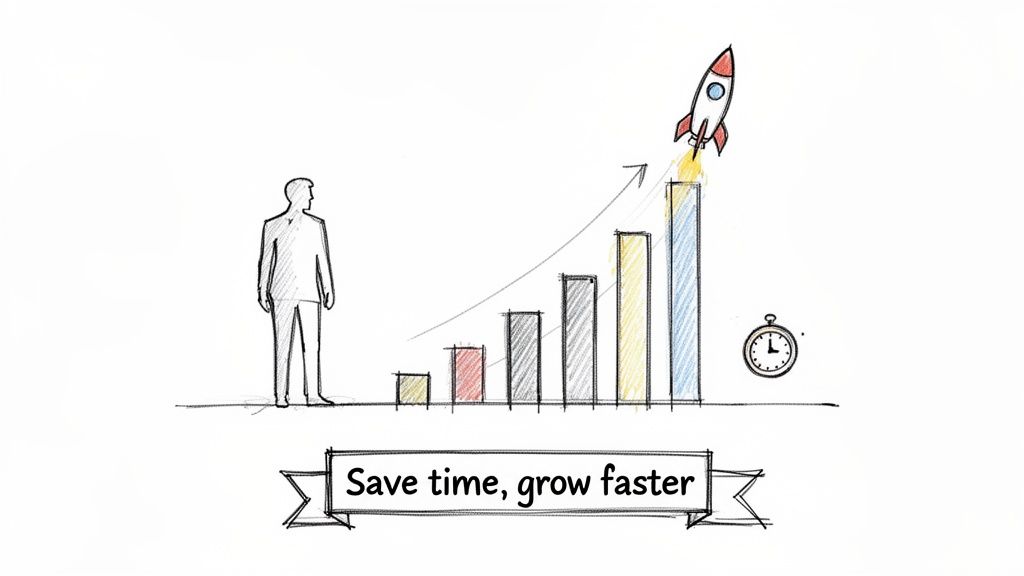
This strategy is a cornerstone of direct response marketing and has been mastered by SaaS giants like Slack, whose CTA "Make work simpler, more pleasant, and more productive" promises a tangible improvement to the user's daily life. For a tool like Postful, a CTA like "Grow your reach quickly" is far more compelling than a generic alternative because it speaks directly to the primary motivation of its target audience: busy founders who need efficient growth.
Why This CTA Works
This is one of the most effective call to action examples because it shifts the focus from the action itself to the desirable outcome. It transforms a simple click into the first step toward solving a problem or achieving a goal. This value-first approach builds trust and makes the decision to convert feel logical and beneficial, reducing friction and hesitation. Great benefit-driven copy is a key part of this, so for more detail, explore these copywriting tips for beginners.
Actionable Takeaways for Founders
- Lead with the Primary Benefit: Identify the single most important outcome your users want and put it front and center. Is it saving 10 hours a week? Or removing the guesswork from content creation? Example: "Save 10 Hours on Social Media Every Week."
- Use Strong Action Verbs: Pair your benefit with a powerful verb. Words like "Unlock," "Achieve," "Master," and "Transform" create a sense of empowerment and progress. Example: "Unlock Your Content's Full Potential."
- Quantify the Value: Whenever possible, use specific numbers to make the benefit more concrete and believable. This turns a vague promise into a measurable result. Example: "Double Your Engagement in 30 Days."
- Productivity Workflow: Create a "Benefit Matrix" in a simple spreadsheet. List your top 3 audience segments in the rows and their top 3 pain points in the columns. In each cell, brainstorm a benefit-focused CTA that solves that specific pain point. This gives you a reusable library of powerful CTAs, saving you time and creative energy for every new campaign.
3. Action-Oriented Verb CTAs
Action-oriented CTAs use strong, specific verbs to command attention and inspire immediate action. Instead of passive or generic phrases like "Submit" or "Learn More," these CTAs use dynamic words like "Start," "Launch," "Discover," or "Unlock." This approach creates a sense of momentum and clearly communicates the value a user will get by clicking.
This tactic is a cornerstone of direct-response copywriting and is used effectively by leading SaaS companies. For instance, Asana's "Get Started" invites users into a collaborative process, while Canva’s "Start Designing" immediately places the user in a creative, productive mindset. For a tool like Postful, a CTA such as "Launch Your Consistent Presence" speaks directly to the ambitious goals of its founder and side-hustler audience.
Why This CTA Works
This is one of the most effective call to action examples because it replaces ambiguity with clarity and energy. Action verbs help users visualize the outcome of their click, making the value proposition more tangible and compelling. It frames the next step not as a simple submission of information, but as the beginning of a valuable experience or achievement.
Actionable Takeaways for Founders
- Choose Verbs That Promise Value: Select verbs that align with your user’s end goal. "Unlock AI-powered content" is far more enticing than "Get access." The verb itself should hint at the benefit.
- Match Verb Intensity to Your Brand: A high-energy brand might use "Launch" or "Transform," while a more pragmatic tool might use "Build" or "Organize." Ensure the verb’s tone aligns with your overall messaging.
- Productivity Tool: Use a thesaurus tool like Power Thesaurus and search for a generic verb like "Get." It will provide a list of stronger, more evocative alternatives. Bookmark a list of your top 10 "power verbs" in a notes app for quick access when writing copy.
- Incorporate a First-Person Perspective: Increase a user's sense of ownership by framing the CTA from their point of view. For example, use a tool like Google Optimize or VWO to A/B test "Start My Free Trial" against "Start Your Free Trial" — this simple change can often lead to higher conversion rates.
4. Social Proof-Enhanced CTAs
Social proof-enhanced CTAs build trust and reduce hesitation by showing that others have already taken the desired action and found value. This approach leverages the human tendency to follow the actions of the masses, a powerful psychological trigger that validates a user's decision. By incorporating user counts, testimonials, or success metrics directly into or around your call to action, you transform a simple request into a safe, popular choice.
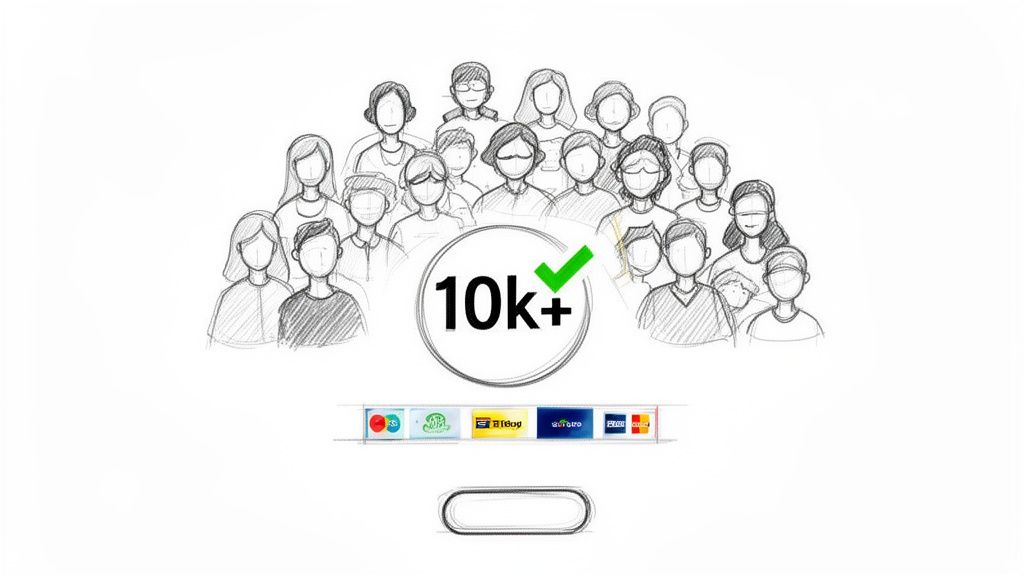
This tactic is ubiquitous in the SaaS world for a reason. Calendly’s homepage prominently states it is "Trusted by 10 million users," and Duolingo encourages sign-ups with its "Join 500+ million learners" CTA. For a founder-focused tool like Postful, this could be "Join 10,000+ founders growing their brand on social media." This isn't just about showing off numbers; it's about providing instant validation and de-risking the decision to sign up.
Why This CTA Works
This is one of the most effective call to action examples because it provides immediate evidence that your product is tested, trusted, and valuable. It answers the subconscious question in a user's mind: "Are other people like me using this and is it any good?" A positive answer, backed by data or testimonials, significantly lowers the barrier to conversion. To dive deeper into this concept, you can learn more about what social proof is and how to use it.
Actionable Takeaways for Founders
- Be Hyper-Specific: Vague claims like "Join thousands" are less impactful than precise numbers. Use "Join 7,842 creators" or "Trusted by 150+ YC founders." Tools like Proof or Nudgify can display real-time user activity to create dynamic, powerful social proof.
- Productivity Workflow: Create an automated workflow to gather testimonials. Use a tool like Zapier to connect your payment processor (e.g., Stripe) to a survey tool (e.g., Typeform). 30 days after a customer signs up, automatically send them an email with a link to a simple form asking for feedback. This system builds your social proof library on autopilot.
- Combine Metrics with Outcomes: Don't just state the number of users. Connect it to a benefit. For instance, instead of just "10,000 users," try "Join 10,000+ founders who save 10 hours a week on social media."
- Start Small and Grow: If you don't have thousands of users yet, start with what you have. "Join our first 100 beta users" or "Featured in TechCrunch" can be equally powerful forms of early-stage social proof.
5. Personalized Segment-Specific CTAs
Personalized, segment-specific CTAs move beyond the one-size-fits-all approach. This strategy involves tailoring your call to action to distinct audience segments based on their unique roles, pain points, and stage in the customer journey. Instead of a generic "Sign Up," you speak directly to the specific motivations of each user group.
This method is powerfully demonstrated by platforms like HubSpot, which presents different CTAs and content to marketers versus salespeople on its site. For a social media tool, this could mean showing "Build consistent presence while scaling your startup" to founders, but "Grow your side hustle without the daily grind" to side-hustlers. This personalization makes the value proposition feel instantly relevant and compelling.
Why This CTA Works
This is one of the most effective call to action examples because relevance drives conversion. When a CTA mirrors a user's specific problem or goal, it builds an immediate connection and significantly increases the likelihood of a click. It shows you understand their world, transforming a generic ask into a tailored solution for them.
Actionable Takeaways for Founders
- Define Your Core Segments: Start by identifying 3-5 distinct audience segments. For a founder, this could be "early-stage founders," "side-hustlers," and "small business owners." If you're new to this, you can learn more about how to get started with audience segmentation.
- Map Pain Points to CTAs: For each segment, list their primary pain point and craft a CTA that directly addresses it. A founder's pain is scaling, while a side-hustler's pain is time. Your CTAs should reflect this difference.
- Use Dynamic Content Tools: Implement tools on your website like Mutiny or RightMessage to show different CTAs based on the user's traffic source (e.g., referral from Twitter vs. a startup directory), on-site behavior, or quiz answers. This automates personalization at scale.
- Productivity Workflow: In your email marketing platform (like Mailchimp or ActiveCampaign), use tags to segment your audience based on their sign-up source or survey responses. Create different email templates with pre-written, segment-specific CTAs. This ensures every email feels personal without requiring manual work for each send.
6. Friction-Reducing Progressive CTAs
Progressive CTAs break down the sign-up process into smaller, manageable steps, significantly reducing initial friction. Instead of confronting users with a long form, this approach asks for the bare minimum upfront, like an email address, and then gathers more information over time. This makes the initial commitment feel small and easy, boosting initial conversion rates.
This strategy is highly effective for invite-only platforms or products requiring detailed user profiles. For instance, Product Hunt allows you to follow an upcoming launch with just one click, only asking for more details later. Similarly, early-stage startups often use a simple "Join the Waitlist" form asking only for an email, then follow up to gather more data about the user's needs or company.
Why This CTA Works
This is one of the most effective call to action examples for lead generation because it aligns with the principle of gradual commitment. Once a user completes a small, easy first step (like giving an email), they are psychologically more likely to complete subsequent, larger requests. This method respects the user's time and reduces the cognitive load required to sign up.
Actionable Takeaways for Founders
- Start with One Field: Make your initial CTA ask for the single most essential piece of information, which is almost always the user's email address. Anything else can wait.
- Leverage Follow-up Emails: Use automated email sequences in a tool like Customer.io or Intercom to progressively ask for more information. For example, the first welcome email can include a link to "Complete your profile" or ask a single question to help segment them.
- Gamify Profile Completion: Offer incentives for providing more data later on. This could be early access, a free resource, or a small product credit. Frame it as unlocking more value, not just filling out a form.
- Productivity Workflow: Design a multi-step sign-up flow using a form builder like Tally or Jotform that supports conditional logic. Step 1: Email only. Step 2 (on the "Thank You" page): Ask for their name and role. Step 3 (in a follow-up email): Ask them to complete a 2-minute onboarding survey. This breaks the data collection process into frictionless micro-steps.
7. Problem-Solution Narrative CTAs
Problem-Solution Narrative CTAs are embedded within a story that first establishes a relatable pain point and then presents the action as the clear, logical solution. This storytelling approach builds an emotional connection with the user, making the call to action feel less like a demand and more like a helpful next step. It shifts the focus from your product's features to the user's challenges and aspirations.
This method is famously used by companies like Dollar Shave Club, whose viral video brilliantly outlined the problems with expensive, over-engineered razors before offering their simple, affordable solution. Similarly, Notion’s homepage frames itself as the antidote to scattered docs and chaotic workflows with its "All-in-one workspace" narrative, leading seamlessly to a "Try Notion free" CTA. The action becomes the inevitable conclusion to the story you’ve just told.
Why This CTA Works
This is one of the most effective call to action examples because it mirrors a fundamental human thought process: identifying a problem and seeking a solution. By articulating the user's struggle better than they can themselves, you build immediate trust and rapport. The CTA isn't a sales pitch; it's the resolution the user is now actively seeking.
Actionable Takeaways for Founders
- Agitate the Pain Point: Don't just state the problem; describe the frustrating consequences. Instead of "Save time," try "Stop wasting Saturdays on manual data entry." This makes the problem more tangible and the need for a solution more urgent.
- Productivity Workflow: Use the "Problem-Agitate-Solve" (PAS) framework as a template for your landing pages and emails. Create a reusable document or template in your content tool that has three sections: 1) Problem: State the customer's pain point. 2) Agitate: Describe why it's so frustrating. 3) Solve: Introduce your product with a clear CTA as the solution. This structured workflow streamlines your copywriting process.
- Make the CTA the Climax: The call to action should feel like the final, satisfying chapter of the story. A CTA like "End the chaos" or "Start creating with confidence" completes the narrative arc you’ve established.
- Use “You” Language: Frame the entire narrative around the user. Phrases like "Tired of staring at a blank page?" and "Are you struggling to…" make the story personal and directly relatable to their experience.
8. FOMO-Driven Community and Referral CTAs
Referral-based CTAs transform your existing users into a powerful marketing engine. This strategy leverages network effects and social proof by incentivizing users to invite others from their network. By offering a tangible reward for both the referrer and the new user, you create a self-perpetuating growth loop driven by trust and shared value.
This model was famously executed by Dropbox, which offered free storage space for every successful referral, and Robinhood, which gives users a free stock when a friend signs up. For founders, a CTA like "Invite 3 friends to unlock [Feature X]" not only acquires new users at a low cost but also deepens the engagement of your existing ones. It turns passive users into active brand advocates.
Why This CTA Works
This is one of the most effective call to action examples because it builds on established trust. A recommendation from a friend is far more persuasive than a traditional advertisement. It taps into our desire for social connection and mutual benefit, making the act of sharing feel less like marketing and more like helping a friend discover something great.
Actionable Takeaways for Founders
- Offer a Double-Sided Incentive: Reward both the person referring and the person being referred. This "give-get" model makes the invitation more appealing and increases the likelihood of conversion. Example: "Give 50% off, Get $20."
- Make Sharing Frictionless: Your referral process should be effortless. Provide users with a unique, one-click referral link they can easily share via text, email, or social media. Pre-populate the share message to save them time.
- Productivity Tool: Instead of building a referral system from scratch, use an off-the-shelf tool like ReferralCandy or Rewardful. These platforms integrate with your billing system and handle link generation, tracking, and reward fulfillment automatically, saving you significant development time.
- Visualize the Reward: Show users their progress toward earning a reward. A simple progress bar or a checklist (e.g., "2 of 3 invites complete") can gamify the experience and motivate them to complete the action.
9. Free Trial or Freemium Conversion CTAs
Free trial or freemium CTAs are designed to dramatically lower the barrier to entry for potential users. By offering a taste of the product's value without an upfront financial commitment, these calls to action remove friction and risk from the decision-making process. This strategy builds trust and allows the product's quality to do the heavy lifting in converting users into paying customers.
This approach is the backbone of modern SaaS growth, championed by companies like Notion with its "Start using Notion for free" and Zapier with its "15-day free trial." The core idea is to let users experience the "aha!" moment firsthand. Once they've integrated the tool into their workflow and see its benefits, the transition to a paid plan becomes a logical next step rather than a speculative purchase.
Why This CTA Works
This is one of the most effective call to action examples for software and service-based businesses because it aligns with the "try before you buy" mentality. It shifts the user's focus from "What if I don't like it?" to "What can I accomplish with this?" By removing payment friction, you get more users in the door, creating a larger pool of potential customers to nurture and convert.
Actionable Takeaways for Founders
- Remove All Friction: If possible, use "No credit card required." This simple phrase can significantly boost sign-up rates as it signals a truly risk-free trial.
- Set Clear Expectations: Be transparent about what the free trial or freemium plan includes and its limitations. Specify the duration (e.g., "14-day free trial") or feature caps to avoid user frustration.
- Productivity Workflow: Design an automated onboarding email sequence that guides new trial users toward their "aha!" moment. Use a tool like Userlist or Mixpanel to track user actions. Trigger emails based on behavior (e.g., if a user hasn't tried a key feature within 3 days, send a helpful tip). This workflow automates the process of converting trial users into active, engaged customers.
- Create a Gentle Upgrade Path: As a trial nears its end, send friendly reminders that highlight the value they've received and what they'll lose. For freemium users, place upgrade prompts contextually when they attempt to use a premium feature.
10. Curiosity-Gap and Intrigue-Based CTAs
Intrigue-based CTAs work by creating a "curiosity gap" in the user's mind, a concept popularized by behavioral economist George Loewenstein. This approach intentionally withholds information, presenting a question or a surprising hint that the user feels compelled to resolve by clicking. Instead of laying out all the benefits, these CTAs tease a valuable outcome or a secret insight.
This tactic is a cornerstone of modern content marketing, seen everywhere from BuzzFeed headlines to high-converting landing pages. For example, a productivity app might use a CTA like, "We removed the blank page. See what changed," which creates immediate intrigue. Rather than saying "Try our new editor," it makes the user wonder what innovative solution replaced the familiar but daunting blank page. This forces a click to satisfy that curiosity.
Why This CTA Works
This strategy is one of the most effective call to action examples because it leverages the brain’s natural desire for closure. An open loop or an unanswered question creates mild cognitive discomfort, and clicking the CTA is the only way to relieve it. It transforms a passive browsing experience into an active quest for information, significantly boosting engagement and click-through rates.
Actionable Takeaways for Founders
- Create Genuine Intrigue, Not Clickbait: Your promise must align with the content behind the click. A CTA like "The one tool founders use to stop wasting time" must lead to a page that clearly explains and demonstrates that specific tool. Misleading users erodes trust.
- Productivity Tool: Use a headline analyzer tool (like CoSchedule's or Sharethrough's) to test the "curiosity score" of your CTA copy. These tools can help you refine your wording to maximize intrigue without straying into clickbait.
- Balance Mystery with Clarity: While creating intrigue is key, the user should still have a general idea of the topic. Combine a mysterious headline with a clear sub-headline. For example, "The biggest mistake in SaaS pricing (and how to fix it)."
- Deliver the Payoff Immediately: The moment a user clicks, the curiosity gap must be closed. Ensure your landing page instantly answers the question or reveals the information promised in the CTA. Delaying the reward will lead to frustration and a high bounce rate.
Comparison of 10 Effective CTAs
| Approach | 🔄 Implementation Complexity | ⚡ Resource Requirements | 📊 Expected Outcomes | 💡 Ideal Use Cases | ⭐ Key Advantages |
|---|---|---|---|---|---|
| Urgency-Driven CTAs with Limited Access | Medium — timed logic & UI | Medium — design, backend, comms | High (15–35% uplift); ⭐⭐⭐⭐ | Invite-only launches, beta signups | Creates exclusivity & immediate action; drives buzz |
| Benefit-Focused CTAs with Clear Value Propositions | Low–Medium — research + copy iteration | Low–Medium — copywriting & testing | High (12–28% when clear); ⭐⭐⭐⭐ | Product pages, founders seeking ROI | Communicates tangible value; reduces friction |
| Action-Oriented Verb CTAs | Low — copy change + A/B tests | Low — copy resources only | Medium–High (10–22%); ⭐⭐⭐ | Onboarding flows, CTAs for builders | Increases clarity and momentum; concise |
| Social Proof-Enhanced CTAs | Low–Medium — collect & display proof | Medium — testimonials, metrics upkeep | High (18–35% uplift); ⭐⭐⭐⭐ | New platforms, trust-building pages | Builds credibility; reduces perceived risk |
| Personalized Segment-Specific CTAs | High — segmentation & dynamic content | High — data, tooling, content variants | Very High (25–45% when targeted); ⭐⭐⭐⭐⭐ | Multi-audience SaaS landing pages | Highly relevant messaging; better match to intent |
| Friction-Reducing Progressive CTAs | Medium — multi-step UX & state | Medium — flows, follow-ups, tracking | Very High (35–60% higher sign-ups); ⭐⭐⭐⭐⭐ | Waitlists, initial user capture, mobile signups | Lowers abandonment; quick initial conversion |
| Problem-Solution Narrative CTAs | Medium–High — long-form storytelling | Medium — content creation & editing | Medium–High (12–28% dependent on quality); ⭐⭐⭐ | Content-led landing pages, case studies | Emotional resonance; justifies the action |
| FOMO-Driven Community & Referral CTAs | Medium — referral mechanics & tracking | Medium–High — rewards, fraud controls | Very High (can cut CAC 30–60%); ⭐⭐⭐⭐⭐ | Viral growth for invite-only products | Drives viral loops; rewards advocacy |
| Free Trial / Freemium Conversion CTAs | Medium — billing, tiers, onboarding | Medium–High — product readiness & support | High (10–15% trial→paid typical); ⭐⭐⭐⭐ | SaaS product-led growth, demo-first flows | Lowers entry barrier; lets product prove value |
| Curiosity-Gap and Intrigue-Based CTAs | Low–Medium — clever copy & sequencing | Low — copywriting & testing | Medium–High (15–30% CTR possible); ⭐⭐⭐ | Content marketing, lead magnets, teasers | High CTR and memorability if promise delivered |
Your Actionable CTA Productivity Workflow
We've journeyed through a comprehensive collection of effective call to action examples, from the urgency-driven tactics of limited access offers to the subtle power of curiosity-gap CTAs. Understanding the psychology behind why these examples work is the crucial first step. Now, the real challenge begins: transforming this knowledge into a consistent, productive, and growth-driving system for your business.
The most common mistake founders and side-hustlers make is treating the call to action as an afterthought, hastily tacked on at the end of a social post or email. This approach wastes your hard work. To truly leverage the power of a great CTA, you must flip your content creation process on its head.
The CTA-First Mindset: Your New Workflow
Instead of writing content and then asking, "What CTA should I add?", start by asking, "What is the single most important action I want a reader to take right now?" This simple shift in perspective reframes your entire content creation process, ensuring every word, image, and headline is purposefully driving your audience toward that specific goal.
Your new productivity workflow should look something like this:
- Define the Goal: Before you write a single word, clarify your objective. Is it to capture an email lead, drive a sale, book a demo, or increase community engagement?
- Select the Strategy: Based on your goal, review the CTA archetypes we covered. Is this a moment for a benefit-focused CTA like "Get Your Free Marketing Plan" or a FOMO-driven community CTA like "Join 500+ Founders Inside"?
- Draft the CTA: Write the actual CTA copy first. This serves as your North Star for the rest of the content.
- Build the Narrative: With your CTA as the destination, build the surrounding content (your ad copy, email body, or landing page headline) as the map that logically and emotionally guides the user there.
- Measure and Iterate: Track the performance of your CTA. Note which verb, value proposition, or psychological trigger resonates most with your audience and refine your approach over time.
From Theory to Systemized Action
By adopting this CTA-first workflow, you move from random acts of marketing to a deliberate, strategic system. This is how you build a predictable engine for growth. You stop guessing and start engineering conversions.
Think of your collection of effective call to action examples as a toolbox. You wouldn't use a hammer for every job, and you shouldn't use the same generic "Learn More" CTA for every piece of content.
Strategic Takeaway: The goal isn't just to write better CTAs; it's to build a system where the right CTA is deployed for the right audience at the right time, almost on autopilot. This is how you reclaim your time and scale your impact.
For solo entrepreneurs and small teams, this systemization is not a "nice-to-have," it's a necessity. You don't have time to reinvent the wheel with every post. Creating a "CTA library" in a simple document or spreadsheet can be a game-changer. Categorize them by goal (e.g., Lead Generation, Sales, Engagement) and platform (e.g., Instagram Story, Email Newsletter, Landing Page). When it's time to create content, you simply pull a proven, pre-written CTA, saving valuable creative energy for other parts of your business. This is the essence of working smarter, not harder.
The principles we've discussed are universal, but their power is unlocked through consistent application. Mastering the art and science of the call to action is one of the highest-leverage skills you can develop. It’s the final, critical link that turns passive readers into active customers, followers, and brand advocates.
Ready to turn these examples into an unstoppable productivity system? Postful helps you save your best-performing CTAs as reusable templates and uses AI to help you craft the perfect message for any channel. Stop guessing and start converting by exploring Postful today.