
Forget the sales pitch for a minute.
Storytelling in marketing is really about connection. It's the art of weaving a narrative that ties what your brand stands for directly to what your customers actually need and feel. Instead of just pushing a product, you’re starting a conversation that makes your audience the hero of the story. Do that right, and you build real trust and become unforgettable.
Beyond the Pitch: What Is Storytelling in Marketing?
Think about traditional marketing like someone shouting facts from a megaphone. It’s all about features, sales announcements, and the "what." It gets the message out, but it doesn't really land.
Storytelling, on the other hand, is like sharing a great story around a campfire. It's about creating a human connection. You frame your message within a relatable narrative that has a clear beginning, middle, and end.
This approach isn't about selling a product; it’s about sharing an experience, a mission, or a transformation. It’s designed to make your audience feel seen and understood. The goal is to spark an emotion—whether it’s inspiration, a good laugh, or a moment of empathy—that forms a genuine bond.
Why It Matters Now More Than Ever
In a world overflowing with ads and content, people have become incredibly good at tuning out the noise. They can spot a generic, cookie-cutter sales pitch from a mile away.
This is where a great story cuts through. It helps you hit some major business goals:
- Builds Lasting Trust: Stories make your brand feel human and relatable, not like some faceless corporation.
- Simplifies Complex Ideas: A good narrative can take a complicated product or service and make it instantly understandable by showing it in action. Practical Example: A SaaS company could tell the story of "Jane," a freelance project manager who was drowning in spreadsheets before using their software to reclaim 10 hours a week.
- Makes Your Brand Memorable: Facts and figures are easy to forget. A compelling story sticks.
This isn't just a fleeting trend. The demand for storytelling in marketing has seen a remarkable 46% growth over the last five years, a clear sign that businesses everywhere are turning to narrative to connect with their audiences. For small business owners and side-hustlers, it’s become an absolute game-changer for building loyal communities. You can dig into more of these fascinating storytelling statistics on ElectroIQ.com.
To put it in perspective, let's look at a quick side-by-side comparison.
Storytelling Marketing vs Traditional Marketing
This table breaks down the fundamental differences between the old-school approach and a narrative-driven one.
| Aspect | Traditional Marketing | Storytelling Marketing |
|---|---|---|
| Primary Goal | Drive immediate sales | Build a long-term relationship |
| Approach | Interruptive (ads, pop-ups) | Engaging (pulls audience in) |
| Focus | Product features and price | Customer's problems and journey |
| Message | "Buy our product." | "We understand you." |
| Audience Role | Passive consumer | Active participant |
| Impact | Transactional and short-lived | Emotional and memorable |
As you can see, the focus shifts entirely from the brand to the customer, creating a much deeper connection.
Ultimately, storytelling isn't just a creative add-on. It’s one of the most powerful content marketing best practices for building a strong brand and connecting with your audience on a level that actually matters.
The Science of Why Stories Sell
Ever wonder why a great story sticks with you, but a list of facts vanishes from your memory almost instantly? It’s not magic. It’s biology. Our brains are hardwired to process and remember narratives, a trait that smart marketers tap into to build real connections.
When you hear a well-told story, your brain doesn’t just register words. It lights up, activating sensory and emotional centers all at once. This creates an immersive experience that makes the information feel personal and far more memorable than isolated data points.
Tapping into Brain Chemistry
The real power of storytelling in marketing comes down to brain chemistry. A compelling story can trigger the release of oxytocin, often called the "empathy hormone." It's the same chemical that helps us bond with friends and build trust.
When you tell a story that resonates, you're literally creating a biological connection between your brand and your audience. That chemical response builds empathy, making people more receptive to your message and more likely to feel loyal to your brand. It’s the science behind why we root for the underdog or feel a character’s struggle as if it were our own.
"A story, if it is any good, will hook you and take you on a journey. It will transport you from your world into the world of the story." – Paul J. Zak, Neuroscientist
The data shows this connection isn't just a feeling—it's driving real growth and interest in storytelling for marketing.
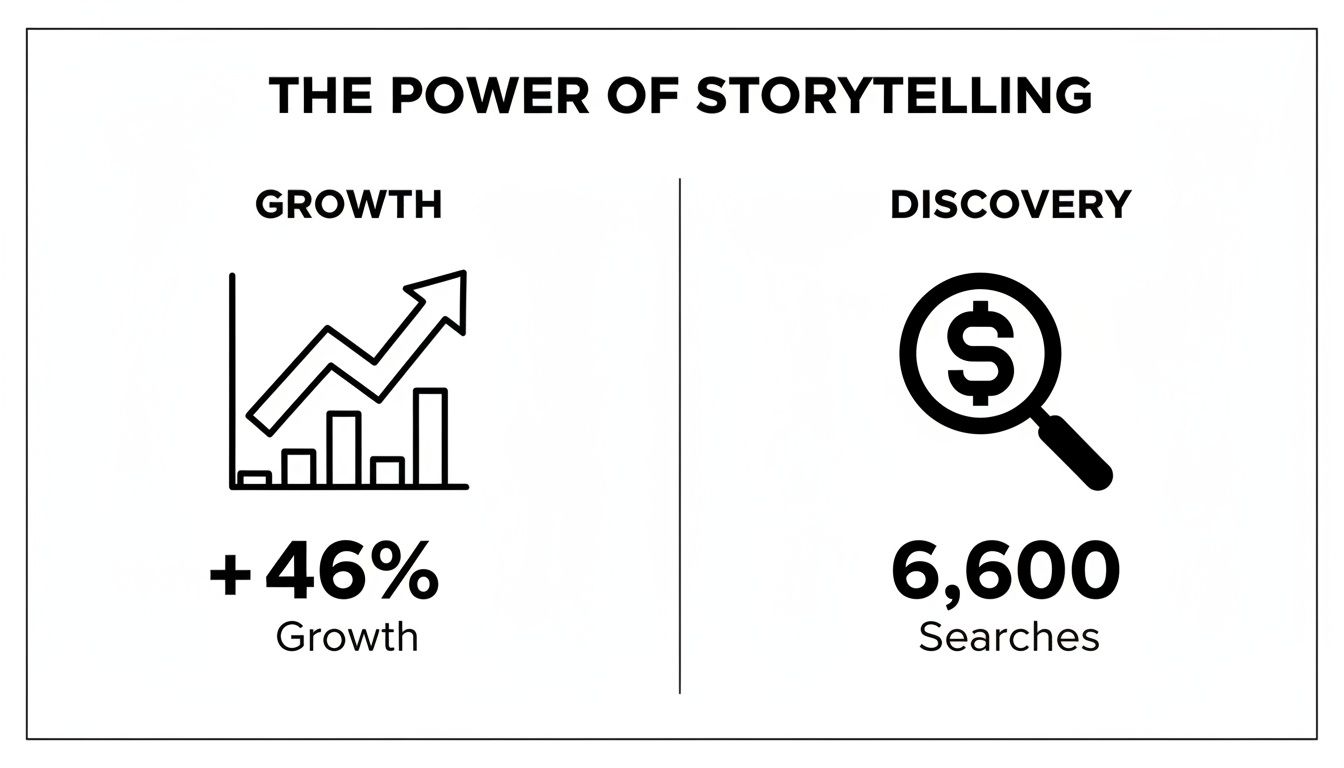
This surge shows a clear shift in how businesses are connecting with their audiences, moving toward narratives to build stronger, more memorable relationships.
Making Facts Unforgettable
This neurological shortcut has a huge impact on how well people remember a brand. Research shows that a whopping 92% of consumers want brands to create stories, not just straightforward promotions.
The science backs it up: we are 22 times more likely to remember facts when they’re wrapped inside a story. That’s because narratives activate the parts of our brain tied to emotion and memory—something a dry statistic on a slide could never do. You can find more insights on how storytelling impacts memory on HigoCreative.com.
The Four Core Elements of a Great Brand Story
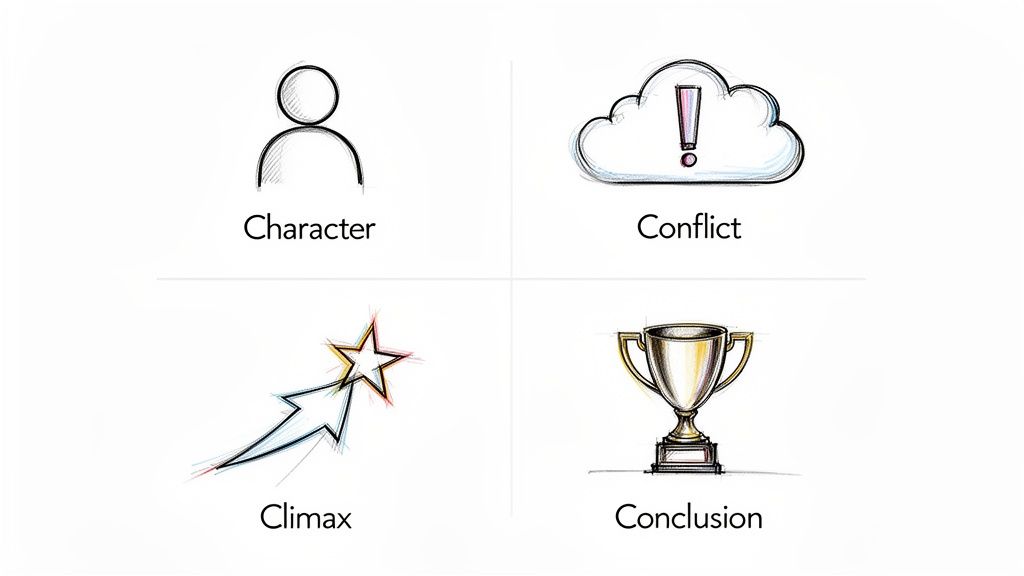
If you want to make marketing storytelling feel less like some mysterious art form and more like a repeatable process, you need a framework. Let's break down the four essential ingredients that make up just about every great story ever told.
Think of these as the building blocks for any narrative that truly connects. Once you get the hang of them, you’ll have a reliable blueprint for crafting stories that stick with your audience every single time. They give your message a clear path, making it easy for people to follow along and get invested in the outcome.
The Character: Your Hero
First things first: every story needs a hero. Here’s the single most important rule in brand storytelling: the hero is always your customer, not your brand. Making this mental shift changes everything. Your entire narrative needs to revolve around their struggles, their goals, and their journey.
So where does your brand fit in? You’re the wise guide, the trusted mentor who gives the hero the tools they need to win. Apple, for instance, doesn’t tell stories about how amazing their computers are. They tell stories about creative people (the heroes) using Apple products (the tools) to change the world.
The Conflict: Their Challenge
Next up, your hero has to face a real, relatable conflict. This is the problem or obstacle standing in their way. Without a challenge, you don't have a story—you just have a list of facts. The conflict is what creates tension and gives the audience a reason to care.
Is your customer struggling with an inefficient process? Are they feeling overwhelmed or stuck? Get specific about their pain point. This conflict is the "before" picture in your story, setting the stage for the transformation that’s about to unfold. You can explore how this ties into your bigger picture in our guide on what is brand messaging.
The Climax: Their Transformation
The climax is the turning point. It's that moment where the hero, with your brand's help, finally overcomes the conflict. This is where your product or service enables a breakthrough, but you have to show it, not just talk about it.
A strong brand story makes the customer the hero, your brand the guide, and your product the tool that helps them win the day. This simple framework turns a sales pitch into an empowering narrative.
Nike’s ads almost never focus on shoe technology. The climax is the athlete pushing past their limits—a moment of personal victory that their gear helped make possible. That emotional peak is what makes the brand's value feel real and tangible.
The Conclusion: Their Success
Finally, the conclusion shows us the hero’s new reality. What does life look like now that the conflict is resolved? This is your "after" picture—a vision of success, freedom, or achievement that your audience can see themselves in. This new reality is what solidifies the value of the transformation.
And this structure gets results. Research shows that 55% of consumers are more likely to buy from a brand if they love its story. It's not just fluff; emotional narratives can deliver a 44% higher ROI than ads that just stick to the facts.
Storytelling Frameworks You Can Use Today
Knowing the elements of a story is one thing, but actually putting them to work is a whole different ballgame. That's where frameworks come in. Think of them as repeatable recipes that turn the abstract art of storytelling into a practical, day-to-day workflow.
Frameworks take the guesswork out of the process, helping you build narratives that consistently connect with your audience. Instead of staring at a blank page, you can follow a proven path to craft great content for social media, your website, or your next email campaign. It’s a huge time-saver.
To really get storytelling working for you, it helps to lean on a solid brand storytelling framework to guide your efforts. Here are three powerful models you can start using right away.
The Hero’s Journey
This is a classic for a reason. It's perfect for your "About Us" page or telling your brand's origin story. The key is to position your customer as the hero who goes on a journey, overcomes a challenge with your guidance, and returns transformed.
- The Call to Adventure: The hero (your customer) realizes they have a problem.
- Meeting the Guide: They find your brand, which offers the tools or wisdom they need.
- Overcoming the Obstacle: With your product, they conquer their challenge.
- The Return: They achieve success and are now living in a new, improved reality.
Practical Example (LinkedIn Post):
"Starting a side hustle felt like navigating a maze blindfolded. That was Sarah (our hero). She had the passion but struggled with marketing (the obstacle). After discovering our scheduling tool (the guide), she automated her social media, freeing up 10 hours a week to focus on her craft. Today, her business is thriving (the return)."
The Before-After-Bridge Model
This one is simple, direct, and incredibly effective. It’s ideal for case studies, testimonials, and any product-focused post where you want to show a clear transformation.
It works by painting a picture of a relatable problem, showing a much more desirable outcome, and then positioning your brand as the bridge that gets people from one to the other.
The Before-After-Bridge model is powerful because it focuses on transformation. It moves the conversation from what your product is to what your product does for the customer.
Practical Example (Instagram Caption):
"Before: Wasting hours staring at a blank content calendar. After: Having a full month of engaging posts scheduled in 30 minutes. The Bridge: Our AI-powered idea generator. Stop guessing, start creating."
Simon Sinek's Start With Why
If you want to build a mission-driven brand that fosters a deeper connection with customers, this is your framework. Instead of leading with what you do, you start with why you do it. As Sinek says, "People don't buy what you do; they buy why you do it."
- Why: Start with your core purpose or belief. Why does your company even exist?
- How: Explain the process or principles you use to fulfill that purpose. What makes you different?
- What: Finally, describe what you actually do or sell.
This structure communicates from the inside out, appealing to the emotional, decision-making parts of the brain first. It helps you build real loyalty by attracting customers who share your core values.
Practical Ways to Weave Stories into Your Content
Theory is great, but let's be honest—turning those big ideas into actual content is where the real work begins. The goal here isn't to create a daunting task that leaves you staring at a blank page. It's to make storytelling a repeatable, even easy, part of your marketing workflow.
We need to move from concept to creation. The trick is to build a simple process that helps you find story ideas, shape them for different platforms, and get them scheduled consistently. This is how you stop reacting and start proactively building a compelling narrative for your brand, day after day.
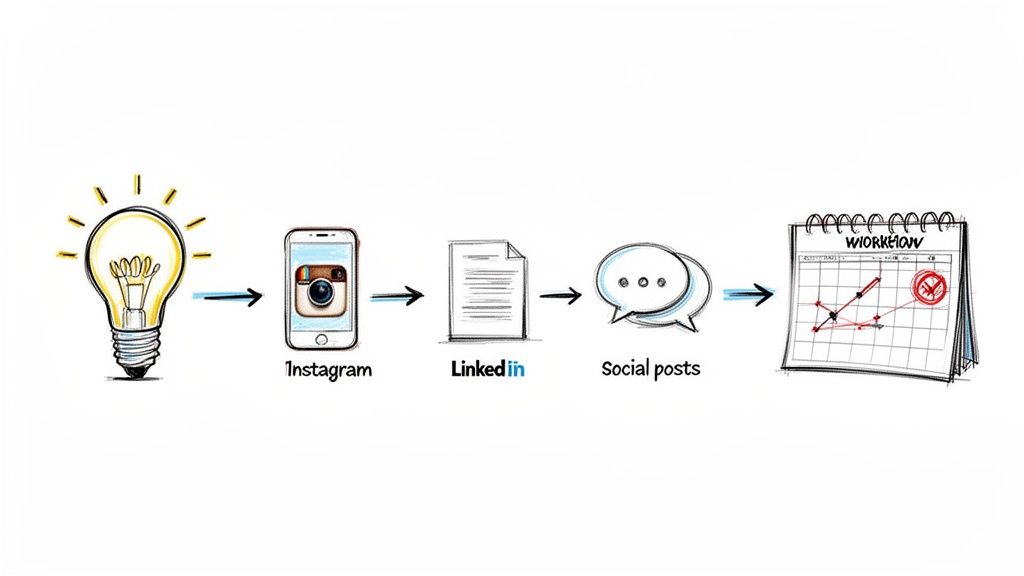
This workflow shows how a simple idea can be expanded and scheduled, turning storytelling into a manageable system instead of a creative headache.
Finding and Structuring Your Story Prompts
The best stories usually pop up in the middle of your day-to-day business. You don't need a Hollywood plot; you just need a genuine human experience someone can connect with.
Start by looking for inspiration in these places:
- Customer Wins: Did a customer hit a huge goal with your product? Turn their success into a mini-case study using the Before-After-Bridge model. It's powerful stuff.
- Behind-the-Scenes Moments: Show people how a new feature gets made or talk about the "why" behind a recent decision. This kind of transparency builds serious trust.
- Your Origin Story: Why did you even start this business? Use The Hero's Journey to tell the story of the problem you just had to solve.
- Common Mistakes: Talk about a time you messed up and what you learned. This kind of vulnerability makes your brand feel incredibly human and relatable.
Once you have a spark of an idea, think about the platform. A deep-dive narrative works great for a LinkedIn article, but an Instagram carousel needs a visual story broken into bite-sized slides. Sometimes, a single, powerful caption is all you need. For more on this, check out our guide to developing a strong brand voice that stays consistent everywhere.
A Productivity-Focused Storytelling Workflow
To make storytelling stick, you need a workflow—and the right tools to back it up. Instead of trying to create content on the fly, a structured process will save you a ton of time and keep you consistent.
Here’s a simple, three-step workflow that works wonders:
- Brainstorm and Batch Ideas: Set aside one block of time each week just for brainstorming. Use a tool like Trello or Notion to create a "Story Bank." Make columns for "Idea," "Drafting," and "Scheduled."
- Draft and Refine: Write out your stories using the frameworks we've talked about. For higher efficiency, you can use AI writing assistants like Postful or Jasper to generate initial drafts from your story ideas, which you can then edit and polish.
- Schedule for Consistency: Use a scheduler to plan your content out. This ensures a steady stream of stories goes live without you needing to be online every single day, keeping your audience engaged and your brand present.
Adopting a batching workflow for your content creation can increase your output by over 50%. By separating idea generation from writing and scheduling, you reduce context-switching and stay focused, making your marketing efforts far more productive.
This structured approach transforms storytelling from something you do "when you have time" into a core, manageable part of your marketing strategy. The result? A stronger brand with a lot less stress.
Building Your Brand One Story at a Time
Storytelling isn't just another marketing tactic; it's the very heartbeat of a brand people remember. It’s the simple but powerful shift from just telling people what you sell to sharing why it matters. This creates real relationships that last far longer than any single campaign.
Every single business, no matter its size, has a story to tell. It could be your origin story, a customer’s big win, or a quick peek behind the scenes. These are the narratives that build bridges, turning people who just browse into a loyal community that actually cares about your mission.
The most powerful stories don't just sell products; they build belonging. By consistently sharing your 'why,' you invite customers to become part of a larger narrative, turning them from buyers into advocates for your brand.
It's time to move beyond rattling off features and start connecting on a human level. When you weave stories into your marketing, you build trust and stand out in a ridiculously crowded space. Consistent, authentic storytelling isn’t just good for business—it’s how you grow a community that truly believes in what you do.
Ready to put these ideas into action? Learn more about how a strong narrative fits into a larger content marketing strategy in our guide and start building your brand, one story at a time.
A Few Common Questions About Marketing Stories
Even after you get the frameworks down, a few practical questions always pop up. Let's tackle the most common ones I hear from founders and marketers who are just getting started with storytelling. The goal here is to give you quick, clear answers so you can get back to building.
How Do I Find My Brand’s Story If I’m Just Starting Out?
When you’re new, your story isn’t about a long, storied past—it’s about your vision for the future. Your origin story is actually one of the most powerful things you have. Just ask yourself: what specific problem did I set out to solve? That "why" is the real heart of your narrative.
Your first story can be built around a few core ideas:
- The Founder’s Journey: What personal frustration or moment of insight led you to create this business? Practical Example: "I spent a decade struggling to find healthy snacks for my kids. I was tired of reading labels full of ingredients I couldn't pronounce. So, I started my own company…"
- The Customer’s Problem: Paint a vivid picture of the exact person you're trying to help.
- The Mission: What change do you want to see in your industry, or even the world?
Your story will grow and change as you collect customer wins, but it always comes back to that initial purpose.
Authenticity is your greatest asset when you're new. Don't invent a story; simply tell the true one about why you started. That passion and purpose will connect with your first true fans more than any polished corporate narrative.
What Is the Difference Between a Brand Story and a Campaign?
Here’s an easy way to think about it: your brand story is the entire novel. It’s the big-picture narrative of who you are, what you believe in, and why you even exist. It's consistent, it's long-term, and it's the foundation for everything you do.
A marketing campaign, on the other hand, is just a single chapter in that novel. It’s a focused, short-term push with a very specific goal, like launching a new product or promoting a holiday sale. Every campaign should feel like it belongs in your larger brand story, but it has its own little plot and a clear ending. Your brand story is permanent; campaigns are temporary.
How Long Should a Marketing Story Be?
This one’s simple: it depends entirely on the platform and how much time people are willing to give you. There's no magic number, just what works in context.
- TikTok & Instagram Reels: Keep it super short. We’re talking under 15-30 seconds. The story has to be visual and fast, often just a simple before-and-after shot.
- Instagram & Facebook Posts: The sweet spot is usually around 100-150 words. You absolutely need a strong hook in that first sentence to stop the scroll.
- LinkedIn Articles & Blog Posts: Here’s where you can go deeper. A 500-1,000 word post gives you enough room to really unpack a narrative, like a detailed customer success story or a look behind the scenes.
Ready to stop staring at a blank page and start telling your brand’s story? Postful gives you AI-powered templates and idea starters to jumpstart your content creation. Join the waitlist to build a consistent, effective social media presence with less effort. Learn more at https://postful.ai.