
For most entrepreneurs, "social media marketing" sounds like another full-time job you just don't have time for. The good news? It doesn't have to be.
It’s not about posting everywhere, all the time. It’s about being smart and strategic on platforms like Instagram, LinkedIn, or TikTok to build your brand, connect with customers, and actually drive growth. The key is to build a solid foundation and a productive workflow that respects your clock.
Building Your Social Media Foundation
Let's be real—your schedule is already bursting at the seams. Adding another major task can feel like a non-starter, but building a presence on social media isn't optional anymore. It's a core part of how modern businesses grow.
In fact, 96% of small business owners are already using social media for marketing. With over 5 billion people actively scrolling, skipping it means leaving a massive, engaged audience on the table.
This guide cuts through the fluff. We're going straight to a practical system that works with your schedule, not against it. And it all starts with getting your foundation right.
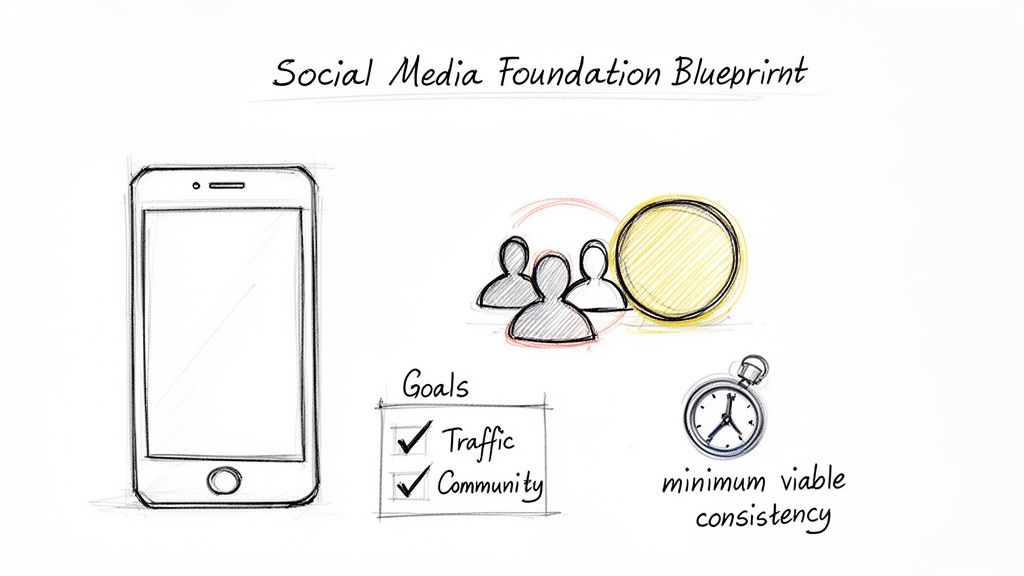
Define Your Goals and Audience First
Before you write a single post, you need to know why you're posting and who you're talking to. Vague goals like "get more followers" are a recipe for wasted effort. You need specific, measurable objectives that tie directly back to your business.
What does a practical goal look like?
- Goal: Drive qualified traffic to your product pages.
- Actionable Step: Use a link-in-bio tool like Linktree or Beacons to direct traffic. Aim for a 5% increase in clicks month-over-month.
- Goal: Generate high-quality leads.
- Actionable Step: Promote a free webinar or downloadable checklist via LinkedIn posts, aiming for 3 sign-ups per week.
- Goal: Build an engaged community.
- Actionable Step: Host a weekly Q&A in your Instagram Stories or create a dedicated Facebook Group, aiming to increase comments by 10% each month.
- Goal: Establish yourself as the go-to authority in your niche.
- Actionable Step: Publish one in-depth "how-to" carousel post on your primary platform each week.
Once your goals are crystal clear, defining your ideal customer gets a lot easier. This isn't just about demographics—it's about deeply understanding their pain points, what motivates them, and where they hang out online. A rock-solid audience profile is the bedrock of every piece of content you'll create. For a deeper dive, check out our guide on how to find your target audience.
Choose Your Platforms Wisely
The single biggest productivity drain for entrepreneurs is trying to be everywhere at once. It’s a fast track to burnout and a feed full of mediocre content.
The smarter move? Pick just one or two platforms where your ideal audience genuinely spends their time.
A B2B consultant will find far more traction building authority on LinkedIn by sharing case studies and industry analysis. On the other hand, an entrepreneur selling handmade jewelry will connect with customers more effectively on visual platforms like Instagram or Pinterest by showcasing product creation videos and high-quality lifestyle photos.
The aim here is to achieve minimum viable consistency—the smallest amount of effort you need to maintain a meaningful, regular presence. By focusing your energy, you can create high-quality content that truly resonates and drives results.
And if video is part of your plan, making your content discoverable is key. Mastering something like YouTube SEO for beginners can give you a huge advantage. It all comes back to a simple idea: don't drain your most valuable resource—your time.
Developing Your High-Impact Content Strategy
Content is the engine of your social media, but let's be honest—it's also where most of us get stuck. That feeling of staring at a blank screen, wondering what on earth to post today? It's a massive time suck. The answer isn't to just brainstorm harder. It's to build a smart, repeatable system that takes the guesswork out of it.
The whole game changes once you define your content pillars. Think of these as the 3 to 4 core themes your brand will own. They’re like the main channels on your personal TV network—every single piece of content you create will fit neatly into one of them.
Defining Your Core Content Pillars
Your pillars should live at the sweet spot where your expertise, your business goals, and what your audience actually wants to know all overlap. Getting this right means your content always feels relevant and purposeful. When you stick to these themes, you start building real authority and people instantly know what you're about.
Here’s a practical example for an entrepreneur running a boutique marketing agency for tech startups:
- Pillar 1: Startup Growth Hacks. Quick, no-fluff marketing tips a founder can put into action right away. (e.g., "3 free tools for competitor analysis," "How to write a headline that converts").
- Pillar 2: Behind the Agency. A look at client wins, team culture, and the real story of building a business. (e.g., "A day in the life of a founder," "Client success story: from 0 to 10k users").
- Pillar 3: Demystifying Marketing Tech. Simple breakdowns of complex tools and trends, from SEO to AI. (e.g., "What is GA4 and why should you care?" "Can ChatGPT write your ad copy?").
See the difference? You never start from zero again. Instead of asking, "What should I post today?" your workflow starts with, "What 'Startup Growth Hack' can I share today?" That small shift makes creating content infinitely easier and more productive.
From Pillars to a Simple Content Calendar
Once your pillars are set, building a content calendar becomes straightforward. And no, this doesn't need to be some complex project management beast. A simple spreadsheet or a free template from a tool like Notion or Trello works perfectly. The goal is just to plan ahead—that’s the foundation for getting things done efficiently.
One of the biggest hurdles for entrepreneurs is the pressure to come up with brand-new, brilliant ideas every single day. This is where AI-powered tools can be a productivity lifesaver. You can feed your content pillars into a tool and get dozens of specific post ideas back in minutes. It becomes your creative partner.
Example AI Prompt Workflow:
- Open your AI tool of choice.
- Enter a prompt like this: "I'm a marketing consultant for tech startups. My content pillar is 'Startup Growth Hacks.' Generate 10 social media post ideas for Instagram and LinkedIn that are practical, actionable, and under 200 words."
- Review and select the best ideas. You now have a week's worth of content ideas in under 5 minutes.
This approach turns content creation from a daunting, creative chore into a structured, almost assembly-line process. You’ll claw back hours every week and keep your social media consistently on-brand and valuable. To build on this foundation, you might also want to check out these 9 Social Media Marketing Strategies.
Focusing on a pillar-based system gives you a sustainable content engine that fuels your growth without burning you out. If you want to go deeper on this, we wrote a whole guide on how to use content pillars to streamline your strategy. With this system in place, you're perfectly set up for the next step: building a rapid creation workflow.
Adopt a Rapid Content Creation Workflow
A brilliant strategy is useless if you can't execute it. For a busy entrepreneur, that execution has to be fast and efficient.
Let's be honest, the secret to social media isn't spending hours agonizing over the "perfect" post. It's building a repeatable system that gets high-quality content out the door without throwing your entire day off track.
The Power of Batching
Forget the last-minute scramble to find something to post. The most productive founders I know swear by content batching.
This just means you dedicate a single, focused block of time each week—or even each month—to create and schedule all your content at once. Think of it like meal prepping on a Sunday versus trying to cook every single meal from scratch. One is a lifesaver; the other is a recipe for burnout.
The process is pretty straightforward: you take your core content pillars, brainstorm ideas that fit them, and then slot those ideas into your calendar.
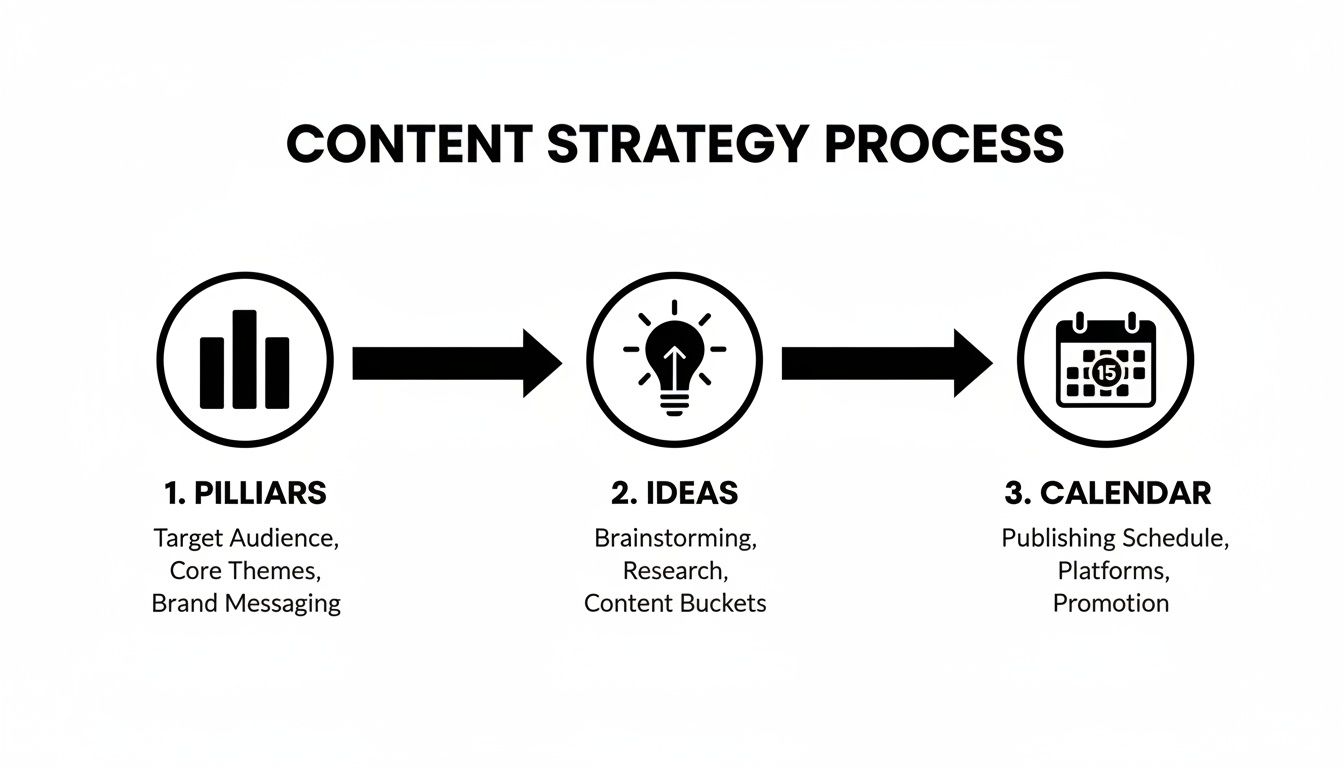
Having a simple, visual system like this completely eliminates the "blank page" problem. Every piece of content you create has a clear purpose tied directly back to your strategy.
Build Your Content Assembly Line
I like to think of content creation as an assembly line. Each stage has one specific job, and you do all of one stage before moving to the next. This simple rule stops you from context-switching, which is an absolute productivity killer.
So, what does a real-life batching session look like? Here’s a quick schedule you could knock out in a single afternoon.
| Weekly Content Batching Workflow Example |
| :— | :— | :— |
| Time Block | Task | Tools & Tips |
| 1:00 PM – 2:30 PM (90 min) | Write All Captions | Open a single Google Doc or Notion page. Focus only on writing the words for every post this week. No distractions. Use a tool like Hemingway App to check for clarity. |
| 2:30 PM – 3:30 PM (60 min) | Create All Visuals | Pull from your template library in a tool like Canva. Just swap in photos and text. Don't start from scratch. Keep a folder of approved brand assets handy to drag and drop. |
| 3:30 PM – 4:00 PM (30 min) | Schedule Everything | Load all the finished captions and visuals into your scheduling tool (like Postful!). Check your posting times and confirm. You're done! |
In less than three hours, your entire week is done. You've just turned a chaotic daily chore into a predictable, manageable project. If you want to get even more organized, check out our guide on how to plan a month of social media content in just one afternoon.
Work Smarter with Templates
Starting every graphic from zero is a massive time-waster and the fastest way to an inconsistent, messy-looking feed. Templates solve both problems.
Using a tool like Canva, you can create a handful of branded templates that perfectly match your content pillars.
Let’s say you're an e-commerce founder selling sustainable home goods. You could create specific templates for a 'Product Spotlight,' a 'Customer Testimonial,' and a 'Behind-the-Scenes' post. When it's time to create visuals, you just drop in the new text and images. The branding, fonts, and layout are already locked in. This workflow takes a 20-minute design task down to 2 minutes.
This kind of workflow does more than just save you a few hours. It frees up your mental energy to focus on what actually matters—running your business.
Your social media becomes a well-oiled machine that runs consistently in the background, building your brand and connecting with your audience while you tackle the big-picture tasks that move the needle.
Automating and Scaling Your Social Media Presence
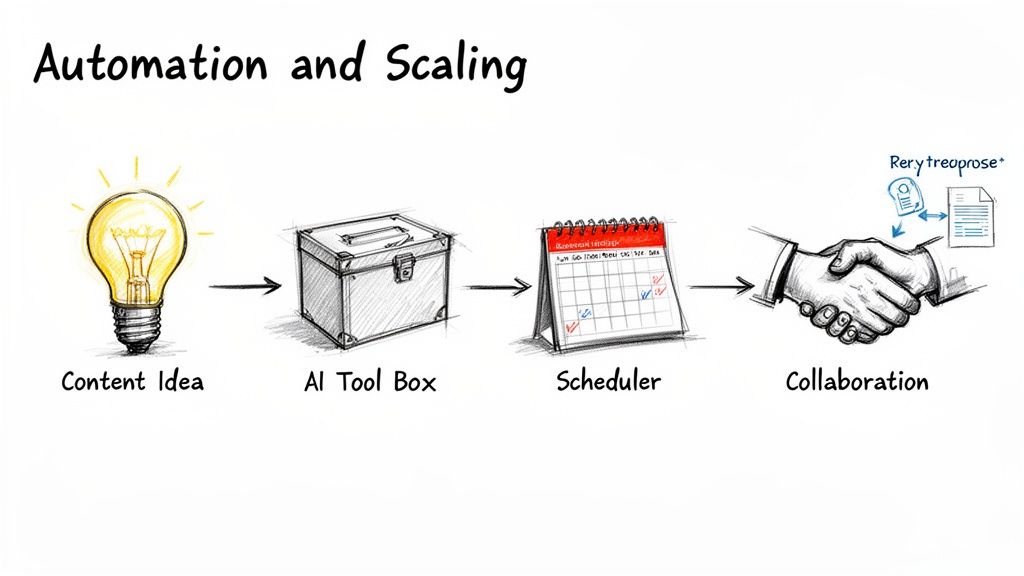
We all know consistency is the engine of social media growth, but it should never come at the cost of your sanity. Once you've got a solid content workflow, the real trick is building a system that runs on its own—or at least, with a lot less of your daily input.
This is where smart automation becomes a total game-changer for any entrepreneur looking to scale.
And I don't just mean scheduling posts ahead of time. True automation means setting up an intelligent system to handle all the repetitive stuff. That frees you up for what really matters: engaging with your community and building actual relationships.
Leveraging AI for Smarter Workflows
AI tools have completely flipped the script on content creation. Instead of just scheduling, you can now automate everything from idea generation to refining drafts, helping you keep a steady posting rhythm without the daily grind.
Take an AI-powered tool like Postful, for example. You can feed it one of your core content pillars, and it'll spit out a dozen relevant post ideas, complete with hashtags. What used to be a long brainstorming session is now a five-minute task.
Productivity Example:
A fitness coach can upload a long-form YouTube video about nutrition into an AI repurposing tool like Opus Clip or Vidyo.ai. The tool automatically chops it into 5-7 shareable, vertical short-form videos with captions, perfect for TikTok and Instagram Reels. This turns one piece of pillar content into a week's worth of posts with minimal effort.
With 91% of social media users being mobile-first, entrepreneurs need tools that are both powerful and easy to use on the go. This is where AI-driven platforms really deliver. It's no surprise that image and video generators are seeing adoption rates of 44-45% among marketers trying to work smarter.
A tool like Postful is built for this—its automated workflows and templates ensure a steady stream of content without burnout. That’s huge, because we all know the algorithms reward consistent, high-quality output. You can find more insights on current social media marketing trends over on jctgrowth.com.
Scaling Beyond Your Own Content
Growing your presence isn't just about posting more of your own stuff. It's about expanding your reach in clever ways. Smart collaborations are one of the most effective ways to do this with almost no extra effort. It’s a classic win-win that lets you tap into shared audiences.
Here are a few collaboration ideas I’ve seen work really well:
- Co-hosted Live Events: A business coach partners with a micro-influencer in the finance space for a live Q&A on Instagram. Both promote it to their followers, effectively doubling their potential reach overnight.
- Content Swaps: An e-commerce founder selling productivity planners writes a guest post for a popular productivity blog. In return, the blogger creates a short video showcasing the planner on their own social channels.
- Shared Giveaways: Team up with a complementary brand to offer a joint prize. Both brands can require entrants to follow both accounts, which is a super simple way to drive mutual audience growth.
By combining intelligent automation with strategic collaborations, you create a powerful social media engine that builds its own momentum—without demanding all of your time.
Measuring The Metrics That Actually Matter
Putting in the work is one thing, but knowing if it's actually paying off is what separates the entrepreneurs who get traction from those who just spin their wheels. It's so easy to get distracted by vanity metrics like your follower count. A big audience looks great on paper, but it doesn't mean a thing if it isn't driving real business results.
Instead, you need to zero in on a few key performance indicators (KPIs) that give you a direct signal on the health and ROI of your social media. This is how you shift social media from a "nice-to-have" into a predictable engine for growth.
Go Beyond Likes and Follows
For any entrepreneur, there are really only three metrics that tell the true story: engagement rate, click-through rate (CTR), and conversion rate. Together, they answer the most important questions: Is my audience actually listening? Are they taking the action I want them to? And are they becoming customers?
Don't forget, this stuff matters. Globally, people spend an average of 2 hours and 24 minutes scrolling social media every single day. In places like the US and UK, a whopping 73% of internet users are on these platforms researching brands before they even think about buying. Your content is a critical first impression, and you have to know if it's working. You can dig into more social media marketing statistics over at lyfemarketing.com.
How to Track What Matters
Let's get practical. Here’s how you can track these core metrics using the tools you already have.
-
Engagement Rate: This is all about interaction. A healthy engagement rate tells you that your content is hitting the mark and resonating with your audience.
- Practical Example: Let's calculate it for an Instagram post. Add up the likes and comments, divide that number by your total followers, then multiply by 100. If you have 1,000 followers and a post gets 90 likes and 10 comments, your engagement rate is a solid 10% ([90+10]/1000 * 100). Check this weekly to see which content pillars perform best.
-
Click-Through Rate (CTR): This one is simple: how many people actually clicked the link you shared? It’s a direct measure of how compelling your call-to-action is.
- Practical Example: Say you shared a link to your new blog post in an Instagram Story. If 500 people saw the story and 25 of them swiped up or tapped the link, your CTR is 5% (25 clicks / 500 views * 100). Use your platform's built-in analytics to find this number.
-
Conversion Rate: This is the big one—the ultimate metric. It tracks how many people completed the real goal, like buying a product or signing up for your newsletter, after clicking your link.
- Practical Example: Use Google's free Campaign URL Builder to create a unique UTM link for the LinkedIn post where you're promoting a webinar. Later, you can log into Google Analytics, go to
Acquisition > Campaigns > All Campaigns, and see that 15 people who came from that exact link signed up. That’s a direct, measurable ROI from a single post.
- Practical Example: Use Google's free Campaign URL Builder to create a unique UTM link for the LinkedIn post where you're promoting a webinar. Later, you can log into Google Analytics, go to
Tracking these metrics isn't just about crunching numbers. It's about getting clear, actionable feedback on what's working so you can double down on it and stop wasting time on what's not. This is how you make social media a profitable part of your business.
Your Social Media Productivity FAQ
Of all the questions entrepreneurs ask me about social media, a few pop up over and over. Getting straight, practical answers is the only way to build a strategy that works without eating up all your time. Let's tackle some of the most common ones I hear.
How Much Time Should I Realistically Spend on Social Media Each Week?
There’s no magic number, but I’ve found the sweet spot for most entrepreneurs is around 3-4 hours per week. The real secret isn't the number, though—it's how you use that time. It's about being efficient, not being online 24/7.
A "batching" workflow is your best friend here. Find a focused 2-3 hour block once a week to plan, write, and schedule everything. Then, use the leftover time for daily engagement—think 15-20 minutes a day to hop in, reply to comments, and answer messages. That small daily touchpoint is what actually builds a community.
Productivity Tip: Set a timer for your 15-minute engagement sessions. When the timer goes off, log out. This prevents mindless scrolling and keeps you focused on high-value interactions.
Which Social Media Platform Is Best for a B2B Startup?
For almost every B2B startup I've worked with, LinkedIn is the non-negotiable starting point. It’s where your potential clients, decision-makers, and industry peers are actually looking for business content. Get that right first.
So what does that look like in practice?
- Workflow: Once a week, post a "problem-solution" text post. State a common pain point for your target client, then briefly explain how to solve it. This builds authority.
- Example Post: "Struggling with low lead quality? Your landing page copy might be too broad. Try focusing on one specific outcome instead of listing every feature. Tighter copy = better leads."
- Engage: Spend 10 minutes a day commenting on posts from potential clients or industry leaders. Don't sell, just add value.
But don't just live on LinkedIn. I see X (formerly Twitter) as the place for real-time conversations, especially with journalists and other industry leaders. My advice is always the same: master LinkedIn, then strategically layer on the others.
Should I Invest in Paid Ads or Focus Only on Organic Content First?
Start with a solid organic foundation, always. Before you spend a single dollar on ads, you need a clear brand message, a consistent posting rhythm, and—most importantly—a real understanding of what your audience actually cares about.
Practical Workflow:
- Give your organic strategy at least 2-3 months to breathe and collect data.
- At the end of each month, go into your platform's analytics and identify your top 3 posts based on engagement rate.
- Take your single best-performing post and put a small "boost" budget behind it (e.g., $50) to amplify its reach to a lookalike audience.
This data-first approach is so much more effective. You're not guessing what might work; you're amplifying content that’s already proven it can connect with people. Your ad spend will go a whole lot further.
What's the Fastest Way to Grow My Following as a New Entrepreneur?
Forget the "follow-for-follow" games. The fastest way to build a following that actually matters is to provide undeniable value and engage like a real human. A small, fired-up audience will always be worth more than a huge, passive one.
The trick is to create content that people can't help but share with a friend or colleague.
Practical Content Examples:
- Practical Checklists: An Instagram carousel post titled: "5-Step Checklist for Launching Your Shopify Store."
- Quick Tutorials: A 60-second Reels video showing how you use a specific Notion template to organize your day.
- Myth-Busting Posts: A LinkedIn post starting with: "Myth: You need 10,000 followers to get clients. Here's the truth…"
Beyond your own content, team up with other entrepreneurs in your space to cross-promote each other’s work. And get active in online communities where your ideal customers are already hanging out. Answer questions and offer help without pitching. That’s how you build real authority and attract the right kind of followers.
Ready to stop guessing and start growing? Postful is the AI-powered social media tool built for entrepreneurs who need to save time and get results. From generating on-brand post ideas to automating your schedule, we make it simple to show up consistently and confidently. Try Postful for free and see the difference.