

A social media audit is basically a deep-dive into your brand's entire social media presence. Think of it as a full check-up for your accounts—it tells you what's working, what's a total time-waster, and where you can find some hidden gems for growth. It’s the move that takes you from just guessing what to post to making smart, data-backed decisions that actually save you time and get better results.
Why a Social Media Audit Is Your Secret Weapon
Ever feel like you're just posting into the void? You’re definitely not alone. For busy founders and small teams, social media often feels like a hamster wheel of content creation with no real destination. An audit cuts right through that noise. It gives you the clarity you need to turn all that effort into something that actually helps your business.
Honestly, it's the single best way to shift your social media from a daily chore into a real strategic asset.
The whole point is to make sure what you’re doing on social media lines up with what you’re trying to achieve in your business. Instead of just chasing likes, an audit makes you ask the tough questions:
- Is any of this actually sending people to our website or bringing in leads?
- Are we talking to our ideal customers, or just a random bunch of people?
- Does our brand look and sound consistent and professional everywhere we show up?
- What are our competitors doing well, and where are the gaps we can jump into?
Move from Guessing to Knowing
Without an audit, you're just flying blind. You might think your audience is all about video, but the data could show that your simple text-and-image posts are the ones sparking real conversations. This is where you swap those gut feelings for cold, hard facts. It lets you go all-in on what works and, just as importantly, stop wasting time on the stuff that doesn’t.
Here’s a practical example: A solo founder running a boutique coffee brand might be pouring hours into slick Instagram Reels just because they’re trendy. But a quick audit of her social media traffic in Google Analytics reveals that her LinkedIn articles on ethical sourcing are actually generating serious B2B partnership inquiries. That insight is a game-changer. It immediately redirects her precious time toward what’s actually growing the business.
A social media audit isn't about finding what you're doing wrong; it's about finding your focus. It gives you permission to do less—but do it smarter—by putting your energy into the channels and content that give you the biggest bang for your buck.
Uncover Your Competitive Edge in a Crowded Market
Let's be real: the internet is noisy. Insanely noisy. By 2025, it's estimated that 5.24 billion people will be on social media, spending an average of 2 hours and 20 minutes scrolling every single day. In a world this saturated, an audit isn't just a nice-to-have; it's a survival tactic.
This is where you find your edge. You'll spot what your competitors are overlooking and discover what your audience is craving but not getting. For more on this, check out these social media statistics for 2025 and see why it matters so much.
Time to Roll Up Your Sleeves: The Social Media Audit Workflow
Alright, we’ve covered the "why." Now for the fun part: the "how." A good social media audit isn’t some chaotic deep dive into a sea of analytics. It's a structured, repeatable process. When you break it down into a few key stages, you can move from just guessing what works to knowing what works—without getting completely overwhelmed.
Think of it as turning vague assumptions into a clear, actionable game plan.
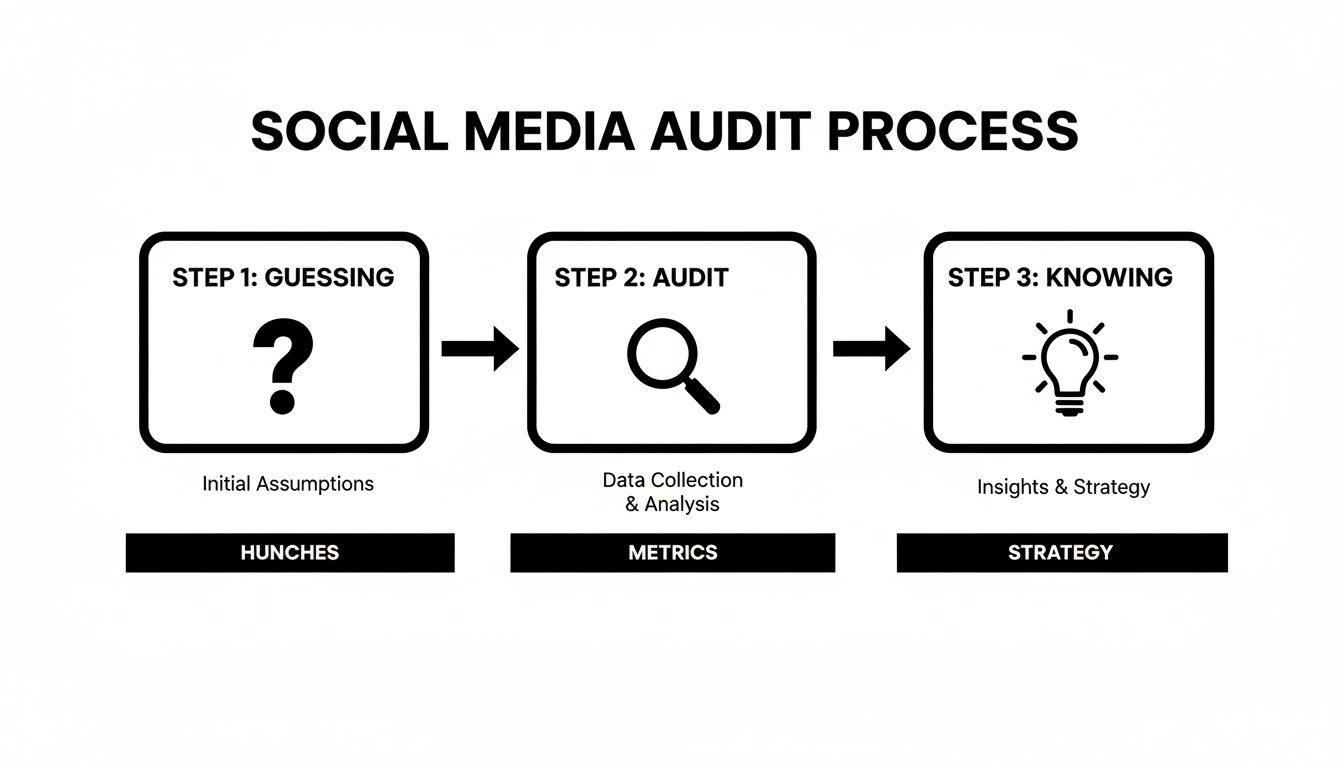
This workflow is really all about transforming gut feelings into hard evidence. Let's get into it.
Your Complete Account Inventory
First things first, you need to know exactly what you’re working with. You can’t fix what you don’t know exists. This means making a master list of every single social media profile tied to your brand—not just the ones you use every day.
You might be surprised by what you uncover. An old YouTube channel from a forgotten project? A Pinterest board you set up years ago? Maybe even an unofficial page someone else created. These "ghost accounts" can dilute your brand and confuse your audience.
Productivity Suggestion: Don't do this from memory. Use a tool like Namechk or simply search Google for your brand name, variations, and key product names to uncover forgotten profiles.
Create a simple spreadsheet and track these basics:
- Platform: Instagram, LinkedIn, TikTok, etc.
- URL: A direct link to the profile.
- Owner/Login Info: Who has the keys? (Make sure you store this securely in a password manager!)
- Purpose: What's the main goal here? (e.g., Lead gen, community building, brand awareness).
- Last Activity: When was the last time something was posted?
This initial inventory does more than just tidy up your digital footprint. It forces you to get honest about which platforms are actually pulling their weight and which have become digital dead ends.
Connecting Your Efforts to Real Business Goals
Once your inventory is complete, it's time for the most critical step: goal alignment. This is where you have to ask the tough question for every single account: "Why are we even on this platform?"
If your answer is something fluffy like "to get our name out there," you need to dig deeper.
Strong social media goals are tied directly to tangible business outcomes. A SaaS founder isn't just posting updates on LinkedIn; their real goal is to generate 10 qualified demo requests each month. An e-commerce brand isn't on Instagram just for the likes; they want to drive $5,000 in monthly sales through product tags and shoppable posts.
An audit’s true power is connecting every post, comment, and campaign back to a core business objective. If an activity doesn't support a goal, it's a prime candidate for the chopping block.
This phase is all about brutal honesty. If you’ve been posting daily on X (formerly Twitter) for six months without generating a single lead or meaningful website click, it's time to seriously question its role in your strategy.
The KPI Deep Dive: Measuring What Matters
With clear goals in hand, you can finally pick the right Key Performance Indicators (KPIs) to measure your progress. Metrics without context are just noise; KPIs are the numbers that tell you if you're actually winning.
Don't try to track everything. Just focus on the few metrics that directly reflect your goals for each platform.
- For Brand Awareness: Your go-to KPIs are Reach (how many unique people see your content) and Impressions (how many times your content is shown). A sudden drop in reach might hint at an algorithm change or content that’s just not connecting.
- For Community Engagement: Look at your Engagement Rate (likes + comments + shares / followers). I also love tracking comments per post—it’s a great measure of how much real conversation you're sparking. A high engagement rate on a smaller account is often way more valuable than a low one on a huge account.
- For Website Traffic: The one metric you can't ignore is Click-Through Rate (CTR). It tells you exactly what percentage of people who saw your post cared enough to click the link. A high CTR means your content and call-to-action are on point.
You can pull all this data from the native analytics tools on each platform, like Instagram Insights or LinkedIn Analytics. They're free, surprisingly powerful, and give you everything you need to get started.
To make this easier, here's a quick cheat sheet for the most important metrics to watch during your audit.
Key Social Media Audit Metrics and What They Mean
| Metric | What It Measures | Why It Matters for Your Audit |
|---|---|---|
| Reach | The number of unique accounts that saw your post. | Shows the true size of your audience. If reach is dropping, your content might not be getting surfaced by the algorithm. |
| Engagement Rate | (Likes + Comments + Shares) / Followers or Impressions | Tells you how compelling your content is. A high rate means your audience is actively interested, not just passively scrolling. |
| Click-Through Rate (CTR) | The percentage of viewers who clicked a link in your post. | The ultimate measure of whether your content drives action. Essential for traffic-related goals. |
| Follower Growth Rate | The speed at which you're gaining new followers. | Indicates brand health and appeal. Stagnant or negative growth is a major red flag that something needs to change. |
| Comments Per Post | The average number of comments on your posts. | A direct measure of conversation and community. High-quality comments are more valuable than likes. |
| Video View Rate | The percentage of a video that viewers watch. | Shows if your video content is holding attention. A low rate means your intros aren't hooking people. |
This table isn't exhaustive, but it covers the core metrics that give you a clear picture of your performance. Focusing on these will keep you from getting lost in vanity metrics that don't actually move the needle for your business.
The Content Performance Review
The final piece of the puzzle is to look at what you’ve actually been posting. This is where you identify your content pillars—the themes and formats that consistently knock it out of the park—and, just as importantly, your content duds.
Workflow Suggestion: Export the last 90 days of post data from your platform's analytics into a CSV file. Open it in a spreadsheet and sort the columns by your primary KPI (e.g., sort by 'Comments' or 'Link Clicks'). This instantly surfaces your top and bottom performers.
Here’s a practical example:
A solo consultant I know was auditing her LinkedIn content. She sorted her posts by comments and found that her raw, text-only posts about a tough client challenge got 3x more comments than her posts linking out to her blog. Meanwhile, the polished infographics she spent hours creating got plenty of likes but almost zero comments or clicks.
The insight was crystal clear: her audience craved authenticity and stories, not generic tips. The action plan wrote itself: spend less time on fancy graphics and double down on storytelling. She even started looking into how to document her work like a pro to better capture those client stories for future content.
By following this four-stage workflow—Inventory, Goal Alignment, KPI Deep Dive, and Content Review—you're building a repeatable system. It turns the overwhelming idea of a "social media audit" into a manageable and incredibly insightful process that will sharpen your strategy for months to come.
Analyzing Your Audience and Competitive Landscape
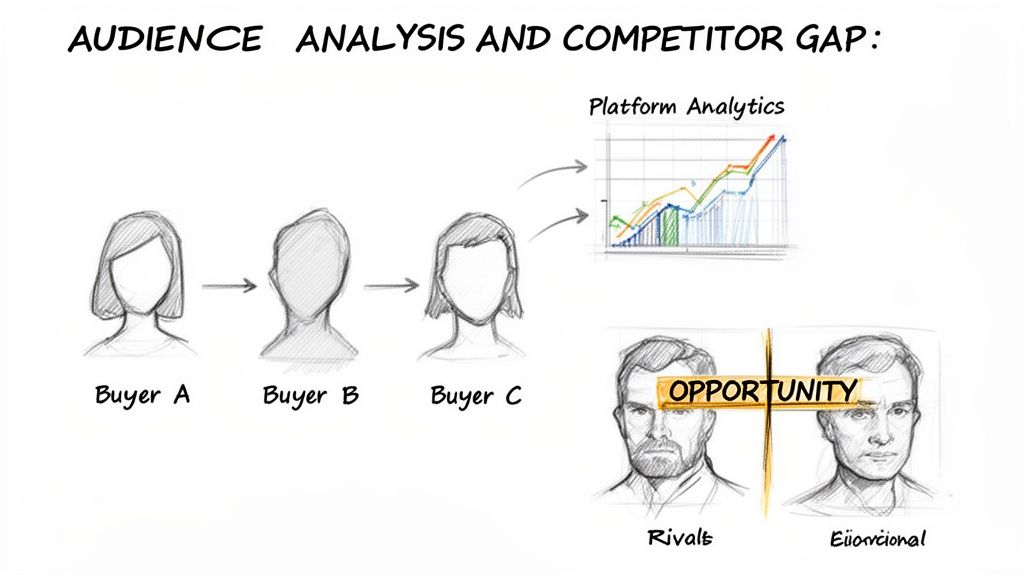
A social media audit that only looks inward is half an audit. Once you’ve taken stock of your own performance, it’s time to look outside your four walls. This means getting a real handle on the two forces that truly shape your strategy: your audience and your competitors. This is where you graduate from looking at simple metrics to uncovering deep, strategic insights.
Getting this right is the difference between creating content you think your audience wants and delivering what they actually crave. It’s how you stop blindly copying what your competitors are doing and start strategically outsmarting them.
Go Beyond Basic Demographics
Knowing your audience's age and location is a start, but it’s really just scratching the surface. A productive audit digs into their behaviors, their motivations, and what makes them tick. The native analytics tools on platforms like Instagram, Facebook, and LinkedIn are your best friends here—and they’re completely free.
Jump into the "Audience" or "Followers" tabs and look for the story the data is telling you:
- Active Times: When are your followers actually online and scrolling? This is your golden window for posting. Don’t just look at the day; get granular with the specific hours. You might find that posting at 7 PM gets you 50% more engagement than posting at noon, simply because that’s when your audience finally has a moment to themselves.
- Top Locations: Are you attracting people from the cities, states, or countries you actually serve? If there's a mismatch, your content might be too broad or your targeting might be off.
- Content Affinity: What other accounts do they follow? What topics are they interested in? This helps you paint a much richer picture of their world beyond your brand.
For an even deeper understanding, try running a simple one-question poll in your Instagram Stories or sending a quick survey to your email list. Ask something direct like, "What's the #1 thing you struggle with when it comes to [your niche]?" The answers you get are pure content gold. Learning how to find your target audience isn't a one-and-done task; your audit is the perfect time to refine that picture.
Conduct a Smart Competitor Analysis
Okay, now let's turn our attention to the competition. The goal here is absolutely not to copy what they’re doing. It’s to find the gaps they’re leaving wide open for you.
Pick two direct competitors and one "aspirational" brand—a leader in your space whose work you genuinely admire.
Productivity Workflow: Create a "Competitor" tab in your audit spreadsheet. Set a timer for 20 minutes per competitor. During that time, scroll through their feed and populate the columns below. This prevents you from falling into an endless rabbit hole of scrolling.
- Primary Platforms: Where are they focusing most of their energy?
- Content Mix: What formats are they leaning on? (e.g., 60% video, 30% carousels, 10% single images).
- Top Performing Posts: What kind of content consistently gets the most comments and shares? Look for recurring themes.
- Weaknesses/Gaps: What are they not doing? Are their replies to comments slow or nonexistent? Is their content all sales-y with zero personality?
This kind of analysis quickly reveals opportunities. If you want to get even more sophisticated, competitor AI analysis tools can give you incredibly granular insights into what’s working for them and why.
The most valuable part of a competitive analysis isn't seeing what your rivals do well—it's spotting what they do poorly or ignore completely. That's where you win.
Find and Fill the Content Gap
This is where it all comes together. Your audience insights and your competitor analysis are about to intersect to create a powerful, focused strategy. The "content gap" is that sweet spot where your audience's interests overlap with your competitors' weaknesses.
Let's walk through a practical scenario.
Imagine you run a small e-commerce brand that sells handmade, eco-friendly candles. Your audit uncovers two key things:
- Audience Insight: From an Instagram poll, you learn your customers are fascinated by the process behind your products. They want to see behind-the-scenes content and learn about your sustainable materials.
- Competitor Analysis: You notice your main competitors have slick, professional product photos. Their feeds look great, but they also feel a bit corporate and impersonal. There's no user-generated content (UGC) and absolutely no "making-of" footage.
Boom. You've just found your content gap.
Your action plan just became crystal clear. While your competitors focus on polish, you’re going to double down on authenticity. You can build out an entire content pillar focused on the creation process:
- Create short Instagram Reels showing you mixing scents or pouring wax.
- Design a carousel post explaining where you source your sustainable soy wax.
- Launch a campaign encouraging customers to share photos of your candles in their homes, which you can then reshare.
This strategy doesn't require a bigger budget or more hours in the day. It just requires a smarter angle—one that directly serves what your audience is asking for and what your competitors are completely ignoring. By filling this gap, you stop competing on their terms and start building a unique brand that attracts loyal fans, not just one-time buyers.
Turning Audit Insights into an Actionable Growth Plan
You've done the hard work and waded through the data. You know what's working, what's flopping, and where your competitors are leaving the door wide open. But let’s be honest: insights without action are just interesting facts. The real magic happens when you turn that audit data into a simple, actionable growth plan.
This is the part where analysis becomes results. Forget about creating some dense, 50-page strategy document that no one will ever read. The goal here is a straightforward roadmap you and your team can actually use to get things done.
Synthesize Your Findings into Clear Priorities
First thing's first: boil down all your notes into a few core takeaways. Don't get lost in every single metric. You're looking for the big patterns, the stuff that tells a clear story about what's going on.
This isn't about spreadsheets; it's about synthesis. I find it helps to group findings into three buckets. It creates instant clarity.
- Quick Wins (Low Effort, High Impact): These are the no-brainers. Maybe your audit showed that simply adding a clear CTA to your Instagram posts doubles clicks. The action is simple: update your content checklist to include a CTA every time.
- Medium-Term Adjustments (Moderate Effort, High Impact): These take a little more thought. For instance, your data might scream that your audience is all over LinkedIn, but you’ve been ignoring it. The adjustment? Block out one hour a week to create and engage with content on LinkedIn.
- Long-Term Pivots (High Effort, Transformative Impact): These are the big strategic shifts. Maybe you discovered your TikTok ads are bringing in 2.4x the return of everything else. A long-term pivot could be reallocating a real chunk of your marketing budget toward TikTok video.
Your audit plan shouldn't feel like a mountain you have to climb all at once. Sorting actions into these three buckets lets you tackle the quick wins right away, giving you momentum while you schedule and resource the bigger moves.
Build Your Action Plan Framework
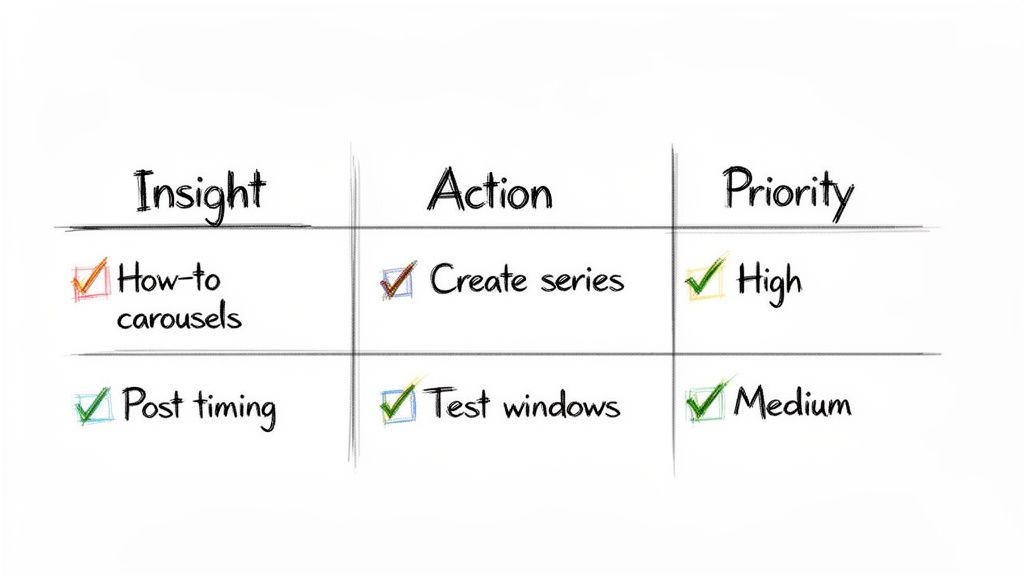
Now, let's get this organized. A simple table is your best friend here. It forces you to connect every insight to a specific, measurable action. Just create a document with three columns.
- The Insight: What did the data tell you? Get specific.
- The Action: What are you going to do about it? Use action verbs.
- The Priority: Is it a Quick Win, Medium-Term, or Long-Term play?
Practical Example in Action
Let's imagine a solo founder who sells productivity software. After their audit, their action plan could look something like this:
| The Insight | The Action | The Priority |
|---|---|---|
| Insight: Our text-only "quick tip" posts on LinkedIn get 4x more comments and drive more demo requests than blog links. | Action: Create a series of 12 "Productivity Hacks" as text-only posts for next quarter. Schedule two a week using a tool like Postful. | Quick Win |
| Insight: Instagram Reels get high views, but the click-through rate to our site is abysmal. The CTA is getting lost. | Action: Test three new CTA formats in Reels: a bold text overlay, a verbal CTA in the first 5 seconds, and a pinned comment with the link. | Medium-Term |
| Insight: A key competitor is totally absent on Pinterest, yet our customer survey showed 60% of our users get work inspiration there. | Action: Launch a Pinterest profile focused on "Productivity Workflows" and "Home Office Organization." Create 10 starter boards and a Q3 content plan. | Long-Term |
This framework turns vague observations ("we should do more on LinkedIn") into a concrete to-do list. There’s no ambiguity. You know what you learned, what you need to do, and how soon you need to do it.
With global social media ad spend projected to hit $276.7 billion in 2025, you can't afford to guess. You can read more about key social media statistics to understand the stakes. A clear action plan ensures every dollar and minute you spend is aimed at getting the best possible return.
Streamlining Your Audit with Smart Tools and Templates
A proper social media audit is a game-changer, but it shouldn't feel like you’re writing a thesis. As a founder or small business owner, time is your most valuable currency. The good news? You can build an efficient "audit toolkit" with a mix of free and paid resources to speed things up without cutting corners.
The point isn't to use every shiny new tool out there. It's about picking the right ones for the job, helping you pull the data quickly so you can spend your time on what actually matters: thinking and planning.
Your Essential (and Free) Audit Toolkit
You don't need a huge budget to do this right. In fact, some of the most powerful insights come from tools that won't cost you a dime. I always recommend starting here before even thinking about paid subscriptions.
Native Platform Analytics: This is your ground zero, your non-negotiable first stop. Tools like Instagram Insights, LinkedIn Analytics, and TikTok Analytics are goldmines of data on your audience, top-performing content, and follower habits. Practical Example: Instagram Insights can show you the exact hours your followers are most active—a simple insight that lets you immediately tweak your posting schedule in your content calendar for better reach.
Google Sheets or Notion: Forget fancy software for the initial data dump. A basic Google Sheet is perfect for your account inventory and action plan. You can build a simple template with columns for Platform, URL, KPIs, Key Insights, and Action Steps. Better yet, it becomes a living document you can reuse for every audit down the road.
When to Bring in Paid Tools
Free tools are fantastic, but paid solutions can give you a serious edge and save you a ton of time, especially with competitor analysis and trend spotting. If you're looking to really streamline the process, checking out some of the best social media monitoring tools is a smart move.
These platforms often pull metrics from all your accounts into one clean dashboard, which is a massive time-saver compared to exporting data from each network manually. Many also come with advanced social listening features.
Social listening is the engine behind a great audit, powering a market that's expected to jump from $9.61 billion in 2025 to $18.43 billion by 2030. For founders, this growth underscores just how important it is to stay on top of the conversation. Audits can uncover critical issues, like the audience fatigue that affects 50% of consumers and leads to engagement drops.
Productivity Tip: Don't get locked into a year-long subscription for a tool you only need for an audit. Look for platforms with monthly plans. You can sign up for one month, do your deep dive, grab all the insights, and then cancel. It's a savvy way to get enterprise-level data without the enterprise-level cost.
Building Your Repeatable Workflow
The real win here is creating a process you can repeat quarterly or annually without starting from scratch every single time. Once your first audit is done, your spreadsheet and your chosen tools form a system.
Your next audit is then just a matter of plugging in new data and re-evaluating your action plan. To close the loop, you can pair your audit insights with the best social media management tools to make your day-to-day execution that much sharper.
A Few Common Questions About Social Media Audits
Even with a solid game plan, you're bound to run into a few questions during your first social media audit. It happens to everyone. Here are the ones we hear most often from founders and small teams, along with some straight-to-the-point answers.
How Often Should I Actually Do This?
Realistically, a big, deep-dive audit once a year is plenty for most small businesses. This gives you a proper benchmark to see how your strategy is paying off over the long haul.
That said, I’m a big fan of doing a lighter "quarterly health check" about every 90 days. This isn't a full-blown audit. It’s a quick pulse check on your main KPIs and what’s been working (or not working) with your recent content. This keeps you agile and lets you make small adjustments on the fly instead of waiting a whole year to react.
Think of it like an annual physical with quick, quarterly check-ins to make sure everything's on track.
What's the Single Most Important Metric to Track?
This is a classic trick question, and the answer is always: it depends entirely on your goal for that platform. A metric without a goal is just a vanity number.
- If your goal is brand awareness, then your North Star is Reach. How many eyeballs are seeing your stuff?
- If you’re trying to build a community, the only thing that really matters is your Engagement Rate.
- And if you're trying to drive sales, you need to be obsessed with your Click-Through Rate (CTR) and Conversion Rate.
The first step of any good audit is to decide what you’re trying to achieve on each channel. Once you nail that down, the most important metric becomes crystal clear. Your goal dictates your KPI, not the other way around.
Can I Do a Social Media Audit for Free?
Absolutely. You don't need fancy, expensive software to get real insights. While paid tools can automate some of the grunt work and offer slick competitor analysis, a powerful audit is totally doable with free resources.
Every single platform—from Instagram Insights to LinkedIn Analytics—gives you its own free, surprisingly detailed analytics dashboard. Pair that raw data with a simple Google Sheets template to organize your findings, and you have everything you need.
Start with the free tools. Get a feel for the process and build your auditing muscle. A free audit is infinitely better than no audit at all. You can always look at paid options down the road when you’re ready to scale.
Ready to turn those audit insights into a content plan that actually works? Postful helps you go from planning to publishing with AI-powered idea generation and a simple scheduler. Get started for free and grow your reach without the grind.