
In the world of startups and side-hustles, branding is more than just a slick logo or a catchy tagline; it’s the consistent, authentic story you tell across every touchpoint. For busy founders, the challenge isn’t just defining your brand, but executing it consistently without sacrificing productivity. A strong brand builds trust, differentiates you from competitors, and creates a loyal community around your work, turning one-time customers into lifelong advocates. Without it, even the best products can get lost in the noise.
This guide cuts through the theory with practical, actionable small business branding tips designed for the modern founder. We're moving beyond generic advice to provide a curated collection of workflows you can implement immediately. Each tip is a mini-playbook, complete with clear implementation steps, real-world examples from fellow entrepreneurs, and social media post templates you can adapt with tools like Postful to build a memorable brand efficiently. You'll learn how to define your unique value proposition, establish a consistent visual and written identity, and build an engaged community. Let's get straight to the actionable strategies that will help you build a brand that connects, converts, and stands the test of time.
1. Define Your Unique Value Proposition
Your Unique Value Proposition (UVP) is the cornerstone of your brand. It’s a concise statement explaining what makes you different from competitors and why customers should choose you. For small businesses, a strong UVP is one of the most powerful small business branding tips because it clarifies your message and guides every marketing decision, ensuring you stand out even with a limited budget.
A great UVP answers the customer's core question: "What problem do you solve for me, and why are you the best choice?" It’s not just a slogan; it’s a promise. Consider Slack’s "Where work happens," which clearly positions it as a central communication hub, or a local coffee shop's UVP: "The quietest place to work remotely with the fastest Wi-Fi in town," which targets a specific customer need.
How to Craft Your UVP
Start by deeply understanding your audience and the competitive landscape. Your goal is to find the intersection between what your customers need and what you do better than anyone else.
- Analyze Competitors: Use a simple spreadsheet to list 3 competitors. Create columns for their main message, target audience, and pricing. Note what they don't offer. For example, if they all offer complex, enterprise-level software, your UVP could be about simplicity for small teams.
- Interview Customers: Use a free tool like Google Forms to create a short survey for 5-10 customers. Ask direct questions: "What was the biggest problem you faced before using our product?" and "Why did you choose us over other options?"
- Draft and Simplify: Use a simple formula to draft your statement: "We help [Target Audience] do [Benefit/Job to be done] by [Unique Differentiator]." For example: "We help busy professionals eat healthy by delivering pre-portioned, chef-prepared meals."
Pro-Tip: Your UVP should be so clear that a new visitor to your website understands your core value in less than five seconds. Test this by showing your homepage to someone unfamiliar with your brand and asking them to explain what you do.
Putting Your UVP into Action
Once drafted, your UVP becomes your strategic filter. Use it to create consistent messaging across your website homepage, social media bios, and marketing materials.
For example, to boost productivity, create a document in Notion or a Google Doc with your final UVP at the top. Below it, write 3-5 "messaging pillars" derived from it. If your UVP is about "making sustainable living easy for busy families," your pillars could be: 1. Time-Saving Eco-Tips, 2. Kid-Friendly Sustainable Products, 3. Debunking Eco-Myths. When using a tool like Postful, base your content templates on these pillars to ensure every post reinforces your core promise efficiently.
2. Create a Consistent Visual Identity
Your visual identity is the "face" of your brand. It includes your logo, color palette, typography, and imagery style. For small businesses, maintaining consistency across these elements is one of the most vital small business branding tips because it builds recognition, professionalism, and trust. A cohesive visual system makes you instantly memorable, whether a customer sees your post on Instagram, visits your website, or receives your business card.
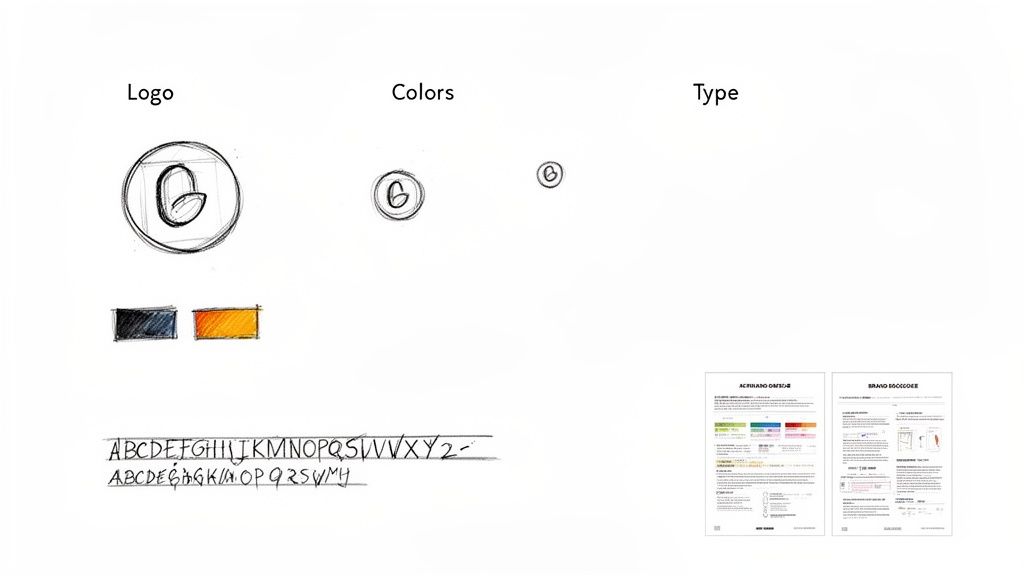
This consistency works because it reinforces your brand at every touchpoint. Think of Notion’s minimalist design and clean typography, which communicates efficiency and organization. Similarly, Canva uses a bright, playful color palette that perfectly reflects its mission to make creativity accessible and fun. When your visuals align with your brand's personality, you create a powerful and silent form of communication with your audience.
How to Build Your Visual Identity
Start by creating a simple one-page brand style guide. This document doesn't need to be complex; it just needs to define your core visual elements to ensure anyone creating content for you stays on-brand.
- Choose Core Elements: Use a free tool like Coolors.co to generate a professional color palette. Select a primary and secondary color, and a neutral for text. For fonts, use Google Fonts to find a clean, readable pair—one for headings (e.g., Montserrat) and one for body text (e.g., Lato).
- Define Imagery Style: Create a Pinterest or Miro board with 10-15 images that capture your brand's aesthetic. Are they bright and airy? Dark and moody? Professional stock photos or authentic, behind-the-scenes shots?
- Create Templates: Use a tool like Canva or Figma to build 5-10 reusable templates for your most common content types (e.g., Instagram post, blog header, story graphic). This workflow is the single biggest productivity hack for maintaining visual consistency. For a truly distinctive brand presence, consider investing in high-quality custom signage solutions.
Pro-Tip: Your logo should be legible and recognizable even when scaled down to a tiny favicon on a browser tab. Test it by shrinking it down to 16×16 pixels before finalizing.
Putting Your Visual Identity into Action
Apply your style guide everywhere. This includes your website, email newsletters, social media profiles, and even your invoices. A consistent visual language makes your small business look more established and reliable.
To improve your workflow, use Canva's Brand Kit to store your logo, colors, and fonts. This allows you to apply your branding to any design with one click. When using Postful, you can upload these assets once to automatically apply them to every generated post, ensuring your brand identity is reinforced with every single post without any extra effort.
3. Develop a Content Pillars Strategy
Content pillars are the 3-5 core themes or topics your brand consistently talks about. They form the backbone of your content strategy, ensuring everything you publish is relevant to your audience and reinforces your brand identity. For small businesses, using content pillars is one of the most effective small business branding tips because it eliminates the "what should I post today?" panic and builds authority in your niche.
This strategic approach ensures your messaging is focused and valuable. For example, a financial advisor for freelancers might use pillars like: 1. Tax Tips for Solopreneurs, 2. Investing for the Self-Employed, 3. Client Success Stories, and 4. Productivity Tools. This creates a predictable and valuable content mix.
How to Define Your Content Pillars
Start by identifying the primary topics that align with your brand's expertise and your audience's needs. The goal is to create a content framework that is both authentic to your brand and engaging for your followers.
- Analyze Your Audience: Use a tool like AnswerThePublic to see what questions people are asking related to your industry. Check the comment sections of competitors' posts to identify customer pain points.
- Map to Your Expertise: Create a mind map with your core product/service in the center. Branch out with all the related topics you can confidently speak about. Group these into 3-5 main themes.
- Draft and Balance: Aim for 3-5 broad pillars. A practical workflow is to assign each pillar a day of the week (e.g., "Motivation Monday," "Tech Tip Tuesday," "Workshop Wednesday"). This simplifies planning and creates a consistent schedule your audience can rely on. A good mix is often 40% educational, 40% inspirational or entertaining, and 20% promotional.
Pro-Tip: Your content pillars should directly support your business goals. If your goal is to sell a specific service, at least one pillar should be dedicated to educating the audience about the problem that service solves.
Putting Your Content Pillars into Action
Once your pillars are defined, they become your guide for all content creation. Use them to plan your editorial calendar, ensuring a consistent and balanced mix of topics. Learn more about how to develop a Content Pillars Strategy for a deeper dive.
For a productivity boost, create a content database in Airtable or Notion. Make a table with columns for "Pillar," "Topic Idea," "Status," and "Publish Date." Spend one hour a month brainstorming ideas for each pillar. When using a tool like Postful, you can create templates for each pillar (e.g., a "Quick Tip" template, a "Customer Story" template) to streamline content creation and maintain brand consistency.
4. Build Authentic Personal Branding
Personal branding means strategically sharing your expertise, values, and personality to build a genuine connection with your audience. For small businesses, this is one of the most effective branding tips because the founder's story and credibility directly impact the business's appeal. Authenticity is the key; modern audiences connect with real people, not polished corporate facades.
By sharing your journey, including the challenges and insights, you create trust and differentiate your brand in a crowded market. For solopreneurs, your personal brand is a powerful strength. For example, a web developer who shares her coding process on Twitter, including debugging frustrations, builds a more loyal following than one who only posts finished projects.

How to Craft Your Personal Brand
Start by identifying the core elements of your story and expertise that align with your business. Your goal is to become the face of your brand in a way that feels natural and sustainable.
- Identify Your Pillars: Just like with content, choose 3 personal brand pillars. These could be: 1. Your core skill (e.g., "Marketing Automation"), 2. Your business philosophy (e.g., "Bootstrapped Growth"), and 3. A related personal interest (e.g., "Productivity Hacks").
- Share Your Journey: Use a "document, don't create" approach to save time. Instead of trying to create perfect content, simply share what you're already doing. Take a quick photo of your workspace, share a surprising customer insight from a meeting, or post a short reflection at the end of the week.
- Engage Authentically: Don't just broadcast; communicate. Use a social media management tool to set up keyword searches for your industry. Spend 15 minutes a day responding to relevant conversations, offering helpful advice without a sales pitch.
Pro-Tip: Set clear boundaries from the start. Decide what aspects of your life are private. Authenticity doesn't require you to share everything; it requires you to be real about what you do choose to share.
Putting Your Personal Brand into Action
Integrate your personal brand into your content strategy to humanize your business and build community. This makes your marketing feel less like an advertisement and more like a conversation.
To make this a habit, create a recurring weekly calendar event called "Founder Story." During this 30-minute block, write one post sharing a lesson learned, a behind-the-scenes moment, or a personal win. When using a tool like Postful, you can use its AI brainstorming features to generate ideas based on your personal brand pillars. For example, input "Share a lesson about bootstrapped growth," and it can help you draft a compelling story.
5. Establish Consistent Brand Voice and Messaging
Your brand voice is the distinct personality that comes through in all your communications, from website copy to social media replies. For a small business, a consistent voice is crucial because it makes your brand recognizable and builds trust. It ensures that whether a customer reads an email, visits your site, or sees a post, they feel like they’re interacting with the same entity every time.
A strong brand voice humanizes your business, turning transactions into relationships. For example, a productivity app might use a voice that is "motivational, clear, and efficient," while a handmade soap company's voice could be "warm, natural, and gentle." These voices work because they are consistent and authentic.
How to Define Your Brand Voice
Your voice should be a true reflection of your brand's values and resonate with your target audience. It’s not about faking a personality but amplifying the one that already exists within your business.
- Choose Your Adjectives: Brainstorm a list of adjectives that describe your brand. Narrow it down to 3-5 core voice attributes, such as "Playful, encouraging, and direct" or "Professional, authoritative, and calm."
- Create a Voice Chart: For a practical workflow, create a simple two-column table. In the left column, list your voice attribute (e.g., "Playful"). In the right, write a "Do/Don't" rule (e.g., "DO use emojis and lighthearted puns. DON'T use slang or be unprofessional.").
- Analyze Your Best Content: Review your past emails or posts that received the best engagement. Copy and paste the highest-performing sentences into a document. Highlight common words and phrases to identify your natural voice. For a deeper dive, you can learn more about what brand voice is and how to craft one from scratch.
Pro-Tip: Read your content aloud before publishing. If it doesn't sound like something you or your brand would say in a real conversation, revise it until it does.
Putting Your Brand Voice into Action
A documented brand voice guide is a powerful tool for maintaining consistency, especially as your team grows. This guide should be the foundation for all content creation, ensuring your brand sounds like itself everywhere.
To boost productivity, create text snippets or saved replies in your email client or social media tools for common customer interactions (e.g., thank you messages, support queries), all written in your defined brand voice. When using a tool like Postful, you can input your brand voice guidelines (e.g., "Witty but helpful") directly into the AI prompt to ensure all generated content aligns perfectly with your personality, automating consistency.
6. Leverage User-Generated Content and Social Proof
User-generated content (UGC), which includes posts, reviews, and photos from customers, is one of the most authentic and powerful small business branding tips. It serves as powerful social proof, building credibility and trust far more effectively than traditional advertising. For small businesses, authentic customer voices carry immense weight and help level the playing field against larger competitors.

This strategy turns your happy customers into a volunteer marketing team. For example, a local bakery can reshare customers' Instagram stories of them enjoying a croissant, or a SaaS company can embed positive tweets from users on its homepage. This is far more believable than the company saying its own croissants or software are great.
How to Collect and Share UGC
Proactively create systems to encourage and capture customer content. The goal is to make sharing easy for them and showcasing it a standard part of your marketing workflow.
- Ask Directly: Automate your process. Set up an automated post-purchase email (using a tool like Mailchimp or Klaviyo) that goes out 14 days after delivery, asking for a review and a photo of the product in use.
- Create a Hashtag: Establish a unique and memorable brand hashtag (e.g., #YourBrandInTheWild) and promote it in your social media bios, email footers, and on your packaging.
- Run a Contest: Incentivize sharing by running a contest where the best customer photo or story wins a prize. Use a tool like Gleam or RafflePress to manage entries and track participation efficiently.
Pro-Tip: Always ask for permission before reposting a customer's photo or content on your official channels. A quick DM shows respect and protects your brand legally. Create a saved reply to make this faster: "We love this! Mind if we share it on our feed and tag you?"
Putting Your UGC into Action
Integrate social proof across all your marketing channels to maximize its impact. This authentic content should be a cornerstone of your communication strategy, reinforcing your brand's value through the voices of real people.
Create a productive workflow: Set up a folder in Google Drive or Dropbox called "UGC." Whenever you get permission to use a customer's content, save it there. Once a week, go through the folder and schedule one UGC post. When using Postful, you can create a dedicated content category for "UGC Features" and schedule these posts in batches, ensuring a consistent stream of social proof that builds trust on autopilot. For more ideas, explore this guide on how to repurpose reviews and photos into weekly social content.
7. Maintain Active Community Engagement
Your brand isn't just what you broadcast; it's the relationships you build. Active community engagement means consistently interacting with your audience by responding to comments, answering questions, and participating in relevant conversations. For small businesses, this personal touch is a powerful branding tip and a significant competitive advantage over larger, less personal corporations.
Engagement signals to social media algorithms that your content is valuable, boosting your reach. More importantly, it shows your followers that you see and value them. This two-way communication turns passive followers into a loyal community. A practical example is a software founder who actively answers questions in a relevant subreddit, building a reputation as a helpful expert long before ever pitching their product.
How to Foster Engagement
The goal is to create a space where your audience feels heard and wants to participate. This requires a consistent, proactive effort to nurture conversations and show appreciation for every interaction.
- Schedule Engagement Time: Use the "time blocking" method. Dedicate two 15-minute blocks in your calendar each day—one in the morning, one in the evening—solely for responding to comments and messages. This prevents social media from becoming a constant distraction.
- Ask Genuine Questions: Instead of "What do you think?", ask pointed questions that are easy to answer. For a coffee brand: "Drip or espresso? What’s your morning go-to?" For a designer: "Light mode or dark mode? Tell me your favorite!"
- Engage with Their Content: Create a private Twitter List or Instagram "Close Friends" group of your top 20 most engaged followers. Spend 10 minutes a week engaging with their content to build deeper relationships.
Pro-Tip: Aim to respond to 100% of comments within the first 24 hours. This initial timeframe is when posts get the most visibility, and quick responses encourage more people to join the conversation.
Putting Engagement into Action
Integrate community management into your daily workflow. Treat it with the same importance as content creation. This is where you transform your brand from a faceless entity into a trusted presence.
For a productive workflow, batch-schedule your content in advance using a tool like Postful. This frees up your daily time for what can't be automated: real-time interaction. If your brand is about "empowering first-time freelance designers," your engagement strategy should be to spend 15 minutes a day in relevant Facebook groups or on LinkedIn, offering advice on posts where people are asking for help. This helpful presence builds your brand far more effectively than just posting content.
8. Build Strategic Brand Partnerships and Collaborations
Partnerships amplify your brand by tapping into established, relevant audiences. For small businesses, collaborating with complementary brands, influencers, or communities provides credibility by association and access to new customers. This is one of the most effective small business branding tips because it creates marketing leverage without requiring a massive budget.
Strategic partnerships combine forces to create value that is greater than what either party could achieve alone. A simple example is a local gym partnering with a neighboring health food cafe for a "Workout & Smoothie" discount package. Both businesses get exposure to the other's customer base.
How to Build Your Partnerships
Start by identifying potential partners whose audience overlaps with yours but whose products don't directly compete. Your goal is to find a mutually beneficial arrangement where both brands win.
- Identify Potential Partners: Create a spreadsheet of 10 potential partners. Columns should include: Brand Name, Contact Info, Follower Count, and a "Why It's a Fit" note. Look for brands that are similar in size to yours for a higher chance of response.
- Start Small: Begin with a low-commitment collaboration. Suggest an Instagram Live session where you each interview the other, or offer to write a guest post for their blog. This is a low-risk way to test the partnership.
- Propose a Win-Win: When you reach out, use a clear, concise email template. Your subject line could be "Collaboration Idea: [Your Brand] x [Their Brand]." In the body, state the shared audience and propose one specific, easy-to-execute idea.
Pro-Tip: Frame your partnership proposal around shared value. Instead of asking "What can you do for me?", ask "What can we create together for our audiences?"
Putting Your Partnerships into Action
Once a partnership is established, promote it consistently to maximize its impact. This is where you leverage your brand’s voice to build excitement and drive engagement across all your channels.
For an efficient workflow, create a shared project plan in a tool like Trello or Asana. Create cards for key tasks: "Draft Announcement Copy," "Create Graphics," "Schedule Posts," and "Post-Campaign Analysis." When using a tool like Postful, you can create a dedicated content series to announce and celebrate the collaboration, scheduling a sequence of posts: a teaser, the announcement, and a final thank you post to ensure the partnership gets maximum visibility.
Small Business Branding: 8-Point Comparison
| Item | Implementation Complexity 🔄 | Resource Requirements ⚡ | Expected Outcomes 📊 | Ideal Use Cases 💡 | Key Advantages ⭐ |
|---|---|---|---|---|---|
| Define Your Unique Value Proposition | Moderate 🔄 — research + iteration | Low budget, medium time ⚡ | Clear differentiation; improved targeting 📊 | New startups, rebrands, tight marketing budgets 💡 | Strong positioning; consistent messaging ⭐ |
| Create a Consistent Visual Identity | Moderate–High 🔄 — design + guidelines | Designer or design tools, upfront cost ⚡ | Higher brand recognition and trust 📊 | Multi-platform presence, product launches 💡 | Professional look; faster content creation ⭐ |
| Develop a Content Pillars Strategy | Low–Moderate 🔄 — planning + topic research | Time for research; templates speed work ⚡ | Consistent content; faster planning; SEO gains 📊 | Solopreneurs needing structure; content calendars 💡 | Reduces decision fatigue; builds topical authority ⭐ |
| Build Authentic Personal Branding | Moderate 🔄 — ongoing vulnerability & consistency | Time, willingness to be public; low cash ⚡ | Deeper trust; engaged community; opportunities 📊 | Founders, service providers, thought leaders 💡 | Strong loyalty; unique differentiation ⭐ |
| Establish Consistent Brand Voice and Messaging | Moderate 🔄 — documentation + enforcement | Time to document; style guide and training ⚡ | Recognizable language; better outsourced content 📊 | Scaling content teams; outsourcing copy 💡 | Faster communication; clear differentiation ⭐ |
| Leverage User-Generated Content & Social Proof | Low–Moderate 🔄 — collection & curation | Active customers, permission workflows, tools ⚡ | Improved conversions and credibility 📊 | Product businesses, e‑commerce, community brands 💡 | High-trust, cost-effective content; social proof boost ⭐ |
| Maintain Active Community Engagement | High 🔄 — daily responsiveness & moderation | Significant time or team; community tools ⚡ | Higher retention, advocacy, algorithmic reach 📊 | Community-driven brands, service businesses 💡 | Loyal advocates; real-time feedback loop ⭐ |
| Build Strategic Brand Partnerships & Collaborations | Moderate 🔄 — outreach + coordination | Time to vet/coordinate partners; shared resources ⚡ | Rapid audience expansion; credibility by association 📊 | Bootstrapped brands seeking reach; co-marketing 💡 | Scales reach cost-effectively; shared value creation ⭐ |
Your Next Step: From Branding to Building
You've just navigated a comprehensive collection of actionable small business branding tips, moving from foundational concepts like defining your unique value proposition to dynamic strategies like leveraging user-generated content and strategic partnerships. The journey from a great idea to a recognized brand can feel overwhelming, but as we've demonstrated, it's not about doing everything at once. It's about taking deliberate, consistent steps that build upon each other.
The core thread weaving through all these tips is the powerful combination of consistency and authenticity. Your visual identity, brand voice, content pillars, and community engagement must all align to tell the same compelling story. This alignment is what transforms a simple business into a memorable brand that customers trust and connect with on a deeper level. Without it, even the most creative marketing efforts can feel disjointed and fail to make a lasting impact.
Turning Strategy into Sustainable Action
The true challenge for any busy founder or side-hustler isn't understanding what to do, but finding the time and energy to do it consistently. This is where creating efficient workflows and leveraging the right tools becomes a non-negotiable part of your strategy.
- Prioritize and Batch: Don't try to implement all eight strategies this week. Choose one or two that address your most pressing needs. For instance, if your messaging feels inconsistent, dedicate this month to solidifying your brand voice and creating message templates. Batch-create a month's worth of social media content in one afternoon using your new guidelines.
- Create a Repeatable System: Turn these tips into a checklist. For every new product launch or marketing campaign, run through your brand voice guide, visual identity rules, and content pillars. This systemization reduces decision fatigue and ensures every asset you produce is perfectly on-brand.
- Automate Where Possible: Your time is your most valuable asset. Use social media schedulers and content management tools to automate the repetitive tasks of posting and distribution. This frees you up to focus on high-impact activities like genuine community engagement and building strategic relationships.
Ultimately, a strong brand does more than just attract new customers; it creates a loyal community that champions your business. Building that loyalty is the next crucial phase of your growth. To move beyond initial branding and build a sustainable business, a key focus is customer retention. For a deeper dive into extending customer relationships past the initial purchase, consult this comprehensive small business guide to customer retention and loyalty. By mastering both acquisition and retention, you create a powerful engine for sustainable growth.
Your brand is a living entity, an asset that grows in value with every consistent action you take. Embrace this process not as a list of chores, but as the exciting and creative work of building something truly your own.
Ready to turn these branding tips into a seamless workflow? Postful is an AI-powered social media manager designed to help you create, schedule, and analyze on-brand content in a fraction of the time. Stop juggling tasks and start building your brand with confidence by joining the Postful waitlist today.