
If you're chasing follower counts without a real plan, you're just spinning your wheels. You might see a little movement, but you won't get anywhere meaningful. Before you even think about creating your next post, the single most productive thing you can do is build a solid foundation. This is what separates accounts that have a fleeting viral moment from those that build sustainable, long-term growth.
The process itself is pretty straightforward. First, you figure out who you want to attract. Then, you pinpoint what they actually care about. Finally, you create content that speaks directly to those needs, over and over again.
This isn't just theory; it's a practical workflow.
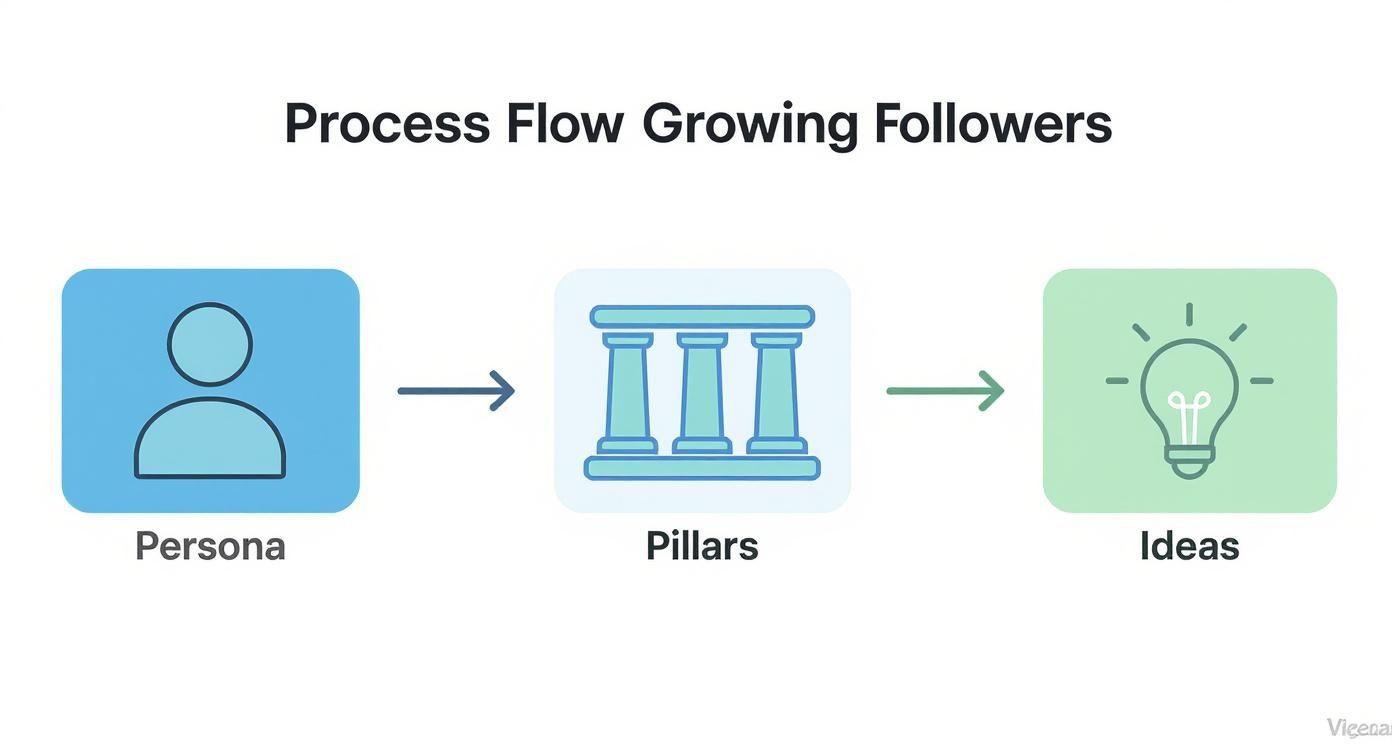
This simple model—from persona to pillars to ideas—is the engine that will drive your entire content strategy. It ensures every single post has a purpose.
Define Your Ideal Follower Persona
Let's get one thing straight: you can't attract the right people if you have no idea who they are. And I'm not talking about vague demographics like "millennial small business owner." That's not nearly enough. A truly useful Ideal Follower Persona dives deep into their mindset, their biggest challenges, and how they behave online. This detailed picture becomes your North Star for every content decision you make.
Productivity Workflow: Block out 60 minutes to create your persona. Open a new document and answer these questions: What is their job title? What are their top 3 goals this quarter? What are their biggest time-wasting frustrations? What social media platforms do they use and who do they follow? Answering these transforms your abstract idea into a tangible guide.
Let's walk through a practical example. Imagine we're a B2B SaaS company with a project management tool.
Our Ideal Follower Persona: "The Growth-Minded Founder"
- Role: Founder of a tech startup with a team of 5-15 people.
- Goals: Scaling the business, making the team more productive, and locking down the next round of funding.
- Pain Points: They're drowning in operational chaos, the team isn't aligned, and they're bleeding time on clunky workflows. Their biggest fear? Missing growth targets because of disorganization.
- Content Preferences: They want actionable advice, not motivational fluff. They're scrolling short-form videos on LinkedIn, reading insightful Twitter threads, and looking for practical case studies.
- Online Habits: They live on LinkedIn during the workday and catch up on Twitter at night. They follow industry leaders like Jason Fried and Sahil Lavingia.
See the difference? This level of detail makes it instantly clear what kind of content will grab their attention. Our "Growth-Minded Founder" doesn't need another generic productivity hack; they need specific fixes for their scaling headaches.
Establish Your Core Content Pillars
Once you know exactly who you're talking to, the next step is to lock in 3-5 core content pillars. Think of these as the main topics or themes you'll own. They act as guardrails for your content, keeping everything you post focused and relevant to your ideal follower.
Content pillars are what turn your social media feed from a random jumble of posts into a go-to resource. When your audience knows what to expect, they have a reason to follow you—and stick around.
Practical Example for "The Growth-Minded Founder":
- Team Productivity Systems: Sharing practical frameworks and workflows that actually improve team efficiency. (Example topic: "How to run a 30-minute weekly sprint meeting that doesn't suck.")
- Leadership & Scaling: Offering real talk on hiring, delegating, and navigating the messy parts of growing a startup. (Example topic: "A 3-step framework for delegating tasks without losing control.")
- Founder Wellness: Getting real about the burnout, stress, and time management struggles every founder faces. (Example topic: "The 'Shutdown Ritual' I use to protect my evenings.")
These pillars hit our persona's pain points and goals head-on. They're specific enough to attract the right crowd but broad enough to give us endless content ideas. If you're looking for a wider view on this, there's an actionable guide to social media marketing for small business that's worth a read.
Map Out Your Content Ideas
Okay, now for the fun part: brainstorming. With your pillars defined, generating a month's worth of content ideas becomes surprisingly easy. And this is where the right tools can be a massive time-saver.
A productive workflow is to open a simple spreadsheet with four columns: "Pillar," "Idea/Headline," "Format," and "Status." Spend one hour filling this out.
Example using our spreadsheet:
-
Pillar: Team Productivity Systems
-
Idea/Headline: The 3 Asana Automations That Saved Us 10 Hours a Week
-
Format: Twitter Thread
-
Status: To Do
-
Pillar: Leadership & Scaling
-
Idea/Headline: How to Run a 30-Minute Weekly Sprint Planning Meeting That Doesn't Suck
-
Format: LinkedIn Carousel
-
Status: To Do
This transforms content creation from a daily grind into a strategic process you can batch. By putting in the foundational work first, you guarantee that every piece of content you create has a clear purpose, speaks directly to the right people, and contributes to real, sustainable growth.
Master Your Content Creation and Scheduling Workflow
Got a list of killer content ideas? Great. But turning those ideas into a steady stream of posts is where the real work happens. This is where your workflow comes in—it's the engine that drives sustainable growth on social media.
A solid system is what separates the accounts that post whenever they feel like it from the ones that show up day in and day out. That consistency signals to both the algorithm and your audience that you’re a reliable source of value. It’s not about working harder; it’s about working smarter. You want to ditch that daily "what do I even post today?" panic and replace it with a calm, repeatable process.

Boost Productivity with Reusable Templates
One of the biggest time-sucks in content creation is starting from a blank page every single time. Reusable templates are a total game-changer here. They let you maintain a cohesive brand look while speeding up your entire workflow.
Productivity Tip: Dedicate one 90-minute block to create your core templates in a tool like Canva. This initial time investment will pay for itself tenfold.
- Carousel Templates: Design a 5-10 slide template with a title slide, content slides using your brand fonts and colors, and a final call-to-action slide. Practical Example: Create a template with a bold hook on slide 1, numbered points on slides 2-4, and a "Follow for more tips like this" CTA on slide 5.
- Short-Form Video Templates: Create a template in CapCut or Canva with a placeholder for your video, a headline at the top, and your brand's style for auto-captions at the bottom.
- Quote Graphics: Keep a few pre-designed templates on hand for when you want to share a powerful quote or stat.
Spend a couple of hours building these upfront, and you'll save yourself dozens of hours later. Each new post just becomes a simple drag-and-drop affair, not a complete redesign.
Implement a Content Batching Workflow
Content batching is exactly what it sounds like: creating a full week's or month's worth of content in just one or two dedicated sessions. This approach keeps you focused, guarantees consistency, and frees you from the daily pressure of having to create on the fly. A key part of making this work is creating a comprehensive LinkedIn content calendar to give yourself a clear roadmap.
Here’s a simple workflow for batching a week of content in a single afternoon, using a tool like Postful to pull it all together:
- Pick Your Ideas (30 mins): Pull 5-7 content ideas from your brainstorming spreadsheet. Make sure you have a good mix of formats—maybe one thread, two carousels, and two single-image posts.
- Write the Copy (60 mins): Set aside a block of time to write all the captions and copy for the week. When you focus on just one task, you get into a creative flow and produce better stuff, faster.
- Create the Visuals (60 mins): Now, open up those Canva templates you made and create all the graphics and video clips for the week's posts.
- Upload and Schedule (30 mins): Finally, get everything into your scheduling tool. This is your chance to fine-tune the details and set each post to go live at the perfect time.
This turns content creation from a chaotic daily chore into a structured, predictable task.
By batching your content, you're not just saving time—you're protecting your creative energy. This allows you to stay ahead of your schedule, post consistently even on busy days, and avoid burnout.
Schedule Your Posts for Maximum Impact
Posting consistently is half the battle. The other half is posting at the right time to maximize your reach.
Productivity Workflow: At the start of each month, check your native analytics. Note the top 2-3 time slots for engagement. Go into your scheduling tool (like Postful) and set those as your default publishing times. This automates the "when to post" decision for the entire month.
- Practical Example: Instagram Insights shows your followers are most active from 6 PM – 9 PM on weekdays. You set up your scheduler to publish one post automatically at 7 PM every Monday, Wednesday, and Friday.
Use that data. We cover the specifics in our guide on how to schedule social media posts. When you have a system that automatically publishes your batched content at the best hours, you give every single post its best shot at being seen and shared.
The Art of Engagement and Community Building
Getting your content scheduled and published is only half the work. The other half—the part that really drives growth—is turning your profile from a simple broadcast channel into a lively community hub.
A passive audience might see your posts, but an engaged community is what will amplify them, advocate for you, and bring new people into your world. This is where you stop just talking at people and start building real connections.
This means showing up every day, not just to post, but to listen and join the conversations happening in your corner of the internet. It’s a proactive habit. When you make this a core part of your workflow, you’re sending a strong signal to the algorithms that your account is valuable, which almost always leads to better visibility.
Implement the 10/10/10 Daily Engagement Method
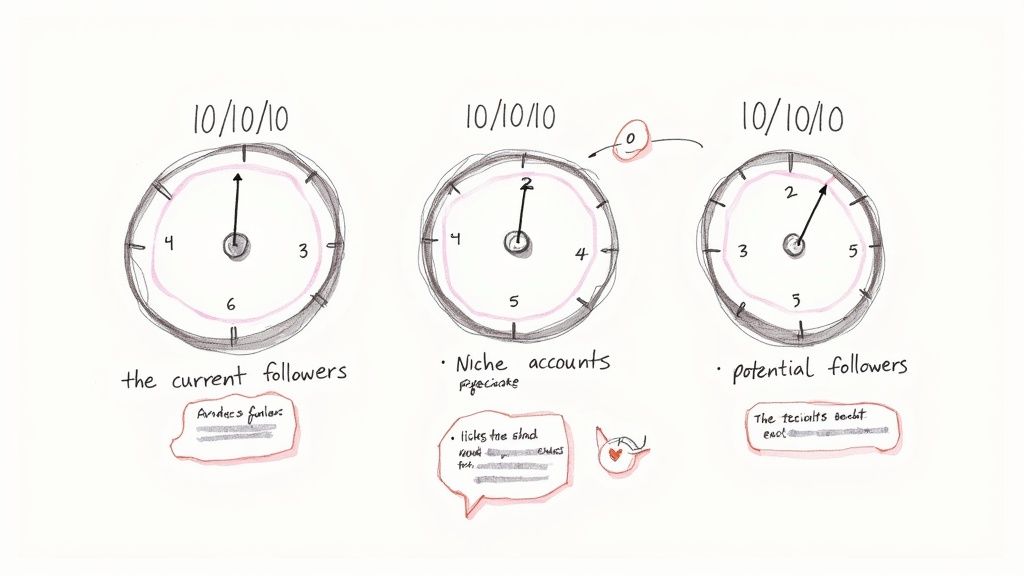
To keep this from becoming a time-suck, I recommend the 10/10/10 method. It’s a simple framework that lets you nurture key relationships in just 30 minutes a day—a total productivity hack for focused community building.
- 10 Minutes with Your Current Followers: Jump in and respond to every single comment and DM. Practical Example: Someone comments "Great tip!" You reply, "Thanks! I'm curious, what's the biggest productivity challenge you're facing this week?" This opens a conversation.
- 10 Minutes with Niche Peers: Find 5-10 other accounts in your industry (think collaborators, not direct competitors). Go leave thoughtful, valuable comments on their latest stuff. Practical Example: A peer posts about a new project management feature. You comment, "This is a great breakdown. The new automation rule is a game-changer for our team's weekly reporting. Have you tried integrating it with Slack yet?"
- 10 Minutes with Potential Followers: Use relevant hashtags or locations to find people who match your Ideal Follower Persona. Practical Example: Search the #startupfounder hashtag, find a post where someone is asking for advice, and leave a genuinely helpful comment.
This structured approach stops the mindless scrolling and turns your engagement time into a strategic growth activity.
Turn Comments into Conversations
Think of every comment on your post as an open door. Your job is to walk through it and turn that one interaction into a real back-and-forth dialogue.
This does two things: it builds a much stronger connection with that person, and it tells the platform’s algorithm that your content is genuinely sparking discussion.
The depth of your engagement matters far more than the volume. A handful of real, multi-reply conversations is more valuable to the algorithm—and your community—than dozens of one-word comments.
Practical Workflow: When you get a new comment notification, your goal isn't just to reply, but to ask an open-ended question.
- If someone comments: "Great tip!"
- Don't just reply: "Thanks!"
- Instead, ask: "Thanks! Have you tried a similar approach, and what were your results?"
This simple shift invites a deeper response and makes people feel heard. If you want to dive deeper, we have a whole guide on how to increase social media engagement.
Spark Discussion with Strategic Questions
The easiest way to get comments is to ask for them. But the old, tired "comment below" just doesn't cut it anymore. Instead, build compelling, low-effort questions right into your captions.
Here are a few practical examples to use:
- Closed Questions (A or B): "When it comes to productivity, are you Team Digital Calendar or Team Physical Planner?"
- Fill-in-the-Blank: "My biggest business goal for the next quarter is ______."
- Experience-Based: "What's the best piece of business advice you've ever received?"
These prompts are easy to answer and get the conversation started, turning your comments section into a place where people actually hang out. The payoff for this effort varies by platform. In 2025, LinkedIn is leading the pack with an average engagement rate of around 6.50%. Instagram comes in at 3.00% by reach, still well ahead of Facebook's 1.20%. And don't sleep on TikTok, where smaller creators can see organic engagement rates as high as 7.5%, fueling incredibly fast growth.
Run Strategic Experiments to Accelerate Your Reach
At some point, every social media account hits a plateau. It’s frustrating, but it’s also completely normal. You've built a solid foundation, you're posting consistently, but the follower count just…stops.
This is where most people get stuck. But for you, it's the perfect time to switch gears from just executing to strategically experimenting. Instead of guessing what might work, you can use a structured, data-driven approach to figure out exactly what your audience wants next. This means running small tests, measuring what happens, and then pouring your energy into what actually works.
Design Your Growth Experiments
Every solid experiment starts with a simple hypothesis—an "if I do X, then Y will happen" statement. This little framework is what turns random ideas into measurable tests.
Here are a few practical experiments you can try to break through a growth slump.
Experiment 1: Cross-Promote in Your Email Newsletter
- Hypothesis: If we feature our Instagram profile in our weekly newsletter, we’ll see a 10% bump in new followers within 48 hours because we're tapping into an audience that already likes our stuff.
- Workflow: Add a dedicated section to your next email blast. Don't just drop a link. Showcase 3-4 of your best visual posts and add a clear CTA like, "Follow us on Instagram for daily tips and behind-the-scenes content."
- Tools: Use your email marketing platform (like Mailchimp or ConvertKit) to track click-through rates on the social links. Compare your follower count right before the email goes out and again two days later.
Experiment 2: Run a Targeted Giveaway
- Hypothesis: If we host a giveaway that requires a follow and tagging two friends, we'll gain at least 100 new followers and boost our engagement rate by 20% in one week.
- Workflow: Team up with a brand that complements yours to offer a more compelling prize. Keep the rules dead simple: follow both accounts, like the post, and tag two people in the comments. Announce the giveaway on a Monday and run it for 3-5 days.
- Tools: Use a free tool like Comment Picker to randomly select a winner, ensuring fairness and transparency. Track new followers and post reach directly in your native analytics.
A quick pro-tip: Only change one thing at a time. If you test a new content format and a new posting time in the same experiment, you'll never know which one was actually responsible for the results.
Collaborate with Micro-Influencers
Working with micro-influencers (accounts with 10,000 to 100,000 followers) is one of my favorite growth hacks. It’s often way more effective—and affordable—than chasing creators with massive followings. Their audiences are usually more niche and super engaged, which makes them incredible partners.
- Hypothesis: If we collaborate with three micro-influencers in our niche, we'll gain at least 50 new, highly relevant followers from each partnership.
- Workflow: Use platform search or a tool like Upfluence to find influencers whose audience looks exactly like your Ideal Follower Persona. Don't just give them an ad to run; co-create content with them that feels totally authentic. For example, have them show how they use your product in a "day in the life" Reel.
- Tools: Provide each influencer with a unique UTM link or discount code. This allows you to precisely track how much traffic and how many new leads each partnership drives.
This kind of collaboration is getting more important by the day, especially as social platforms turn into legitimate shopping destinations. A wild 58% of users bought products through social media in 2024, a huge leap from 49% in 2022. It’s clear proof that putting the right product in front of an engaged audience can turn followers into paying customers, fast. You can dig deeper into social media usage statistics over on hookagency.com.
Test New Content Formats
Audience preferences change. Algorithms change. What crushed it six months ago might be totally ignored today. That’s why you have to keep testing different content formats to see what's resonating right now.
- Hypothesis: If we repurpose our best-performing blog post into a LinkedIn carousel, it will get 50% more reach than our usual text-and-link posts.
- Workflow: Pull the 5-7 key takeaways from a popular article. Open your pre-made Canva carousel template. Design a simple, clean 7-10 slide carousel. Each slide should hit one core idea, making it super easy to digest. Post it during your peak engagement time.
- Tools: After 7 days, compare the post's reach and engagement rate in your LinkedIn analytics against your average for the month.
By running these kinds of small, systematic experiments, you stop guessing and start knowing. You’ll quickly find out what truly moves the needle for your audience, letting you put your time and resources into the tactics that deliver real, measurable growth.
Analyze Your Performance and Refine Your Strategy
Putting content out there is only half the job. Real, lasting growth kicks in when you stop guessing what works and start letting data guide your decisions. Think of analyzing your performance as the engine for a smart social media workflow—it shows you what to double down on and what to confidently leave behind.
This isn't about getting lost in a sea of spreadsheets. It's about building a simple, repeatable habit to look at what you’ve done, understand the story the numbers are telling, and constantly tweak your strategy to get better results. The goal is to move past vanity metrics like likes and focus on what truly signals a healthy, growing community.
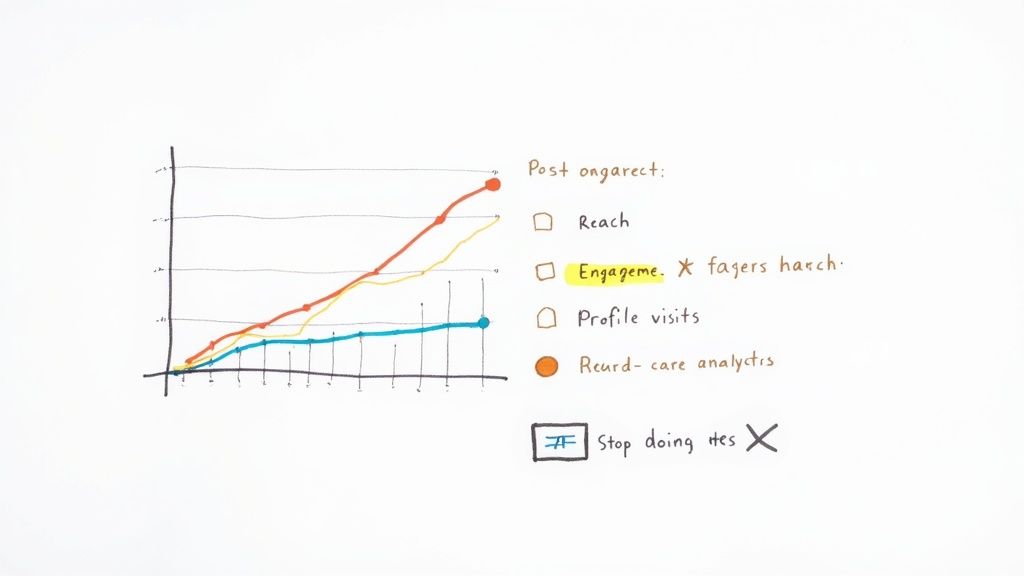
Key Metrics That Actually Matter for Growth
To really understand how to grow, you need to track the right things. Forget the noise and zero in on these four metrics. Together, they paint a clear picture of your account's health and momentum.
- Reach: This is the unique number of people who saw your content. It’s your top-of-funnel signal, telling you how well your stuff is spreading beyond your current followers.
- Engagement Rate: Calculated by (likes + comments + shares) ÷ followers, this shows how interesting your content actually is. A high rate is a powerful signal to the algorithms that your content is worth showing to more people.
- Profile Visits: This one signals serious interest. Someone who takes the time to click through to your profile is actively thinking about following you or learning more. Don't ignore it.
- Follower Growth Rate: Instead of just staring at the total follower count, track your percentage growth month-over-month. Practical Example: If you grew from 1000 to 1100 followers, your growth rate is 10%. This gives you a much better sense of your actual momentum than just seeing "+100 followers".
Analyzing these core metrics is like having a direct conversation with your audience. Their clicks, shares, and follows are telling you exactly what they want to see more of. Listening is the key to creating content that hits the mark, again and again.
The Monthly Performance Review Workflow
Just set aside one hour each month for this. Seriously. This simple habit will save you countless hours of creating content that goes nowhere.
- Pull Your Data (15 mins): Jump into your native platform analytics and export the data for the last 30 days. Focus on the four key metrics above for each post.
- Spot Your Winners (15 mins): Sort your posts by reach and engagement. What were your top three? Make a note of the format (carousel, video, etc.), the topic, and the specific angle you took. Practical Example: You notice your top 3 posts were all carousels breaking down a complex topic into simple steps.
- Ask "Why" (15 mins): This is where the magic happens. Why did those posts do so well? Was it a super-relatable story? A controversial take? An incredibly practical tip? Your conclusion: "My audience loves simple, step-by-step guides in a carousel format."
- Action Plan (15 mins): Look at your worst-performing posts. Are there common themes? Be ruthless. Your action plan for next month: "Create two more step-by-step carousels and stop posting single-image quotes, as they consistently underperform."
This review process is your secret weapon, especially when you consider the sheer scale of social media today. As of early 2025, there were about 5.66 billion social media users worldwide, with 7.8 new users joining every second. That’s a massive opportunity, but it also means you have to be smart to get noticed. You can find more of these insights into global social media usage at DataReportal. By constantly refining your approach based on what your data tells you, you give your content the best possible chance to connect with this huge, ever-growing audience.
Frequently Asked Questions
As you dig into growing your social media presence, you're bound to have questions. Everyone does. I've rounded up some of the most common ones I hear and answered them with practical, no-fluff advice to help you navigate the tricky parts of building a real community.
How Long Does It Really Take to See Follower Growth?
There's no magic number here. Your growth timeline depends heavily on your niche, how consistently you show up, and the quality of your content. But with a solid, dedicated strategy, you can expect to see real momentum building within 3 to 6 months.
The beginning is always the slowest part of the journey. In those early days, it’s better to focus on leading indicators like your engagement rate and profile visits instead of obsessing over the follower count. Sustainable growth is a marathon, not a sprint.
Your first 100 followers are the hardest to get. Your next 1,000 will come much faster because you've proven your value. Don't get discouraged by slow initial progress; it's a normal and necessary part of building a genuine audience.
Practical Example: A new B2B consultant might only gain 50 followers in their first two months. But if those followers are highly engaged—commenting, sharing, and messaging—they're absolutely on the right track. That early engagement is a powerful signal to the algorithm that their content is valuable, which will eventually ramp up their reach.
Should I Ever Buy Followers to Get Started?
An emphatic no. Buying followers is the fastest way to sabotage your account's health. You’re paying for bots or ghost accounts that will never, ever engage with your content, and that absolutely tanks your engagement rate.
When your engagement rate plummets, the platform's algorithm gets a clear signal: this content isn't valuable. Your organic reach gets crushed as a result. It is so much better to have 100 genuine followers who actually care about what you post than 10,000 fake ones who don't. You have to earn real followers with great content.
Practical Example: You're a local bakery. Buying followers is like filling your shop with mannequins. It might look full from the outside, but nobody's actually buying bread. A line of ten real, paying customers out the door is infinitely more valuable.
What Is a Realistic Posting Frequency?
This definitely varies by platform, but the golden rule is always quality over quantity. I've seen it time and again: posting truly valuable content 3-5 times a week is far more effective than posting mediocre fluff every single day.
For platforms like Instagram or LinkedIn, once a day is more than enough for most accounts. The real key is to avoid burnout. You need a pace you can stick with for the long haul.
Here's a simple productivity workflow to find your sweet spot:
- Start Small: Pick a manageable schedule you know you can hit, like posting on Mondays, Wednesdays, and Fridays.
- Check Analytics: After a month, dive into your native analytics. See which days and times your audience was most active.
- Adjust and Test: If you notice your audience is super engaged on weekends, try adding a Saturday post to your schedule and see how it performs.
Remember, consistency trumps frequency every time. Showing up reliably is how you build trust and keep your audience coming back for more.
What Are the Essential Tools for Managing Growth?
You can definitely start with just the tools built into the platforms themselves. But if you want to work smarter, not harder, a few key products will make a world of difference for your productivity.
- Scheduling Tool: This is non-negotiable for planning content, batching your work, and staying consistent without living on social media. Example Tools: Postful, Buffer, Later.
- Design Tool: Something simple like Canva is perfect for creating professional-looking graphics, videos, and reusable templates that keep your brand looking sharp.
- Analytics: Get comfortable with each platform's native analytics. This is where you'll find the data to understand what's working so you can double down on it. Productivity Tip: Create a simple dashboard or spreadsheet to track your 4 key growth metrics month-over-month.
This basic toolkit gives you a sustainable and efficient workflow, freeing you up to focus on what really matters: creating great content and talking to your community.
Ready to stop guessing and start growing? Postful is the AI-powered social media tool built for founders and doers who need to show up consistently without the grind. Get ready-to-use templates and on-demand brainstorming tools to create better content, faster. Join the waitlist at https://postful.ai and secure your spot to build a more effective social media presence.