
So many startups and side-hustles fizzle out for one big reason: they don’t really know who they’re selling to. As a founder or solopreneur, your time and money are finite. Spraying and praying your marketing is a surefire way to burn through both.
That’s why getting crystal clear on your ideal customer is the bedrock of every smart business decision you’ll make. It’s the difference between guessing and knowing.
This guide is a practical workflow—no fluff—for finding, understanding, and connecting with the people who genuinely need what you’re building. We’ll skip the generic advice and get straight to tactics, tools, and workflows, from digging into your earliest customer data to running interviews that actually give you insight. It’s time to stop marketing to everyone, and start talking to the right one. You can dig even deeper into how to identify your target audience and drive real growth to really nail this down.
Moving from Guesswork to Data
The goal here is to trade your assumptions for action. We’re going to turn raw data and real conversations into a clear picture of your ideal customer. Think of it less like creating a static document and more like building a living, breathing understanding of your audience that evolves right alongside your business.
Effective audience research isn’t a shot in the dark; it’s a structured process. You start with a hunch, test it with real data, and end up with a genuine connection to your customers.
So, what does this actually do for your productivity? When you focus your efforts, you:
- Stop Wasting Time: No more building features or writing content that nobody wants. A founder selling handmade leather wallets can finally stop wasting ad spend on vegan forums.
- Boost Marketing ROI: Your messaging gets sharper because you know exactly which buttons to push and which problems to solve. Productivity Tip: Create content templates based on your audience’s top 3 pain points to streamline content creation.
- Build a Real Community: People feel seen when your brand speaks their language. That’s how you turn casual buyers into true fans who do the selling for you.
You don’t just find an audience—you build it, piece by piece. It’s a continuous loop of listening, learning, and adapting. Every bit of data, every customer conversation, is another brick in the foundation.
Uncover Clues Within Your Existing Data
The best place to start looking for your target audience is with the people who have already found you. It’s tempting to jump straight into broad market research, but you’ve probably got more data than you think, even if you’re just starting out. This first step is all about swapping your assumptions for actual facts.
It’s about finding the clues hidden in your own digital footprint.
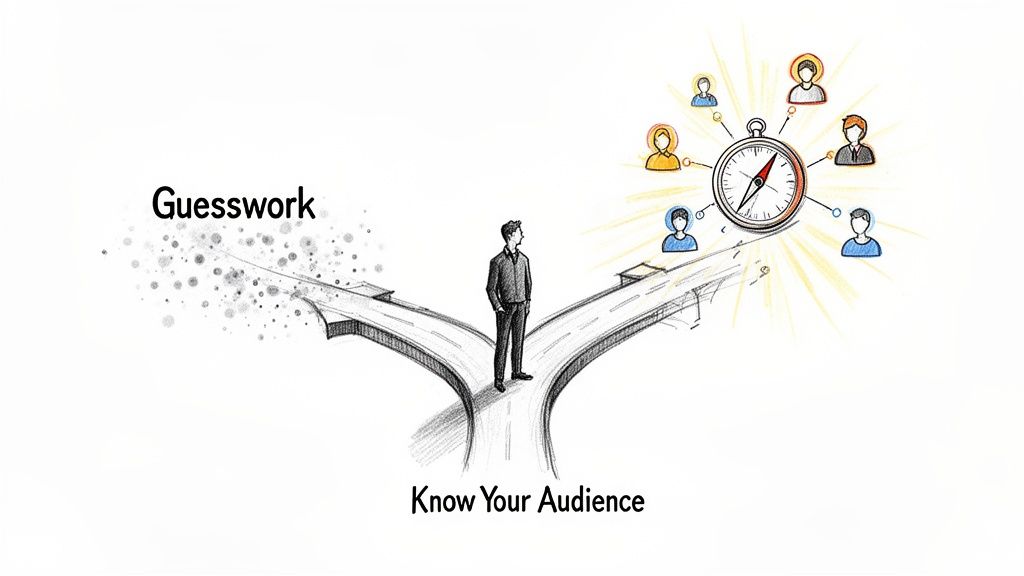
This process grounds your strategy in reality before you sink a dime into ads or big campaigns. We’re looking for early patterns in your social media followers, website visitors, and email subscribers. Let’s dig in.
Mine Your Social Media Insights
Your social media analytics are a goldmine for this. Seriously. Most platforms give you free, built-in tools that paint a surprisingly clear picture of who’s paying attention to what you’re putting out there.
Think about it: by 2025, over 5.24 billion people will be on social media. The goal isn’t to reach all of them; it’s to find your people. Facebook, for instance, lets you get incredibly specific—like targeting small business owners aged 25-44 who follow entrepreneurship pages. This is how you stop shouting into the void. You can learn more about how social media statistics can shape your strategy.
Here’s a simple productivity workflow:
- Monday Morning Metrics: Block out just 15 minutes in your calendar every Monday to review last week’s data. Use a simple spreadsheet or a note-taking app to track key findings week-over-week.
- Where to Look: Instagram Insights and Facebook Analytics are the perfect places to start.
- What to Look For: Zero in on Age Range, Gender, Top Locations (city/country), and Most Active Times.
Practical Example: Imagine you’re a side-hustler selling productivity planners. You might find that 70% of your most engaged followers are women aged 28-35 in major US cities, and they’re most active on weekday mornings. Boom. That one insight tells you to schedule your most valuable content for 9 AM EST on weekdays using a scheduling tool like Buffer or Later.
Analyze Your Website Traffic
If you have a website or a blog, Google Analytics is your next stop. This is where you can go deeper than basic demographics and start to understand the behaviors and interests of the people visiting your site.
The goal isn’t just to collect data points, but to connect them. If your social data shows a spike in followers from Austin, TX, and your Google Analytics shows a similar increase in website traffic from that area, you’ve just uncovered a potential geographic hotspot for your audience.
Once you’re in your Google Analytics dashboard, head over to the “Audience” reports. Pay close attention to the Interests section. The data here can be surprising and incredibly useful.
Practical Example: Let’s say you’re the founder of a project management app. You might find that a huge chunk of your visitors fall into the “technophiles” and “business professionals” categories, which confirms what you already suspected. But you might also discover an unexpected interest in “home and garden,” hinting that your audience really values work-life balance. That’s a powerful new angle for your marketing messages and future blog posts.
Gather Deeper Insights Through Direct Conversation
Data tells you what is happening. Conversations tell you why.
While analytics can show you patterns in age, location, and interests, it can’t get into the heads of your customers. It won’t reveal the real-world frustrations, motivations, and daily struggles that actually drive their decisions. To get that, you have to go beyond the numbers and just talk to people.
This is where you find the rich, qualitative gold that makes your data finally click. For a founder or solopreneur, a few focused chats can give you more genuine direction than weeks of blind guesswork.

Conduct Effective Customer Interviews
Interviewing customers—or even potential ones—doesn’t have to be some formal, intimidating process. Your only goal is to understand their world. Even if you only have a handful of early users or a small email list, they are an invaluable source of truth.
The trick is to ask open-ended questions that get them telling stories. Don’t ask, “Don’t you find it hard to manage social media?” That just prompts a lazy ‘yes’ or ‘no’.
Instead, try something like, “Can you walk me through your process for creating and posting content last week?” See the difference?
Here are a few powerful prompts to get you started:
- “What’s the hardest part about [the problem you solve]?” This gets right to the core pain points.
- “Tell me about the last time you tried to solve this problem. What did you do?” This reveals their current workarounds and the other tools they’ve already tried (and likely failed with).
- “What does a ‘successful’ outcome look like for you when it comes to [your solution area]?” This helps you understand their goals in their own words.
Productivity Tip: Use a tool like Calendly to schedule interviews easily. Record the calls (with permission) using Zoom or Google Meet, then use an AI transcription service like Otter.ai to get a searchable text transcript. This saves hours of note-taking and lets you focus on the conversation.
Become a Digital Ethnographer
You don’t always have to initiate the conversation. Sometimes, the most powerful insights come from simply observing your audience in their natural digital habitats. It’s a practice often called ‘digital ethnography,’ and it’s perfect for solopreneurs who have more time than money.
It boils down to lurking—with purpose—in the online communities where your ideal customers hang out.
Think of yourself as a quiet observer in a coffee shop. You’re not there to interrupt, but to listen to the recurring themes, common complaints, and shared wins. An hour spent in a relevant subreddit can often yield more actionable insights than a pricey market research report.
You can find these communities on platforms like:
- Reddit: Look for subreddits related to your industry or the problem you solve (e.g., r/solopreneurs, r/sidehustle).
- Facebook Groups: Search for groups dedicated to specific professions, hobbies, or challenges your audience is grappling with.
- Industry Forums: Niche communities like Indie Hackers provide direct, unfiltered access to specific conversations.
Productivity Workflow: Create a simple spreadsheet with columns for “Source Link,” “Direct Quote,” “Pain Point,” and “Goal.” Spend 30 minutes each Friday populating this sheet. Soon, you’ll have a repository of your audience’s exact language to use in your marketing, which is a huge time-saver for copywriting. This is also a fantastic source of real quotes for learning the right way to ask for customer reviews.
Build Actionable Personas That Guide Decisions
You’ve done the hard work of gathering data and listening to your audience. Now it’s time to pull it all together. The point here isn’t to create some dense document that gets filed away and forgotten; it’s to build a simple, powerful tool that guides every single business decision you make. That tool is your audience persona.
Think of an audience persona as a semi-fictional profile of your ideal customer, but one that’s grounded in real data and actual quotes from your research. For a busy founder, this isn’t about listing generic traits. It’s about creating a practical, one-page summary that keeps your content, product development, and marketing laser-focused on the right person.
From Data Points to a Human Profile
The real magic happens when you start blending what you’ve learned. You take the demographics from your analytics and combine them with the motivations and frustrations you heard in your interviews. This is how abstract data becomes a relatable human profile that you and your team can actually picture.
Practical Example: Let’s say your research starts showing a pattern:
- Quantitative Data: You notice 65% of your most engaged users are women between 28-40, living in cities, and usually browsing your site on their phones in the evening.
- Qualitative Data: In interviews, you keep hearing phrases like “I’m so overwhelmed by my content calendar” and “I’m tired of switching between five different apps just to get a post out.”
When you put those two pieces together, a persona starts to emerge. Let’s call her “Side-Hustle Sarah.”
The most powerful personas feel real because they are built from real words. Instead of saying your persona ‘wants to be more productive,’ use a direct quote from your research: ‘I just need a simple way to get my ideas out of my head and onto social media without it taking over my weekend.’
Focusing on What Truly Matters
To keep your persona useful, stick to the details that actually influence your strategy. Forget about their eye color or favorite movies unless it’s somehow directly relevant to what you sell.
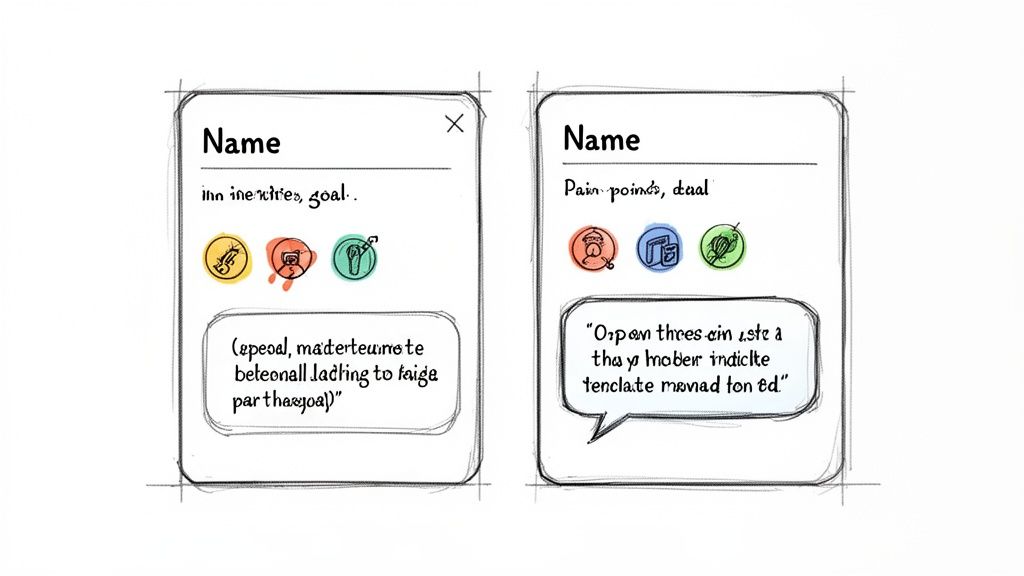
A good persona template is simple. It just needs to answer these core questions:
- Goals: What are they trying to achieve? (e.g., “Grow my side-hustle’s online presence to get 3 new clients per month.”)
- Pain Points: What specific frustrations are holding them back? (e.g., “I waste hours staring at a blank page, and scheduling posts across different platforms is a manual chore.”)
- Daily Workflow: What does their typical day look like? (e.g., “Works a 9-5 job, dedicates evenings and weekends to her business, primarily uses a smartphone for social media.”)
- Communication Channels: Where do they hang out and get information? (e.g., “Active in female entrepreneur Facebook groups, follows industry leaders on Instagram, listens to business podcasts on her commute.”)
Productivity Tool: Use a free tool like Miro or a simple Canva template to build your one-page persona. This visual format makes it easy to reference before starting any new marketing task. If you find yourself building out multiple personas, it’s helpful to understand what is audience segmentation and how to tailor your approach for each group.
Validate and Refine Your Audience Understanding
Finding your target audience isn’t a one-time task you can just check off a list. I think of it as a continuous loop: learn, test, and refine. Once you’ve built your initial personas based on data and a few good conversations, the real work begins. You have to test your assumptions out in the wild.
This step is what keeps you from pouring time and money into a strategy that’s just slightly off-target. You need to see what actually connects with people.
Run Small-Scale Tests to See What Sticks
You don’t need a massive budget to validate your ideas. The goal here is to run small, measurable experiments that give you clear signals about your messaging and audience focus. Think of them as low-risk reality checks.
A good way to start is by creating a few different versions of your content, each tailored to a specific pain point or motivation you uncovered in your research. For solopreneurs, productivity tools are a lifesaver here, letting you generate and schedule content variations without eating up your whole day.
Here are a few practical tests you can run:
- Targeted Social Media Ads: Run a small A/B test campaign on Facebook or Instagram. Create two ad sets with the same visual but different copy. Maybe one version uses language from your “Side-Hustle Sarah” persona, focusing on the feeling of “overwhelm,” while the other hits a different pain point. A tiny budget of just $50 is often enough to see which message gets more clicks.
- Content Angle Testing: Write two blog posts or create two social media carousels on a similar topic, but frame them from different angles. For instance, a post titled “5 Time-Saving Hacks for Busy Founders” tests the “productivity” angle. Compare that to “How to Avoid Burnout as a Solopreneur,” which tests the “well-being” angle. See which one gets more shares and comments.
- Newsletter Segmentation: If you have an email list, send two slightly different versions of your next newsletter to small, random segments. Productivity Tool: Most email marketing platforms like Mailchimp or ConvertKit have built-in A/B testing features that make this easy. Tweak the subject line and watch which version drives a higher open rate.
This cycle of building, testing, and learning is what keeps your connection with your audience from going stale.
Finding your target audience is less like finding a needle in a haystack and more like tuning a radio. You start with a general frequency, listen for a clear signal, and then make tiny adjustments until the message comes through perfectly.
Measure and Adapt
The key to making any of this work is tracking the right metrics. For every test, you should be measuring engagement, clicks, and conversions to see what’s actually resonating. Did the ad copy using direct quotes from your interviews crush the more generic version? That’s a powerful sign that your persona is on the right track.
This is especially true on social media, where 5.17 billion users are scrolling past anything that doesn’t feel relevant to them.
One of my favorite ways to validate an audience is to watch micro-influencers in a niche. These creators often pull in 60% higher engagement rates than macro-influencers because their connection with followers is authentic and highly tuned. By borrowing from their language and content themes, you can quickly test what connects with a hyper-specific group. You can find more ideas in these powerful social media targeting strategies.
Translate Your Research into a Social Media Strategy
Okay, so you’ve built your audience personas. Now what?
The next move is to figure out where these people actually spend their time online. Knowing who your audience is tells you nothing if you don’t know where to find them. This is where your research gets real and turns into an actionable social media plan.
Every social platform has its own vibe and user base. You wouldn’t talk to a potential client on LinkedIn the same way you’d try to grab a follower’s attention on TikTok. The whole point is to show up where your audience is already hanging out and, crucially, to speak their language.
Match Your Persona to the Platform
Your persona research should be your roadmap for choosing your channels.
If your ideal customer is a Gen Z creator, for example, then being on TikTok and Instagram is pretty much non-negotiable. On the flip side, a B2B founder is far more likely to be networking and digging into industry content on LinkedIn.
Making a strategic choice here stops you from spreading yourself too thin, trying to be everywhere at once. Trust me, a focused, strong presence on two relevant platforms will always beat a weak, scattered presence on five.
The most productive social media strategy isn’t about being on every platform; it’s about dominating the few that matter most to your specific audience. It’s the difference between using a megaphone in an empty field versus having a meaningful conversation in a crowded room.
Understanding platform demographics is everything. The social media landscape is always changing, with global users expected to hit 5.44 billion by 2025. Today, a staggering 73% of people research brands on social media, so picking your channels wisely is essential.
Practical Example: Gen Z flocks to YouTube and TikTok, while adults still tend to favor Facebook. A financial advisor targeting millennials would find more success creating educational carousels on Instagram than trying to go viral on TikTok. Knowing these nuances helps you put your time where it’ll have the biggest impact. You can dig into more insights on global social network usage on Statista.
Tailor Your Message and Measure What Matters
Once you’ve picked your platforms, you need to adapt your content. A long, educational post that kills it on LinkedIn would have to be completely re-imagined as a quick, visual Reel for Instagram. This is where productivity tools become a founder’s best friend, using AI and templates to create platform-specific content that speaks directly to your audience.
After you’ve nailed down who you’re talking to and where you’re talking to them, you can focus on creating engaging social media content.
The final piece of the puzzle is tracking your performance to see if your strategy is actually working. That’s where you can learn more about how to measure social media ROI and connect your efforts to real business results.
A Few Common Questions About Finding Your Audience
Trying to pin down your target audience always brings up some tricky, real-world questions. If you’re a founder or solopreneur, you don’t have time for vague answers. You need a clear path forward.
Let’s dig into some of the most common hurdles I see people face.
What If I Have No Customers or Data Yet?
Ah, the classic chicken-and-egg problem. It feels like you’re flying blind, but you’re not. Your first move is to look at your competitors.
Who are the people following businesses with similar solutions? What kind of language are they using in reviews and comments? Productivity Workflow: Spend one hour using a tool like SparkToro (they have a free version) to analyze the audiences of 3-5 competitors. It will show you what they read, watch, and listen to, giving you a massive head start on where to find your own potential customers.
How Many Audience Personas Should I Create?
Less is absolutely more, especially in the early days. My advice? Start with one primary persona. Just one. This person represents the absolute core of your market.
Trying to be everything to everyone is a surefire way to dilute your message and burn through your limited resources.
Nail your messaging and strategy for one core group first. Get to know them inside and out. Once you’ve truly connected with them, you can think about expanding to a secondary persona—but only if your product genuinely solves a problem for another distinct group.
For example, a productivity app might work for freelance writers and project managers. But a smart founder will pick one—let’s say the writers—and pour all their energy into winning them over before even thinking about the managers.
How Often Should I Update My Audience Research?
Your audience isn’t static. Their needs, habits, and the world they live in are always changing. That means your research can’t be a “one-and-done” project. Think of it as an ongoing conversation.
As a rule of thumb, it’s a good idea to formally revisit and update your personas at least once a year. You should also do a refresh anytime you’re planning a major product pivot or a big shift in your marketing strategy.
But informally? You should be gathering feedback all the time. Productivity Tip: Create a dedicated folder in your email or a tag in your project management tool (like Notion or Trello) called “Audience Insights.” Whenever you get a valuable piece of customer feedback via email or social media, file it there. This makes your annual review a simple process of reviewing curated insights instead of starting from scratch.
Ready to stop guessing and start connecting? Postful is the AI-powered social media tool that makes reaching your audience simple. Built for founders and all-in-one doers, Postful helps you grow your reach confidently and consistently. Try Postful Today!