
Forget the fluff. Building a personal brand isn’t about chasing likes or followers. It’s a deliberate, strategic process of defining your expertise, communicating your value, and building real trust with an audience. Get it right, and your reputation transforms into a magnet for career-defining opportunities.
Why Your Personal Brand Is a Career Superpower
If you think personal branding is just for influencers, think again. For founders and side-hustlers, it’s one of the most powerful tools you can have.
A strong personal brand is a shortcut to trust and credibility in a ridiculously crowded market. When people feel like they know, like, and trust you, they are infinitely more likely to buy from, invest in, or work with you.
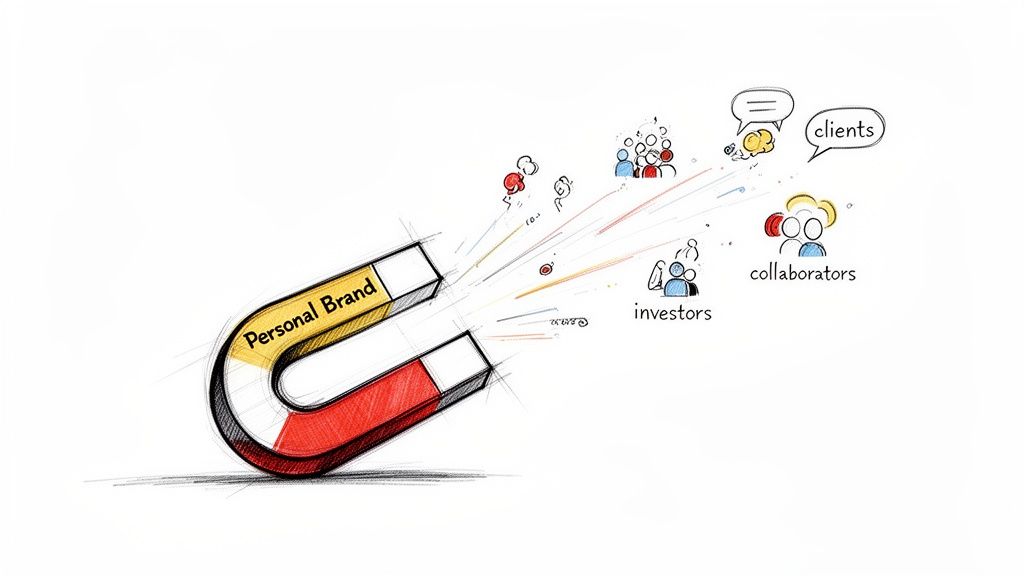
It’s the ultimate competitive edge. While your competitors are busy pouring money into ads, your authentic voice and consistent insights are building a loyal community that actually roots for you. This isn't just theory—the numbers back it up.
The Power of Trust and Connection
Trust is the new currency, and a personal brand lets you print your own. Research shows that 74% of people are more likely to trust someone with an established personal brand. That simple fact shows why this isn't a "nice-to-have." For founders, this trust translates directly into growth by building a foundation for customer loyalty and word-of-mouth that you can’t buy.
This connection builds a protective moat around your career or business. With a strong brand, you’re no longer just a commodity. You become the go-to expert, the first person that pops into someone’s head when they need a solution in your niche.
A personal brand is what people say about you when you're not in the room. By proactively building it, you take control of that narrative and ensure it aligns with your professional goals.
Attracting Opportunities Instead of Chasing Them
A well-built personal brand completely flips the script on career growth. Instead of desperately hunting for clients or networking for your next gig, opportunities start finding their way to you.
Think about these real-world scenarios:
- The SaaS Founder: She consistently shares insights on LinkedIn about solving a specific industry problem. Pretty soon, she's seen as a thought leader. Investors and potential partners start reaching out, drawn in by her expertise.
- The Side-Hustle Consultant: A freelance graphic designer uses Instagram to showcase his design process and client wins. This steady stream of valuable content attracts a flow of inbound leads, and he hasn't sent a cold email in months.
In both cases, their brand did the heavy lifting. To really make this work and open doors, a practical guide to personal branding is essential. It turns your online presence from a static resume into a machine that generates opportunities for you 24/7.
Building Your Authentic Brand Foundation
Before you even think about posting, we need to lay the groundwork. A strong personal brand isn't about faking it until you make it; it’s about figuring out what makes you you, and then turning up the volume on that.
Trying to build a brand without this foundation is like building a house on sand. It might look okay for a little while, but it's not going to last. The goal here is to get crystal clear on who you are so that every single thing you post feels consistent and genuine—both to you and your audience. This all comes down to three things: your expertise, your values, and your voice.
Define Your Core Expertise
First up, what do you actually know? Your expertise is the specific skill or knowledge you want to be known for. This isn't about claiming you're the number one expert in the world. It’s about carving out a specific niche where you can genuinely help people.
Saying your expertise is "business strategy" is way too broad. It’s forgettable. But "go-to-market strategy for B2B SaaS startups"? Now that’s specific. It’s memorable. It immediately tells a certain group of people that you're the person they should listen to.
To nail this down, ask yourself a few honest questions:
- What problems do people keep asking me to solve? Productivity tip: Search your email and DMs for the phrase "can you help me with" to spot recurring patterns.
- What do I geek out on in my free time? The topics you're naturally drawn to are often where your deepest knowledge lies.
- Where have I gotten real, measurable results? Your track record is proof that you know what you're talking about. Example: "Increased user retention by 15% in Q3 by implementing a new onboarding flow."
The magic happens at the intersection of what you're good at, what you actually enjoy, and what people are willing to pay attention to. Don't be scared to get specific. It’s way better to be a big fish in a small pond.
Uncover Your Guiding Values
Your values are the "why" behind your "what." They're the principles that quietly guide how you work, what you talk about, and how you show up. In a sea of experts all talking about the same things, your values are what make you relatable. They're what build trust.
Think about it: people don't just follow someone for their expertise. They follow people they feel a connection with. If one of your core values is transparency, you’ll be the person who shares the messy behind-the-scenes stuff, not just the wins. If you value simplicity, your content will be all about breaking down complicated ideas into simple, actionable steps.
Your values differentiate you when your skills don't. Anyone can claim expertise in a topic, but nobody can replicate your unique combination of principles and beliefs. This is your true competitive advantage.
To figure out your values, think about the moments in your career you're most proud of. What principles were you living by? This isn't about picking cool-sounding words from a list. It’s about identifying the beliefs you'll stand by, no matter what.
Master Your Unique Voice
Finally, your voice is how your brand sounds. It's the personality that comes through in your writing. Are you witty and a bit sarcastic? Or are you more analytical and straight to the point? Your voice should feel like a natural extension of who you really are, making your content instantly recognizable.
A consistent voice builds a sense of familiarity. Over time, your audience should feel like they're hearing from a friend, not some faceless corporate account. To really dial this in, you need to understand what makes a brand voice tick. For a deeper dive, our guide on what is brand voice will help you find a style that’s authentic and connects with your ideal audience.
Bringing these three pillars—expertise, values, and voice—together is where the real work begins. I find it incredibly helpful to put it all down in a simple "Brand DNA" document. It's basically a one-page cheat sheet that keeps you honest and ensures every piece of content you create is perfectly aligned with who you are.
To help you get started, here’s a quick template to map out your own Brand DNA. It's a simple way to turn those abstract ideas into a concrete guide for your personal brand.
Your Personal Brand DNA Template
| Brand Component | Guiding Questions | Your Notes (Example) |
|---|---|---|
| Core Expertise | What specific problem do I solve for whom? | I help early-stage B2B SaaS founders build scalable go-to-market strategies. |
| Guiding Values | What are 3-5 non-negotiable principles that guide my work? | Simplicity, Transparency, Action Over Theory. |
| Brand Voice | What three words describe my communication style? | Direct, encouraging, and data-driven. |
| Unique Selling Prop. | What makes my approach different from others? | I focus on low-cost, high-impact tactics for bootstrapped startups. |
| Target Audience | Who am I creating content for? What are their biggest challenges? | Founders with <$1M ARR who are overwhelmed by marketing options. |
Fill this out for yourself. Stick it somewhere you can see it. This little document will be your north star as you start creating content.
Designing a Content Workflow That Works for You
A killer personal brand isn’t built on one viral post. It's forged in the trenches, through steady, consistent communication. But let's be real—if you're a founder or a side-hustler, finding the time to consistently create high-value content feels next to impossible.
The secret isn’t about working harder. It's about working smarter with a repeatable system that prevents you from burning out.
This is where a productivity-first approach becomes your superpower. Instead of staring at a blank screen every day wondering what to post, you build a workflow that makes creating content feel almost effortless. It all starts by ditching the random acts of content and embracing a structured, strategic plan.
From Brand DNA to Content Pillars
Your Brand DNA document is your north star. Now, we need to translate that foundation into tangible topics you can talk about week in, and week out. These are your content pillars—the core themes or subjects that spring directly from your expertise and values.
Think of them like the main categories of your personal blog or the recurring segments on your favorite TV show. They give you structure and make sure every single thing you create is aligned with the brand you’re building.
For a B2B SaaS founder, those pillars might look something like this:
- Pillar 1: Go-to-Market Strategy: Actionable tips and frameworks for other early-stage startups.
- Pillar 2: Bootstrapped Growth: Documenting the real journey of growing a company on a shoestring budget.
- Pillar 3: Founder Productivity: Sharing workflows and insights for other founders who are just as busy.
Once you have these pillars defined, you'll never be short on ideas again. Every week, you can zero in on creating one core piece of content for a single pillar, then slice and dice it across multiple channels. This simple process—mapping your core brand elements to your content strategy—is the bedrock of a memorable personal brand.
This diagram shows how your expertise, values, and voice all come together to create that solid foundation.
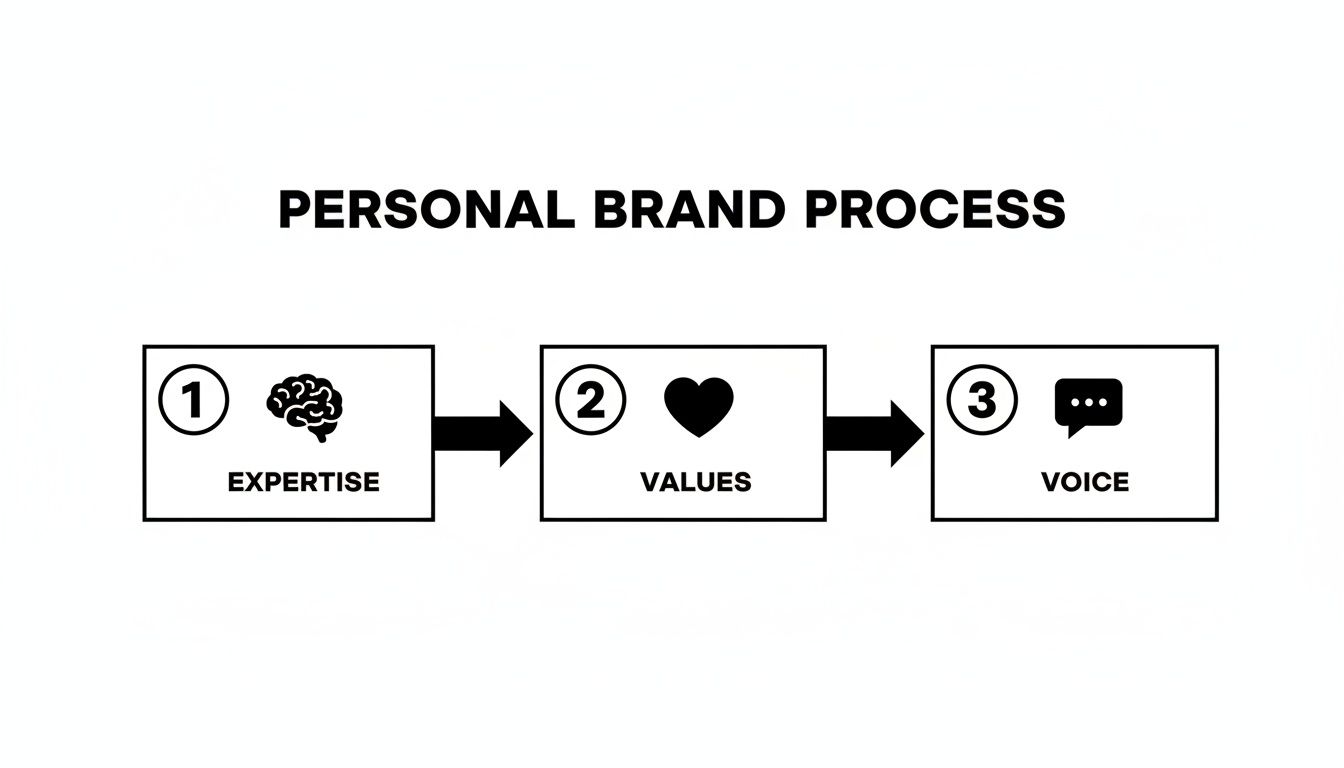
This flow isn’t just a pretty picture; it shows how a powerful brand is built intentionally, with each piece reinforcing the others to create a presence that's both consistent and authentic.
The Power of Repurposing One Idea
Let’s get practical. Imagine our SaaS founder wants to create content around their "Founder Productivity" pillar. The core idea for the week is a simple one: "The '5-Minute Rule' for Overcoming Procrastination."
Instead of dreaming up seven totally different ideas for the week, they create seven variations of this one idea.
- Monday (LinkedIn Text Post): A short, punchy post explaining the 5-Minute Rule and how it helped them ship a new feature.
- Tuesday (Instagram Carousel): A 5-slide visual breaking down the rule into simple, actionable steps with icons and bold text.
- Wednesday (Short-Form Video): A 30-second Reel or TikTok where they quickly explain the concept and show a real-life example at their desk.
- Thursday (LinkedIn Poll): A simple poll asking, "What's your go-to trick for beating procrastination?" with the rule as one of the options.
- Friday (Twitter Thread): A thread that goes deeper into the psychological reasons why the rule works, citing a study or a personal insight.
This is the very essence of a sustainable workflow. You go deep on one valuable idea, then slice it into multiple formats. Not only does this save an incredible amount of time, but it also hammers home your core message, making your brand that much more memorable.
Building a System for Consistency
The real secret to a successful content workflow is offloading the repetitive tasks so you can stay focused on the ideas. It’s all about batching your work and using the right tools to streamline the entire process.
A great workflow might look something like this:
- Hour 1 (Ideation): Brainstorm and outline four core ideas for the entire upcoming month—one for each week. Productivity tip: Use a tool like Notion to create a simple database for your ideas, tagging each by content pillar.
- Hour 2 (Creation): Write the "main" piece of content for each of those ideas, like a detailed LinkedIn post or a short blog entry.
- Hour 3 (Repurposing & Scheduling): Break down each main piece into smaller formats (tweets, carousels, video scripts) and get everything scheduled using a tool.
This is where platforms like Postful become so valuable. Instead of juggling everything manually, you can use AI-powered idea generation to fill your pipeline and lean on proven templates to quickly format posts for different platforms. The goal here is automation and efficiency.
Just remember, especially with video, that bad audio can seriously undermine your message and make you seem less credible. Understanding the impact of audio quality on your brand's credibility is a must for any creator building a personal brand.
The most productive personal brands aren't run by people with more time; they're run by people with better systems. Your workflow is your competitive advantage.
Ultimately, a well-designed content workflow frees you from that daily pressure to "be creative." By planning ahead and systemizing your process with a content calendar, you guarantee consistency. You can learn more about getting one set up with our guide on what is a content calendar. This is exactly how you build a powerful personal brand without sacrificing your business—or your sanity.
Turning Followers Into a Thriving Community
If consistent content is the engine of your personal brand, engagement is the fuel that actually makes it go. Just broadcasting your message out into the void isn't enough. The real magic happens when you stop thinking like a content creator and start acting like a community builder.
This is how you turn passive followers into a loyal, engaged audience—the kind of people who trust you and champion your work.
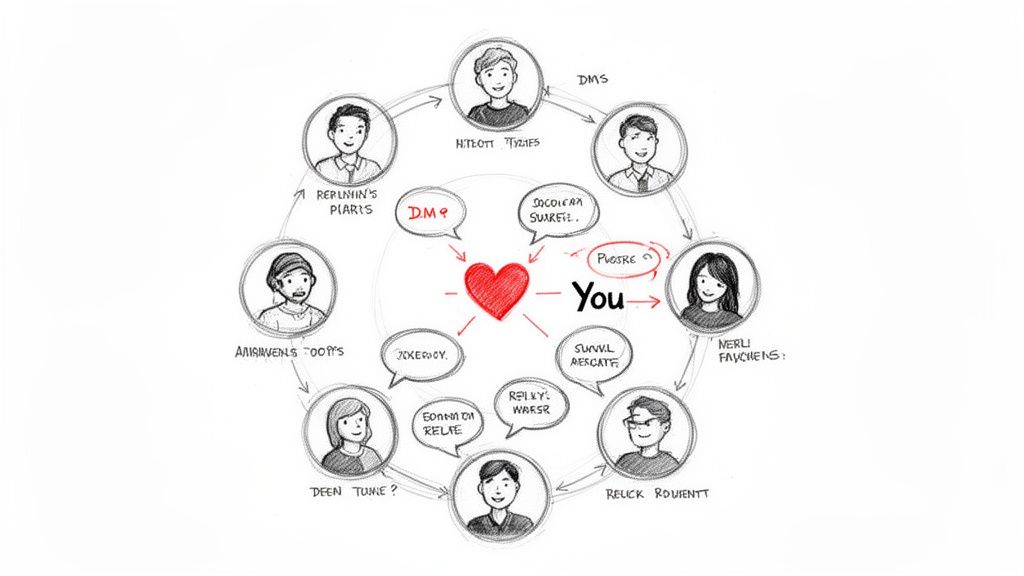
It’s all about turning your little corner of the internet into a place where real conversations happen. And no, this doesn't mean you need to spend hours glued to your phone. It just requires a smart, repeatable system for how you interact.
Nail Down a Daily Engagement Routine
The secret to building a community without burning yourself out is a solid workflow. A focused, time-boxed routine is way more effective than randomly checking notifications all day.
I recommend trying a 15-Minute Daily Engagement Routine. Seriously, that's all it takes.
Block out 15 minutes on your calendar—maybe first thing in the morning with your coffee—and split it into three quick sprints:
- First 5 Mins (Your House): Jump into your latest posts and reply to every genuine comment. Go deeper than a simple "thanks!" Ask a follow-up question to keep the conversation alive. Example: If someone comments "Great tip!", you could reply, "Thanks! Have you ever tried a similar approach? Curious to know what works for you."
- Next 5 Mins (The Neighborhood): Find 5-10 people in your niche and engage with their content. Leave a thoughtful, insightful comment that actually adds to their discussion. Productivity tip: Create a "list" on X or a private list in a CRM of key people to engage with so you don't have to search for them every day.
- Final 5 Mins (The Town Square): Start a new conversation. Shoot a personalized DM to a new follower or reply to an interesting story you saw. The goal here is to initiate, not just react.
This simple workflow ensures you’re consistently showing up for your network. It’s a small daily habit that pays off big time in loyalty down the road.
Master the Art of Personalization
Generic interactions build shallow connections. If you want a real community, you have to make people feel seen and heard.
Personalization isn't just a feel-good tactic; it's a powerful business driver. Data shows that 90% of consumers prefer personalized experiences, and 77% are more likely to buy from companies where leaders are active on social media. You can dig into more stats about personalized marketing on Statista.com.
For founders, this means ditching the automated replies and using small, specific details to build a stronger bond. Practical example: Before sending a connection request on LinkedIn, check their "Activity" tab. If they just posted an article, mention a specific point you liked from it in your request note. This instantly sets you apart from 99% of generic requests.
Personalization is remembering the little things. It’s mentioning a project someone shared last week or referencing a common interest you noticed in their bio. It shows you’re paying attention, and in a noisy world, attention is the ultimate currency.
Spark Meaningful Conversations
The best communities are built on two-way dialogue, not one-way broadcasts. Your job is to get people talking—not just to you, but to each other.
A simple way to do this? End your posts with open-ended questions instead of just statements.
Here are a few prompts you can steal and adapt:
- Sharing a win: "This was a huge milestone for us. What's a recent win you're proud of, big or small?"
- Sharing a lesson: "I learned this the hard way. What's a mistake that ended up teaching you something valuable?"
- Asking for input: "We're exploring new ideas for [topic]. What's the biggest challenge you're facing with this right now?"
These questions invite people to share their own experiences, turning your comment section into a genuine forum. This is the heart of effective community building. If you want to dive deeper, check out our guide on what is community management.
Ultimately, when you systemize your engagement and personalize your interactions, you create a space where people don't just follow you—they feel like they belong.
Measuring Your Brand's Impact and Optimizing for Growth
Putting out content and engaging with your audience is a great start, but if you're not measuring your efforts, you’re just flying blind. You need a simple system for tracking what’s working—and what isn’t—to understand if your personal brand is actually delivering results.
This isn't about chasing vanity metrics like follower counts or likes. We're going to focus on the key performance indicators (KPIs) that directly tie your personal brand to real career and business outcomes. This is how you build a powerful feedback loop and make sure you're always improving.
Moving Beyond Vanity Metrics
It's way too easy to get caught up in the dopamine hit from a post getting a ton of likes. The reality is, those numbers rarely tell the whole story. A post can rack up thousands of likes but generate zero meaningful conversations or leads. That's why we need to look deeper.
Here’s a quick rundown of what to track instead of getting distracted by surface-level stats:
- Instead of Follower Count, track Profile Visits: This number tells you how many people were intrigued enough by your content to click through and see who you are. It’s a direct signal of interest and brand curiosity.
- Instead of Likes, track Engagement Rate: Calculated as (comments + shares) ÷ impressions, this metric shows how much your content is actually sparking a conversation, not just passive scrolling.
- Instead of Reach, track Inbound DMs/Emails: This is where the magic really happens. How many people are sliding into your DMs for advice, collaborations, or business inquiries? This is the clearest sign your brand is creating real opportunities.
Shifting your focus to these metrics gives you a much more honest picture of your brand's health and actual influence. It helps you see what content truly moves the needle.
Creating a Simple Performance Dashboard
You don’t need some fancy, expensive analytics software to get started. A simple spreadsheet is all it takes to build a powerful tracking dashboard. The goal here is to get into a weekly or bi-weekly rhythm of logging your numbers so you can start to spot trends over time.
Think of this dashboard as your single source of truth. It helps you make data-driven decisions instead of just guessing what your audience wants to see next.
What gets measured gets managed. A simple tracking dashboard turns abstract branding efforts into a clear, actionable game plan for growth.
Here’s a template you can steal for Google Sheets or Notion. Start tracking these key metrics weekly, and you'll quickly see patterns emerge.
Your Weekly Brand Performance Dashboard
| Metric | Last Week | This Week | Change | Notes/Observations |
|---|---|---|---|---|
| Profile Visits (LinkedIn) | 150 | 185 | +23% | The video post on Tuesday drove a lot of traffic. |
| Engagement Rate | 2.5% | 3.1% | +0.6% | Posts with open-ended questions are performing best. |
| Website Clicks | 25 | 40 | +60% | The link in my bio to the new case study is working. |
| Inbound DMs/Leads | 2 | 4 | +100% | Two potential consulting leads came from my thread. |
| Speaking/Podcast Invites | 0 | 1 | +1 | Got invited to a niche podcast after they saw my post. |
The simple act of writing your numbers down forces you to be honest with yourself about what's working. After just a few weeks, you'll see exactly which content pillars and formats are driving the outcomes that matter most to you.
Running a Quarterly Brand Review
While weekly tracking is perfect for spotting short-term trends, a Quarterly Brand Review is your secret weapon for long-term strategic adjustments. This is your dedicated time to zoom out, look at the big picture, and make sure your personal brand is still aligned with your bigger career goals.
Block off 90 minutes every three months and walk through this simple three-part framework:
- Review the Data (30 mins): Pull up your dashboard for the last 12 weeks. What were your biggest content wins? What completely flopped? Pinpoint the top three posts that drove the most profile visits and inbound leads.
- Assess Your Goals (30 mins): Are your career or business goals the same as they were three months ago? Maybe you've pivoted slightly. If so, your content pillars might need a tweak, too. Make sure your brand is still serving your future self.
- Plan Your Next Moves (30 mins): Based on your data and goals, decide where you're going to double down. Should you create more video content? Focus on a different content pillar? Set one or two clear, actionable goals for the next quarter. Example Goal: "Increase inbound leads from LinkedIn by 25% by posting two carousel-style case studies per month."
This review process is your built-in mechanism for evolution. It ensures your personal brand doesn't get stale and continues to be a powerful asset that grows right alongside your ambitions.
Got a few questions about building a personal brand? Most people do. Let's tackle some of the most common ones I hear from founders and side-hustlers who are just getting their footing.
How Much Time Does This Actually Take?
This is the big one, especially for busy founders. The good news? You don't need to live on social media. It's all about consistency, not sheer volume.
Aim for 15-20 minutes of focused engagement each day. Then, block out one to two hours a week to actually create and schedule your content. That small, steady investment pays off way more than trying to do it all in frantic, day-long bursts.
A personal brand is a marathon, not a sprint. A sustainable system you can stick with for months will always beat a short-term push that just leads to burnout.
What if I Don't Feel Like an Expert?
Ah, imposter syndrome. It's real, but remember, "expert" is a relative term. You don't have to be the #1 authority in the world to offer something valuable. You just need to know a little more than the person you're trying to help.
Instead of trying to "teach," just document your journey. Share what you’re learning, the mistakes you’re making, and the small wins. People connect with that kind of authenticity and will happily grow alongside you. It makes the whole process feel much more genuine.
Which Social Media Platform Should I Choose?
Don't try to be everywhere. The best place to start is wherever your target audience already hangs out.
- For B2B founders and consultants: You have to be on LinkedIn. It's the hub for professional networking and sharing your perspective.
- For creators and B2C brands: Instagram and TikTok are your go-to for visual storytelling, especially if you want to reach a younger crowd.
- For writers and thinkers: X (formerly Twitter) is still the best spot for quick insights and jumping into real-time conversations.
Pick one platform and get really good at it first. Once you've got a solid system down, then you can think about adding a second.
Do I Need to Share Personal Things?
Being authentic doesn't mean you have to broadcast your private life. It just means being a relatable human.
You're the one who gets to draw the line. You can build a powerful brand simply by sharing your professional journey—the challenges, the wins, and your unique take on your industry. A little personality, like a hobby or an interest, can make you more memorable, but it’s definitely not a requirement. Just focus on the value you bring to the table.
Ready to stop guessing and start growing? Postful gives you the AI-powered tools and proven templates to build your personal brand with confidence and consistency. Join the waitlist today and simplify your social media workflow.