
As a founder or side-hustler, your time is your most valuable asset. Juggling product development, sales, and operations leaves little room for a social media strategy that feels like a full-time job. Generic advice like 'be authentic' or 'post consistently' isn't helpful without a practical system to back it up. This is where a defined set of best social media practices becomes critical, not as a list of chores, but as a framework for efficiency and growth.
This guide cuts through the noise. We've compiled a prioritized roundup of 10 actionable practices designed specifically for operators who need to maximize impact with minimal effort. We will move beyond abstract tips and provide concrete workflows you can implement immediately. You will learn how to build a content engine, engage your community authentically without spending all day scrolling, and use data to make smarter decisions, faster. To stay ahead in the dynamic digital landscape, you must continuously adapt your approach with effective social media marketing strategies, and the foundational practices outlined here are your starting point.
Each point is broken down into a productivity-focused workflow, complete with tool recommendations and real-world examples. Forget the fluff; this is your roadmap to building a powerful, efficient, and growth-oriented social media presence that actually drives business results without draining your resources. Let's transform your social media from a time-consuming mystery into a predictable growth channel.
1. Consistent Posting Schedule
Maintaining a regular and predictable posting cadence is one of the most fundamental yet impactful best social media practices. It signals to both your audience and the platform algorithms that your account is active, reliable, and a valuable source of information. Consistency builds anticipation and trust; your followers learn when to expect new content from you, making your brand a regular part of their digital routine.
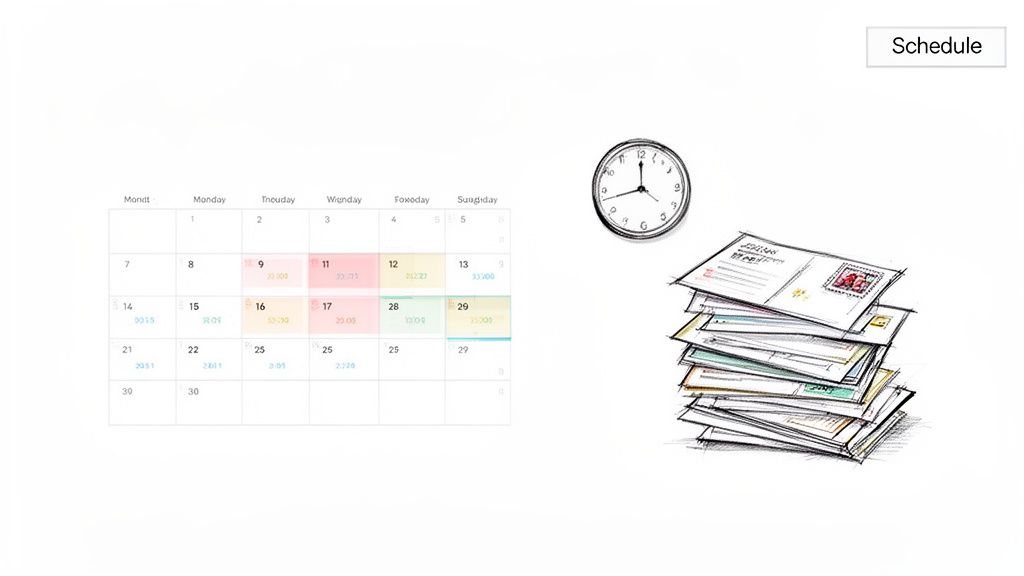
For busy founders and small business owners, a strategic schedule prevents the all-too-common cycle of intense posting followed by weeks of silence. This stop-and-start approach confuses algorithms and erodes audience loyalty. A steady rhythm, even if it's just a few high-quality posts per week, consistently outperforms sporadic, high-volume bursts.
Why It Works & How to Implement It
A consistent schedule keeps your brand top-of-mind and steadily fuels the engagement metrics that platforms prioritize, such as likes, comments, and shares. For example, Morning Brew’s unwavering daily email and social media presence has been a key driver in growing its audience to over 3 million subscribers. They've trained their audience to expect valuable content every single morning.
To build your own rhythm without burning out, follow this productivity workflow:
- Batch Your Content: Dedicate a 2-hour block on your calendar every Sunday to create all your social media content for the upcoming week. This "content batching" workflow is far more efficient than the creative drain of creating posts daily.
- Use Scheduling Tools: Leverage platforms like Postful, Buffer, or Later to schedule your batched content weeks in advance. This ensures your profiles remain active even when you're focused on other business-critical tasks.
- Analyze Peak Times: Use the built-in analytics on Instagram, Facebook, or LinkedIn to identify when your audience is most active. For instance, if your data shows peak activity at 6 PM on weekdays, set your scheduling tool to publish your best content during that window to maximize initial reach.
- Create a Content Calendar: A simple spreadsheet in Google Sheets or a Trello board is the backbone of consistency. Create columns for 'Date,' 'Pillar' (e.g., Educational, Behind-the-Scenes), 'Copy,' 'Visual,' and 'Status' (Draft, Scheduled, Posted). This provides a clear, at-a-glance view of your entire content plan.
2. Audience Research and Segmentation
Creating content without deeply understanding your audience is like shouting into the void. Audience research is a foundational social media practice that involves identifying your target customers' demographics, pain points, and online behaviors. Segmentation takes this a step further, allowing you to tailor specific messages to different subgroups for maximum relevance and impact.
For a startup founder or small business owner, this means no more wasted effort on content that doesn't resonate. Instead of a one-size-fits-all approach, you can create posts that speak directly to the needs of different customer types. This precision not only boosts engagement but also drives higher-quality leads and conversions, making your social media efforts far more efficient.
Why It Works & How to Implement It
Targeted content makes your audience feel seen and understood, building a stronger connection and fostering brand loyalty. When your posts solve a specific problem or reflect a shared value, they are far more likely to be liked, shared, and acted upon. For example, Notion effectively segments its audience by creating distinct content for students (e.g., "how to organize your class notes"), project managers ("5 templates for agile sprints"), and enterprise teams, ensuring every message feels personalized.
To develop a crystal-clear understanding of your audience, follow this practical workflow:
- Create Buyer Personas: Develop 2-3 detailed personas using a free tool like HubSpot's Make My Persona. Give them names, job titles (e.g., "Marketing Manager Mary"), goals, and specific challenges ("struggles with measuring social media ROI"). This transforms abstract data into relatable characters to guide your content creation.
- Analyze Platform Analytics: Dive into the native analytics on your platforms. For example, Instagram Insights will show you the age range and top city locations of your followers. If you see a large audience in a specific city, you can create content relevant to a local event there.
- Survey Your Existing Customers: Use Google Forms or Typeform to create a simple 3-question survey. Ask them: 1) "What was the biggest problem you hoped our product would solve?" 2) "Which social media platform do you use most often for professional advice?" 3) "What kind of content would be most helpful to you?" The answers are a goldmine.
- Monitor Your Competitors: Go to the profiles of 3 direct competitors. Look at their most commented-on posts. Read the comments to understand what questions their audience is asking and what topics generate the most excitement. This is a quick way to uncover audience pain points and interests.
3. Authentic Engagement and Community Building
True social media success is a two-way street; it’s about dialogue, not a monologue. Authentic engagement moves beyond simply broadcasting content and focuses on building a genuine community around your brand. This practice involves actively listening to your audience, responding to their comments, and participating in relevant conversations, transforming passive followers into a loyal and supportive community.
For founders and small business owners, this human-centered approach is invaluable. It builds the trust and social proof necessary to compete with larger, more established brands. When people feel seen and heard, they are more likely to become brand advocates, driving organic growth and word-of-mouth marketing that advertising alone cannot achieve.
Why It Works & How to Implement It
Engaging authentically signals to algorithms that your content sparks meaningful interaction, a key metric for boosting reach. More importantly, it shows your audience you care. Pat Flynn of Smart Passive Income built a multimillion-dollar brand by consistently engaging with his audience through comments, forums, and live sessions, creating an intensely loyal "superfan" base. This is one of the most powerful best social media practices for long-term growth.
To foster a vibrant community without getting overwhelmed, integrate this productivity-focused workflow:
- Implement the "First Hour" Rule: Dedicate time to reply to every comment within the first 60 minutes of posting. This immediate feedback loop encourages more interaction and boosts the post's initial performance in the algorithm. A practical tip is to set a phone reminder for 15 minutes after your scheduled post goes live.
- Ask Open-Ended Questions: End your captions with questions that prompt more than a one-word answer. Instead of "Like this post if you agree," try "What's the one productivity tool you can't live without and why?" This sparks genuine conversation.
- Schedule "Engagement Blocks": Block out two 15-minute "engagement sprints" on your calendar each day (e.g., 9:00 AM and 4:00 PM). Use this time exclusively for community management. This prevents mindless scrolling and focuses your efforts.
- Highlight User-Generated Content (UGC): Actively look for and re-share content created by your customers or followers (with proper credit). For example, if a customer posts an Instagram Story tagging your software, re-share it to your own Story with a "Thank you!" sticker. This provides you with authentic content and makes your community members feel valued.
4. Data-Driven Content Optimization
Posting content without analyzing its performance is like driving blind. Data-driven content optimization is one of the most critical social media practices for turning guesswork into a predictable growth strategy. It involves using analytics to understand what resonates with your audience, allowing you to double down on what works and refine what doesn't.
Metrics like engagement rate, reach, click-through rate, and shares provide a clear roadmap for improvement. For busy founders, this data is not just a report card; it is a resource-saving tool that ensures every minute spent on content creation delivers the highest possible return on investment. It stops you from wasting time on content formats that your audience simply ignores.
Why It Works & How to Implement It
A data-driven approach transforms your content strategy from a set of assumptions into a system of continuous improvement. For instance, SaaS company Drift famously analyzed their blog performance and decided to focus only on creating content similar to their top-performing 20%. This ruthless prioritization led to more impactful content and efficient use of their team's time.
To start optimizing your content with data, implement this simple workflow:
- Conduct Weekly Reviews: Set a 30-minute recurring calendar event for Monday mornings called "Social Media Review." During this time, open your platform's analytics and identify your top-performing post from the previous week based on engagement rate (likes + comments / followers).
- Track Key Metrics: Create a simple Google Sheet with columns for 'Post Date,' 'Post Topic,' 'Format' (e.g., video, carousel, image), and 'Engagement Rate.' Each Monday, log the data for your top post. This creates a historical record to spot trends over time.
- Identify Content Pillars: After a month of tracking, you'll see a pattern. Perhaps your "behind-the-scenes" carousels consistently get the highest engagement. This is now a validated content pillar. The next month, create more posts in this format.
- A/B Test Systematically: Don't just analyze; experiment. For example, test two different hooks for the same carousel post. Post one with a question as the headline ("Struggling with productivity?") and another with a bold statement ("This is the only productivity hack you need."). Compare the results to see which style resonates better.
5. Multi-Platform Strategy with Platform-Specific Content
One of the most common pitfalls for busy founders is the "copy-paste" approach to social media, where identical content is blasted across all platforms. This strategy ignores the unique culture, algorithms, and audience expectations of each network. A far more effective practice is to adapt your core message and format to fit the native environment of each platform, maximizing both reach and engagement.
Treating each platform as a distinct channel with its own rules is a cornerstone of advanced social media marketing. LinkedIn users expect professional insights, while TikTok users crave authentic, trend-driven video. Pushing a formal, text-heavy post to a visual-first platform like Instagram is a recipe for low engagement. Tailoring content shows you understand the platform and respect your audience's time.
Why It Works & How to Implement It
Adapting content significantly boosts its performance because it aligns with what each platform's algorithm is designed to promote. For example, HubSpot is a master of this, turning a single comprehensive blog post into dozens of platform-specific assets, from an in-depth LinkedIn article and a visual carousel for Instagram to a quick-tip video for TikTok. This repurposing maximises the value of a single idea.
To implement a platform-specific strategy without creating completely new content from scratch, follow this efficient workflow:
- Choose Core Platforms Wisely: Don't try to be everywhere. Focus on the 2-3 platforms where your target audience is most active. For a B2B SaaS founder, this might be LinkedIn and Twitter. For a D2C brand, it might be Instagram and TikTok. Quality over quantity is key.
- Adapt Your Content Format: Your core message can stay the same, but the delivery must change. For example, a single interview with an industry expert can be repurposed: the full video on YouTube, a 5-minute key takeaway clip on LinkedIn, a 30-second quote-card video for Instagram Reels, and a text-based thread of the main points on Twitter.
- Tailor the Tone and Copy: A professional, data-driven tone works on LinkedIn (e.g., "Our new data shows…"). The same message on Twitter should be more conversational and concise (e.g., "Mind-blowing stat we just found…"). On Instagram, the focus should be on a story-driven caption.
- Adjust Hashtag Strategy: Use a tool like Flick or the native search function to find platform-appropriate hashtags. A good rule of thumb is 3-5 relevant hashtags on LinkedIn, 1-2 on Twitter, and up to 15-20 on Instagram to maximize discovery. This is a simple but critical part of the best social media practices for discoverability.
6. Strategic Use of Hashtags and Keywords
Hashtags and keywords are the signposts that guide users and algorithms to your content. A strategic approach to using them transforms your posts from isolated updates into discoverable assets that attract relevant audiences. This practice involves more than just tacking on popular tags; it's about understanding search intent and community conversations on each platform.
Properly optimized captions and a well-curated set of hashtags connect your brand to trending topics, niche communities, and users actively searching for your solutions. For busy entrepreneurs, mastering this skill is a low-effort, high-impact way to amplify reach without spending a dime on ads. It ensures your hard work gets seen by people who are most likely to convert.
Why It Works & How to Implement It
Strategic hashtag and keyword use directly boosts your content's visibility in search results, on explore pages, and within topic-specific feeds. For instance, an entrepreneur using specific tags like #StartupLife or #SmallBizTips reaches an audience far more engaged than one using generic tags like #Success. Similarly, Coca-Cola's #ShareACoke campaign created a branded hashtag that generated millions of user-submitted posts, turning customers into organic marketers.
To implement this powerful discovery practice, follow this efficient workflow:
- Create a Tiered Hashtag List: Use a notes app on your phone to build "hashtag sets" for different content pillars. For each pillar, create a tiered list of 20-30 tags: 5-10 high-volume (1M+ posts), 5-10 mid-volume (100k-1M posts), and 5-10 niche-specific tags (<100k posts). This blend helps you compete in smaller conversations while still tapping into larger trends.
- Optimize Beyond the Tags: Treat your captions and bio like a blog post from an SEO perspective. Weave in keywords naturally. Instead of saying "Our new tool is great," say "Our new graphic design tool for startups helps you create stunning visuals in minutes."
- Create and Promote a Branded Hashtag: Develop a unique hashtag for your business (e.g.,
#YourBrandChallenge) and encourage followers to use it. A practical example is to run a contest where users post with your hashtag for a chance to win a prize. Feature the hashtag prominently in your bio. - Analyze and Refresh: Don't set and forget your hashtag strategy. Once a month, check your Instagram post insights to see the "Impressions from Hashtags." If a certain set of tags is performing well, keep using it. If not, swap it out with a new set from your research. To master this for video, explore guides on the best Reels hashtags for Instagram.
7. Compelling Visual Content and Storytelling
In a visually saturated digital landscape, high-quality visuals and authentic storytelling are what separate memorable brands from the noise. This practice involves using striking images, videos, and graphics to create an emotional connection with your audience, which drives loyalty and action far more effectively than text-only posts. A strong visual identity makes your brand instantly recognizable and elevates its perceived value in crowded feeds.

This isn't just about aesthetics; it's about strategy. Compelling visuals stop the scroll, while storytelling gives your audience a reason to care. Together, they form a powerful combination that boosts engagement, communicates your brand's personality, and ultimately encourages conversion.
Why It Works & How to Implement It
Humans process images 60,000 times faster than text, making visual content a highly efficient communication tool. Brands like Apple leverage a minimalist visual aesthetic to convey premium quality and innovation without saying a word. Similarly, GoPro's user-generated action shots showcase its product's capabilities in the most authentic way possible, building a community around shared experiences.
To implement this crucial social media practice, focus on this productive workflow:
- Develop a Visual Identity: Use a tool like Canva to create 5-10 reusable templates for different post types (e.g., quote, listicle, announcement). Define a consistent color palette (2-3 primary colors) and 1-2 fonts. This simple system ensures brand recognition and speeds up content creation immensely.
- Prioritize Vertical Video: Most users consume social media on mobile devices. Film short videos using your smartphone in a 9:16 aspect ratio. Use a simple editing app like CapCut to add captions, trim clips, and add music. A 30-second "tip of the day" video is a highly effective format.
- Tell a Story: Use a simple three-act structure for your visual stories: 1) The Hook (a problem or question), 2) The Middle (your process or solution), 3) The End (the result or call-to-action). This can be applied to a carousel post, a video, or even a series of Instagram Stories.
- Optimize for Accessibility: Add captions or text overlays to all videos using the native features in Instagram or TikTok, or an app like Captions.ai. This ensures your message is understood by the ~85% of users who watch videos with the sound off and makes your content more accessible.
8. Value-First Content and Educational Posts
Prioritizing giving value before asking for a sale is a cornerstone of modern social media marketing. This approach shifts the focus from direct promotion to providing educational content, actionable tips, industry insights, and genuine solutions to your audience's problems. It’s a powerful strategy that establishes your authority, builds deep-seated trust, and encourages organic sharing, which is essential for founders and creators focused on building thought leadership.
This value-first mindset transforms your social media presence from a simple advertising channel into a go-to resource. When you consistently solve problems for free, your audience naturally becomes more receptive to your paid offerings when the time is right. You build a community that not only follows you but also advocates for you.
Why It Works & How to Implement It
A value-first content strategy accelerates trust and positions you as an expert in your field, making it one of the most effective best social media practices for long-term growth. For instance, Alex Hormozi gained hundreds of thousands of followers by freely sharing sophisticated business frameworks that others would charge for. This generosity built a massive, loyal audience that was eager to buy his books and invest in his portfolio companies.
To adopt this powerful strategy, follow this productivity-focused workflow:
- Solve a Core Problem: Use a tool like AnswerThePublic or simply type your main keyword into Google and look at the "People also ask" section. This gives you a direct list of your audience's most painful problems. Create your first ten posts answering these specific questions.
- Create Reusable Templates: Format your advice into digestible templates you can use repeatedly. For example, create a "Top 3 Tools for [Task]" carousel template or a "Common Mistake in [Industry]" video format. This makes content creation fast and predictable.
- Share Lessons from Failures: Keep a "Failure Log" in a notebook or digital doc. Once a month, review it and pick one lesson learned. Share the story of what went wrong, what you learned, and how others can avoid the same mistake. This is unique, relatable content that builds deep trust.
- Provide Tangible Tools: Develop a simple, one-page checklist in Google Docs or Canva that helps your audience achieve a quick win. For example, a "5-Point Checklist for a Perfect LinkedIn Profile." Offer this for free in your posts to provide immediate utility.
9. Call-to-Action Optimization and Conversion Strategy
A compelling call-to-action (CTA) is the bridge between audience engagement and business results. It’s the specific instruction that tells your followers what to do next, transforming passive viewers into active participants, leads, or customers. Without a clear CTA, even the most viral content fails to generate tangible outcomes for your business.
Effective CTAs are direct, create a sense of urgency, and align perfectly with the content they follow. They answer the viewer's silent question: "What now?" This is a crucial component of the best social media practices because it ensures your content creation efforts are directly tied to your business objectives, whether that's growing an email list, booking appointments, or driving sales.
Why It Works & How to Implement It
A strong CTA removes friction and ambiguity, making it simple for your audience to take the desired step. For example, Calendly's strategy of including a direct booking link in social posts makes scheduling a meeting frictionless, directly converting interest into appointments. Similarly, creators on ConvertKit often use a consistent CTA like "Join my free email course" to steadily build their most valuable asset: their email list.
To turn your posts into conversion engines, follow this practical workflow:
- Be Benefit-Focused: Instead of a generic "Click the link in bio," use a value-driven CTA like "Get the free brand kit template at the link in my bio." Frame the action around what the user receives, not what they have to do.
- Use Action Verbs: Start your CTAs with strong verbs. Practical examples include "Download the guide," "Save this post for later," "Tag a founder who needs to hear this," or "Share your biggest takeaway in the comments."
- Maintain Singular Focus: Stick to one primary CTA per post. If your goal is website clicks, don't also ask for comments and shares. For instance, a post promoting a new blog might end with: "For the full deep-dive, tap the link in our bio." That's it.
- Track and Test: Use a tool like Bitly to create unique short links for different campaigns. For example, use one link for your Instagram bio and another for a specific promotion. This allows you to see exactly which CTA is driving the most traffic. Test different wording to see what performs best over time.
10. Collaboration, Community Partnerships and Real-Time Trend Responsiveness
Beyond creating your own content, one of the most powerful growth levers is tapping into existing audiences and conversations. This involves strategically partnering with complementary creators and brands while staying agile enough to engage with real-time trends. This approach builds credibility, exponentially expands your reach, and ensures your content remains culturally relevant.
For bootstrapped founders and side-hustlers, collaborations are a force multiplier, providing access to audiences that would otherwise take months or years to build. Similarly, responding quickly to trends allows you to capture outsized attention without a large marketing budget, inserting your brand directly into the day's most visible conversations.
Why It Works & How to Implement It
Strategic partnerships and trend responsiveness are core to effective social media practices because they leverage external momentum. For example, Wendy's has famously generated millions of impressions by engaging with cultural events and other brands in real-time on Twitter. On a smaller scale, creators who jump on a new TikTok sound within the first 24-48 hours often see massive algorithmic boosts.
Follow this productivity workflow to integrate this dual strategy:
- Identify Aligned Partners: Create a simple spreadsheet listing 10-20 creators in your niche who have a similar audience size. Columns should include 'Name,' 'Platform Link,' 'Audience Size,' and 'Contact Info.' Start by engaging with their content genuinely for a week before reaching out.
- Create Mutual Wins: When you pitch a collaboration, make it easy for them to say yes. Instead of a vague "let's partner," suggest a specific, low-effort idea like: "I loved your recent post on productivity. I'm doing an expert roundup on the topic for my blog. Could you share your #1 tip? I'll link back to your profile."
- Monitor Trends Systematically: Dedicate 15 minutes each morning to scan the "Trending" sections on Twitter and TikTok. Use a tool like Google Alerts for keywords relevant to your industry. This small habit keeps you ahead of the curve.
- Engage in Real-Time: When a major account in your niche makes a post, try to be one of the first to leave a thoughtful, value-adding comment. This "top comment strategy" can drive significant profile visits. For instance, if a marketing guru posts about SEO, add a comment with a specific tool that helped you with that exact problem.
Top 10 Social Media Practices Comparison
| Strategy | 🔄 Implementation complexity | ⚡ Resource requirements | ⭐ Expected outcomes | 📊 Key advantages / impact | 💡 Ideal use cases |
|---|---|---|---|---|---|
| Consistent Posting Schedule | Moderate — requires planning, calendar and scheduling setup | Low–Moderate — time upfront; scheduling tools or automation | Steady visibility and predictable engagement growth | Improves algorithm ranking; reduces last-minute stress; measurable engagement gains | Busy founders, solopreneurs, side-hustlers needing regular presence |
| Audience Research and Segmentation | Moderate–High — data collection and persona building | Moderate — analytics, surveys, time for analysis | More relevant content and higher conversion rates | Targeted messaging; reduces wasted effort; informs product decisions | Targeted campaigns, product launches, audience expansion |
| Authentic Engagement & Community Building | Moderate — ongoing human moderation and conversation | High — time for replies, moderation, community events | Strong loyalty, retention and organic reach growth | Builds trust, social proof and word-of-mouth advocacy | Personal brands, early-stage communities, retention-focused strategies |
| Data-Driven Content Optimization | High — tracking, A/B tests and continuous measurement | Moderate–High — analytics tools, reporting time | Rapid iteration and improved ROI from content | Eliminates guesswork; identifies high-performers and trends | Scaling content programs, performance marketing, optimization efforts |
| Multi-Platform Strategy (Platform-Specific Content) | High — adapt formats and tone per platform | High — repurposing, design/video resources, management overhead | Higher engagement per channel and broader reach | Maximizes content ROI; aligns with platform norms; reduces single-platform risk | Brands targeting diverse audiences across platforms |
| Strategic Use of Hashtags & Keywords | Low–Moderate — research and periodic updates | Low — research tools and testing time | Increased discoverability and incremental reach | Cost-free reach expansion; branded hashtag communities | Small accounts seeking discovery; trend-driven posts |
| Compelling Visual Content & Storytelling | Moderate–High — consistent visual system and production | High — equipment, design/video tools or outsourcing | Higher engagement, memorability and shareability | Emotional connection; strong brand identity; more shares | Consumer brands, product demos, visually-driven niches |
| Value-First Content & Educational Posts | Moderate — requires subject-matter expertise and planning | Moderate — research and quality content creation time | Authority building, long-term trust and lead generation | Creates content moat; highly shareable; nurtures audience before selling | Thought leaders, educators, SaaS freemium and lead-gen funnels |
| Call-to-Action Optimization & Conversion Strategy | Moderate — testing CTAs and aligning funnels | Low–Moderate — tracking links, UTM setup, conversion tools | Improved conversion rates and measurable business outcomes | Directly converts followers to customers; clarifies user journey | Product launches, lead-gen campaigns, monetization pushes |
| Collaboration, Partnerships & Trend Responsiveness | High — partner coordination and rapid response systems | Moderate–High — relationship building and monitoring tools | Fast reach expansion and viral opportunity capture | Access to new audiences; credibility via association; low-cost reach | Growth campaigns, trend-driven content, cross-promotion efforts |
Your Action Plan: Integrating These Practices Without the Burnout
You’ve just navigated a comprehensive blueprint of the best social media practices for today's dynamic digital landscape. From establishing a rock-solid posting schedule to mastering authentic community engagement and leveraging data for smarter decisions, these ten pillars form the foundation of a powerful and sustainable online presence. The sheer volume of advice, however, can feel like a mandate to do everything, all at once. This is the fastest path to burnout, especially for busy founders and small business owners.
The true secret to success isn't about perfectly executing all ten practices from day one. It's about strategic, incremental integration. Think of this not as a checklist to be completed, but as a framework for building a resilient, efficient, and growth-oriented social media system. Your goal is to transform these individual tactics into interconnected, semi-automated workflows that serve your business without consuming your life.
The Phased Approach: Your First 90 Days
Instead of trying to boil the ocean, focus on creating momentum. Break down the implementation of these best social media practices into a manageable, 90-day plan.
Month 1: The Foundation (Practices 1, 2, & 8)
- Week 1-2: Consistency & Audience. Forget complex content for now. Your only goals are to define your ideal audience persona (Practice #2) and establish a consistent posting schedule you can realistically maintain (Practice #1). Use a simple spreadsheet or a scheduling tool to plan just one week of content in advance.
- Week 3-4: Value-First Content. With your schedule in place, shift your focus to creating simple, value-driven posts (Practice #8). Ask yourself, "What is the single most common question my target customer asks?" Create three short posts answering that question from different angles. This builds the habit of thinking like your audience.
Month 2: Engagement & Optimization (Practices 3, 4, & 6)
- Week 5-6: Authentic Engagement. Dedicate 15-20 minutes daily to actively engaging with your community (Practice #3). Respond to every comment, follow relevant accounts, and leave thoughtful comments on others' posts. This is non-negotiable community-building time.
- Week 7-8: Data & Hashtags. Begin your journey with analytics (Practice #4). At the end of each week, look at your platform's built-in insights. Identify one post that performed well and one that didn't. Ask "why?" At the same time, refine your hashtag strategy (Practice #6) based on what you see top-performing accounts in your niche are using.
Month 3: Expansion & Refinement (Practices 5, 7, & 9)
- Week 9-10: Visuals & CTAs. Now that you have a rhythm, it's time to elevate your content. Focus on improving your visual storytelling (Practice #7). Experiment with a simple video or a basic Canva carousel template. Simultaneously, ensure every post has a clear, intentional call-to-action (Practice #9), even if it's just asking a question.
- Week 11-12: Strategic Expansion. Consider adding a second platform (Practice #5), but only if you have a clear plan to repurpose your existing content. Don't create net-new work; adapt what’s already working. This is the stage where you start building a true content engine rather than just making posts.
By layering these best social media practices over time, you build habits and systems. Each new practice is added to a solid foundation, making the entire process feel manageable and preventing the overwhelm that plagues so many entrepreneurs. This methodical approach ensures that your social media efforts are not just busy work but a strategic asset that builds brand equity, fosters a loyal community, and ultimately drives tangible business results.
Ready to implement these best social media practices without the manual effort? Postful is an all-in-one AI social media manager designed to help you generate ideas, write compelling posts, and schedule content in minutes, turning strategy into an efficient, automated workflow. Stop juggling tasks and start building your brand by visiting Postful to see how it works.